Likes
9
Share
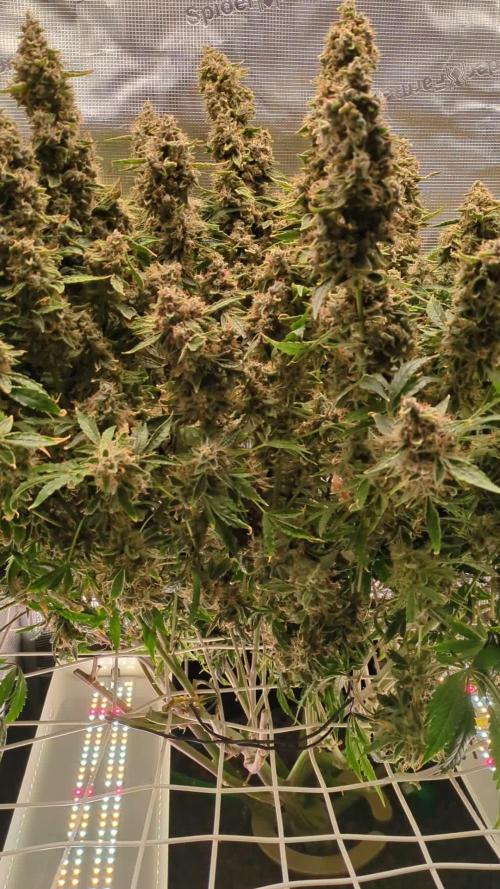
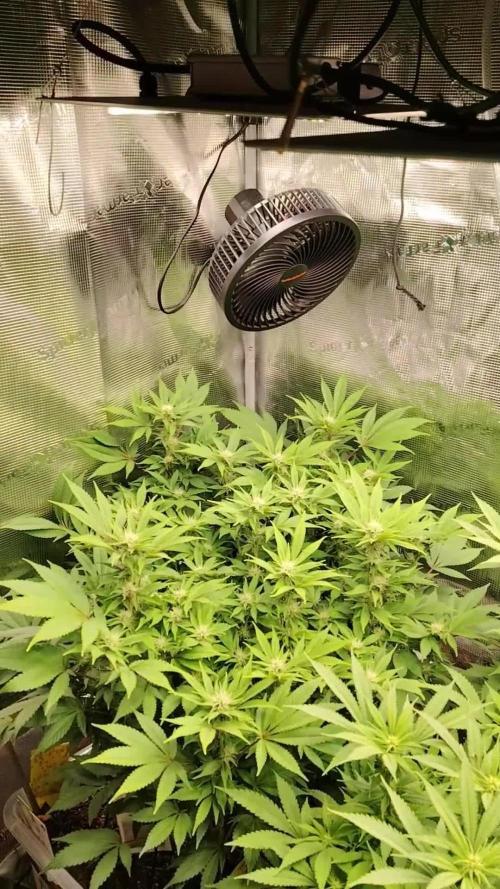
Week 1 bloom Everything stretched a lot this week. I’m not sure why. My lights are powerful I’m feeding by the green planet chart. So lots of nutes. Hopefully they slow down or I’m going to run out of room. At the end of this week I did another lollipop and small defoliation. The canopy was super dense. If you got this far hit the like button and give me some validation lol.
Likes
14
Share
@Bilge420
Follow
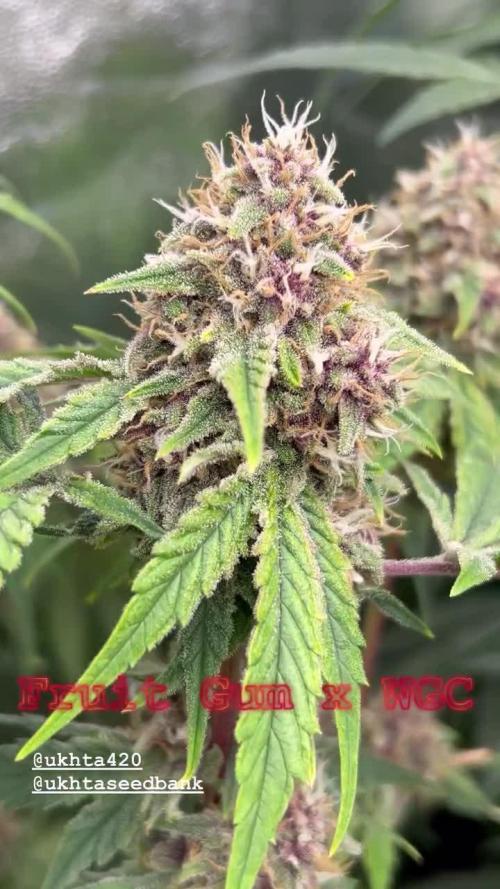
Starting to have a sweet ripe banana's smell that's getting stronger every day. Day 54 it's still smelling amazing but is having some sort of deficiency.
Likes
23
Share
@TOTEM
Follow
Ouch, I can’t take serious photos with this plant. She’s growing regularly, with no much space to express herself. If her smoke is pleasant, I’ll grow her again with the proper training 😉
Likes
2
Share
@MT_Farmer
Follow
I put a net in to try to get a more even canopy and utilise the space of the tent. It didnt really work too well though. I ended up only leaving it in for periods as i found it really annoying to water and manage devices in the tent with the net in.
Likes
9
Share
@Cultivate
Follow
Spent some time just defoliating the girls last night, tried not to go too far but you get lost😂 Also did some Pruning/Lollipoping to Increase that airflow 💨 Happy so far! Stinking now
Likes
47
Share
What's in the soil? What's not in the soil would be an easier question to answer. 16-18 DLI @ the minute. +++ as she grows. Probably not recommended, but to get to where it needs to be, I need to start now. Vegetative @1400ppm 0.8–1.2 kPa 80–86°F (26.7–30°C) 65–75%, LST Day 10, Fim'd Day 11 CEC (Cation Exchange Capacity): This is a measure of a soil's ability to hold and exchange positively charged nutrients, like calcium, magnesium, and potassium. Soils with high CEC (more clay and organic matter) have more negative charges that attract and hold these essential nutrients, preventing them from leaching away. Biochar is highly efficient at increasing cation exchange capacity (CEC) compared to many other amendments. Biochar's high CEC potential stems from its negatively charged functional groups, and studies show it can increase CEC by over 90%. Amendments like compost also increase CEC but are often more prone to rapid biodegradation, which can make biochar's effect more long-lasting. biochar acts as a long-lasting Cation Exchange Capacity (CEC) enhancer because its porous, carbon-rich structure provides sites for nutrients to bind to, effectively improving nutrient retention in soil without relying on the short-term benefits of fresh organic matter like compost or manure. Biochar's stability means these benefits last much longer than those from traditional organic amendments, making it a sustainable way to improve soil fertility, water retention, and structure over time. Needs to be charged first, similar to Coco, or it will immobilize cations, but at a much higher ratio. a high cation exchange capacity (CEC) results in a high buffer protection, meaning the soil can better resist changes in pH and nutrient availability. This is because a high CEC soil has more negatively charged sites to hold onto essential positively charged nutrients, like calcium and magnesium, and to buffer against acid ions, such as hydrogen. EC (Electrical Conductivity): This measures the amount of soluble salts in the soil. High EC levels indicate a high concentration of dissolved salts and can be a sign of potential salinity issues that can harm plants. The stored cations associated with a medium's cation exchange capacity (CEC) do not directly contribute to a real-time electrical conductivity (EC) reading. A real-time EC measurement reflects only the concentration of free, dissolved salt ions in the water solution within the medium. 98% of a plants nutrients comes directly from the water solution. 2% come directly from soil particles. CEC is a mediums storage capacity for cations. These stored cations do not contribute to a mediums EC directly. Electrical Conductivity (EC) does not measure salt ions adsorbed (stored) onto a Cation Exchange Capacity (CEC) site, as EC measures the conductivity of ions in solution within a soil or water sample, not those held on soil particles. A medium releases stored cations to water by ion exchange, where a new, more desirable ion from the water solution temporarily displaces the stored cation from the medium's surface, a process also seen in plants absorbing nutrients via mass flow. For example, in water softeners, sodium ions are released from resin beads to bond with the medium's surface, displacing calcium and magnesium ions which then enter the water. This same principle applies when plants take up nutrients from the soil solution: the cations are released from the soil particles into the water in response to a concentration equilibrium, and then moved to the root surface via mass flow. An example of ion exchange within the context of Cation Exchange Capacity (CEC) is a soil particle with a negative charge attracting and holding positively charged nutrient ions, like potassium (K+) or calcium (Ca2+), and then exchanging them for other positive ions present in the soil solution. For instance, a negatively charged clay particle in soil can hold a K+ ion and later release it to a plant's roots when a different cation, such as calcium (Ca2+), is abundant and replaces the potassium. This process of holding and swapping positively charged ions is fundamental to soil fertility, as it provides plants with essential nutrients. Negative charges on soil particles: Soil particles, particularly clay and organic matter, have negatively charged surfaces due to their chemical structure. Attraction of cations: These negative charges attract and hold positively charged ions, or cations, such as: Potassium (K+) Calcium (Ca2+) Magnesium (Mg2+) Sodium (Na+) Ammonium (NH4+) Plant roots excrete hydrogen ions (H+) through the action of proton pumps embedded in the root cell membranes, which use ATP (energy) to actively transport H+ ions from inside the root cell into the surrounding soil. This process lowers the pH of the soil, which helps to make certain mineral nutrients, such as iron, more available for uptake by the plant. Mechanism of H+ Excretion Proton Pumps: Root cells contain specialized proteins called proton pumps (H+-ATPases) in their cell membranes. Active Transport: These proton pumps use energy from ATP to actively move H+ ions from the cytoplasm of the root cell into the soil, against their concentration gradient. Role in pH Regulation: This active excretion of H+ is a major way plants regulate their internal cytoplasmic pH. Nutrient Availability: The resulting decrease in soil pH makes certain essential mineral nutrients, like iron, more soluble and available for the root cells to absorb. Ion Exchange: The H+ ions also displace positively charged mineral cations from the soil particles, making them available for uptake. Iron Uptake: In response to iron deficiency stress, plants enhance H+ excretion and reductant release to lower the pH and convert Fe3+ to the more available form Fe2+. The altered pH can influence the activity and composition of beneficial microbes in the soil. The H+ gradient created by the proton pumps can also be used for other vital cell functions, such as ATP synthesis and the transport of other solutes. The hydrogen ions (H+) excreted during photosynthesis come from the splitting of water molecules. This splitting, called photolysis, occurs in Photosystem II to replace the electrons used in the light-dependent reactions. The released hydrogen ions are then pumped into the thylakoid lumen, creating a proton gradient that drives ATP synthesis. Plants release hydrogen ions (H+) from their roots into the soil, a process that occurs in conjunction with nutrient uptake and photosynthesis. These H+ ions compete with mineral cations for the negatively charged sites on soil particles, a phenomenon known as cation exchange. By displacing beneficial mineral cations, the excreted H+ ions make these nutrients available for the plant to absorb, which can also lower the soil pH and indirectly affect its Cation Exchange Capacity (CEC) by altering the pool of exchangeable cations in the soil solution. Plants use proton (H+) exudation, driven by the H+-ATPase enzyme, to release H+ ions into the soil, creating a more acidic rhizosphere, which enhances nutrient availability and influences nutrient cycling processes. This acidification mobilizes insoluble nutrients like iron (Fe) by breaking them down, while also facilitating the activity of beneficial microbes involved in the nutrient cycle. Therefore, H+ exudation is a critical plant strategy for nutrient acquisition and management, allowing plants to improve their access to essential elements from the soil. A lack of water splitting during photosynthesis can affect iron uptake because the resulting energy imbalance disrupts the plant's ability to produce ATP and NADPH, which are crucial for overall photosynthetic energy conversion and can trigger a deficiency in iron homeostasis pathways. While photosynthesis uses hydrogen ions produced from water splitting for the Calvin cycle, not to create a hydrogen gas deficiency, the overall process is sensitive to nutrient availability, and iron is essential for chloroplast function. In photosynthesis, water is split to provide electrons to replace those lost in Photosystem II, which is triggered by light absorption. These electrons then travel along a transport chain to generate ATP (energy currency) and NADPH (reducing power). Carbon Fixation: The generated ATP and NADPH are then used to convert carbon dioxide into carbohydrates in the Calvin cycle. Impaired water splitting (via water in or out) breaks the chain reaction of photosynthesis. This leads to an imbalance in ATP and NADPH levels, which disrupts the Calvin cycle and overall energy production in the plant. Plants require a sufficient supply of essential mineral elements like iron for photosynthesis. Iron is vital for chlorophyll formation and plays a crucial role in electron transport within the chloroplasts. The complex relationship between nutrient status and photosynthesis is evident when iron deficiency can be reverted by depleting other micronutrients like manganese. This highlights how nutrient homeostasis influences photosynthetic function. A lack of adequate energy and reducing power from photosynthesis, which is directly linked to water splitting, can trigger complex adaptive responses in the plant's iron uptake and distribution systems. Plants possess receptors called transceptors that can directly detect specific nutrient concentrations in the soil or within the plant's tissues. These receptors trigger signaling pathways, sometimes involving calcium influx or changes in protein complex activity, that then influence nutrient uptake by the roots. Plants use this information to make long-term adjustments, such as Increasing root biomass to explore more soil for nutrients. Modifying metabolic pathways to make better use of available resources. Adjusting the rate of nutrient transport into the roots. That's why I keep a high EC. Abundance resonates Abundance.
Processing
Likes
10
Share
@yaron
Follow
Hi guys!its getting kind of boring but again a rainy day.They need sunlight bad,the coming days the sun will shine so we will see what happens. Cheers! Finally we have sunshine!The smallest one,a gg,just will not grow i dont know whats wrong with her and she is already in flower. The rest is doing fine i think. Cheers!
Likes
19
Share
@Lilside
Follow
Starting to flush out the plant I'm using the flawless finish going to 2ml for ph'd litre of water twice a week and between 1 liter ph'd water I hope this last week of flawless flushed them out there looking super good and in ready to harvest but I am not sure they all are I would also like to have them all have a couple days of darkness
Likes
81
Share
Although the yellow appearance this lady has still been growing at the same rate as the rest and shooting out the side branches nicley , she is a week behind the rest due too the first seed not germinating but week by week progress has been the same as the others
Processing
Likes
154
Share
@FAST_BUDS, Hi all the happy people here in GrowDiaries. This is my second cultivation ever and it will be fun to try a bigger space than my closet grow. First, I'm just going to say I'm done with the construction of my new growroom. I put some pictures on the construction here in week one. The room is 2.14 meters by 1.7 meters and has a ceiling height of 2 meters. It provides a floor area of ​​3.6 square meters. I use a 54 Watt Lightwawe T5 for germination and 2 Pcs 400 Watt HPS lamps. I have a channel fan that replaces the room air about 40 times an hour to get a comfortable environment in the room, the air enters a fresh air intake from the outside. The air is purified through a carbon filter to then leave the room to the rest of the basement. Then I use that heat to heat the rest of the basement. I will use 8 pcs 15 liter Autopots to grow with and a 100 liter water tank that supplies the pots of water and nutrition. I will grow completely organically in soil and will watercure my buds to get the best possible medicine for me. But there are no cultivation rooms to be displayed here, so I continue with what is most important. Today I have put my seeds in my moisture dome and hope the seeds have germinated within a few days. I am very excited to see how the new growroom will work and how this new secret CBD plant from @FAST_BUDS, will turn out. .............................................................................................................................................................................................................................................................................................................................................. Update 2017-08-15. Both seeds have germinated and planted in small pots inside the humidity dome. I'm so glad it worked so well and now it's just hoping they'll start growing and become 2 big healthy girls :) ............................................................................................................................................................................................................................................................................................................................................... Update 2017-08-16. I have mixed my own soil today. Its 40% sieved peat harrow H2-H4 0-30 mm, 45% sieved peat harrow H4-H6 0-30 mm. 5% sand and 10% of compost soil. And i use 15% of perlite and mix it all together. .................................................................................................................................................................................................................................................................................................................................................... 2017-08-21 The 2 sisters are doing great, Nr2 is a bit after Nr1 . Some new pics. ............................................................................................................................................................................................................................................................................................................................................................................ 2017-08-23. Transplanted from humidity dome and the small germinating pots to 15 liter autopots. ................................................................................................................................................................................................................................................................................................................................................................................ 2017-08-27. The girls have settled in to there new home of the 15 liters autopot after a little transplant chock. Now the real week 1 starts for me and the girls. 4 new pics. --------------------------------------------------------------------------------------------------------------------------------------------------------------------------------------------------------- 2017-08-29. New movie of the girls. Its no water for 3 days now so the roots develop more and match the plant above the soil. The temp controlled fan is awesome, its easy to set what temp you like to have in the room. Right now its 28 celcius. And humidity is 56%. -------------------------------------------------------------------------------------------------------------------------------------------------------------------------------------------------------------------------------------------------- 2017-08-29. Hello to you who read my diary, I just want to say that I am pleased that you have chosen to check in with me and in my diary. I just want to say that I do this for myself and for a steady flow of my medicine. Everything you read and see in my diary is 100% honest and I will never distort or beautify anything here. I document my crops so that I can learn from my mistakes and also to look back at those different crops. I try to update with pictures every day and with text if something special has happened in the garden. This is my strainhunt for the best medicine and the beginning of my journey with cannabis and the cultivation of it. ----------------------------------------------------------------------------------------------------------------------------------------------------------------------- 2017-08-30. Cleaned the room this morning, just vacuuming and cleaning with chlorine solution. Im testing the fan to control temp and humidity, it works great. Added some pics with measurements and a movie. Everything is looking great right now. ----------------------------------------------------------------------------------------------------------------------------------------------------------------------------- 2017-08-31. New video of the girls. ------------------------------------------------------------------------------------------------------------------------------------------------------------------------------- 2017-09-01. New pics and videos. Gave each of the girls with 2 ml Alg-A-Mic, 4ml Bio-Grow, 4ml Bio-Heaven and 10 ml Formulex mixed in 2 liters of water. I hope they like it :) ------------------------------------------------------------------------------------------------------------------------------------------------------------------------------------------------------------------------------------------- 2017-09-02. New pics and the girls liked the water and nutrients yesterday. ----------------------------------------------------------------------------------------- 2017-09-03. Video of the girls this morning. Kl 16.00. Did some defoliation on the girls. Videos added. KL. 23.00. New video. ---------------------------------------------------------------------------------- 2017-09-04. The start of week 3. New pics. Im trying to LST the girls. KL 23.00. Added new video. -------------------------------------------------------------------------------------------- 2017-09-05. KL 08.00. Cleaned the room this morning, just vacuuming and cleaning with chlorine solution. KL 12.00. The girls got 2 liters of water each with nutes in it, added a video. ----------------------------------------------------------------------------------------------------------------------------------- 2017-09-06. KL 08.00. The girls woke up after their beauty sleep, the leaves are always a bit down after 6 h of darkness, but they will stretch now when the HPS lamp starts. Everything looks good and I keep trying to tuck the leaves so they get the maximum amount of light where needed. Added pics and video. KL 23.30. Did some LST and leaftucking. -------------------------------------------------------------------------------------------------------------------------------------------- 2017-09-07. This is day 21 from sprouting. I have never tested PH in my grows, when growing organic in soil iv learned that it adapt PH by it self. But im curious by nature so i had to test. Kl 10.00 Tested PH in the soil, it was 6.9 and tested my tap water and it was 6.8. Added video/pics of the girls, its 10 H after defoliation, LST and leaftucking. I think its looking good. Kl 22.30. New pics ------------------------------------------------------------------------------------------------------------------------------------------------------------------------- 2017-09-08 KL 08.00. Good morning, added new video. 2017-09-08. Kl 23.50. Gave every girl 3 liters of water and nutes, added new video. ----------------------------------------------------------------------------------------- 2017-09-09. Kl 21.00. Defoliated a lot today, new pics. --------------------------------------------------------------------------------- 2017-09-10. Kl 08.00. Last day of week 3. New video. 2017-09-10. Kl 23.00. 3 New videos. ---------------------------------------------------------------------------------------------
Likes
6
Share
@Borberad
Follow
​Verehrte Chronisten des grünen Treibens im Hause Borberad! Diesmal wagen wir uns an einen wahren Sprinter der feminisierten Cannabissorten: Cannabis indica L. var. Candy Cream Go Fast aus den geschätzten Händen der Genetiker von Kannabia Seeds. ​Bereiten euch auf eine weitere tiefgreifende und süße Untersuchung des pflanzlichen Wachstums vor. Unsere bewährte Methodik der fast täglichen Bilddokumentation und sporadischen Videoanalysen wird auch bei diesem Exemplar, wohlgebettet in unserer standardisierten Erdmischung zum Einsatz kommen. Wir werden Zeuge der Entwicklung einer Pflanze, deren Name bereits ein außergewöhnliches Aroma und damit ihre – sagen wir mal – 'süße Verführungskraft' verspricht. Verfolget mit uns, wie sich diese 'Zuckercreme' im Rekordtempo entfaltet und welche duftenden Herausforderungen uns Borberads bei ihrer Aufzucht erwarten. ​Detaillierte Sortenbeschreibung: Kannabia Seeds Candy Cream Go Fast ​Genetik: Candy Cream Go Fast ist das beeindruckende Resultat einer gezielten Kreuzung von Indica Cream und Auto Indica Cream. Diese zu 60 % indicadominante Melange besticht durch eine drastisch verkürzte Blütezeit (Fast-Version), ohne dabei auf die bewährten Charakteristika ihrer Cream-Familie zu verzichten. ​Größe: Im Innenbereich erwarten wir für die Candy Cream eine kompakte Wuchshöhe von etwa 80 bis 100 Zentimetern. Dies macht sie zu einer ausgezeichneten und leicht zu bändigenden Wahl für unsere Zeltlandschaften. ​Farbe: Die Farbpalette ist von satten Grüntönen dominiert, an denen sich im fortgeschrittenen Stadium äußerst dichte und harzige Blüten bilden. Ein wahrer Augenschmaus, der im Licht der LEDs oft so wirkt, als wäre er großzügig mit Puderzucker bestäubt. ​Geschmack: Der Name deutet es bereits an: Eine süße Symphonie! Das Geschmacksprofil ist eine cremige Mischung, die stark an Vanille und Karamell erinnert, sanft abgerundet mit fruchtigen Anklängen und feinen, erdigen Untertönen. Ein geradezu buttriges Geschmackserlebnis. ​Eigenarten: Diese Sorte ist ein wahrer Sprinter mit einer rasanten Blütezeit von lediglich 46 bis 49 Tagen. Mit einem THC-Gehalt von rund 20 % liefert sie ein sanftes, beruhigendes Body-High. Ihre hohe Resistenz gegenüber Feuchtigkeit und Schädlingen macht sie zu einer überaus robusten Kandidatin für unsere Aufzeichnungen. ​Rechtlicher Hinweis: "Abschließend sei wie immer angemerkt, dass dieses Growtagebuch die dokumentarische Begleitung eines privaten und legalen Anbauvorhabens im Rahmen der jeweils gültigen Gesetze darstellt. Wir bei Borberad distanzieren uns ausdrücklich von jeglichen illegalen Aktivitäten und betonen die Wichtigkeit der Einhaltung der lokalen Rechtsvorschriften bezüglich des Anbaus von Cannabis." ​Woche 0: Die Keimungsphase ​Das Keimen des VIP-Samens hat im Mars Hydro Anzuchtzelt begonnen. Tag 1 Entgegen unserer gewohnten Vorgehensweise nutzen wir kein Tauchbad mit 1% H202 zum Quellen der Samen sondern lassen den Samen vollständig im von Kannabia freundlicherweise zur Verfügung gestellten Sproutly Keimen. Tag 2 Nach 36h wurden der Sproutly das erste Mal geöffnet und zeigte gekeimte Samen mit ca 5mm langer, weißer und gesunder Wurzel. Also rein in die Vorbereiteten und zuvor temperierten Anzuchttöpfe, anstelle der in letzter Zeit üblichen Easyplugs. Tag3 Warten Tag 4 91 Stunden nach dem Start des Quellen waren die kleinen Keimlinge dann schon ohne Helmchen ins Licht gewachsen. Tag5. Die Keimblätter sind entfaltet und die ersten echten Blattpaare öffnen sich. Tag 6 Sie macht einen soliden Eindruck. Tag 7 ... und lässt sich etwas Zeit. ​Düngung & Messwerte: kein zusätzlicher Dünger notwendig. Fokus auf stabilen VPD von 0,8 kPa.
Likes
6
Share
@Domenik
Follow
The jack herrer had some problems so she wasn‘t really tall, but the buds turned out really well so all good :)
Likes
46
Share
welcome to📅 Day 8 6/14/2021. Things are going just as I would expect for this stage and no gnats as of yet thank god for that🙏 If things go as planed top feedings will stop by the end of the week and I will move on to the reservoir on a 2 week cycle. The Mars Hydro TS 1000 is performing just as I would expect and that's to say flawlessly this little light works its magic best in the veg faze of the grow when growing multiple plants but in flower it will need some help. If I had 2 of them I think I would be fine in my 4x4 tent one for each plant or better yet the TS 2000 for each plant Until Thursday Happy Growing and as always Keep your stick on the ice 🏒 Update 📅Day 11 6/17/2021 she is well on her way and I am very happy with the progress. My Mars Hydro TS 1000 light is preforming just as I would expect and I have turned is up to 75 %
Likes
25
Share
*****Week 17 growth – March 27 to Apr 2, 2021 – Week 8 flower ****** We are in the first full week of flush now. Color change time and more swelling😃👍 GDP x GSC should have some purple in her......there certainly is in both. I have missed CL1 though, due to my actions. Pushing the nutes and lights is showing signs this week and both are fox tailing now. CL2 is holding it together though better than CL1........she said F you and shot her tips way up. Tails coming up the side of the bud as well, not excessive but they are prominent. They feel dense, yeah I squished a couple😏, so they should still have a good finish. CL2 is the looker right now and will have more dense buds I suspect but CL1 is showing that she can make some chunky LARGE buds if given what she wants.......without excess🙂 Frost levels on both girls is very high and looking sparkly😎 Aromas have been coming out more now and I pick up sweet and kind of floral......F I don’t know fully on these ones right now but it’s freaking good......smells like good weed!!! Running these both again I think. I was going to let CL1 go but color isn’t everything....CL1 should have fatter buds and I think she deserves another chance👍 CL2 is a given she will be run another time as well🔥❄️ 🔥❄️🔥❄️🔥 The girls are drinking well with being watered almost everyday. Moving into the phase of letting the pots dry right out before adding more water to ensure they are finishing all the nutrients in the media. Again, really just keeping them watered when they want it and taking pictures at this point😎 Little more detail….. Mar 27/21, Day 50 - 4L plain water at 6.0pH - Mar 28/21, Day 51 - 4L watering today with RO water. - 30ppm and 6.1pH Mar 29/21, Day 52 - cold in the tent today so turned the heater back on to brin up to 77 degrees. It was holding at 74, a little low. - nothing watered. Mar 30/21, Day 53 - 4L watering with tap water at 5.8pH - Mar 31/21, Day 54 - watered late in the day with only 3L of RO water - 25ppm and 6.1 pH Apr 1/21, Day 55 - dry out day Apr 2/21, Day 56 - light power reduced again and down to 300 watts. - plain water with tap. - 3L each 280ppm and 6.1pH Through week 8 and going into 9 now. Still some nutrient to keep working on in the leaves......give them a little more time💪
Likes
7
Share
@DE_BW
Follow
Week 7: She is staying compact but stacking nicely, with all bud sites now clearly exposed after a light inner defoliation. Stretch has been moderate, so I’m focusing on maximizing canopy efficiency and light penetration rather than height. Lights are being lowered gradually while monitoring for stress, and overall she looks healthy and dialed in.