Likes
Comments
Share
@Spliffi29
Follow
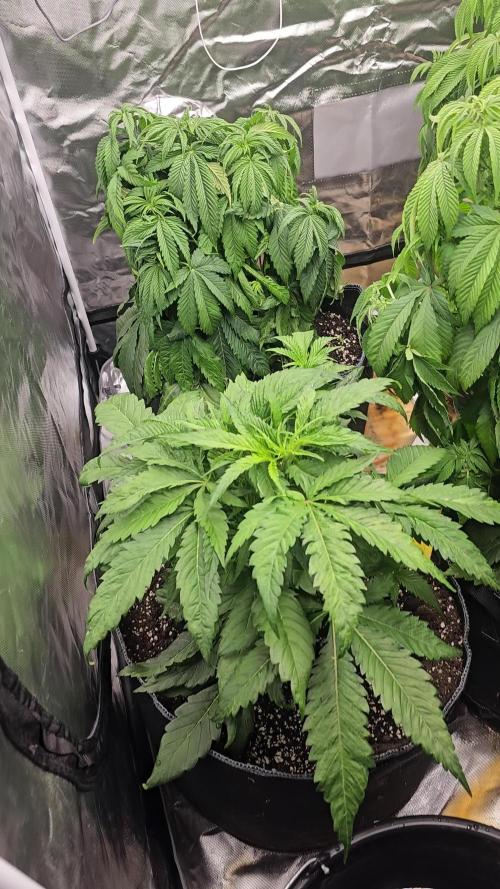
Defoliated both and stripped the cali octane naked. She didn’t stretch rlly so the tangie is overshadowing her a a bit. i have ordered a raiser for the CA that will arrive in a few days to level it out. Going strong into week 3 of flower 💚💚💚
Likes
29
Share
@DE_BW
Follow
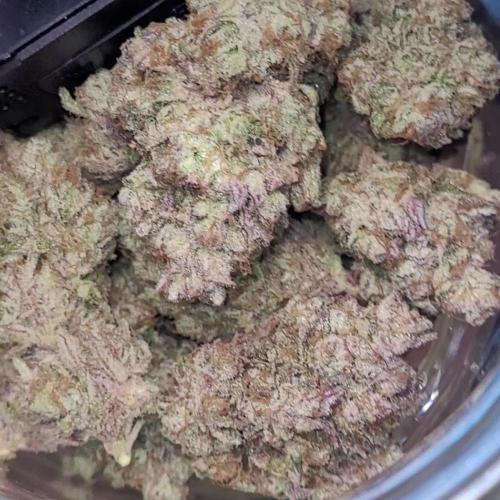
Mendo Frost is stacking beautifully and continues to impress with her structure. The buds are developing nicely across all branches, while the trichome production is ramping up fast, giving the entire plant a heavy frosted look already. Pistils are still mostly white, suggesting there’s plenty of time left for swelling and maturation. Overall, she’s looking very healthy and seems set up for a strong finish.
Likes
58
Share
@Gisbert
Follow
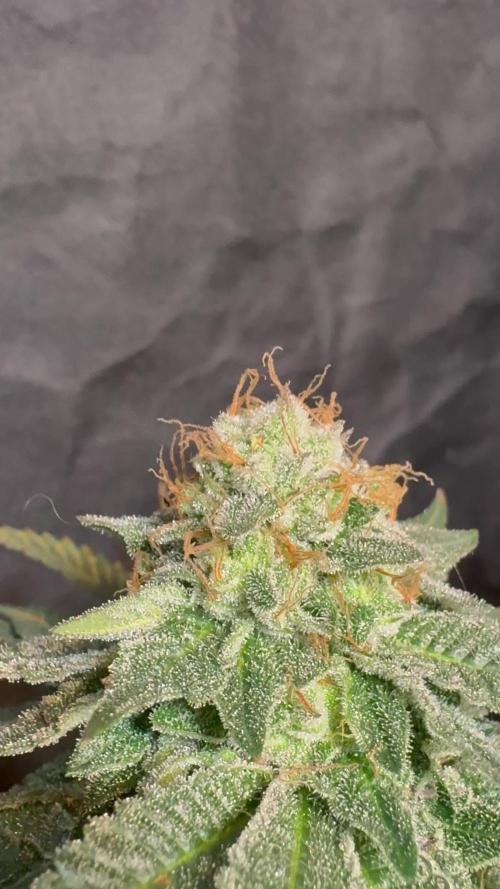
An Größenwachstum ist kaum etwas dazu gekommen. Dafür entwickeln sich die Blüten prächtig und der Geruch ist ein Traum, superintensiv nach Limette.
Likes
15
Share
Week 5 of veg: repotted into the final 12L pots using a 100% organic soil mix I made myself with dry organic amendments only — no bottled organic products. Watered with compost tea, and bent/trained the plants to shape the canopy for a SOG setup. For this keeper hunt (if we find one), we have three Blue Honey candidates: BH1, BH2, and BH4. Root-wise, BH1 seems to have slightly more mass, but nothing dramatically different. Structurally, BH1 and BH2 responded well so far, while BH4 stayed much smaller and stockier — we’ll see how it develops, but at the moment BH4 is trailing behind.
Likes
39
Share
3/18/25 Start of another week. Plants just finished 2nd week of flowering so these most recent pictures are day 14 since the flip to 12/12 Some plants are only 28-30 inches and others are stretched up to 36-40 inches 3/22/25 R3 looks like shes going to produce the most mass. everything looks really happy. Everything looks happy and healthy
Likes
9
Share
@Changman
Follow
01-07-2024 This week has been phenomenal for the Banana Kosher Kush plants, they are loving their enviroment and their nutrients. Our Sugar Bomb Punch seedlings are going but our Lion Holdings Soil is not the best in comparison to the growth we've gotten from our Freedom Farms soil. Again only time will tell and we are keeping a close eye on them as always. Our Auto Power Plant seedlings are showing rapid growth and we will be transplanting them in the next two days to prevent too much shock. Our northern lights are struggling a bit as is our Girlscout Cookies but I will add some variations to feeding to see if that helps.
Likes
10
Share
# LSD Zamnesia Tripping 🙂 | Drying, Trimming & Final Numbers — Week 15 From Seed First of all… Yes 😄 We are once again dividing the harvest into multiple parts, and we sincerely apologize for that. But honestly, there was simply no realistic way to fit everything properly into a single GrowDiaries update. Between: - harvest photos, - trimming sessions, - macro stacks, - drying process, - preservation methods, - extraction preparation, - washing content, - smoke review material, - and all the little behind-the-scenes moments… …the amount of data collected during this run became massive. And instead of rushing through everything or leaving important parts unexplained, we decided to split the final stages into multiple chapters so every step gets the attention it deserves. Because harvest is not just “cut plant, dry plant, smoke plant.” The final weeks are honestly an entire process on their own. And this week? This week was all about: - drying, - trimming, - preservation, - resin collection, - and finally seeing what these girls truly delivered. For everyone joining now, quick recap: These LSD girls were grown under 12/12 from seed from the very beginning. Minimal intervention. Almost no traditional training. Mostly leaf tucking and gentle bending when needed. The plants grew naturally toward the light while we focused mainly on environmental balance and observation instead of aggressive manipulation. The goal was never maximum optimization. The goal was understanding. And honestly? These girls became absolute monsters anyway. After harvest, the plants that were not frozen for future washing were dried mostly whole instead of being aggressively broken down immediately. We wanted the drying process to happen slowly and naturally to help preserve: - terpenes, - resin quality, - smoothness, - and final flower texture. Drying conditions stayed around: - 18–20°C - approximately 60% humidity And after around 10 days… That beautiful little branch “click” finally arrived. Growers know the sound 😄 Not fully snapping into dust… not bending wet anymore… …that perfect middle point where you know trimming time has officially arrived. And honestly? This is where the room became chaos again 😄 Trim bin ready. Gloves on. Scissors prepared. Mr. Baggy supervising operations as usual. We even gave him a trimming cap so his imaginary hairs would not contaminate the flowers 😄 Safety first. One branch at a time, we slowly started breaking everything down by hand: - separating flowers, - removing excess leaf material, - preserving structure, - checking density, - and admiring the insane amount of frost these girls developed. And wow… These flowers are ridiculously resinous. Not just visually frosty. Sticky frosty. The type where: - scissors stop cooperating, - gloves become glued together, - fingers turn black with resin, - and every few minutes you accidentally create little hash sculptures while trimming. The Zamnesia curved trimming scissors honestly became one of my favorite tools during this process. The pointed curved tips make it incredibly easy to reach deep inside dense flowers without damaging structure too aggressively. And these flowers definitely deserved precision. Dense. Heavy. Compact. Extremely resinous. Some buds honestly felt closer to small rocks than flowers 😄 While trimming, the trim bin also started collecting beautiful material underneath: - tiny trichome heads, - broken resin glands, - small fragments, - and all the golden dusty goodness growers love seeing accumulate slowly over time. And once enough collected… Of course we hand-pressed it 😄 Nothing fancy. No giant machinery. No complicated setup. Just warmth from the hands, gentle pressure, patience, and resin slowly transforming itself into beautiful soft hash. The color came out gorgeous too: light golden, slightly creamy, soft, sticky, and incredibly fragrant. Simple. Traditional. Beautiful. Exactly the kind of small moments that make harvest season special. Now for the final dry numbers so far: Plant A: 287g dry flower Plant B: 107.3g dry flower And it is important to mention: the second plant was NOT harvested fully for flower because a significant portion had already been separated and frozen for future ice-water extraction work. So these numbers do not represent the total biomass produced by that plant. And honestly? We are extremely happy with the results. Especially considering: - the 12/12-from-seed approach, - minimal intervention, - the massive resin production, - the flower density, - and the overall quality expression these girls delivered. The aroma during trimming was unbelievable too. The entire studio became saturated with terpenes: - loud, - greasy, - sweet, - sharp, - complex, - almost offensive in the best possible way 😄 Every movement released more aroma into the room. Every branch smelled alive. And even now during curing, these girls continue evolving beautifully. For preservation, we decided to divide storage between: - Grove Bags, - glass jars, - and a few additional preservation containers. And honestly, this is something we always enjoy testing because curing is never just “put flower somewhere and forget about it.” Different storage methods can slightly influence: - moisture stabilization, - terpene retention, - aroma evolution, - texture, - and long-term aging behavior. Glass jars remain classics for a reason. But Grove Bags are also extremely interesting because they are specifically designed to help stabilize humidity exchange internally without constant burping routines. And over time, comparing these methods becomes part of the fun too. Of course, this is still not the end of the story. Far from it 😄 The next chapters will cover: - frozen material washing, - ice-water extraction, - separation, - resin collection, - drying techniques, - curing updates, - smoke review, - terpene analysis, - and final concentrate results. And honestly… These girls already gave us some absolutely beautiful medicine during washing tests 👀 But we will save those details for the proper extraction update. Mr. Baggy stayed with us through the entire trimming process as always, emotionally supporting operations and probably stealing quality control samples when nobody was looking 😄 And finally… Thank you. To Zamnesia for the genetics. To Plagron. To F.O.G. To all the LEDs, gear, and equipment involved. To GrowDiaries. To the community. To the longtime followers. To the new followers. To the silent supporters. To the curious visitors. To the skeptics. To the lovers and the haters 😄 To everyone spending even a few minutes following this strange beautiful plant journey with us. And next week? Things get icy 🌊❄️ Fresh frozen material. Washing. Extraction. Resin separation. And another entire side of this plant still waiting to be explored. Stay safe everyone. Stay curious. And may your scissors always stay sticky 🌱
Likes
177
Share
@DreamIT
Follow
Strong genetics, resistant, fast enough, easy to grow and never pretentious. I will try further training techniques on this strain, while waiting to make more room in the box to plant the Red hot cookie as well. If you like sweet flavors and fragrant plants this is definitely for you! Soon new updates for a cycle of only plants in "monstercropping", to continue my eternal red garden 😁🦄 thanks for following me up to here and leave a comment and suggestions 🦄👍🤘
Likes
2
Share
We become aware at such times of man's wonderful ability to bring seemingly unrelated elements into harmonic balance, and receive a glimpse into a world where everything exists in conscious sympathetic attunement to everything else. When we listen to a piece of music that seems to strike a beautiful chord somewhere inside us, or view a painting that simply glows with harmonic awareness well executed, we probably do not spare much time to contemplate the wonderfully intricate combination of vibrations that our sensors make it possible for us to perceive. We tend to appreciate the relationship between the parts of something by an awareness of the harmony or dissonance of the whole. This ability enables us to say "what a beautiful house!" instead of "analysis has proven that this collection of building materials exhibits certain elements of harmonic proportion." While this ability to instinctively appreciate the beauty of true harmony has an important role to play in evolution, a more analytical understanding of the laws involved can be most useful. This is especially so if we wish to create works of art where each part exists in true harmony, not only with the other part of that particular whole, but with the universe within which the creator and the created exist. Everything vibrates. From the most dense matter to the most subtle cosmic rays, everything which our senses allow our thoughts to become aware of, can be specified in terms of wavelength or frequency of vibration. These two terms define the same thing, but from different points of view. The following are the approximate wavelengths of various energy carriers: Cosmic rays 0.000,000,001 mm Gamma rays 0.000,000,1 mm X rays 0.000,500 mm Ultraviolet rays 0.003 mm Visible light 0.006 mm Infrared 0.01 mm Sound waves 1 meter Radio waves 300 meters Violet light 400 nm to 450 nm Blue light 450 nm to 500 nm Green light 500 nm to 570 nm Yellow light 570 nm to 590 nm Orange light 590 nm to 610 nm Red light 610 to 700 nm 1 nanometer (nm) = 0.000,000,1 cm = 1/10,000,000 cm If a guitar string is plucked and we hear a sound, it is not too difficult for the human mind to associate this sound with the vibration of the guitar string. With color it is quite different. It is difficult for us to conceive that the color of a substance is not an inherent property of the substance itself, but an indication picked up by our senses of that substance's ability to absorb or reflect the light which happens to be shining on it at that moment. Neither the matter nor the light is colored. What happens is that the brain learns to differentiate between the frequencies reflected or transmitted by the substance the eyes are focused on. The same thing happens with sound. When we say "Oh! Listen, they're playing my favorite song," what we really mean is: "My brain has stored within it a particular pattern of frequencies. I have compared the new information being received with this stored pattern and have deduced the answer that the two patterns are similar within certain specified tolerances." The 'pleasure' involved could have something to do with our running the pre-recorded pattern at the same time, in 'sympathy' with the new pattern as it is received. The word sympathy describes very well our ability to appreciate color and sound. It also describes the reason behind certain elements of harmony. For instance, if a substance vibrating at 100 cycles per second (tone 1) is in the proximity of another substance vibrating at 200 cycles per second (tone 2), we could perceive, if we had the right equipment, a certain sympathetic relationship between the two. We will see from this that there is a uniform doubling of the first tone seen in the second. At various points along the waves, the two are the same in amplitude. At other points, they are at opposite poles to each other. This doubled frequency has more points of similarity to the original than any other frequency except the original itself. If the equipment we had available for measuring these two frequencies was a soundboard amplifier and a pair of ears, then we would hear what would sound to us like one tone. If we had the opportunity to hear one at a time, we would hear that although they sound the same, one is higher in pitch than the other. This characteristic of 'the same but different in pitch', musicians have called the octave. Any two tones produced where one has exactly doubled the frequency of the other is called an octave. Speaking in ratios, an octave would appear then as the ratio 2:1 or 1:2, depending on whether we are talking of an octave up or down. A single note produced by almost any instrument will contain more than one wavelength or frequency. It will have a dominant frequency, the wavelength of which we would call the note's 'fundamental' or 1st harmonic. It will also have a varying number of upper harmonics, gradually fading in intensity into infinity or silence. Natural harmonics always have the same pattern of intervals between them. The interval between the 1st and 2nd harmonic is a perfect octave; between the 2nd and 3rd a perfect fifth; between the 3rd and 4th a perfect 4th; and so on, the intervals becoming smaller and smaller until they lose any relationship with the western 12 tone scale as it exists at the moment. Just as an octave has certain elements of sympathy with its fundamental, so some intervals have been noted to be more perfectly in sympathy with the fundamental than others. The ratio of the 'perfect 5th' or interval of 7 semitones, as it occurs in the harmonic series, is 3:2 or 2:3, while that of the 'perfect fourth" is 4:3 or 3:4. All the tones in the western 12 tone scale can be expressed in terms of the ratio between the upper tone and its fundamental. This would seem to be an ideal way of generating a scale from any given fundamental and several attempts have been made to do this, the Pythagorean system being probably the most well known. Although when working with a single tone instrument playing on its own, the Pythagorean formula works wonderfully well, if we had several instruments tuned this way together and asked them to play almost any western music, we would find that at times they sounded quite out of tune to each other. The lack of flexibility of the various scale systems based on the harmonic series has led to what is known as the 'tempered' scale. This uses as its primary unit of interval the ratio of the octave or 2:1. It then proceeds to divide the interval between any fundamental and its upper octave into 12 smaller intervals by applying the ratio: two to the one-twelfth power, to one (21/12:1). This equals 1.059463094, so by multiplying any frequency by this number, we will obtain the tempered semitone next up from our fundamental. We will also find that any tone twelve semitones up from any other tone, in a scale generated in this way, will have exactly double the frequency. If we took the note middle C on a piano and halved the wavelength, we would have the note C one octave above. If we halved this, we would have the C above, and so on. However, within about 6 octaves, we would find that although a 'sound' was being produced, no human ear could perceive it. If we kept on going, halving and producing upper octaves of our fundamental C, we would proceed through the infrared band, into the visible light spectrum. If we happened to be outside during the day, we would, for one octave only, see the note C with our eyes. The next octave above would already be in the ultraviolet band, and outside the eye's sensitivity range. If we can think of color as being an indication of a substance's vibratory rate or wavelength, we may begin to see a relationship that could exist between the color and sound spectrums. The logical extension of what has so far been said is that there exists a scale in the color spectrum that corresponds exactly to the scale in the sound spectrum, each color tone being an octave of the equivalent note in the sound range. This is not the end of the story but only the beginning. If we can for the moment accept that any wavelength in one band has upper and lower octave stretching out to infinity, then the next question is 'fine, but what shall we use as our fundamental? A particular color? A particular sound frequency?' The musicians among us will probably say 'A 440'. This means that the note A should vibrate at 440 Hertz, or 440 times per second. They would tell us that this is standard pitch has been adopted by most orchestras around the world; pianos are tuned to it, instruments are constructed to formulas based on it, and so to them it would probably seem the most appropriate place to begin. Some of these musicians may know of the battle that is still raging with regards to this being the standard, but few would know why A = 440 Hz was chosen except that it worked when it was set to be a suitable compromise between the many different pitches in use at the time. 432 Hz is said to be mathematically consistent with the patterns of the universe. Studies reveal that 432 Hz tuning vibrates with the universe’s golden mean PHI and unifies the properties of light, time, space, matter, gravity, and magnetism with biology, the DNA code, and consciousness. When our atoms and DNA start to resonate in harmony with the spiraling pattern of nature, our sense of connection to nature is said to be magnified. Another interesting factor to consider is that the A=432 Hz tuning correlates with the color spectrum, while the A=440 Hz is off. Audiophiles have also stated that A = 432 Hz music seems to be non-local and can fill an entire room, whereas A=440 Hz can be perceived as directional or linear in sound propagation. Once you adopt the idea that sound (or vibration in general) can have an equalizing and harmonizing effect (as well as a disturbing effect), the science of harmony can be applied to bring greater harmony into one's life or tune to specific energies. There is a form of absolute and relative harmony. Absolute harmony can, for example, be determined by the tuning of an instrument. The ancients tuned their instruments at an A of 432 Hz instead of 440 Hz - and for a good reason. There are plenty of music examples on the internet that you can listen to in order to establish the difference for yourself. Attuning the instrument to 432 Hz results in a more relaxing sound, while 440 Hz slightly tenses up the body. This is because 440 Hz is out of tune with both macro and micro cosmos. On the contrary, 432 Hz is in tune. To give an example of how this is manifested microcosmically: our breath (0,3 Hz) and our pulse (1,2 Hz) relate to the frequency of the lower octave of an A of 432 Hz (108 Hz) as 1:360 and 1:90. It is interesting to note that 432 Hz was the standard pitch of many old instruments and that it was only recently (19th and 20th century) the standard pitch was increased. This was done in order to be able to play for bigger audiences. Bigger audiences (more bodies) absorb more of the lower frequencies, so the higher pitch was more likely to “cut through”. One of the oldest instruments of the world is the bell ensemble of Yi Zeng (dated 423 BC), tuned to a standard F4 of 345 Hz, which gives an A= 432 Hz. The frequency of 345 Hz is that of the platonic year! Similarly, many old organs are tuned in A=432 as well; for example, St. Peter’s Capella Gregoriana, St. Peter’s Capella Giulia, S. Maria Maggiore in Rome. Maria Renold’s book “Intervals Scales Tones and the Concert Pitch C=128 Hz” claims conclusive evidence that 440 Hz and raising concert pitch above scientific “C” Prime=128 Hz (Concert A=432 Hz) disassociates the connection of consciousness to the body and creates anti-social conditions in humanity. The difference between concert pitch A=440 Hz and Concert A=432 Hz is only 8 cycles per second, but it is a perceptible difference of awareness in the human consciousness experience of the dream we share called existence.
Likes
20
Share
@Haoss
Follow
I have to dry the buds in the dark, at 21 degrees in 50% humidity
Processing
Likes
5
Share
@HERBBEANZ
Follow
Okay so I came up with this incredible method of training that I call "root lining".I figured this out years ago in outdoor season when a deer bulldozed through my med crop and knocked a sweet lady over, that started it all. The plant was completely parallel to the ground with roots growing out of the nodes where contact was made with the ground at the stock. Long story short she ended up being a 14 footer with 6 foot whale dicks! That gave me this little idea that's been non stop producing top quality fat resinous buds. This method increases nutrient uptake and makes a huge difference in quality and size. I essentially main line, really low to the ground, until the stock makes full contact with the ground. I then gently rub the downside of the stock with the back of a butter knife to speed things up and break down the chlorophyll layer. Then I add remo roots gel (see all videos). I then add a sprinkle of coco on top just to barely cover the stock (dont add to thick of a layer as this might "choke" and rot the stock) and mist that spot 2-3 times a day. 3 days later and boom! She'll be pumping out roots and go into full beast mode. Give it a try and you'll never go back!
Likes
11
Share
Likes
12
Share
ive harvested the tops of these girls and left the bottom to mature more over another 2 weeks. I will update all the weights at the end. Will give them another bloom boost and some fulvic humic and microbes. should be able to quadruple the weight of the mid and bottom buds.
Likes
Comments
Share
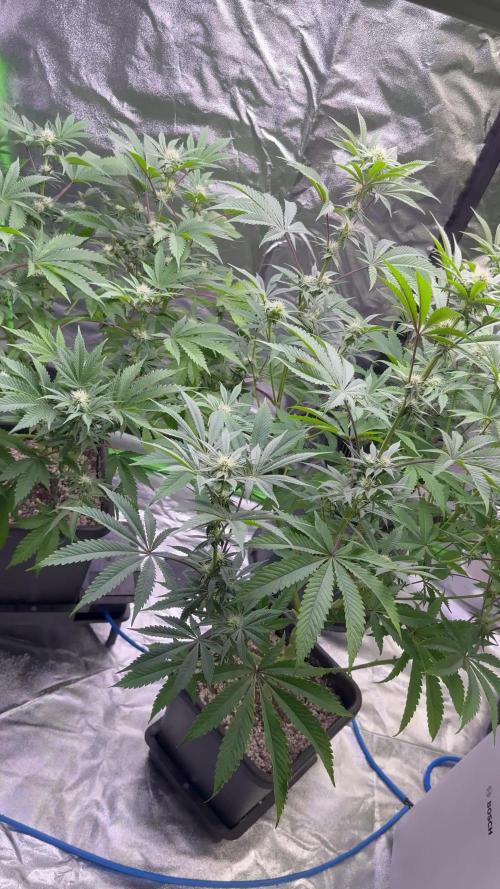
First Harvest-Crazy Day. I had no choice, only to cut it early, but at that moment I thought it was time. I had to leave for 2 weeks and GPT told me it posile to cut now. So I cut my plant, by colas and left them for 2 weeks in fresh frosen to make hash later. 2 weeks later i got some 5 gramm of hash , dry rest of weed ,smoke it in one week. I have got high, but not stoned. at least I got something😂 watch the pictures and lough on me ,I totaly deserved. Enjoy and Peace 4 Everybody Primer dia de coshecha- el dia mas tonto del año Me corte esta plant 5 horas antes de volar fuera de pais por 2 semanas y me puso todo en las bolsas cerrado en frigorifico para hacer luego el hash. en el momento de corte me pense que todo mas o menos bien,hasta GPT me dicia eso. Al final me salio 5 gr de hashish y toda una mierda de hierba mojada. me sece como podido y fume todo en una semana. si, me ponia arriba, pero a mi ,me gusta tumbarme y eso no habia. Entonces soy tonto y me corte mi primera planta como minimo 2 semanas antes. Que vas hacer? sentarte y mas crecer😎 un Abrazo a todo el mundo. Chao Sprritzer
Likes
10
Share
@Grilla
Follow
Wednesday, May 10 at 1:07 PM D 70 -today’s the last day of week nine. These past few weeks I feel like I’ve been trying to control the damage I did. It’s not like the plants are horrible. They actually all smell great even the blood Orange that had no smell is starting to smell again. It is definitely a different phenotype than the other Blood Orange. The other blood orange I have smells like an orange, and the other one smells like spiciness. With this being D 70 harvest is quickly approaching.
Likes
2
Share
Empty watering was done before going into overdrive. ssh took too long criticalwidow fills 30th day in flower.
Likes
10
Share
No signs of flowering yet, maybe slight formation of calxys beginning. Been spraying with molasses, neem, cal mag and liquid kelp (bioweed) and superthrive just once to hopefully delay flowering to increase yield. P.S. if youre new at growing DO NOT try this unless you know what your doing with hormones etc. Theres a chance it can turn your girls hermie. Just be aware!