




Likes
25
Share


@Stick
Follow
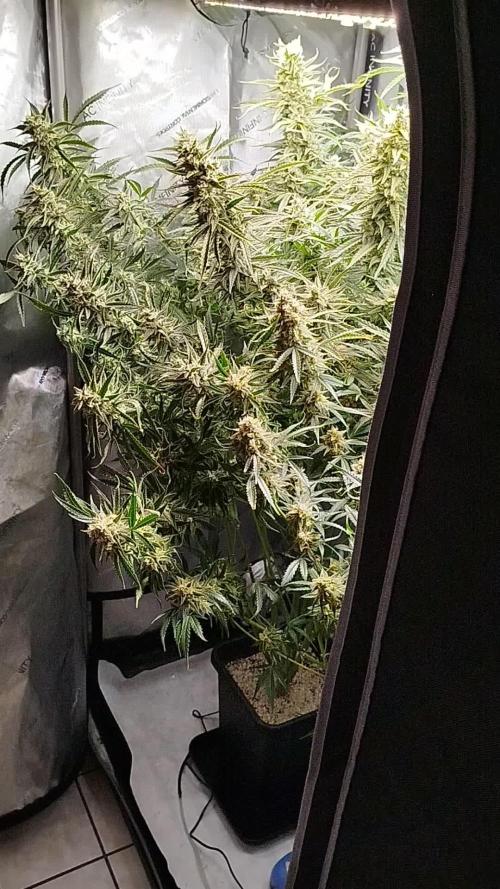
OK guys I'm back after being away for 2 weeks. I've proceeded to a final transplantation into a 9L AirPot container, right before I left for vacations. Despite the transplantation, no special operation was done, I want to see how this clone is going to grow on its own and I don't have enough room for training / bending. A friend was in charge of the grow room while I was away, and she did a pretty good job. The clone is healthy, standing proud and praying the light. I started to build the manifold for 4 colas but some side branches have already reached the canopy, that clone wants to produce weight! She will remain under vegetative stage for 1~2 weeks before flipping into 12/12 light schedule. I can't wait to see her full of buds! Thanks for stopping by 👊

Likes
23
Share


@caliEskimo5
Follow
I'm done with autoflower cultivar! That and trying to grow outdoor specimens indoors, no bueno. In this micro-grow area of mine will be from now on, limited to two plants and I will be much more selective of what plants to grow out!
I've had a few autos turn out but with this grow getting so out-of-control, autos being photos, etc. It would just be easier for me as an individual limit the type of growing I'm doing to just breeding; one male, one female but with this bagseed male...we will see what the offspring are like at a later time but for now I'm trying to force this male to flower.
Alot of growth from the purple haze auto, so much so it has crowded out both Lemon Haze autos and I can't even see one but can smell it!! Once I get to 12/12, growth should be completely focused on buds but for now I'm allowing all plants time to transition @14 hrs and EOD Emerson effect treatments.
More soon.
Also, something is off with my camera's contrast, everything in my room from my perspective is very green, light/lime yes but it appears yellow in my photos. I suppose I could go a bit higher in soluble N, an and Iron when I feed but as of today, Blood meal is making it's way to the top of my favorite amendments...quick!
I've gone a tad bit more rich with feedings on the N side for the Purple Haze auto as it is not auto and kind of let the Lemon Autos finish, hopefully my 2 in 1 lemon isn't soaking up all the N in its last couple weeks...smoke might be zingy/zesty! Anyways, I've basically let the two lemon autos go and have focused on Purple Haze.
Can't wait until flower!

Likes
10
Share


@cezario
Follow
Most plants are looking good. One plant has some discolorartion tho. Tops are looking nice and thick.
Likes
81
Share


@Kitties_and_Colas
Follow
~_~_~_~_~_~_~_~_~_~_~_~_~_~_~_~_~_~_~_~_~_~_~_~_~_~_~_~_~_~_~_~_~_~_~_~_~_~_~_~_~_~_~_~_~_~_~_~_~_~_~_~_~_~_~_~_~_~_~_~_~_~_~_~_~_~_~_~_~_~_~_~_~_~_~_~_~_~_~_~_~_~_~_
👊😺Woo-Hoo!! About half way there!! everything is going fantastic in this tent! (wish i could say the same for all of them😿)..The SP-3000 is crushing it again! Their nodes are spaced perfectly for fat buds, they start stacking super low, we would normally get light colored growth down there with our old LEDs, this is definitely penetrating deeper..We're still feeding with every watering but one standout will be getting just water this week (too dark)..we removed a few more large fans from the tops but nothing drastic...temps are much better since firing up a 2nd 390CFM for the far tent.. all 3 tents pump thru 6" host to a single 8" hose out a window, the ambient temps of the room are much warmer than the inside of the tents with that much air moving.. thanks @Asnoriu for confirming we wont be hurting much running full time with some negative pressure this summer..We're counting on these "Fast" strains to go about 8 weeks but time will tell.. not too much else to report, its been a breeze this week...thanks as always for dropping by and happy harvests friends!!
⚡Mars Hydro/SP-3000⚡ Specifications ⚙️:
Diodes: Samsung LM301B / Osram 660nm (960 total!)
Driver: Meanwell 300watt 🔌 (300W±5% @AC120V-277V)
PPF: 824umol/S ☢️
PPE: 2.8 µmol/j 〰️〰️
Lifespan: 50k+ hrs ⌛
Weight: 10.1 lbs (4.6kg)
Veg Coverage: 3 x 5 ft 🌱
Flowering Coverage: 2 x 4 ft 🌼
-The SP-3000 uses an aluminum heatsink (no fan) and the driver can be placed outside the tent 🌡️⬇️
-IP65 waterproof ratings, tolerant to high humidity grow environments 💦 ..
-Up to 15 can be daisy-chained together and all controlled from a single light! 💡~💡~💡~💡~💡
~_~_~_~_~_~_~_~_~_~_~_~_~_~_~_~_~_~_~_~_~_~_~_~_~_~_~_~_~_~_~_~_~_~_~_~_~_~_~_~_~_~_~_~_~_~_~_~_~_~_~_~_~_~_~_~_~_~_~_~_~_~_~_~_~_~_~_~_~_~_~_~_~_~_~_~_~_~_~_~_~_~_~_


Likes
99
Share


@McBubatz
Follow
Die 9 Woche startet 💪.
Bis jetz hat sie die letzten Tage mit Unwettern ganz gut überstanden auch der Regen war nicht ganz so schlimm.
Hab mal ein paar Trichom Aufnahmen mit dem Handymikroskop gemacht da die Blüten doch schon recht dick sind, aber überwiegend Klare und Milchige und noch keine bis vereinzelt Bernsteinfarbene Trichome. Also hat scheinbar noch Zeit die gute.
Likes
2
Share

@Growfather1
Follow
Hello everyone,
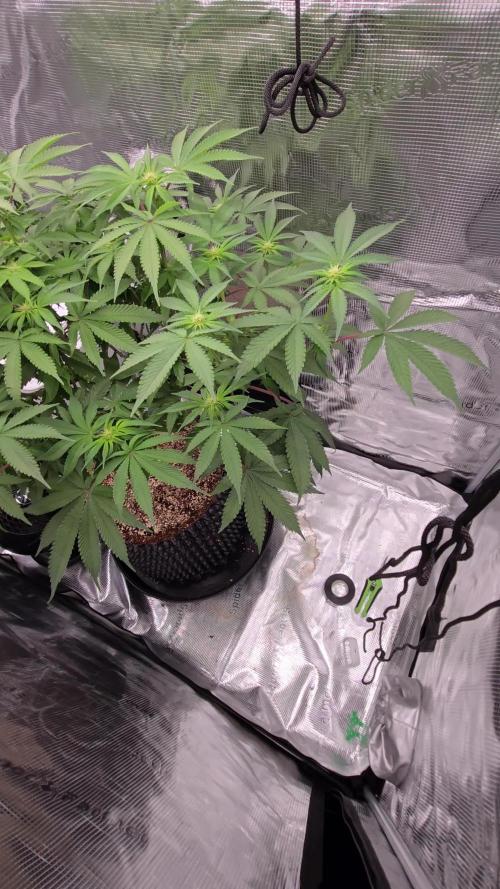
The tangerine dream entered the second week of flower everything is going well with her.
Next week i will start defoliating her to give the lower growth some more light.
I run a light schedule from 17:00 to 05:00 together with airconditioner to keep the temperature under 27 degrees celsius.
Thanks for stopping by and have a nice day.
Best regards,
Growfather


Likes
10
Share


@Hempire
Follow
Hello growers !
This week I start flush ! To clean the roots and to not smoke nutrients left. I fight against bugs and spiders that want to investigate my plants ... I check the trichomes and they are all white

Likes
5
Share


@FlavorzChaser
Follow
Week 3 G14 everything is great I've increased the biobizz to 2ml still adding nitrozyme once a week and a little cal mag I've tied the top in a pony tail for 24/48hrs so branches underneath stretch I used a covid mask string very handy 17th added a net but the holes are a little small and it increases humidity so I've removed it.if your running a mars or any Chinese lights as you know they run hot and increase humidity check out video for a simple hack.


Likes
11
Share


@4_Pro2Bono_0
Follow
Week 3 Veg. These ladies are looking heathy as can be, Very satisfied with the genetics so far!

Likes
6
Share


@Myrcene_Dream
Follow
-Germinated seed in peat pellet and 3 days later sprout popped up
-Put peat pellet with sprout in a 5 gallon fabric pot containing Pro-Mix HP
-Placed into tent where temp/humidity is constant at 78F 70%
-Gave a 3tbsp top dress of Gaia Green all purpose on day 6
-Watering a bit every 3rd day or so

Likes
20
Share


@Bread_n_Buds
Follow
Dear friends, this diary tells the story of the development of two Runtz for convenience I divided the harvests, if you want to see the other plant is documented in the week before the harvest.
I'll tell you about the Zamnesia Runtz that you see in the photos and below my general opinion on the harvest and the strain.
This phenotype has been really very elegant since the beginning or at least since the main cola began to take over. The flower has a very kush shape, different from the other main cola a little less resinous but bigger very very beautiful indeed.
The plants are not giants by definition, this is a very stable strain with not very high heights, the yield is always medium high but the strong point is definitely the quality of the flower.
Beautiful plant, beautiful main cola. Mature very red pistils resin overflowing for real. The purple color is really super beautiful I'll prepare a nice video where I'll show it to you.
The trichomes are multicolored due to the presence of purple, here too we have stuff from pink to fuchsia to dark purple plus the classic colors, the maturation is at a point that I don't mind at all.
In weight we will be around 40 - 50 grams but of excellent quality, let's wait for the dry sla and see.
Perfect strain compliments to Zamnesia breeder.
Most likely nowadays those who give the impression of doing Cannabis Industry manage to provide a product of extreme quality much more than the small breeders who are all stealing strains from California and crossing them with their little experiments. It is no longer the era of the flower children although we have to thank them for the anarchic work they did in the 60s and 70s now it's time to work well, cannabis is spreading all over the world and you can compete with the Americans only by working well, like they do in Zamnesia.
How can I prove it to you? In the years in which I was a tester the breeders made me try a lot of good stuff but often, very often, too often I found hermaphrodites. Now always bringing up good luck, touching wood, where the sun don't shine, doing all the appropriate spells of the case we are at
ZERO HERMAPHRODITES.
No seeds, no balls, nothing at all and after all the years that I have heard the "expert freaks" of breeding talk now I feel like recommending the seeds of the industries much more than the small houses.
I thank all the good operators of small houses and I apologize to them but I will never grow their stuff again there is an exaggerated percentage of hermaphrodites. The industries whether you like it or not guarantee success rates much much better. Especially for the wave of beginners arriving.
Zamnesia Strain Description // Guys, we have really reached a turning point! Our breeders have recreated one of the most sought-after strains by Californians: the very powerful and exquisitely delicious Runtz. This cross between Gelato and Zkittlez is everything you could want from a cannabis strain: tasty, powerful, balanced, productive and fast flowering. Buy the seeds and try it yourself!
- Get a seed of this fantastic strain --- https://www.zamnesia.io/it/6000-zamnesia-seeds-runtz-femminizzato.html
The plant has eaten the 100% Organic feeding of Plagron: Alga Grow and Alga Bloom as basic nutrients, the rooting Power Roots, the amino acids of Sugar Royal, the Enzymes of Pure Zym that eat the dead parts in the soil, Power Buds that always gives us immense satisfaction with rapidity of start of flowering and composition of the buds, the legendary Green Sensation that now needs no introduction, a name a guarantee. Also the foliar Vita Race used for the first time with success.
The fertilizer kits that you can find on the Zamnesia website are perfect
for this purpose, there is everything. Choose them based on their mineral/organic composition and the soil you have chosen.
at the link --- https://www.zamnesia.io/it/11457-plagron-easy-pack-natural.html
The quantity was measured using the sheet prepared on purpose on the Plagron website based on the soil chosen: Plagron Pro Mix + Perlite.
at the link --- https://plagron.com/en
The growbox is the DS120w by Secret Jardin as well as the DF16 ventilation system and all the fans
at the link --- https://www.secretjardin.com/it/
The light was supplied in the past by Viparspectra and it went crazy but it came back to me to produce very well too...
at the link --- https://www.viparspectra.com
A fantastic selection of seeds, a headshop and a selection of exceptional accessories on the world of cannabis, many other things about mushrooms, health, well-being and all the beautiful things that nature offers only on the Zamnesia website
at the link --- www.zamnesia.com
Instagram ----
@zam.nesia - @zamnesiawebshop - @zamnesia_usa - @bread_n_buds



Likes
4
Share


@sunnykuyall
Follow
04 - 07 May 2023 - Germination Week
08 - 14 May 2023 - Veg week 1
15 - 21 May 2023 - Veg week 2
22 - 28 May 2023 - Veg week 3
29 - 04 June 2023 - Veg week 4
05 - 11 June 2023 - Veg week 5
12 - 18 June 2023 - Flower weel 1

Likes
3
Share


@BUZIMAN
Follow
Gelonade: produit beaucoup de feuille donc taille effectué hier pour dégager les bud,continue à prendre de la taille mais devient plus rigide .
Milky Way:
La plante a l’air désormais de ce concentrer sur les bourgeons ne prend plus de taille, une odeur de citron acide 😎
Likes
60
Share


@Philhsy
Follow
Added some great white, wanted to test, a bit late on but what ever, hoing to use next growmore correctly. The hures are smsxing purplish red, dark top colas, almost silver and shiny from all trichromes that just coveres the whole buds and leafs. Amazing plant. Want them to swell up a bit though.
Likes
42
Share


@GanjaReaper
Follow
Spotted some budrot again. This time I had enough of it and didn't want to risk further rot, so I decided to harvest them and not let them flower for another week.
Forgot to take pictures before the trim, they look silly now without the support from the copperdreads and rubberwires haha.
They had 8 weeks of flowering, I'm glad that 1 out of 2 came out nicely. The other one is just another regular looking outside plant lol.
I always give them a first trim, so the buds can dry better, faster, safer. After some days or maybe at the end of drying, i will trim them again.
You can expect the final update with pictures between 7 to 14 days from now.
ps, Somehow the beautifull colors from the better plant doesn't show properly when filming or taking pictures, neighter am I a professional photographer.
But ill promise to take better ones, once the buds got the final trim and got dried.
