Likes
Comments
Share


@JolliGrowz27
Follow
Day 15 the start of week 3. I have defoliated a couple times. Once before I scrogged, and once after today. I am planning on feeding another round of Gaia Green Power Bloom and All Purpose with worm castings. I have also watered with molasses and recharge. Pheno 1 is my favorite so far. She is the second tallest plant. She is the frostiest so far. Darker leaves and more color. The other 2 are similar in colors. Pheno 2 is the tallest, and pheno 3 is not behind much only a few inches shorter. I also shoved a few small pots in the corner of gorilla gas and another random seed I found on the floor hahaha.

Likes
181
Share


@StarLorr
Follow
Welcome to my Øpium diary.
In this diary:
Seeds: sponsored by Ðivine Șeeds
Media: Promix HP
Nutrients: Advanced Nutrients, Diablo Nutrients, Gaia Green Power Bloom.
Light and Weather: Şun☀️and Mother Earth.🌎
___________________________
Wet Weight: 1737 grams
___________________________
Wet Trimming with my trimming bowl was a humongous time saver!!
______________________________
Took me about 7 hours to wet trim
______________________________
I wanna Thanks Ðivine Seeðs for the Opportunity to grow and smøke your Ðivine Plants👊🏼😉
______________________________
Thanks for stopping by, likes and comments are appreciated!👊🏻😎
Keep on growin!
Keep on tokin!!!
😙💨💨💨💨💨





Likes
51
Share


@eldruida_lamota
Follow
Vamos familia, otra vez de vuelta, y es que vaya como se están poniendo las cookies gelato de royalqueenseeds, parecen caramelos repletos de polen.
Variedad híbrida que al parecer tiene floración rápida y si no mirar cómo están con 6 semanas de floración, pronto lavado de raíces.
.
La humedad esta al 45% la temperatura está entre 21/28 grados , y como siempre el ph , ya que es de lo más importante,está en 5,8/6,0.
.
AgroBeta:
1 ml x L Flowering black line , vía radicular.
0,2 ml x L Beta shark, vía radicular.
0.5 gr x L mega PK , vía radicular.
0,8 ml x L Terminator, vía radicular.
0,5 gr x L Engordacogollos, vía radicular.
0,3 ml x L Tucán , vía radicular.
0,1 ml x L Betazyme, vía radicular.
0,3 ml x L Tricoma, vía radicular.
0,05 ml x L Gold Joker, vía radicular.
0,2 ml x L Silver, vía radicular.
.
Hasta aquí todo familia 🕸️ , un saludo y buenos humos fumetillas💨💨💨.


Likes
10
Share


@Ultraviolet
Follow
Added top funnel watering wick, most insects/bugs use damp topsoil 1-2" to reproduce. This uses gravity, 👊👊👊fiber wicks water, and spreads evenly, to keep moisture under the topsoil out of the reach of bugs.
Zinc is a chemical element with the symbol Zn and atomic number 30
Neodymium is a chemical element with the symbol Nd and atomic number 60
Thorium is a weakly radioactive metallic chemical element with the symbol Th and atomic number 90.

Likes
2
Share

@Black_Widow
Follow
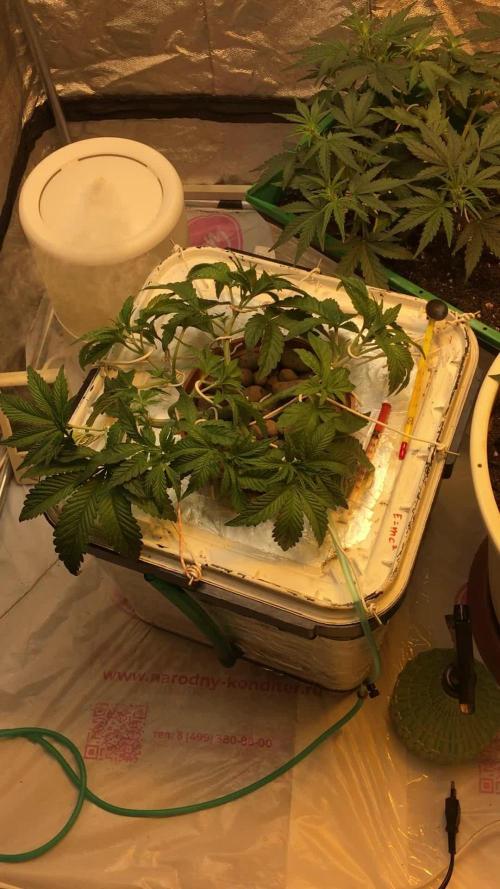
Привет садоводы !
Началась новая неделя
сегодня я заменил питательный раствор на новый и сделал его немного покрепче
все в пределах таблицы кормления
теперь он в значении 700 ppm
а PH также я держу в пределах 5,6
тот цветок ,что в земле после пересадки я пока не поливал
растения выглядят хорошо ,но растут немного медленно
а в общем вроде не плохо
😎

Likes
25
Share


@PacMan420
Follow
This week the lsd Plants were under lst training and only one lsd stretched, the Black Berries weren’t under lst one stretched also.The Gorilla cookie is a week behind and is doing good.Today I will defoliate the plants. Due to Next week they should start flipping into the flowering stage, the lsd to the right looks like it started flowering

Likes
4
Share


@Guerrilla_grower777
Follow
7/10/2025 17:15
Final visit to the spot,it's so cold outside with all days under 20°C and some nights 4/5°C
This plant alone smelled so much and keep pushing but mold is attacking her and it's the fucking 7th of november so i'm going to chop now
Trichomes are mostly white so it's ok even with a very low percentage of amber
The smell Is awesome very runtzy and fresh,not fully mature as the other but i saved her from a bad end
I found some mold on only a few top flowers,checked It properly and throw away without carrying at home with the others
Even if the mold part was very small especially compared to the other Coco i decided to take away all the moldy buds entirely,i don't t want to risk anymore
Before the final video session i took away all the fan leaves because i had not enough space to transport
At the end you can see a dead bud which Is clear when i tried to take a leaf and It pulled of so easy,inside is brown too
During next days i will update with the final thoughts and the final dry weight of both plants
Thanks to everyone who supports me and liked my job,next year i swear everything will be better prepared

Likes
8
Share


@ElchichodelaGrasa
Follow
Muy satisfecho de esta semana ya que parece que están avanzando todas satisfactoriamente, la única que parece haberse quedado atrás es la Glookies y a parte hemos añadido una Watermelon Zkittlez x Animal Cookies y otra Banana Slurricane, parece que cogen fuerza a pasos agigantados 🔥🔥

Likes
2
Share


@TTPIMP
Follow
It's so cool how you can tell the difference between the Indica dominant hybrid and the sativa dominant hybrid. This is my first time growing two different plants at the same time and it's really cool to watch them grow in their own cool way The structure of the branches It's just awesome I enjoy this very much.
May the yields be with you.

Likes
16
Share


@Naujas
Follow
girl, from the beginning she was watered with water from the tap, the value of which is almost 350ppm. and a lot of lime, which prevents me from growing it bigger, but I'm happy with the result :) it's a small pot and only 50 w :) the flowers look very beautiful and sticky :) super
Processing
Likes
3
Share


@Jamminbear
Follow
10/16/18- water Tap-left out to release the chlorine. 1 gallon with Yucca/Fresh Aloe/thriveNAmminos/UrbNatural

Likes
12
Share


@BudXs
Follow
These SECRET genetics look fine. All sprouted, 100% germ, no issues. Got some stretch on one, but thats cool, i like a bit of stretch, will bury her a bit on transplant.
Dont trust the talking dog
Likes
45
Share


@MadeInGermany
Follow
Info:
Unfortunately, I had to find out that my account is used for fake pages in social media.
I am only active here on growdiaries.
I am not on facebook instagram twitter etc All accounts except this one are fake.
Flowering day 21
since the time
change to 12/12 h.
Hi everyone :-) .
She has developed really well this week. it grows super in height 😀.
I am very curious how it will develop.
It was poured twice with 1.2 l per watering.
Otherwise the tent was cleaned as usual and everything checked.
Stay healthy 🙏🏻
You can buy this Strain and Nutrients at :
https://greenhouseseeds.nl/
☝️🏼☝️🏼☝️🏼☝️🏼☝️🏼☝️🏼☝️🏼☝️🏼☝️🏼☝️🏼☝️🏼☝️🏼
Green House Seeds Company Cup Clone 🏆
Type:
Wonder Pie
☝️🏼
Genetics:
Wedding Cake x OG Kush
👍😍
Vega lamp: 2 x Todogrow Led
Quantum Board 100 W
💡
Flower Lamp : 2 x Todogrow Led
Cxb 3590 COB 3500 K 205 W
💡💡☝️🏼
Earth: Canna Coco
☝️🏼
Fertilizer: Bio Grow Feeding ( GHSC ) , Enhancer ( GHSC ) , Bio Bloom ( GHSC)
☝️🏼🌱
Water: Osmosis water mixed with normal water (24 hours stale that the chlorine evaporates) to 0.2 EC. Add Cal / Mag to 0.4 Ec Ph with Organic Ph - to 5.8


Likes
25
Share


@pifflestikkz
Follow
(END OF QUARANTINE)
Now I have put them to finish underground a 600w hps under 12/12 schedule with the Divine Black opium.
Luckily no more mould has spread, and all plants look happy healthy and still developing.
Day 72
12/09/24 Thursday
De-chlorinated tap water pH 6 today with Plagron products.
Finally a video and pictures update
✌️💚
Day 74
14/09/24 Saturday
De-chlorinated tap water pH 6 only today
Day 76
16/09/24 Monday
Feed today using de-chlorinated tap water pH 6.
Will update all videos and pics tonight 😁
Day 77
17/09/24 Tuesday
Feed today using de-chlorinated tap water pH 6.
Seeing good developments, buds forming nicely, divines are smaller denser structures but the buds are not lacking!
Damn I'm surprised by 2L pots.



Likes
22
Share


@420DeepGrow
Follow
📆 Semana 11
Fase final completa, con cogollos totalmente formados, muy duros y en su máxima densidad. La resina está en su punto más alto, con tricomas mayoritariamente lechosos y cada vez más ámbar, marcando la ventana óptima de corte.
La planta ya no crece y centra todo en la maduración final, intensificando terpenos y aroma, ahora más profundo y persistente. Aparece un ligero desgaste en hojas grandes, señal del consumo de reservas antes del lavado de raíces.
Cultivo estable, limpio y listo para el cierre.
Seguimos creciendo fuerte 💪!

Likes
6
Share


@DogDoctorOfficial
Follow
💙 Project Blue Tent – Week 13
🌿 Blue Waffle F1 – Pheno B
🌱 Same Genetics, Different Expression – A Beautiful Fade into Lighter Greens
Hello everyone, and welcome back to another chapter of Project Blue Tent! 💙🌱
My friends, we're back with another individual report, and this time it's all about our beautiful Blue Waffle F1 Pheno B!
And honestly, what can I say?
These girls are amazing! 😂💙
We've reached another interesting stage of flowering, and while all four plants are sharing the same environment, the same reservoir, the same irrigation system, and the same general cultivation approach, each one continues to show us her own individual characteristics.
Last week, we talked about the beautiful development of our Blue Waffle F1 girls and the incredible details we've been capturing through photography and focus stacking.
This week, we're continuing that journey.
The room is moving towards the final stage of flowering. We're gradually reducing temperatures, lowering the nutrient concentrations, and beginning to decrease the output of the overhead LEDs.
The two LumiFlora under-canopy fixtures remain part of the experiment, and the irrigation system continues supporting all four plants.
But today, we're not simply repeating the room update.
We're looking at what makes this particular girl different.
Because even when plants share the same genetics, that doesn't mean they will express themselves in exactly the same way.
And Pheno B is giving us a beautiful example of that.
Her structure is a little different from her sister's. Her flower development has its own character, and her colours are moving more towards lighter shades of green rather than the more pronounced blues, purples, and reddish tones we've been admiring on Pheno A.
She's still compact. She's still beautiful. And the aroma?
Absolutely incredible!
Let's take a closer look. 💙🌿
🌸 WEEK 13 – MOVING TOWARDS THE FINISH
We're now in Week 13 of flowering, and the entire room is gradually moving towards the final stage of the journey.
The major structural work has already been completed.
The plants have been trained, topped, managed through the stretch, and supported with the SCROG system. The second layer of support remains in place, and the under-canopy lighting experiment continues.
At this stage, we're concentrating on maintaining a stable environment and observing how each plant develops.
We're not looking to make unnecessary structural changes just because another week has passed.
Instead, we're watching the flowers, the changing foliage, the overall structure, and the characteristics each phenotype is expressing.
And this is where things become particularly interesting.
Pheno A and Pheno B share the same cultivar, but they aren't identical copies of one another.
They have their own morphology, their own individual appearance, and their own way of progressing through flowering.
Pheno B is now showing us a different side of Blue Waffle F1.
And I'm really enjoying seeing those differences develop!
🌿 SAME GENETICS, DIFFERENT MORPHOLOGY
One of the most interesting things about documenting individual plants is that it gives us the opportunity to observe differences that might otherwise be overlooked.
Our two Blue Waffle F1 plants share the same cultivar, but each comes from a different seed.
And although they share the same growing environment, their physical expression isn't identical.
Pheno B has a different overall structure from her sister.
The way her flowers are developing, the way the plant presents itself, and the colours she's expressing are all slightly different.
We're still seeing that compact appearance, but the overall morphology isn't exactly the same.
It's a reminder that a cultivar name doesn't guarantee that every individual plant will look identical throughout its life cycle.
Genetics provide the potential for particular characteristics, but individual plants can express that potential differently.
Environmental conditions can also influence how plants develop, so we shouldn't automatically attribute every difference to genetics alone.
And that's precisely why we document these plants separately.
We're not trying to force them into the same description.
We're observing what each one actually shows us.
Pheno A has her own personality.
Pheno B has hers.
And both deserve their own spotlight! 💙🌱
🌱 A DIFFERENT STRUCTURE, BUT STILL BEAUTIFULLY COMPACT
Let's talk about the structure of this girl.
Pheno B remains compact and beautifully developed, but when I compare her with Pheno A, I can see differences in the way the plants have expressed themselves.
The overall morphology is slightly different, and the flower formation isn't quite the same.
It's difficult to say exactly why those differences have developed.
It could be down to individual genetic expression, environmental influences, or a combination of factors.
Even though the plants share the same tent, they don't necessarily experience every condition in precisely the same way at every point across the canopy.
Light distribution, local airflow, and individual plant characteristics can all contribute to differences in development.
However, we don't have enough evidence to identify one specific cause here.
And that's perfectly fine.
We're documenting the observations rather than inventing an explanation.
What matters is that Pheno B has developed her own structure, and we're now able to appreciate that individual expression as flowering progresses.
She's looking beautiful, and I'm happy with what we're seeing.
🌸 FLOWER FORMATION – HER OWN WAY OF DOING THINGS
The flower formation is another area where I notice differences between the sisters.
Although both plants remain compact and are progressing through the same general flowering stage, their flowers don't present themselves in exactly the same way.
Pheno B has her own pattern of development, and this is something I'm particularly interested in following as we move closer to the finish.
Was it something about the environment?
Was it simply the individual expression of this plant?
Could it be a combination of factors?
At this point, I can't give you a definitive answer.
And I don't want to pretend otherwise.
Sometimes, when we're growing several plants together, we see differences that are easy to observe but much harder to explain with certainty.
That's part of the learning process.
We record what we see, compare the plants, and continue observing as they mature.
The important thing is that Pheno B is developing beautifully, and her individual characteristics are becoming increasingly clear.
Her sister might be showing a more colourful expression, but Pheno B has her own charm.
And that's exactly why I love keeping separate phenotype diaries.
🌿🌈 THE COLOURS – A DIFFERENT KIND OF BEAUTY
Now, this is where Pheno B really separates herself from her sister.
While Pheno A has been showing us a more pronounced mixture of blues, purples, reddish tones, and greens, Pheno B is moving towards lighter shades of green.
Her fade is different.
It's less about those strong contrasting colours and more about the changing green tones we're seeing throughout the plant.
And honestly, my friends, there's absolutely nothing wrong with that!
😂💚
Not every plant needs to develop the same colours to be beautiful.
Different phenotypes can express different pigmentation patterns, even when they share the same cultivar.
Genetics can influence those characteristics, while environmental conditions and the stage of maturity can also play a role.
We're seeing Pheno B move towards a lighter, greener appearance as she progresses through flowering.
That's what the plant is showing us, and that's what we're documenting.
I'm not going to claim that the cooler temperatures alone caused this particular fade, because we can't establish that from our observations.
Instead, we'll continue watching her colours develop alongside the other signs of maturity.
And I have to say, I really like seeing the contrast between the two sisters.
One is showing a more colourful palette.
The other is expressing herself through lighter greens.
Same cultivar. Same room. Different individual expression.
That's what makes this comparison so interesting! 💙🌿
❄️ COMPACT FLOWERS AND PLENTY OF DETAILS TO OBSERVE
Despite the differences in colour and structure, Pheno B remains compact and attractive.
The photographs give us a closer look at her flowering sites and the details developing across the plant.
And this is another reason I enjoy documenting each phenotype individually.
When we look at the whole tent, it's easy to concentrate on the general appearance of the canopy.
But once we start looking at individual plants, we can appreciate their particular characteristics much more clearly.
The flower structure.
The arrangement of the flowering sites.
The way the plant presents its foliage.
The changing colours.
And the small differences that make one phenotype distinct from another.
We're continuing to observe the flowers and the developing trichomes as the plant progresses.
The pistils are also changing as flowering advances, but their appearance alone doesn't tell us everything about maturity.
We'll keep looking at the overall development rather than relying on a single visual indicator.
For now, Pheno B is looking beautiful, and I'm excited to continue documenting her progress.
📸 PHOTO STACKING – LOOKING CLOSER AT THE DETAILS
Photography remains an important part of Project Blue Tent.
This week, we've continued capturing photographs of the plants and documenting the flowering sites through close-ups and focus stacking.
As many of you already know, focus stacking combines multiple images captured at different focus distances to create a final photograph with greater depth of field.
It's a fantastic technique for showing intricate details that can be difficult to capture in a single frame.
The process also takes time.
We need to set up the camera, choose the composition, capture the individual frames, and then process the stack.
And when we're working inside the grow room rather than in a dedicated studio, we have to work with the conditions available to us.
But that's part of the process, too.
The aim is to document the plants as accurately and clearly as possible, while giving everyone following the diary a closer look at what we're seeing.
For Pheno B, these photographs help us appreciate her individual flower formation and the differences between her and her sister.
They're not just pictures for the sake of taking pictures.
They're part of the record of this grow.
And I genuinely enjoy sharing that process with the community. 📸💙
🌡️ THE SHARED ROOM – LOWER TEMPERATURES FOR THE FINAL STAGE
Now let's return to the wider environment, because everything we've been doing in the room applies to Pheno B as well.
We're gradually lowering both daytime and nighttime temperatures as we move towards the final stage of flowering.
The current daytime air temperature is approximately 25°C.
During the night, when the plants are resting, the temperature drops to around 19–20°C.
We've also brought the solution temperature and substrate temperature down to approximately 21°C.
These adjustments are part of our approach to the finishing stage.
We're interested in observing how the plants respond as the environment changes and how their natural characteristics develop over time.
Cooler conditions can influence colour expression in some cultivars, but the response depends on the genetics and the overall environment.
We're not assuming that every plant will respond in the same way.
And Pheno B is a perfect example of why individual observation matters.
Despite sharing the same room with Pheno A, she's expressing a different colour pattern.
We'll continue watching both plants and documenting what happens as they approach the finish.
💧 HUMIDITY – UNDERSTANDING THE READINGS
Our normal relative humidity is approximately 55%.
You may notice that some photographs show higher readings, particularly when I'm working inside the tent.
When I'm moving around, taking photographs, checking equipment, and breathing inside the room, the humidity can rise temporarily.
Even with the air conditioning running, the readings can change while I'm working.
That's why it's important to distinguish between a temporary measurement during maintenance and the normal operating conditions we're aiming to maintain.
For this report, we're recording approximately 55% relative humidity under normal room conditions.
The aim is to keep the environment stable while monitoring the plants throughout this stage.
🌱 NUTRITION – LOWERING HYDRO A AND B
We've also started reducing the nutritional concentration as the plants move towards the final stage.
The new recorded recipe is:
PLAGRON Hydro A – 1.8 ml/L
PLAGRON Hydro B – 1.8 ml/L
PLAGRON Power Buds – 1 ml/L
PLAGRON pH Plus – as required
PLAGRON pH Minus – as required
The recorded pH is approximately 5.96, while the EC is around 1.86 mS/cm.
By reducing Hydro A and Hydro B, we've also reduced the overall nutrient concentration, which is reflected in the lower EC and TDS readings.
The pH can also shift as the composition of the solution changes, although its response isn't always predictable.
Our target is to keep the pH close to 6, allowing for small variations above or below that point.
As long as the reading remains within our intended range, we avoid unnecessary adjustments.
We're not chasing a perfectly fixed number every minute.
We're observing the solution, keeping the system stable, and making changes when there's a reason to do so.
The same nutritional program is being used across the shared reservoir, so Pheno B is receiving the same general solution as her sister and the two Pickle Lemon Haze F1 plants.
Keeping this consistent also helps us compare the plants without introducing unnecessary differences in the feeding program.
💡 LIGHTING – REDUCING THE OVERHEAD POWER GRADUALLY
The overhead LED output is now approximately 90%.
From here, we're planning to reduce the output gradually, by around one or two percentage points per day, as we move closer to the end.
We're not switching everything off or making a sudden change.
We're taking a gradual approach while observing the plants and maintaining the overall environmental balance.
The goal is to keep the lighting appropriate for this stage rather than simply running the equipment at maximum power.
Light intensity, temperature, humidity, and plant response all need to be considered together.
And that brings us to another interesting part of the project.
💡 TWO LUMIFLORA FIXTURES – LIGHT FROM BELOW
The two LumiFlora 150W full-spectrum under-canopy fixtures remain in place beneath the canopy, arranged in an X-cross configuration.
We're keeping their output around 90–95% for now, with the possibility of reducing it closer to the finish.
The overhead LEDs provide the main lighting, while the under-canopy fixtures supplement the lower portions of the plants.
We're interested in observing how the lower flowering sites develop under this arrangement.
One of our goals is to see whether this lighting balance helps the flowers across different parts of the plant progress more uniformly.
However, we won't assume that the additional lighting automatically produces that result.
We'll continue monitoring the plants and documenting what we see.
The lighting arrangement is part of the experiment, and the individual phenotype reports allow us to keep track of the differences between the plants as they develop.
💧 IRRIGATION AND DRAINAGE – THE SYSTEM CONTINUES WORKING
The automatic irrigation and drainage system remains an important part of the Project Blue Tent ecosystem.
All four plants share the same reservoir, and the system helps us maintain consistency throughout the room.
The recorded watering volume is approximately 1.6 litres per plant per 24 hours.
As always, the actual water requirements of an individual plant can depend on its development and the conditions around it, so we continue observing the system rather than assuming that every plant necessarily uses water at exactly the same rate.
The aim is to keep everything working smoothly while we concentrate on the plants themselves.
And that's one of the advantages of having an established system.
When the equipment is operating as expected, we can focus on observing, photographing, and documenting the plants without making unnecessary changes.
🌿 FOUR PLANTS, TWO CULTIVARS, ONE SHARED ENVIRONMENT
This is one of the most interesting parts of Project Blue Tent.
We have four plants sharing the same room, representing two cultivars: Blue Waffle F1 and Pickle Lemon Haze F1.
They share the same general environment, the same reservoir, and the same lighting setup.
Yet each plant has her own characteristics.
And when we compare Blue Waffle F1 Pheno A with Pheno B, those differences become particularly interesting.
Pheno A is showing more pronounced blues, purples, reddish tones, and contrasting colours.
Pheno B is moving towards lighter greens.
Their structures are also slightly different, and the flower formation isn't identical.
At the same time, both remain compact, both are progressing through flowering, and both are producing an aroma that I absolutely love.
The similarities are just as interesting as the differences.
Their shared genetics provide a starting point for comparison, but they don't mean that every characteristic will be expressed identically.
That's why these individual diaries are so valuable.
We're not trying to make the plants look the same on paper.
We're recording what makes each one unique.
And I'm really enjoying seeing these differences emerge as the girls approach the finish.
👃 THE AROMA – INCREDIBLE, AND VERY SIMILAR TO HER SISTER
Now, one thing that seems remarkably similar between the two Blue Waffle F1 girls is the aroma.
The whole room smells amazing!
😂🌸
Despite their differences in structure and colour, the aroma coming from these plants is very similar, and it's becoming increasingly noticeable as flowering progresses.
It's another interesting point of comparison.
Their visual expression differs, but the overall aromatic impression is remarkably alike.
I'm not going to assign a detailed terpene profile or invent specific aroma notes that we haven't documented.
For now, what I can say is that the smell is strong, beautiful, and very similar between the sisters.
And honestly, it's one of those things that makes spending time in the room such an enjoyable experience.
The photographs can show us their colours and structure.
The video can give you a closer look at the garden.
But the aroma?
You'll have to take my word for it!
😂💙🌿
🔭 WHAT I'M WATCHING NEXT
As we continue towards the end of flowering, I'll be paying particular attention to Pheno B's changing colours and overall development.
I'm interested in seeing how her lighter green fade progresses.
I'll continue observing the flower structure and the developing trichomes, alongside the overall condition of the plant.
I'll also keep comparing her with Pheno A, because their differences are becoming an increasingly interesting part of this project.
We're maintaining the same general environmental approach across the room, gradually reducing the overhead LED output, keeping the under-canopy fixtures in place, and lowering the nutrient concentrations.
Now we give the plants time to respond.
There's no need to rush to a conclusion or assume that the sisters will finish in exactly the same way.
We'll keep observing, photographing, and documenting their individual journeys.
And that's what this project has always been about.
💙 FINAL THOUGHTS – DIFFERENT EXPRESSION, EQUALLY BEAUTIFUL
My friends, Blue Waffle F1 Pheno B is looking beautiful.
She's compact, she's developing her own flower structure, and she's moving towards a lighter green expression as flowering progresses.
Her sister has been showing us more pronounced blues, purples, and reddish tones, while Pheno B is taking a different visual path.
And I love that.
We have the same cultivar, the same shared environment, and the same general cultivation approach, yet the individual plants aren't expressing themselves identically.
It's a great reminder that growing is about observing what actually happens rather than expecting every plant to follow exactly the same pattern.
We can make comparisons.
We can record measurements.
We can photograph the differences.
But we should also be honest when we don't know exactly why a particular characteristic has developed.
That's part of learning.
And it's one of the reasons I enjoy documenting the entire journey, including the weeks when the changes are subtle rather than dramatic.
The room is gradually getting cooler.
The solution and substrate temperatures are around 21°C.
The nutrient concentrations have been reduced.
The overhead LED output is now around 90%, with gradual reductions planned.
The under-canopy lights remain part of the experiment.
And the irrigation system continues supporting all four plants.
Meanwhile, Pheno B is showing us her own beautiful expression of Blue Waffle F1.
Different structure.
Different colours.
Very similar aroma.
And a beautiful plant continuing towards the finish.
I'm genuinely happy with what we're seeing.
Let's keep observing, keep learning, and see what the next chapter brings!
🌿💙🌈
💬 COME JOIN THE DOGDOCTOROFFICIAL DISCORD COMMUNITY!
Before we wrap things up, I want to invite everyone to join our Discord community.
If you're already a member, you know how much fun we have together.
And if you're new, you're more than welcome!
We have a fantastic community where growers can share experiences, exchange ideas, show their gardens, ask questions, and enjoy the hobby together.
No level required.
You don't need to be an expert.
You don't need the biggest setup.
Everyone is welcome.
We also organize giveaways and photo championships, with prizes for the winners.
It's a wonderful place to meet other growers, learn from one another, share photographs, and become part of a community that feels like family.
So come and join us!
💙 DogDoctorOfficial Discord:
https://discord.gg/dogdoctorofficial
Introduce yourself, share your garden, and say hello.
We'd love to see you there!
🙏 A HUGE THANK YOU
A huge thank you to Zamnesia for making Project Blue Tent possible and giving us the opportunity to document these beautiful Blue Waffle F1 and Pickle Lemon Haze F1 plants.
Thank you to PLAGRON for the Hydro nutrient line supporting the girls throughout this journey.
A massive thank you to Zamnesia for the Phytonaut LED lighting, curved scissors, and clip fans that have become important parts of this ecosystem.
Thank you to Mars Hydro for the irrigation and drainage equipment helping us maintain consistency throughout the room.
And a special thank you to LumiFlora for the 150W full-spectrum under-canopy fixtures that we're using to explore supplemental lighting beneath the canopy.
Thank you to GrowDiaries for giving us the platform to document the journey, share the photographs, compare the plants, and record what we learn along the way.
And, of course, thank you to everyone following Project Blue Tent!
Your support and your comments make these diaries even more enjoyable to put together.
We're continuing to observe, experiment, photograph, and learn, one week at a time.
Until next week, my friends...
More flowers.
More observations.
More photographs.
More learning.
And hopefully, even more beautiful details to share with you.
Growers Love, happy growing, and take care everyone! 🌱💙🌸