


Likes
Comments
Share


@Alejangrow
Follow
They're all showing nice little white pistols.♀️
The little one def got a little wind burn from my box fan. 💨🍃
I moved it so it wasnt blowing directly on her anymore.🤷♂️🏽
Other than that lots of foliage growth and a little stretching over the last two weeks.
Looking forward to watching these develop as the weeks progress. 🤓🌺


Likes
4
Share


@DieGrowerAG
Follow
02.04.2025 Tropicana Poison F1 DWC
The plants are looking great the tipps of the colas at starting to get purple 💜
I need to invest in to another clip fan because of the humidity on the stem I will never grow in will blocks again ther are going to get reals nasty
Hoping for a good harvest


Likes
47
Share


@ChachoGreenCrown
Follow
Buenas Compañeros! Semana 8 de Floracion! Llegamos al final. METEMOS MACHETE a este magnífico cultivo mix organico que a resultado ser súper divertido.
Al final ha salido una buena cosecha. Jejeje
💚🌲🔥🌱
Esta última semana hemos tenido las luces máximo con unos 55000 lúmenes y unos 850ppfd y se ha notado El impulso final de tricomas
Esta semana aprovechamos para terminar de limpiar las raíces para ello usamos Clean, Growzime y agrobacterias para terminar de apurar ese exceso de sales.
Hemos ido con una Ec de 0.4 y un pH 6.5
Todo ello proporcionado por la gama de abonos @GreenBuzzNutrients
Hemos cortado 8 plantas de 9.. Una Purple og Punch viene más tardía.. la voy a poner en otro armario y la dejaré minimo 2 semanas más
Os dejo fotos de la cosecha. Espero que os gusten.. en breves subo la cata y fotos de la hierba seca
Un placer y muchas gracias por todas vuestras visitas y apoyo
🌱💚👍🏻😘🤝🏻🍀


Likes
Comments
Share


@AmniZombie
Follow
21/11/24 - Week 4 of flower.
I'm giving the ladies 600w at 80cm distance.
I'm also Struggling with the temps because of the winter.
During lights on temps are between 26 & 28 degrees celsius, with lights off i try to keep the temp steady at 24 25 degrees celcius.


Likes
22
Share


@Weedbadk
Follow
Todo excelente un monstruo este variedad estábamos con 240w ahora con 360w
Desde ahora solo agua y bacteria estas 2semanas

Likes
8
Share


@Santica_Garden
Follow
So this is how things are looking for the ladies at the end of Week 4 of Flower, I have uploaded a video for you guys with all the information, any questions just ask away 👍🏾🔥😎


Likes
12
Share


@Tanjalope
Follow
Flushed all the girls this week seen to be getting close to harvest time now 😁😁 starting to notice more of a lovely smell this week 👌 all frosting over nicely and bulking up not sure if in going to make my target weight this time but should be some tasty smoke.
Got my missile 33 plant looking nice n bushy waiting for a space in the tent think she will be a lovely plant from what I've seen so far.
Roll on harvest time 🍁 peace


Likes
3
Share


@SgtDoofy
Follow
June 21
Fed less than a half gallon of water yesterday evening. Getting really big now! Gonna step up the LST to help keep the size managed.

Likes
10
Share


@iLoveGoodWeed
Follow
She is keep growing and not looking to be harvest for next 3-5 weeks

Likes
57
Share


@TheBudWhisperer
Follow
Week 8 of flower is in the books and this show is quickly coming to an end. I said last week we had about 7-10 days and I was spot on at the 10 day mark. I was only wrong about the order. The cheese is ready to chop before the rest and the gorilla cookies, cherry Bomb and lemon haze will follow in due course. The cheese is a beast and it’ll take a little time to get it all run through the bowl trimmer. At least the big one goes first. Her tallest colas have foxtailed like mar, despite the late supercrop. You can tell where the sweet spot for the light is at about 10” distance from the canopy. Any closer than that and the tails begin to show prominently. It’s a good example of just how close you can get to these fixtures with a little bit of prior experience. It’s been noted for the next run😎👍😎. The res. is on an h2o2 only flush for the remainder until the rest are ready to come down. Not a moment too soon either - the pollen chucking project has stalled out waiting for these girls to finish and now that we’ll have a little extra room, we can start running our cuts in the aerocloner🤟. Not long at all now folks. Thanks for tagging along through all this. Learned a bunch about this system and we’re back to hardware mode to make some serious improvements for the next run🤙😎. I love hardware mode😉.
Background/Repetitive Nonsense
The strain line up on this grow is look’n quite saucy 😈. We’ve got 2 FB strains this time around - Gorilla Cookies (seems we always have some GSC cross in the works). Mainly because the colours look stellar and remind me of a sugar breathe we did last year that was 🔥. The other FB is their original Cheese strain... because we already smoked all our cheese... and we really like our cheese...😉. Emerald triangle was kind enough to include a freebie of Lemon Haze. Wasn’t really big on the list but we haven’t done a haze strain to write home about yet so worth a go👍. The last is a Cherry auto from Bomb seeds that we’ve been trying to get to for months. Let’s just hope that she’s not a dud like the last bean.
The new digs for this run are courtesy MarsHydro👊. Their 2x4 single grow tent, paired with a shiny new 240w QB courtesy ViparSpectra.
These folks were kind enough to discuss a collaboration and as a result, here we are to test out the gear with an inaugural run of autos. Each week, we’ll try to expand on some of the benefits of each, as well as any limiting factors or considerations that need attention when pondering purchase.
Already I can say that both are high quality products in terms of overall craftsmanship.
MarsHydro 2x4 Grow Tent:
Excellent construction in terms of durability. Reinforced stitching on the zippers and corners ensures zero tearing. Conveniently placed screen vents and intake/exhaust ports. The ceiling exhaust port only exists on the right side. Perfect for me but not great if you’re running exhaust from the top on the left side (left side wall port makes up for this however). The aluminum frame is rigid enough to support the weight of the lights and accessories. Once you have some weight in the tent, she’s go’n nowhere and you can assemble and break it down in record time if moving or stashing the grow op.
Only limiting factors I’ve noticed is that temp. Control will be an issue for a tent. It just doesn’t have the same insulating ability as a wood cabinet or other permanent enclosed space. No worries, this is offset by a small desktop heater and keeps the environment exactly where desired. The other issue was a production problem - the ceiling vent was accidentally stitched into the corner seams on the assembly line. Again, no real issue - just pulled it out with no damage or fraying to the tent or port👍.
Website link here:
https://www.mars-hydro.com/grow-tent/buy-mars-hydro-grow-tent-24x48x70-2-x-4-cabinet-closet-grow-box-upgraded-diamond-1680d-mylar-for-sale
ViparSpectra 240w Quantum Board:
This thing is sleek and slick in terms of design. Closest comparable to it that I’ve seen would be spiderfarmers line of qbs. They feature the same top-o-the-line components and roughly similar spectrums. Where VS takes the advantage is in the convenience of the dimmer nob which is easily accessible and works great at 50% with no strobing👍. The heat sink is also larger which contributes to lower temps. That’s not a good thing in my case but beneficial for most folks.
I can already say that this will be a great fixture through all stages of growth. Where I know this light will excel will be in the veg. Stage for sure. Dimming function gives seedlings a much better chance of success with the ability to use lower lighting levels early on and the coverage area on a 240w is great. The average grower will find this panel suitable and fitting to their needs in a 2x4 grow space although I’d suggest 2 units if going any larger than that. The total output in this space equates to about 30w/sq.ft. Which is a decent amount of coverage based on power vs. Growprint. Ideal for veg. Certainly but, in flower - I tend to run closer to 50-60w/sq.ft to achieve higher yields. Again, similar fixtures have performed admirably in the past and while this wouldn’t be considered an “entry-level” fixture, I’d recommend that any grower new to the game not skimp on lighting and start with one of these. The price points are a great value for quality LED tech. These days, so there’s little reason to even consider a lesser fixture👍.
I have no detail on limiting factors for this light as yet but have heard that stock branded fixtures don’t necessarily incorporate enough red diodes. I’ve seen no issue myself but confess - I’m no lighting guru.
Website link:
https://www.viparspectra.com/collections/xs-series/products/xs-series-xs2000
***8% discount when using code: “ItBudWhisper”***
Happy to have you along for the ride if you made it this far through my opening rant!!😎🤟😎🤟😎


Likes
3
Share

@BLAZED
Follow
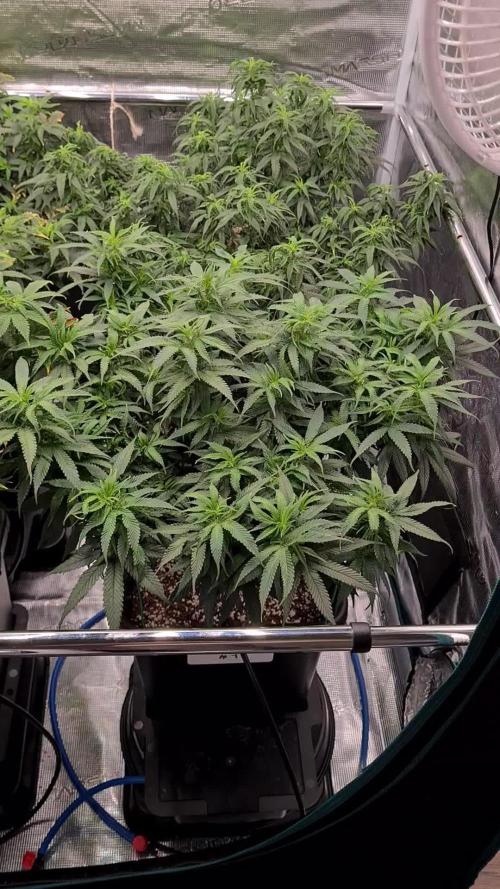
Week 14 (16-9 to 22-9)
16-9
Temps: 19.2 to 23.2 degrees
Humidity: 55% to 66%
Watering #1: 700 ml.
Light set to 12/12.
Finally! It looks like the plants are recovered so i decided to flip to flower.
Dry Weight #1: 3.5 kg. #2: 4.0 kg.
17-9
Temps: 20.4 to 23.6 degrees
Humidity: 59% to 67%
Watering: Both 500 ml.
Dry Weight #1: 3.8 kg. #2: 3.9 kg.
18-9
Temps: 17.9 to 24.1 degrees
Humidity: 61% to 74%
19-9
Temps: 21.2 to 24 degrees
Humidity: 64% to 73%
Watering: Both 500 ml.
Dry Weight #1: 3.5 kg. #2: 3.7 kg.
20-9
Temps: 19.1 to 23.5 degrees
Humidity: 60% to 70%
Watering: Both 500 ml.
Dry Weight #1: 3.6 kg. #2: 3.9 kg.
21-9
Temps: 18.7 to 24.5 degrees
Humidity: 59% to 70%
Watering: Both 500 ml.
Dry Weight #1: 3.6 kg. #2: 4.0 kg.
22-9
Temps: 19.5 to 24.5 degrees
Humidity: 59% to 71%
Watering: Both 500 ml.
Likes
9
Share


@HashCakes
Follow
Another great week of growth. Started training down the main. Probably let her grow natural this coming week to see what I'm working with before doing more. Same regime but Watered twice this week.
****I will post this with every update. This was planted with 40 grams of real growers Grow Dots in 4 gallons of RG coco and 1 gallon of BAS 3.0 for an all in one amendment. ****

Likes
2
Share

@NAG420
Follow
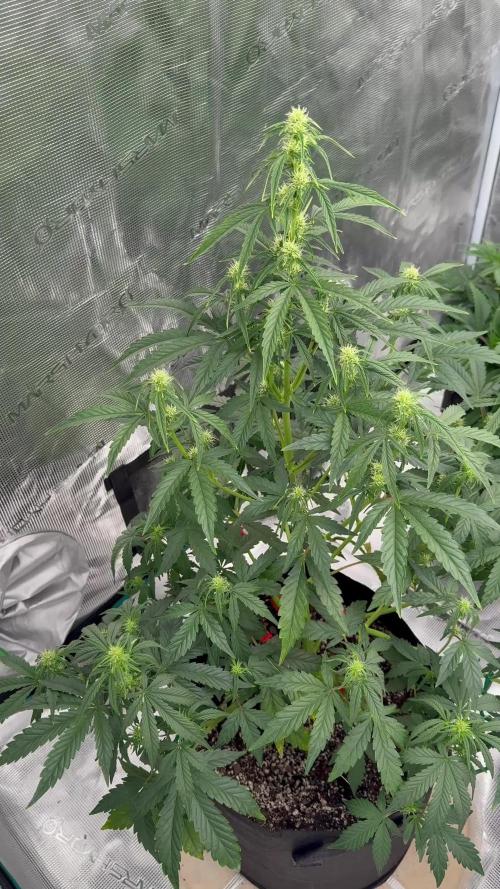
Week 6 of this wonderful Bear Candy Auto phocasseeds is the maker love the smell already skunk smell on her while defoliating today did sown new tie downs before it’s to late I like my main head to be tied down more but was late on pulling her so just let it be this run. Temps been great will have to get a tent ac for the spring and summer for sure but for now it’s good temps.
Likes
6
Share
@Chrisandweed
Follow
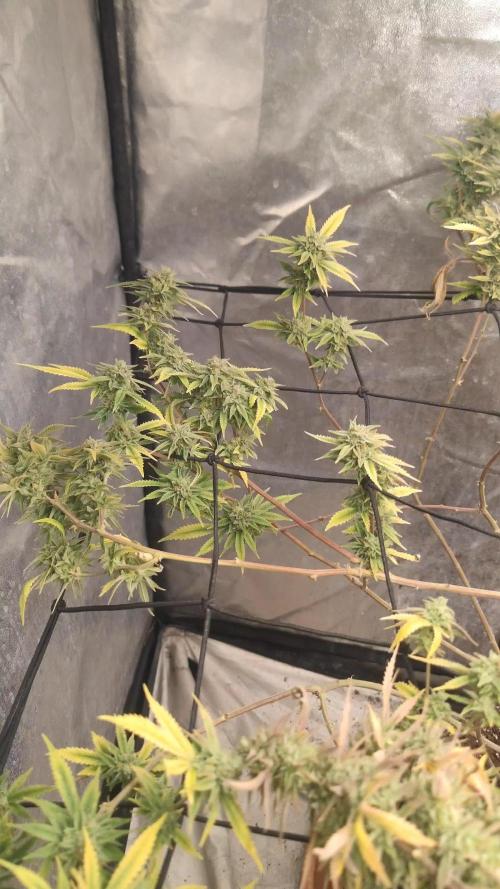
Novena semana de floración de 11 que van a llevar casi casi seguro todas.
Fuah, todas parece que tienen una gelatina de tricomas por encima, espero que salgan riquisimas!
Likes
13
Share


@XanHalen
Follow
Mar 24:
Watering till runoff now...
runoff ppm was 2500+...
Will be using very mild nutes to flush over 1 - 3 feeds... or until I am near my input.
Mar 26:
Continuing to use 650ppm feed with bloom focus, 2L per plant gives 15% runoff...
Runoff ppm is still very high...
I wanted to check pH of runoff but the color is so vibrant i cant use the pH drops to view color, need to get a pH probe.
Plants are thriving, no issues at all. the extra fan fixed the post-water droop.
One plant is bushy and has the most bud sites,
One is the smallest but has the most uniform structure, this one has the biggest buds and thickest stalk,
One is about in the middle of the 2.
Mar 29:
one of these girls gets droopy early when its time for water, thought the canopy was too high so i tied down some more, no cigar...
gonna try increasing calmag, if that doesent work im going to reposition in the grow box to a side instead of middle, may not need the upper end ppfd...

Processing
Likes
13
Share


@RussianGrower
Follow
Всем тем, кто следит за мной здоровья и удачи, надеюсь вы в безопасности. Наступило время вновь обновить «HiFi 4G» от «Dutch Passion» в далёких генах которого есть Fire OG. Уже четвёртая неделя от прорастания семечек. Прогресс на лицо. Я планирую выращивать клонов с нижних веток, именно поэтому я сделал дефолиацию на ранней стадии и не стал формировать крону, так как нижние ветки растения будут клонированы. Дефолиация полезна не только тем, что открывает свет боковым веткам, но также огромные листьев не забирают важные гормоны роста. В этот раз не стал добавлять какие-либо удобрения, а пролил обычной водой с пониженным PH. Так же я подключил дополнительное освещенье полный спектр LED по 27W. Теперь я оставлю растение в покое и буду ждать, когда отрастут ветки на клонирование.
-----------------------------------------------------------------------------------------------------------------------------------------------------------------------------------
To all those who follow me health and good luck, I hope you are safe. It's time to re-update "HiFi 4G" from "Dutch Passion" in the distant genes of which there is Fire OG. It is already the fourth week from the germination of seeds. Progress on the face. I plan to grow clones from the lower branches, which is why I did defoliation at an early stage and did not form a crown, since the lower branches of the plant will be cloned. Defoliation is useful not only because it opens the light to the side branches, but also because the leaves do not take away important growth hormones. This time I did not add any fertilizers, but spilled it with ordinary water with a low PH. I also connected additional lighting with a full range of 27W LED. Now I will leave the plant alone and wait for the branches to grow for cloning.
Likes
2
Share


@NEPA-Cultivations
Follow
this was a homemade grow tent grow..i now have x2 Vivoson tents 3x3 and a 4x4