


Likes
Comments
Share

@RockoCalenberg
Follow
🌿 Blütetag 45 | Tag 105 gesamt
Klima – Frühling?
Draußen bleibt es wechselhaft: feuchte Phasen, kühlere Tage, dann wieder mildere Abschnitte. Ein klarer Rhythmus will sich noch nicht einstellen.
Im Zelt selbst lief es deutlich kontrollierter als zuletzt.
Die VPD-Werte lagen häufiger im Zielbereich, die Kurven wirkten ruhiger und berechenbarer.
Solche Umschwünge zeigen sich dennoch im Detail. Stoffwechsel und Wasserhaushalt reagieren sensibel auf Veränderungen – besonders im Blattbild wird sichtbar, wie fein die Pflanzen abgestimmt arbeiten.
Sie stabilisieren sich wieder, aber jede Schwankung hinterlässt ihre Handschrift.
🌿 Pflanzenstatus
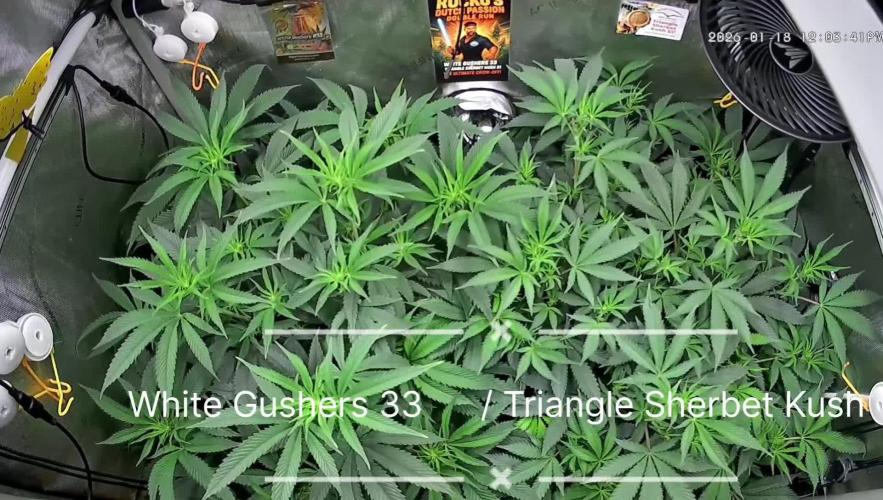
White Gushers 33
Sie bleibt die sensiblere Kandidatin.
An exponierten Trieben zeigen sich kleine Nekrosen und leichte Transportanzeichen. Die Flecken haben leicht zugenommen – es wirkt, als würde sie einzelne Blätter gezielt aufgeben und Energie in die Blüten verlagern.
Diese Woche wurde punktuell entlaubt.
Nur dort, wo Blätter übereinander lagen oder sich gegenseitig Licht nahmen. Ein bis zwei zusätzliche Blätter sind gefallen – bewusst moderat.
Das Stacking läuft weiterhin sehr stark. Die Buds bauen sichtbar auf und werden kompakter.
Beim Trichom-Check in der Nahaufnahme war ich ehrlich überrascht:
Es sind bereits deutlich mehr trübe als klare Köpfe zu sehen.
Für Blütetag 45 ist das weiter, als ich erwartet hätte.
Ob die stabilere VPD-Phase die Reife beschleunigt hat – oder ob die vorherigen Schwankungen einen Impuls gesetzt haben – bleibt offen. Beobachtung läuft.
Triangle Sherbet Kush
Weiterhin die ruhigere Erscheinung im Zelt.
Sie reagiert gelassener auf Schwankungen und zeigt weniger ausgeprägte Blattspuren.
Auch hier wurde punktuell ausgelichtet – minimal gezielter als bei der White Gushers, aber weiterhin sehr zurückhaltend.
Das Stacking läuft sauber und konstant.
Optisch wirkt sie noch etwas weißer in den Pistillen, aber auch hier zeigt der Trichom-Check eine weiter fortgeschrittene Entwicklung als erwartet.
Sehr stabiler Eindruck – mit der Tendenz, früher reif zu sein als der Kalender vermuten lässt.
🌸 Blüten & Duftbild
Die Buds verdichten sich weiter, die Harzschicht wird deutlich kräftiger.
Aromatisch zeigt sich jetzt ein klares Profil:
Mehr Frucht als Gas.
Die fruchtigen Noten stehen im Vordergrund – süßlich, reif und präsent.
Darunter liegt eine würzige Basisnote, die dem Ganzen Tiefe verleiht, ohne dominant zu wirken.
Beim Öffnen des Zeltes kommt zuerst Frucht.
Die Würze trägt im Hintergrund.
Die White Gushers 33 wirkt heller und klar fruchtbetont.
Die Triangle Sherbet Kush bringt etwas mehr Tiefe mit, bleibt aber ebenfalls im fruchtigen Spektrum.
Kein Diesel-Brett – sondern Profil.
💧 Nährstoffe
Konstant gefahren:
CalMag: 1,5 ml/L
Bloom: 1 ml/L
Keine Anpassungen.
Keine Experimente.
Stabilität vor Aktionismus.
🐞 IPM / Biologischer Pflanzenschutz
Im Einsatz:
Florfliegenlarven
Raubmilben
Gelbtafeln
Nematoden (erneut gegossen)
Die Nematoden wurden diese Woche wieder eingebracht – das Intervall war fällig.
Durch die insgesamt guten Bedingungen haben die Trips wieder etwas zugelegt. Kein akuter Befallsdruck, aber sie sind präsent und sichtbar aktiver.
Es bleibt ein begleitender Prozess. Aufmerksamkeit ja – Überreaktion nein.
🔎 Ausblick
Die kommenden Tage verlangen vor allem Beobachtung.
Wenn sich die Trichomentwicklung in diesem Tempo fortsetzt, könnte der geplante Erntezeitpunkt nach vorne rücken.
Klima stabil halten.
Nicht unnötig eingreifen.
Sauber Richtung Reife führen.
.
🔎 Wochenfazit – Ruhe bewahren
Blüte ist kein Sprint, sondern Timing.
Wer jetzt hektisch eingreift, nimmt mehr als er gibt.
Also bleibt das System ruhig.
Die Pflanzen arbeiten – ich lasse sie.
Umschwung draußen.
Fortschritt drinnen.
— Rocko 🌿🔥💚
🌿 Flower Day 45 | Day 105 overall
Climate – Spring?
Outside conditions remain inconsistent: humid phases, cooler days, then milder stretches again. A stable rhythm still hasn’t really settled in.
Inside the tent, however, things felt noticeably more controlled than before.
VPD values stayed within the target range more often, and the curves looked calmer and more predictable.
Even so, these shifts leave subtle marks. Metabolism and water balance react sensitively to environmental changes — especially visible in the foliage.
They stabilize again, but every fluctuation leaves its small signature.
🌿 Plant Status
White Gushers 33
She remains the more sensitive one.
Small necrotic spots and slight transport signs are visible on exposed branches. The spotting has increased slightly — it feels like she’s deliberately letting go of certain leaves to redirect energy into flower production.
Selective defoliation was performed this week.
Only where leaves overlapped or blocked light. One or two additional leaves were removed — intentionally and moderately.
Stacking continues beautifully. Buds are building strongly and tightening up.
During a close trichome inspection, I was honestly surprised:
There are already significantly more cloudy heads than clear ones.
For Flower Day 45, that’s further along than I expected.
Whether the more stable VPD phase accelerated maturation — or whether previous VPD fluctuations triggered a stress response that pushed development — remains an open question. Observation continues.
Triangle Sherbet Kush
Still the calmer presence in the tent.
She handles fluctuations more steadily and shows fewer visible leaf reactions.
Selective defoliation was done here as well — slightly more targeted than on White Gushers, but still restrained.
Stacking is clean and consistent.
Visually she still shows more white pistils, yet trichome development also appears more advanced than the calendar would suggest.
Very stable overall impression — with signs that maturity may arrive earlier than planned.
🌸 Flowers & Aromatic Profile
Bud density continues to increase, and the resin layer is becoming noticeably thicker.
Aromatically, the profile is now clearly defined:
More fruit than gas.
Fruity notes dominate — sweet, ripe, and clearly present.
Beneath that sits a subtle spicy base note, adding depth without overpowering the profile.
When opening the tent, fruit hits first.
The spice carries underneath.
White Gushers 33 leans brighter and more fruit-forward.
Triangle Sherbet Kush brings slightly more depth, but remains clearly within the fruity spectrum.
No diesel punch — just defined character.
💧 Nutrients
Kept consistent:
CalMag: 1.5 ml/L
Bloom: 1 ml/L
No adjustments.
No experimentation.
Stability over intervention.
🐞 IPM / Biological Plant Protection
Currently in place:
Lacewing larvae
Predatory mites
Yellow sticky traps
Nematodes (reapplied this week)
Nematodes were reintroduced this week — the interval was due.
Due to the generally favorable conditions, thrips activity has increased slightly again. No acute pressure, but clearly present.
Managed, not ignored.
🔎 Outlook
The coming days are about close observation.
If trichome development continues at this pace, harvest timing may need to be adjusted earlier than originally planned.
Keep the climate stable.
Avoid unnecessary intervention.
Guide the flowers cleanly into maturity.
🔎 Weekly Conclusion – Stay Calm
Flowering isn’t a sprint — it’s timing.
Overreact now, and you take more than you give.
So the system stays calm.
The plants are working — I let them.
Shift outside.
Progress inside.
— Rocko 🌿🔥💚

Likes
37
Share


@iGrowCulture
Follow
Conditions have remained stable...realized I forgot to drop the light after cleaning, so dropped her back down to 28.5”. She has reacted well to every slight adjustment made...


Likes
43
Share


@TheBulldozerSicily
Follow
27/02/2024
Lavaggio radici e vasca impianto
Dopo accurato lavaggio Cambiamo soluzione nutritiva, Partiamo dai soliti
75 lt demineralizzata ph 8.2 ec 487
Aggiungiamo i nutrienti per 80 lt
160 grow 160 micro 120 bloom
80 sensizym 80 rhino skin 80 bud candy 80 bud factor x 80 big bud
Ottenendo
ph 6.5
ec 2028
Domenica 3/03/2024
Inizio controllo 2472 ph 5.1
Aggiungo 25 lt acqua osmosi Ottenendo ec 1687 ph 5.9
Aggiungo solo 60 ml bloom
Ottenendo
ec 1887
ph 5.9
Likes
33
Share


@SkunkyDog420
Follow
Hallo zusammen 🤙.
Habe sie heute gehackt .
Lassse sie jetzt 3 Wochen trocknen und komme dann mit dem Erntebericht in 3 Wochen wieder 🤙.
Bis in 3 Wochen.


Likes
28
Share


@Trickybis82
Follow
Hello again,
Thank for popping by and checking in.
OK so for this run I am not doing any training on them and only picking minimum leaves that I cannot just hide under new growth.
Plants are looking very healthy we have wedding cheese cake and also grape gushers under a viparspectra xs2000 rather then the 600w hps system I used on the last run. So everything is trial an error until I find the perfect set-up and strain for my environment and me.. peace and love to everyone doing the same!. Much love people for stopping in and sending your likes👍 💯✌️👊😁💪


Likes
7
Share


@R_Dub
Follow
11/13 Started Super Cropping on Amy, Gina, and Rosa, Judy is just at her 4th node, so i reached the second node and twisted the stalk until I could feel the fiber break and then I bent the stalk in the direction that I will ultimately tie down in, not long enough yet to get to the edge of the pot. In an hour I checked on the girls and they were all back to normal.
11/14 Watered 500 mil 6.5 PH tied down Amy, Gina and Rosa, broke a leaf off of Amy while bending
11/15 Spritz with Yucca foliar spray reapplied LST girls are looking great really healthy and green
11/16 Reapplied LST and accidentally broke the main stem on Gina, decided to go ahead and top her since the break was at a node and impossible to tape, so I guess we are also testing topping as well as going Organic. Adjusted lights to 25 inches above Judy the shortest girl. Brewed up an Organic Tea using 1 Cup Nature's Living Soil Concentrate, 1 Cup EB Stone Earth Worm Casings, 1 Tablespoon Unsulphered Molasses, 1 Tablespoon Fish Meal with Kelp, let the tea brew for 18 hours.
11/17 Fed each girl 1 Liter of Compost Tea reapplied LST the thought is the plants are three weeks in the soil and are growing at a healthy pace (with the exception of Judy), I want to make sure they have enough food in the soil available to them now to take them to flower. Next week I will apply dry amendments and 2-8-8 fertilizer to be available that first week of flower.
11/18 Out of town so gave them a light spritz of Yucca before lights on and that's it.
11/19 Man one day without reapplying LST and it freaking shows!! I had to go to town and really work the stems back into shape, really started to figure out what I am actually trying to achieve with spreading the stems out to expose as many sites as possible and trying to get as even a canopy as possible. So at the end of it I had to Super Crop a few stems on Rosa that had grown a little too long, tied down the rest of her stems and tucked the large leaves as best as I could to get as many sites as possible exposed. Applied the same approach to Gina but since she was inadvertently topped little easier to do, also I can see since I fed them the Compost Tea Gina has bounced back from her chop and her leaves are upright and pointing to the light, the two new "main stems" are growing outward and are close to the Mesa that i am creating. Judy is the weird little runt with tight, tight nodes like she's hiding something.....Trudy Judy.....So I just bent her main down and moved the stems as best as I can, I would love to let her just do her thing but I also wanted to try ScrOG on this run but we'll see after next week. Amy, Amy, Amy my pouty princess I don't think she likes being shorter than Rosa because she's become almost shy, not as aggressive growth that she was showing before. Reapplied LST on her main and tucked leaves, also started defoliating some of the lower leaves off of her. I'm going to start plucking lower leaves off of all of the plants going forward to prepare them for the switch to flower. The girls are all showing their sex and I can safely say that they are all Ladies, I'm seeing pistils forming and sites starting to show. I soaked the ladies down with 1/4 tsp Nectar of the Gods Bloom Khaos and 16 oz PH 6.2 bottle. Checked back on them 3 hours later and all of their faces are pointing to the lights, the leaves look amazingly green with no noticeable deficiencies. The Ladybugs are going to town and I don't know what I'm more excited about the amazing growth of the girls or seeing a ladybug crawling on a leaf!


Likes
36
Share


@gottagrowsometime
Follow
Welcome to my 1st fem soil grow: Drop a like so I can visit your grows if you'd like, regardless thank you for your interest .
1st soil photo in the ground. Will be a few days before she shows leafs as I only waited till she showed about 2mm of tap root and she got planted 3/4 of AN inch down and soil lightly folded over and sprayed her with 100ml of mix with 1.5ml/L x3 400ppm. La Sirena is the only nutrient here that changes the EC. 1 5ML adds around 300+ppm to 78ppm water so. I decided to give this girl .5 more as she's going to be in the ground longer and has a long veg life. I'll be running her on TERRA POWERS full 19 line up. For this 1 I'll be following there chart as a guideline for nutrients and when to apply. As for the dose, that will be down to me. But if it's 2ml/L or whatever it is. It'll be getting that in 1L mix a week, (meaning she'll be fed exactly the ml/L as her total feed of that nutrient for the week. So this plant as she'll only be getting fed by ML not by many ml/L mix.) So when she's young her ml/L dose will be low as she'll have to take in a L of her or a high 2ml/500ml she'll be fed on a nutrient ML basis only.
2/5/22 VD1 Popped her head up. Can't wait for this 1, I've also got her in DWC Which is about 12hrs ahead. Have started on a light diet. 555ppm
4/5/22 I decided to go against the chart and give La Calavera for the root stim, I know we are a few days in but I'll wait until 2.5 weeks and stop the La Calavera.
6/5/22 So, it's begun. I've created a negative pressure environment, 1st time, let's see if it makes an impact. On wk 3 onwards I'll be running the intake extraction for 5mins every 30mins and I'll have 2 co2 bags up. If the RH becomes a problem or temp I'll put the extraction/intake back on 100% of the time. The extraction fan/intake is set at a ratio of 2 to 1. (100% extraction 50% intake) making a negative pressure environment, best way to show you have done this, the walls in your tent should bow in lightly
Same Day. Okay, so this my last update. Going to run fans the same right up until flower and then I'll be sealing up my tent and adding 2 co2 bags. And will be adding a dehuimifier and setting at 45% And it checks every 30mins and if it's gone up it'll turn back on and bring down to 45 or set RH, so no co2 will escape. The temp will be bordering 30-33c and then when they go into their rest window they'll be transferred to to a negative pressure environment with low temps and 45-50%RH. I'll only be able to do this for the 3 weeks of pre flower. And maybe some more, it depends how hard the dehuimifier will be working, but i want dense buds and only way to improve that is by introducing Co2 and then a negative pressure cold environment for terps. Then I'll be putting them back into full negative pressure environment and the Co2 will be useless, again all depends how it's gonna affect my bottom line. That and I only have 2 intake fans. I'll be going into detail about my Co2 adventures the week before I'll be prepping them to be able to withstand high temps, so I'll gradually bring up the temps the last wk of veg 28c max and that way when I push it to 30-32c in pre flower she won't stress as much.
Thanks for reading this week, no more updates, just pics for remaining week.
gottagrowsometime

Likes
41
Share


@UnorthadoxDude
Follow
Week 2 begins. Everything seems normal so far.
Day 11: Have produced higher quality images and a video.
Day 13: Growth accelerating.
Weekly Summary: Enigma is right where she should be, as yet showing no significant dwarfism.
Likes
4
Share


@WeedbayGarden
Follow
31.3 F50
2L of water for each plant. Last two weeks of flowering starting, happy happy :)
3.4 F53
1L of water for each plant, seems like the plants are starting to drink less and less. Which is totally okay by me, no need for water every 2 days. Other than that I lowered lights like 5cm since there isn't that much flowering time left, might as well "blast" em with the whole 70 watts lol.
5.4 F55
Lots of small creepy crawlers in the pots. Took a video of predator mite strolling around the fabric pot!


Likes
38
Share


@Snakeking
Follow
Because of my area and situation i have height problem . Lets give scrog technique a chance
Likes
50
Share


@Mr_Motalovah
Follow
Hello Growers and Tokers! 👋 👩🌾 🧑🌾.🔥💨
As soon as I walk into my grow room I can smell them and when I open the tent it's a slap in the face.
Though it's a lovely slap it isn't gentle, it's a 'where've you been?' slap. A 'welcome to Caramel city' slap. 😂😂
Jokes aside. This strain's aroma has me "Enamorado".
Pictures taken day 42 of flower.
The Green Sensation seems to be doing it's job.
Buds are really starting to fatten up fast and are looking very very luscious.
I should have started using it in week 4 so I'm a week late on that. *Made a little reminder for the next run.*
I can't seem to get a good shot of the buds but i'm working on it. Let's see if for next week I can get a good close up.
In flower I water with nutrients in every feed and every 10 days or so I water with only water and Enzymes to help break down the old roots, gives life to the microorganisms, helps out the new roots and helps to prevent root rot. It's great if your using mineral nutrients as there's times where those minerals stay stuck to the roots and can cause root burn.
I use alga based nutrients so I don't have a problem with that but I like to use it, I've noticed a great difference im flower before and after using.
We're getting closer and closer to harvest. 😬
"Sooo exciiited" (In Kevin Hart voice)
If you like the content check out the other strains sharing the tent. 😃
I'll catch y'all next week.
Take care out there!
One love Growers & tokers!
Likes
5
Share


@Mr_nugs_lover_David
Follow
Very terpy smell, strong and very citric like a pure lemon, very lemony smell basically, nothing crazy but it's very nice, she's producing a lot of resin, you can see she's a good autoflower, not the bets I've grown but it's nice to have something to Harvey's fast. 100% organic grown
Likes
10
Share


@Miketama
Follow
Fractal #2 - Final Review 🌿⭐
What an incredible journey with Fractal #2 from Divine Seeds! This girl went on quite the adventure - indoor start, outdoor middle, indoor finish!
Harvest Results:
• 100g trimmed large buds (wet weight)
• 60g roughly trimmed - straight to freezer for bubble hash production
• Abundant trim production - loaded with trichomes for hash!
The Good:
• Incredibly adaptable: Handled indoor → outdoor → indoor transitions like a champion
• Indoor finish boost: Buds bulked up significantly during final indoor phase
• Resin production: Excellent trichome coverage on buds AND trim - perfect for hash
• Generous trim yield: Tons of sugar leaves packed with resin
• Resilience: Thrived through multiple environment changes
• Hash potential: Quality material for bubble production
The Challenges:
• Cold outdoor temperatures required bringing back inside
• Multiple environment transitions (but she handled them!)
A huge thank you to Divine Seed for letting me take part in the contest — my very first one! 🙏
It’s been an amazing growing experience, and I wish the best of luck to all the other participants! 🍀💚

Likes
14
Share


@Bigbombbudz
Follow
Another week closer....
These girls have been a pleasure to grow so far they love everything you can give them ...no deficiencies no problems.....earlier in the week a slight tip burn but after 2 days they adjusted and ask for more.....as they are eating up the nutrients I am replacing and upping it each time...pushing these girls and they are showing there love....17 days since I switched the light and they are filling in nicely.
Until next week, smoke a fatty, help out you're fellow grower


Likes
9
Share


@DeepRootsGrowTrees
Follow
TRIPPLE G by ROYAL QUEEN SEEDS
Week # 17 overall
Week #16 Veg
No issues this week she looking good looks like she is about to start to flower!! Stay Growing!!
Royal Queen Seeds TRIPLE G
