Likes
Comments
Share

@fdvzdfgfdg
Follow
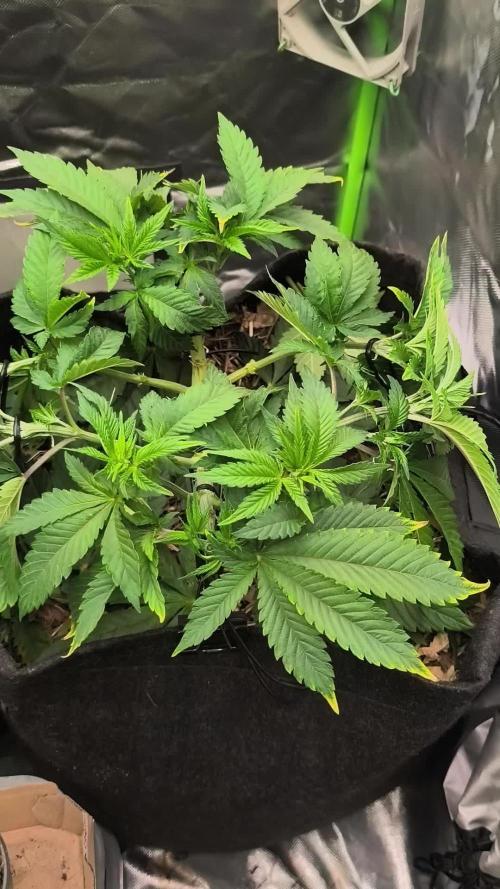
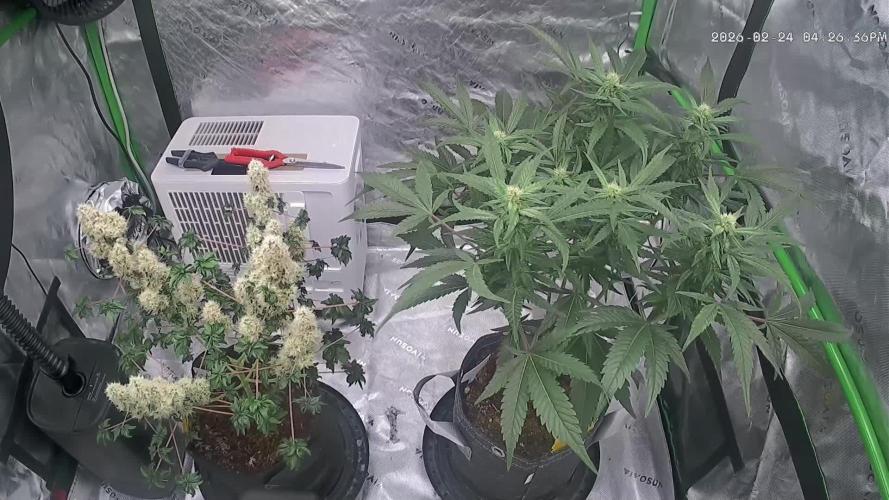
[2026-Feb-27 | Day 63] - She's really developing fast now, and drinking a ton. The estimated 60 day flowering time might just be accurate after all. she seems happy for the most part, and not showing any signs of overfeeding yet.
I've increased lighting to 38 DLI at present, and aside from a small amount of bleaching/burning on a couple of fan leaves, the rest are putting out lots of trichomes to compensate. I will try to increase lighting a little more in the coming week to help maximize energy production and bud development, then start to taper off after that as buds start to ripen.
If she continues to develop this fast, she might just end up getting harvested around the same time as the blueberry bastard nearby.
Likes
10
Share

@Suemchen
Follow
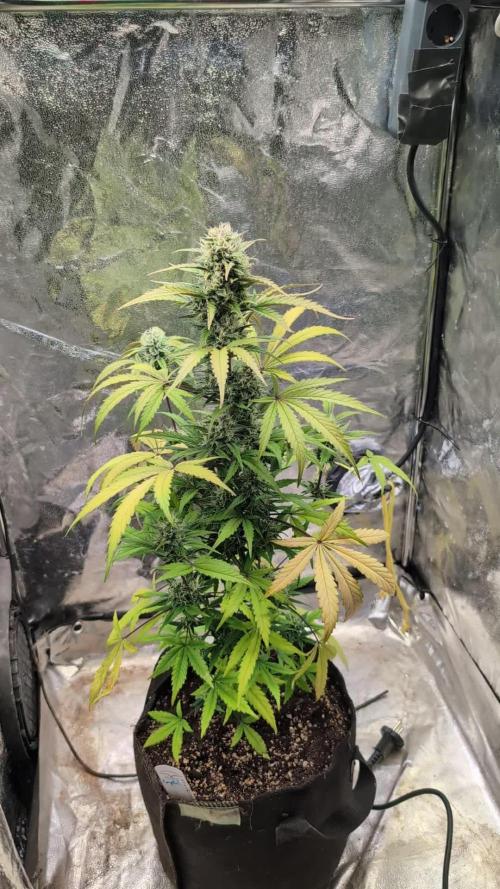
Sanlight EVO 3-60 at 80%
Day 50: watering still with rain water and 3 ml/l AlgaBloom, 1 ml/l CalMag, 2 ml/l Hesi Boost and 1 ml/l Green Sensation 👌🏻 pH at 6.4 👍🏻
Day 55: Night Temperatur dropped to around 17 degrees Celsius because the heating was Not on.... Leaves turned purple.... watering still with rain water and 3 ml/l AlgaBloom, 1 ml/l CalMag, 2 ml/l Hesi Boost and 1 ml/l Green Sensation 👌🏻 pH at 6.4 👍🏻

Likes
38
Share


@Aedaone
Follow
We had a good bit of strong wind and rain at he beginning of this week. One of the plants was blown sideways. This week has been hotter but he plants seem to be loving it. I was a little surprised that I had to start feeding these. I'm thinking the nutes were leached out by rain. I found out my ph wasn't as much of an issue as I first suspected. The problem was lack of iron. I added an organic iron supplement and it cleared up the yellowing. It also ph'd my nutrient solution to 6. The tops I took and attempted to clone didn't clone. It was a fun experiment though. Overall a great week. I expect to see some pistils next week.

Likes
2
Share


@BigHorn
Follow
First week of Budding went well. Growth was about 4-6in. Hairs appeared in some areas. Trimming some of the big Fan Leaves today to make room for more light toward the bottom of the stock. I wasn't anticipating the plant to get this large I'm running out of room probably should have started budding a week earlier. But we will see how this turns out... Since I saw hairs signaling flowering, I did Start with its first watering with Tiger Bloom.
Likes
19
Share


@Krisis
Follow
01/27/25. Welcome to the start of week 4.
Well, fatso is doing great now. She’s perky and happy.. AND she’s darkened up quite a bit. No more pale girl. She was just a hungry little hippo 😸😸
She was just watered yesterday, slowly, until a bit of run off. I’ve upped her food to 2.5 across 3 parts, as well as upped calmag (1) and silica (2).
I pulled a dip shit move and left my measuring tape in the flower tent and it’s lights off, so I’ll have to come back tomorrow to update that.
She’s at 4 nodes and as soon as she’s got 5 I’ll be topping her.
Update: 1/29/25 got measurement updated and watered with food.
1/31/25- topped and plain watered and added picture/video
Thanks for lookin. ✌️

Likes
22
Share

@Bncgrower
Follow
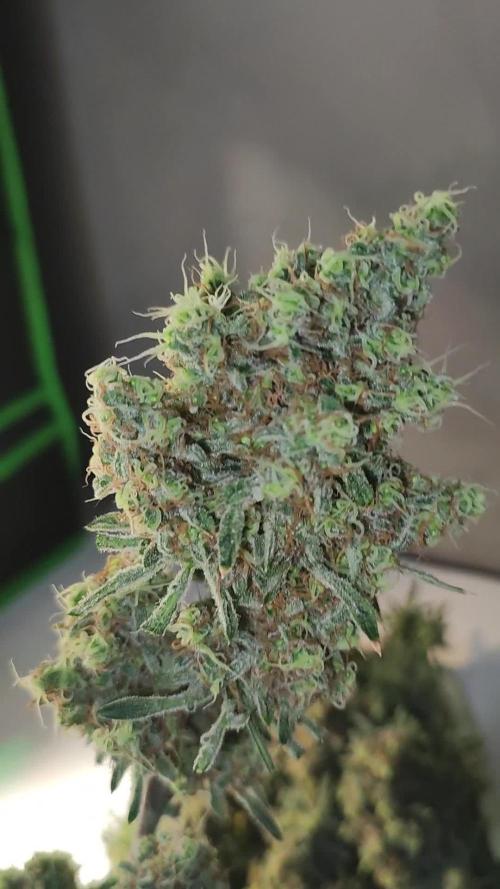
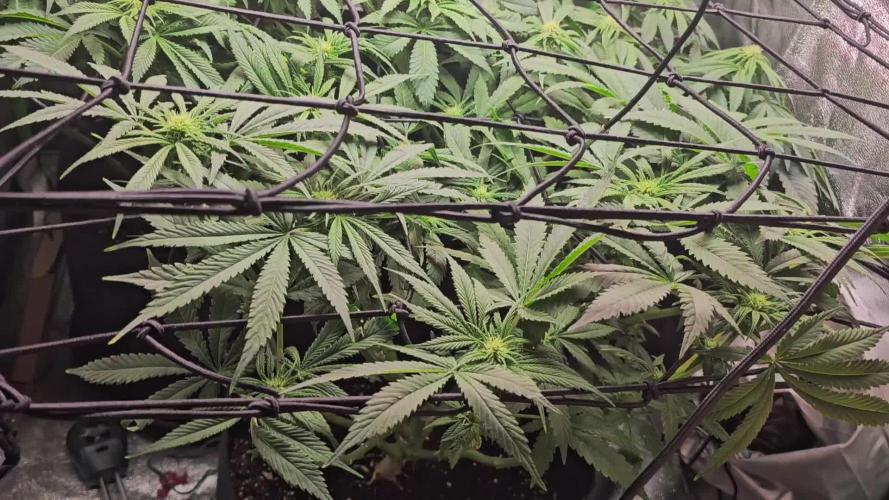
It was an good experience.. the flowers and leaves are very sticky, and the smell is really good — let's see when it's ready. ✂️🌿


Likes
24
Share


@Easygrower
Follow
Hello growers day 58 in the garden I gave her a bit of a leaf defo today still not purple some leafs have purple tips but that’s about it she has got some nice looking buds forming so we will see happy growing
Likes
293
Share


@Ju_Bps
Follow
Hello growmies 👩🌾👨🌾🌲🌲,
👋 The babies growing well, and healthy,
Shame on me, didn't have time to transplant this week, I was so busy.. 🤦♂️🤦♂️
Roots are out of plug, except it, all is good 👍
We'll start grow nutes next week and put in pot 😊
💧 Give water 2x per day, keep soil wet with vaporisator.
Water + Rhizo
PH @6
💡Mars Hydro - FC 3000
50% Not yet under
Mars Hydro Fan kit
Setting 8
Have a good week and see you next week 👋
Thanks community for follow, likes, comments, always a pleasure 👩🌾👨🌾❤️🌲
Mars Hydro - Smart FC3000 300W Samsung LM301B LED Grow Light💡💡
https://www.mars-hydro.com/fc-3000-samsung-lm301b-led-grow-light
Mars Hydro - 6 Inch Inline Fan And Carbon Filter Combo With Thermostat Controller 💨💨
https://www.mars-hydro.com/6-inch-inline-duct-fan-and-carbon-filter-combo-with-thermostat-controller
Fast Buds - Gorilla Cookies FF🌲🌲
https://2fast4buds.com/us/seeds/gorilla-cookies-fast-flowering
Likes
44
Share


@SooSan
Follow
12/12 + 61 jours
Vu qu’il y a 16 plantes mais que sur growdiaries on ne peut mettre que 8 variétés j'ai divisé en 2 diaries pour le bas de la tente
1️⃣
🏠 90x60x90
☀️ FC-E 4800 => puissance a 75%
🍁
1x Black Bomb / Philosopher Seed
2x Amnesia Lemon / PEV Seeds
1x Blueberry / PEV Seeds
1x Blueberry / 00 Seeds
1x Wappa / Paradise Seed
1x Dark Phoenix / Green House Seed
1x Quick Sherbet / Exotic Seeds
1x Mango Cream / Exotic Seeds
1x Banana Frosting / Sensi Seed
1x Hindu Kush / Sensi Seed
3x Fast Mix / Sweet Seed
📎 https://growdiaries.com/diaries/122084-grow-journal-by-soosan
📎https://growdiaries.com/diaries/124052-grow-journal-by-soosan
2️⃣
🏠 30x60x50
☀️TS1000 => puissance a 80%
🍁 4x Quick Sherbet - Exotic Seed
📎 https://growdiaries.com/diaries/122080-grow-journal-by-soosan


Likes
13
Share


@HeavyHead
Follow
Great week :) getting heavier by the day ;p put them onto flushing with straight ph’d water from here out.
Keeping the pots on the dryer side from here out. Lowered the temp of my room and my water as well.
Processing
Likes
10
Share


@DudeGrowsWeed
Follow
Adding Mephisto Sour Hound to my tent of autos. Really excited about growing some Mephisto Genetics, been hearing amazing things about Mehphisto (I also have a Alien vs Triangle going in a separate diary). This is a free seed I received with my order from Seedsman last fall (BTW Seedsman ROCKS!). This first seed failed to pop so I planted a second and that one popped in 4 days!.
My Perpetual Harvest strategy…. Originally my plan was to start 2 seeds each month, but had some seeds from one breeder that did not germinate early in my rotation. Ultimately, this caused single seeds to pop and messed up my 2 at a time plans. But, that seemed to work out OK, because now I think starting one seed every 3 weeks is a better strategy. This should provide me with 4-5 plants at a time, instead of 6. However… Since I need to shut down over the summer because my tent is currently in the attic, I’m starting 2-3 seeds at at time for the last couple of rounds.
Plants get fed once weekly on weekends. Seedlings get water only. Plants in vegetation get water and Recharge. Flowering plants get water, Recharge or Big Bloom (Fox Farm). Feeding is done using 2 gallon watering can. Any additional waterings during the week are given on an as needed basis per plant. I lift the plants to help determine which plants are more dry (lighter) and provide water any plants via water bottles and watering spikes.
I give each pot a quarter turn every day in an effort to make sure the plants get equal lighting from all sides. I rotate the plant in place by turning the pot 90 degrees (I am not rearranging the layout of the plants in the tent on a daily basis).
The soil is an ‘organic super soil’ I mixed myself using organic top soil, organic potting soil, organic compost, organic peat moss, organic perlite, organic vermiculite, lime, epsom salt, expanded clay pellets and Jobe’s organic fast start. I am also recycling my soil and water with Recharge when using recycled soil.
For plant training I have tried a variety of things, but my plans now are to do LST bending only, no HST anymore. I may decide to go back to HST again in the future, but I’m curious to compare LST training only to see how that goes. Around week 3 I'll do a FIM pinch once there are 4-5 nodes established. And some defoliation around the 3rd week of flowering. I have been doing HST bending and having good results, but think the HST may be causing the plants to take longer to harvest. I hope FIM/defoliation only will help increase harvests while getting me to harvest sooner.
Setup:
1- Grow Tent 24”x48”x72”
2- Viparspectra 300W LED’s (1-V300 & 1-R300)
1- Hanging 100w CFL (26w actual)
1- Carbon Filter w/ 190cfm Fan & 4” ducts
1- 6” clip-on fan
1- 700w electric heater - oil filled radiator (in front of air intake behind tent)

Processing
Likes
12
Share


Likes
27
Share


@adam_pawloski87
Follow
Today is Day 50 !! We have started flower an they are just looking amazing! We have switched up the nutrients for flower, instead of 1 tsp bloom and 3 tsp of veg , we just swap 3 tsp of bloom and 1 tsp of veg !! Can’t wait to see what these laddies do this week!!
Likes
15
Share


@Uwish
Follow
Hello guys,
Here I am again to present you a new run, still with the best leds of the market nevertheless as I changed my growing space from 120x120 to 150x150. So I had to update the material inside...
I will run with 3 EVO 5-150 lamps of 320W or 960W with Bluetooth dimmers.
For the Hydro system, it will be the V-SYSTEM from Alienhydroponics.
In fertilizers I am always with Advanced Nutrients.
I work with osmosis water.
Currently, 4 clones took on 4.
Once the roots are ready, I will transfer the cuttings from the propagator to the V-SYSTEM.
------------------------
since the 16/08, when I transplanted the plants in the RDWC system, I noticed some points that I will mention below and correct next time.
1. The cuttings are too small, allow enough time so that I can completely fill my pots with clay balls.
2. Cut out the bottom of the pots from the cuttings.
3. 3/4 of the cuttings are touching the water, so one is late. Next time when transplanting, add more water, up to the basket in order to immerse all the plants and not to create a difference between each one, consequence now I have 3 that are ready to explode and one that will struggle behind, problem corrected today by increasing the volume of water.
4. The b-52 is a real pain in the ass in RDWC, you have to clean the 2 filters almost every day, with this new soup I'm testing without and I think I'll continue like this just with the base sensi grow A and B, as I use Root rot X, I won't use voodoo juice since all the bacteria would be killed.
5. Use of Voodoo Juice is useless if using Root Rot X which will kill the bacteria.
I don't know why but when I transplanted in the RDWC, I put my set up in growth mode, except that the plants were not ready for it, moreover, I made a FIM on each. So I lost some days, these last days I went back to a ppdf of 150, now that my roots touch the water, I declare growth 0 on 22/08, I will do between 21 and 28 days of growth. And as my roots are doing well and touching the water I'll go to a PPFD of 300
++

Likes
290
Share


@Ferenc
Follow
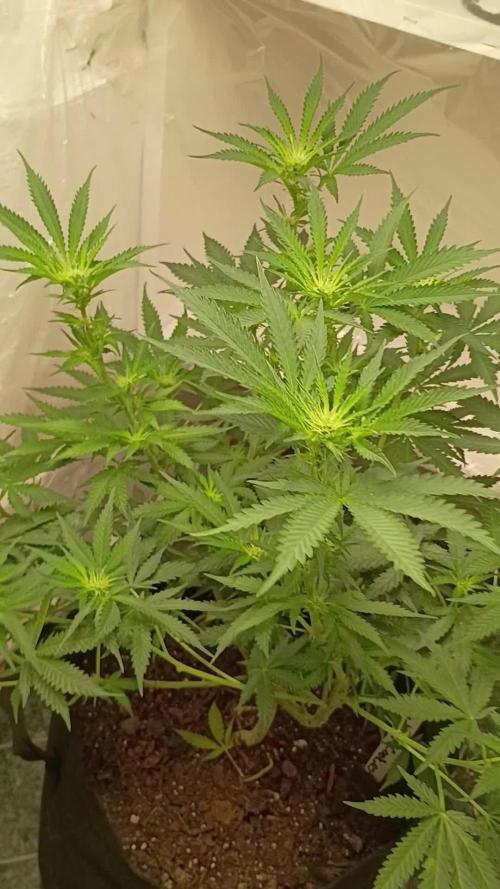
Crazy LST.... I am creating a snake but she loves it. Weather is London shot but all good. She is back after suffering in the tent. :)
I don't know it seems to be liked by the fox some shit is taken there... Why where my plant is.... ? Fox likes marihuana 🤪 You can see in the video....😅 Natural shit nutrition:D


Likes
34
Share


@PapaNugs
Follow
This was the best smelling girl out of the crew. Happy with that. The size of the buds are good considering the plant size and total time of the plant. Will dry for 10-14 days then cure for a month before trying them out.