


Likes
Comments
Share

@JVKdopegrow
Follow
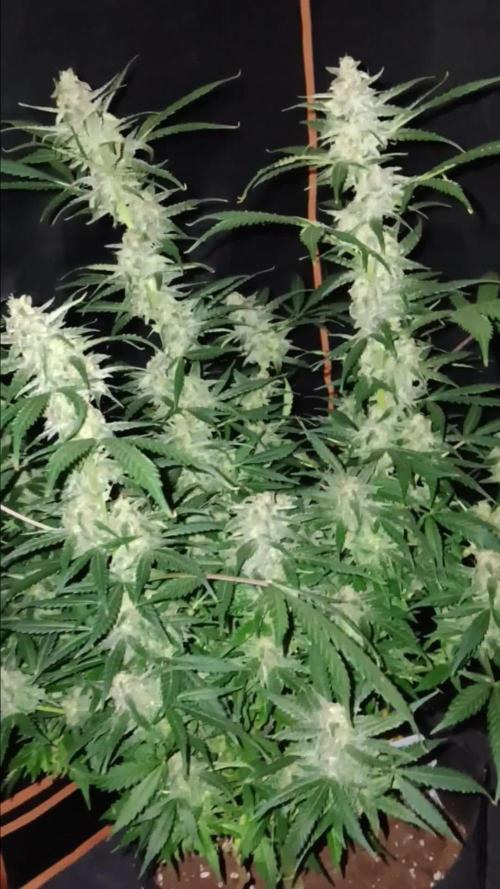
She is in full bloom. Vertical growth stopped and the buds are all getting dense. I had to stake one of the colas as she tipped over from the weight. Hoping they all fill out this next week or two.

Likes
8
Share


@Tricom
Follow
Voila ! Je croix c est bon ils sont arrivé à terme …. Je les mets 48 h dans le noir total … variété facile a cultivé résistante d’une manière générale ( parasite, excès, carence et ph )..avec un bon rendement idéal pour cultivateur novice … très très forte Odeur de skunk a l orange 🍊avec des têtes bien lourd … franchement le hgl rspec 100 w sa envoie du lourd Hezi aussi fait de super produits ..

Likes
2
Share


@Krissci
Follow
Day 3 Light LST as stems are still growing, but nice and green.
Clean pots is always a must

Likes
361
Share


@Ju_Bps
Follow
Hello my friendly growmies 👩🌾👨🌾🌲🌲,
The #1 is my biggest plant ever, 100 cm, it's not a record lol, but for me it's tall 😊😊
The #2 start to turn purple, can't wait to see 💜🍌
Buds start to be formed and are biggest each days 🌲🌲
I'm totally in love with those cute ladies 🌲🌲🌲😁😁💜💜🍌🍌
I've continued to train a bit.
💦I give water each 3 days, 2.75l/plant
Water + RQS Bio Flowering Booster
Water + cannazym + Sugar Royal
@PH6
RQS Bio Flowering Booster - Week 3
THICKER 0.6 ml/l
BIGGER FLOWERS 0.8 ml/l
The RQS liquid kit, look doing the job, not overfert or deficiency sign for the moment.
Lamp @100% and start to be really close to the plant, but not burning sign for the moment.
Thanks community for follow, likes, comments, always a pleasure 👩🌾👨🌾❤️🌲
Mars Hydro - TS1000 💡💡
https://www.mars-hydro.com/ts-1000-led-grow-light
Mars Hydro - FC3000 💡💡
https://www.mars-hydro.com/fc-3000-samsung-lm301b-led-grow-light
RQS - Fat Banana Auto 🍌🍌🌲🌲
https://www.royalqueenseeds.com/autoflowering-cannabis-seeds/487-fat-banana-automatic.html


Likes
1
Share


@Tryhard1988
Follow
Smell Fire really cakey grape smell throwing out pure tricks and she starting to fatten nicely

Likes
16
Share


@EaRtH
Follow
29.12. - Plants are doing well. All of them have developed second pair of leaves. 🌿
30.12. - I could not believe my eyes when I looked into growbox this morning. The Apple Fritter seed that I thought was dead sprouted next to it's replacement 🌱 So I carefully transplanted the Green Gelato into the new pot, now I have 7 plants ❤️
4.1. - Just wow. First week of the veg went really well, plants gained on height, got thicker and developed first true leaves, so I'm starting with nutrients from next week 😎
29.12. - 4.1.2024
Likes
12
Share


@Marijuanaisland
Follow
Desculpe não atualizar antes mais muito trabalho neste fim de ano adoro as cores da Red Hot tive ao total 3 Red Hot mais só fiz o diário de uma três feno tipos diferentes todos reds aromas diferentes em todos doce, pungente, frutas tropicais, owwwwww good Nice, a sweet zkitllez está muito bem também tive outras que não fiz o diário. Obrigado a todos

Likes
2
Share

@Janerussel
Follow
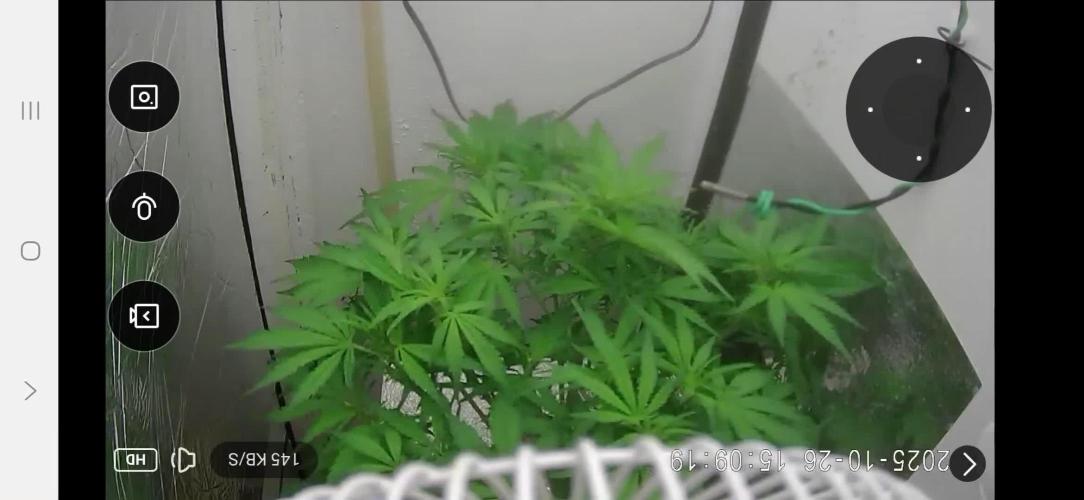
F week 3. It gets really bushy. I had to do a second defoliation. At this point everything seems to go well.
Likes
21
Share


@JohnnyBlaz3
Follow
Shes looking great!!! got some nice flowers started and I bent the main cola back just a little more with a yoyo to give the other branches better light coverage. Got the lady all trimmed up and looking lovely. With some luck and lots of effort it should be smooth sailing for the next month or so as everything is in place in the tent and virtually all trimming done its time to just let the flowers grow!!!
Likes
16
Share


@AestheticGenetics
Follow
4/9/25
This plant is beyond frosty. Stacking up super nicely. Seems like she will yeild quite a bit.
My only gripe is that she has like no smell at all.
Using the foil as a soil cover is working quite nicely. the top soil is getting filled with roots quite well.
Top dressed 1tsp of Bloom
1tsp microbe charge
1tsp bloom

Likes
4
Share

@DogDoctorOfficial
Follow
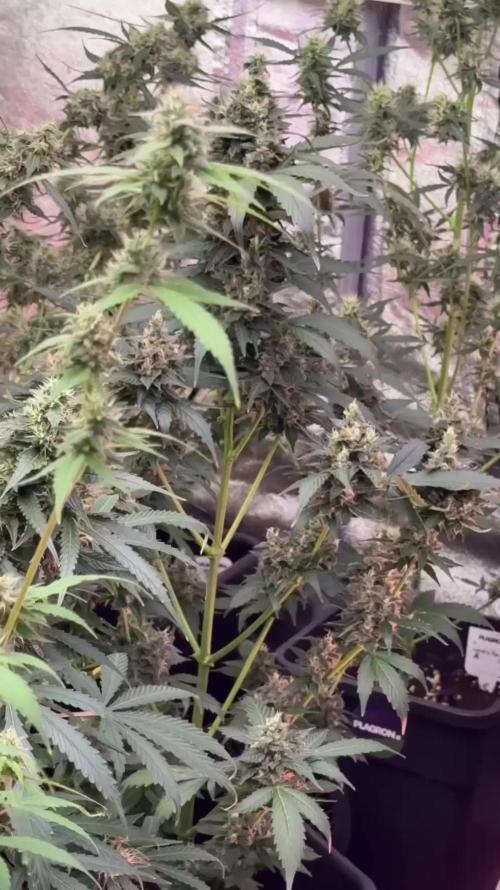
💜 Purple Haze by Zamnesia – Pheno A
Week 10 | This Girl Is on Fire! 🔥💜👑
Welcome back to another chapter of the 8×8 Adventure! 🌱💚
Okay...
I've finally figured out the soundtrack for this girl.
There is only one song playing in my head every single time I look at her.
🎶 “This girl is on fire...” 🎶
Yes.
Alicia Keys. 😂🔥
And I swear...
I can't look at Purple Haze Pheno A anymore without hearing that song in my head.
Because...
THIS GIRL IS ON FIRE. 🔥💜
Look at her.
The colour.
The structure.
The flower formation.
The stacking.
The bud size.
The trichomes.
The density.
Everything seems to be moving forward at once.
And the funny thing?
She's doing it fast.
For a photoperiod running 12/12 from seed, she seems to be moving at a pace that sometimes makes me wonder if somebody secretly turned her into an autoflower when I wasn't looking. 😂
Of course, she's not.
She's a photoperiod.
She's following the same 12/12 schedule as the rest of the room.
But somehow...
when I look at her...
she just seems to be moving.
And moving quickly.
So let's give this girl the spotlight she clearly came here to steal. 💜🔥👑
🔥 This Girl Is on Fire
Last week I called Purple Haze Pheno A one of the most beautifully balanced plants in the room.
This week?
I'm upgrading the description.
She's on fire.
😂🔥
The changes aren't necessarily about one gigantic transformation.
It's the combination of everything happening together.
The buds are stacking.
The flower structures are becoming more substantial.
The developing flowers are getting more definition.
The trichome development is becoming increasingly visible.
The colour remains beautiful.
And the plant overall is starting to look like she's really finding her rhythm.
This is one of those weeks where I walk into the room, look at her...
and immediately stop.
"Whoa."
She's got that effect now.
💜 The Colour Is Still Beautiful
Let's start with something I've loved about this phenotype from the beginning.
That colour.
Those deep greens are absolutely gorgeous.
And as the flowers continue developing, the contrast between the dark foliage and the developing buds becomes even more striking.
There's a richness to this plant.
The leaves look deep and healthy.
The flowers are standing out beautifully against them.
And the whole plant has that incredibly photogenic quality that makes you want to keep taking another photograph.
Then another.
And another.
Because every angle seems to show something different.
The deeper I look...
the more I see.
And right now, I'm seeing a girl that's absolutely thriving in her own little corner of the 8×8 jungle.
🌸 The Buds Are Stacking
This is probably the biggest thing catching my attention this week.
The stacking.
The flowers are becoming much more substantial, and the individual structures are starting to come together in a way that gives the plant a much more developed flowering appearance.
We're not just looking at little flowering points anymore.
We're starting to see real structure.
Real volume.
Real density beginning to develop.
And it's happening throughout the plant.
That makes me particularly excited because one of the things I've appreciated about Purple Haze Pheno A from the beginning has been her balance.
She isn't just producing one impressive top.
She's creating a beautiful overall flowering structure.
And now those structures are starting to build on themselves.
Layer by layer.
Flower by flower.
Week by week.
Stacking. 🌸🔥
❄️ And Those Trichomes...
Oh boy.
This is another part of the story that's becoming increasingly interesting.
The trichome development is becoming much more noticeable, and when you get close enough to really look at the flowers...
there's that sparkle.
That little layer of frost.
That tiny world happening on the surface of the flowers.
This is where macro photography becomes dangerous. 😂📸
Because you start looking at one flower.
Then you zoom in.
Then you look at one little area.
Then another.
And suddenly you've forgotten that you went into the room to check something completely different.
😂💜
But that's what makes this stage so enjoyable.
The plant is changing from something we simply observe from a distance into something that rewards increasingly close inspection.
And Purple Haze?
She's giving the camera plenty to work with.
🚀 Moving Like an Autoflower?
Now here's something that genuinely makes me laugh.
This girl is a photoperiod.
She's running 12/12 from seed, just like the rest of the room.
Yet when I look at her development...
she sometimes looks like she's trying to beat the autoflowers to the finish line. 😂
I'm not saying she's actually ahead.
She's still got plenty of flowering time ahead of her.
And I know better than to start declaring winners at Week 10.
But visually?
She looks like she's moving extremely quickly.
The flower formation.
The stacking.
The resin development.
The overall maturity of the flowers.
It all seems to be happening at a very nice pace.
Maybe it's simply my eye.
Maybe I'm getting excited because I'm watching her every week.
Maybe the difference will become less obvious as the other girls catch up.
Or maybe...
this phenotype really is just moving.
😂🔥
That's what we'll find out.
And that's the beauty of documenting the whole journey.
We don't have to decide today.
We can simply keep watching.
👑 The Crown Is Getting Dangerous
I've said this before...
but I'm saying it again.
Everybody still has a crown. 👑
This room is full of girls that are doing something special.
One has the aroma.
Another has the structure.
Another has the size.
Another has the colour.
Another has the flowers.
And then there's Purple Haze Pheno A standing there like:
"Are we sure everybody gets a crown?"
😂💜👑
Because she's making a very convincing argument for taking everybody else's.
The thing I like most, though, is that we're still nowhere near the end.
This isn't the final chapter.
We're not judging the finished flowers.
We're watching development.
So maybe she's on fire now...
but we've still got a lot of story left to tell.
And I'm absolutely here for it.
🌿 The Perfect Combination
What makes this phenotype particularly exciting for me is that she's not relying on one characteristic.
It's the combination.
Deep green foliage.
Beautiful structure.
Compact proportions.
Strong flower formation.
Increasing bud size.
Visible resin development.
Beautiful stacking.
And now...
speed.
😂🔥
That's a pretty impressive package.
She's still around 120 cm, so she's not trying to become the tallest plant in the room.
She doesn't need to.
She's showing us that you don't have to be enormous to make an enormous impression.
Sometimes it's about what you do with the space you have.
And Purple Haze seems to understand that very well.
💡 Same 12/12. Different Expression.
This is another reason I'm enjoying this phenotype hunt so much.
The room is following the same overall lighting philosophy.
The plants are running under the same 12/12 schedule.
They're sharing the same ecosystem.
They're experiencing the same general environmental conditions.
And yet...
look at the differences.
Every plant has its own rhythm.
Purple Haze Pheno A appears to be finding hers.
And right now, that rhythm seems to be:
build flowers → stack → frost → repeat. 😂🔥
We're simply watching.
⚗️ Feeding & Consistency
The room continues following the established flowering nutrition strategy:
🌱 Plagron Terra Bloom – 2.2 ml/L
🌱 Power Buds – 1 ml/L
🌱 Green Sensation – 1 ml/L
🌱 Sugar Royal – 1 ml/L
⚗️ Lemon Kick / pH adjustment as required
Current readings remain around:
⚗️ pH – 6.0
⚡ EC – approximately 2.0 mS/cm
And again...
there's no reason to complicate something that is working.
Purple Haze is looking fantastic.
She's growing.
She's flowering.
She's stacking.
She's getting frosty.
She's maintaining that beautiful colour.
So we're continuing with consistency and letting her show us what she wants to become.
🌡️ The Environment
This week's recorded conditions are:
🌸 Flower Week: 10
📏 Height: 120 cm
💡 Light schedule: 12/12
🌡️ Day temperature: 29.9°C
🌙 Night temperature: 25°C
💧 Relative humidity: 60%
⚗️ pH: 6.0
⚡ EC: approximately 2.0 mS/cm
💦 Solution temperature: 25°C
🌱 Substrate temperature: 26°C
💨 CO₂: 639 ppm
? Pot size: 15 L
💧 Watering: approximately 1.2 L/plant/24h
The environment remains stable.
And Purple Haze is responding beautifully.
📸 The Camera Loves Her
I think this is becoming obvious by now.
This girl is photogenic.
😂💜📸
The deeper colours.
The flower structure.
The contrast between leaves and flowers.
The developing frost.
The stacking.
The shapes.
Everything works.
And this is exactly the kind of plant that makes macro photography so addictive.
You start with the whole plant.
Then you photograph a branch.
Then a flower.
Then you get closer.
Then closer again.
And suddenly you're looking at an entirely different landscape.
That's one of the things I love most about documenting this run.
We're not just recording growth.
We're discovering tiny worlds.
And Purple Haze Pheno A is giving us plenty of them.
🔥 The Girl Who Keeps Accelerating
There's something really satisfying about watching a plant go from:
"She's beautiful."
to:
"Holy crap, she's really building now."
That's where I feel we are with Purple Haze.
The earlier weeks were about structure.
Then flower formation.
Then development.
And now...
momentum.
Everything seems to be coming together.
The buds are becoming more substantial.
The stacking is becoming more obvious.
The trichomes are becoming more visible.
The plant is looking increasingly mature.
And the whole thing is happening quickly enough that I'm genuinely curious about where she'll be a few weeks from now.
Because if this is Week 10...
I'm very interested in Week 11.
And Week 12.
And beyond.
😂💜🔥
🔍 What Am I Watching Now?
My biggest questions have changed again.
I'm not wondering whether she's going to produce beautiful flowers.
That's already happening.
Now I'm watching:
🌸 How much more will those buds stack?
❄️ How much more resin will develop?
💜 How will the colour evolve as she matures?
🌿 How much more density will the flowers gain?
And perhaps most importantly:
👑 Is this girl actually coming for the crown?
😂🔥
I don't know yet.
And I'm not going to pretend I do.
We're still too early to call the final result.
But she's certainly putting herself into the conversation.
💜 Don't Blink
Honestly...
with this girl, I'm starting to think we shouldn't blink.
😂
You look away for a week...
and suddenly there's more flower.
More stacking.
More frost.
More development.
More reason to grab the camera.
She's becoming one of those plants where the weekly comparison is particularly satisfying because the changes are becoming easier to see.
And that is exactly what I want from this diary.
Not just a final photograph.
Not just a final result.
But the story of how we got there.
Week by week.
Flower by flower.
Photograph by photograph.
🔮 Looking Ahead
I know she's still far from the finish line.
That's important.
We're not calling this the end.
We're not calling her finished.
We're not making predictions about the final result.
We're simply enjoying what she's showing us right now.
And right now?
She's showing us something beautiful.
So I'll keep watching the stacking.
I'll keep watching the resin.
I'll keep watching the flower development.
I'll keep watching the colour.
And, of course...
I'll keep the camera ready.
Because something tells me this girl isn't finished surprising us yet.
👑 Let the Girl Shine
So...
Week 10.
Purple Haze Pheno A.
This girl is on fire. 🔥💜
She's beautiful.
She's stacking.
She's developing beautiful flowers.
She's building impressive bud structure.
She's getting increasingly frosty.
She's maintaining those deep greens.
She's compact.
She's balanced.
She's moving quickly.
And she's starting to make a very serious case for herself.
Maybe she's simply having a particularly good week.
Maybe my eyes are getting carried away.
Maybe the rest of the room will catch up.
Or maybe...
we're watching a phenotype that really does have a little extra speed in her flowering rhythm.
Whatever the answer is...
I'm enjoying the hell out of watching it happen.
😂💜🔥
For now, everybody still gets their crown.
👑
But Purple Haze Pheno A?
She's standing underneath the spotlight...
and she's definitely turning up the heat.
🔥🔥🔥
🙏 Thank You
Another week of the 8×8 Adventure, and another week where the girls continue showing us why phenotype hunting is so much fun.
A huge thank you to GrowDiaries for giving growers a place to document these journeys, share experiences and learn together.
Thank you to Zamnesia for the Purple Haze genetics and for giving us the opportunity to discover what this phenotype can become.
Thank you to Plagron for the nutrition supporting the garden.
Thank you to Future of Grow LED for keeping the photons flying.
Thank you to LumiFlora for helping bring additional light into the deeper canopy.
Thank you to TrolMaster for helping keep the environment stable.
And, of course...
thank you to everyone following along.
Every comment.
Every question.
Every observation.
Every person who stops by to see how the girls are progressing.
It genuinely means a lot.
And Purple Haze Pheno A?
Well...
I think we've found her song. 😂🎶
"This girl is on fire..."
And honestly...
I don't think I could have picked a better one.
She's deep green.
She's frosty.
She's stacking.
She's beautiful.
She's moving fast.
And she's becoming increasingly difficult to ignore.
We're still far from the finish line.
There are still plenty of chapters left.
But for this week?
The spotlight belongs to her. 💜🔥👑
Let's see how far this girl can take it.
Let's see who keeps their crown.
And let's see whether Purple Haze Pheno A can keep that fire burning all the way to the end.
This girl is on fire. 🔥💜
Growers Love, my friends, and happy growing! 🌱💚💜👑

Processing
Likes
21
Share


@RussianGrower
Follow
Hello, friends, I Welcome you again from Russia. Comes week 5 photoperiod Bubblelicious. I planned to make clones of this plant, but unfortunately the whole place is occupied by other projects, and temporarily I have to give up this idea, but I will continue to grow this plant, later on, I still make clones, and while I tear off the vegetative leaves and give free growth.

Likes
5
Share


@NicoCordoba97
Follow
Obvesvacion por Maceta.
Maceta 1: Mucha altura y poca expancion laterales, los cobollos se ven con ojitas muy chicas y definidas, no son tan gordos y comprimidos. Satisfecho. 😃
Maceta 2: Creo que tuvo un desarrollo como espere, con cobollos lindos por el medio y una punta imponente, ¿puede que podia ser mejor? no lo se. MUY satisfecho. 😄
Maceta 3: Fue Historia.
Maceta 4: Petiza, con su unica punta que es igual al cobollo a mediana altura de la maceta 2, puede que haya sido el sustrato ya que tanto la maceta 3 como esta 4 crecieron de igual manera, poco desarroyo, mismos cuidados que las demas. Por ovias razones la regaba menos ya que no consumia tanto y deje de darle productos ya que no lo veia necesario. Decepcionado. 😑
Ahora voy a Cosechar. 😎

Likes
5
Share


@SirBudAlotts
Follow
Well she popped up super fast, for a seedling her stem is quite thick!
I am really interested in the journey I'm about to embark on..
Big shout out to the KANNABIA TEAM for the collaboration 🙌 👌..
Much love ❤️

Likes
10
Share


@Beancultiv8r
Follow
So far these girls are beginning their push towards early stages of flowering! Each node is slowly developing pistils, new growth & reaching for the light! They've widened quite a bit seeing as both plants are slowly making their way outside the edge of their 6.6 gallon autopots. I'm noticing the increase in water consumption with no signs of new deficiencies at the 1.7EC 5.8ph. I will be increasing the the EC to 2.0 after flowering begins to progress.

Likes
4
Share


@Cannibalgardens
Follow
Wow these genetics are awesome the plant has grown so much in the last week after i put her into the bigger pot. The growth took off fast after I topped her and started to spread her out with the LST training . Been feeding her hard and I'm looking forward to how this next week is going to go lots of growth .. Thanks for checking in and cheers canna family ..


Likes
1
Share


@Relytization
Follow
I've seen a visible decrease in live spider mites. Spraying Captain Jack's Deadbug every 3rd day. 2 treatments so far. I took a sample bud from the very center of the plant to examine with my loupe (still need to order a microscope). From what I can tell, most of the trichomes are cloudy. Drying the sample in a brown paper bag. I still don't know if my leaves are turning yellow due to light stress, nutrient deficiency, or because the plant is close to being finished. I've clipped a bunch of leaves off both from yellowing and because there were a bunch of visible spider mite eggs underneath.
There's been a definite decrease in spider mites after 3 treatments, but they're not totally eliminated yet.
Likes
6
Share


@Donniedanko93
Follow
Despite her flaws due to my own fault she was giving me a real cheese smell but now the wedding cake comes through and sweetens it up. She smells amazing
Likes
19
Share


@adam_pawloski87
Follow
Let’s go day 72 from seed!!! Another great week it’s been , 2 Ogreberrys an brucy b been flushing for a week, an the 3 others will continue to get there normal feed of nutrients, they are just not quite ready so they will start getting flushed around next week!! Sweet sweet smell of Grapes And gooey frosty nugs is all I can really say, photos do no justice, some of the craziest fruitiest smelling buds I’ve ever had, Real High quality meds !! Hope you all enjoy an have an amazing productive day as well as a great week!! Peace love an positive vibes to all y’all Cheers 😶🌫️💨💨💨💨💨🤙🏻If there’s any questions, please ask!! 💚🙏🏻💯
