Likes
Comments
Share
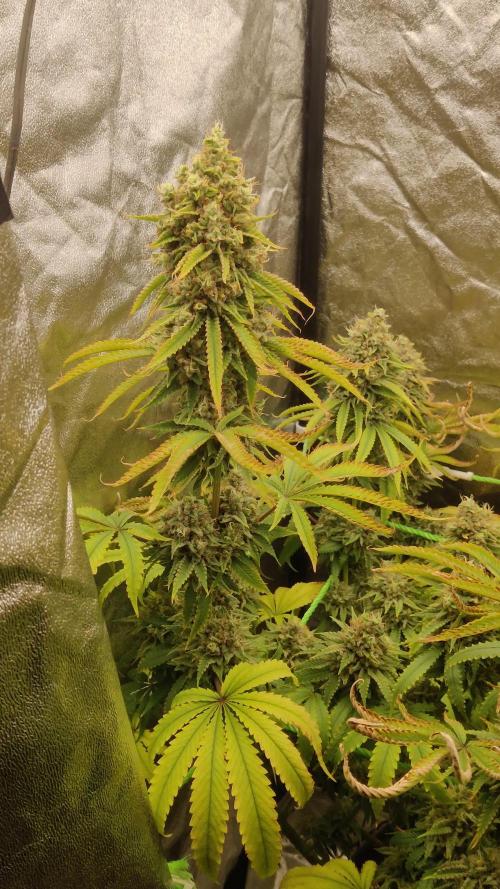
Sie Blüten werden dunkler, nicht mehr lange bis zur Ernte. Die Seneszens hat begonnen, die Pflanze remobilisiert jetzt ihre letzten Nährstoffe aus den Blättern, deshalb werden diese von Tag zu Tag etwas gelber. Der Drain ist wieder in einem guten Bereich und die Pflanze hat inzwischen das schlimmste überstanden. Die Nährstoffe werden in den nächsten Wochen stückchenweise reduziert und in ein paar Tagen werde ich den ersten Trichom Check machen. Bis dahin darf die Dame noch glücklich weiter wachsen! :)
Likes
6
Share
Likes
20
Share
@NONSENSE
Follow
Good day to every one of you. Today I am starting to feed the plant with extra Guano extract from No Mercy suppliers. Plant flowering well, very sweat aroma such candy. Thc all around so the buds will kick off for sure.
Likes
120
Share
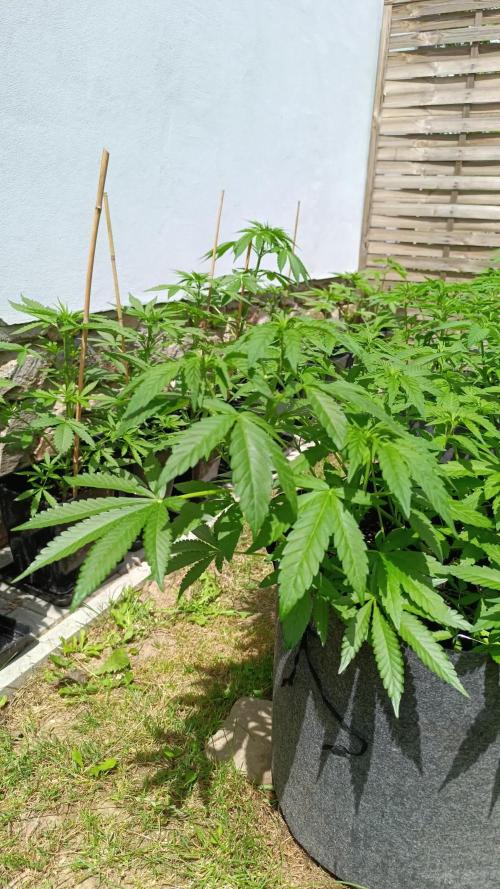
Well, these ladies are growing like weeds! 😃 I am getting ready to do their second topping. They seem to be taking nutrients well. I am planning on vegging them out for at least 3 more weeks. Going to have some monsters! 😎 Sincerely, thanks for all the support. 🙂
Likes
17
Share
Unfortunately GrowDiaries is still acting a little funny with harvest updates, so this report is being uploaded under a normal flowering week again. But make no mistake — this is harvest time. Week 14 from seed, and these girls were ready. 🌱✂️ And honestly… what a beautiful journey this has been. Before talking about harvest itself, I think this is the perfect moment for a quick recap of how these Amnesia Skunks reached this point. This entire run was done The Zamnesia Way — simple, intentional, and plant-led. 12/12 from seed. No traditional veg phase. Very little touching. Almost no manipulation besides some gentle leaf tucking and selective support when needed. No chasing perfection. No fighting the plant. No forcing structure. Just attention, observation, environment, light, airflow, nutrition, and letting the plants grow naturally into the PPFD instead of forcing them into it. And somehow, through simplicity, these girls rewarded us beautifully. Not the tallest plants. Not the biggest yield monsters. But wow… these buds came out incredibly dense, compact, greasy, and aromatic. The structure on these flowers was honestly beautiful to watch during trimming. Thick stems, heavy branching, dense internals… almost like processing little pieces of timber instead of flowers. You can clearly see where the density comes from when looking at the branch structure itself. By Week 14, the signs were all there: fading leaves, slowed drinking, fully swollen flowers, strong aroma, mature trichomes, and that overall feeling the plant gives you when she says: “I’m ready.” So harvest day arrived. ✂️ Some plants were dried whole. Some were broken down branch by branch. And in reality, the dry room became a mix of both methods depending on available space and plant structure. The drying process itself is one of the most important and misunderstood parts of cultivation. A proper dry is not just about removing water. It’s about preserving terpenes, slowing degradation, protecting cannabinoids, and allowing the flower to transition gently instead of crashing into dryness. These girls dried for around 7–10 days. Temperatures stayed mostly around 18–20°C, while humidity stayed close to 60% RH overall. During the first couple of days, humidity was intentionally lowered closer to 45% to help remove the initial surface moisture and reduce the chance of trapped humidity inside these very dense flowers. After that initial phase, the environment stabilized and the flowers were allowed to slow dry properly. One of the simplest indicators we use is the branch “click.” Not a complete snap. Not bending like rubber. But that soft internal click that tells you the outside has dried enough while the inside still contains life and moisture ready for curing. That’s when trimming begins. And for this run, everything was hand trimmed. Scissors. Trim bins. Patience. Love. Care. Every single bud handled individually. Machine trimming is fast, but hand trimming preserves shape, resin heads, bag appeal, and overall flower integrity in a completely different way. Especially with flowers like these, covered in resin and packed tightly, hand trimming allows you to keep the flower looking and feeling natural instead of shaved down or damaged. And underneath the trim bin… the gold. ✨ What many people call waste is actually one of the most beautiful rewards of trimming carefully. All the tiny broken trichome heads, loose resin, micro sugar leaf coverage and fallen gland heads collect naturally at the bottom of the trim bin during the trimming process. That’s what I like to call “trim bin gold.” Not full-melt hash but almost. Not static sift. Not dry sift. But a beautiful natural resin-rich collection straight from handling properly dried flowers. And honestly… these girls gave A LOT of it. One of the resin balls alone came out around 0.7g after simple hand rolling from collected trim-bin resin, while the second plant also produced a very respectable amount even without bothering to weigh it properly. Sticky. Aromatic. Potent. A true pleasure after long trimming sessions. 😄 After trimming, the flowers were transferred into glass jars and also into the Zamnesia vacuum curing containers. And these containers honestly deserve a quick explanation because they are actually very useful for curing. Unlike normal storage, vacuum containers help reduce excess oxygen exposure around the flower while still allowing proper curing conditions inside. Less oxygen means slower terpene degradation, slower oxidation, and better long-term aroma preservation when used correctly. The flowers are now curing slowly and properly for over a month before the final smoke report arrives. And yes… there will absolutely be a full follow-up report very soon. That next report will focus much more on: the cured flower, aroma development, smoke quality, effects, terpene profile, how the cure evolved, and a full reflection on everything we did — and did not do — during this run. Because sometimes what you choose NOT to do matters just as much as what you do. As for final dry numbers after trimming and curing: 57.2g 116.3g 33.8g 85.2g So together, both Amnesia Skunks gave you a final dry/cured/manicured total of 292.5 grams And honestly? For two relatively compact 12/12-from-seed plants with minimal intervention… I’m more than happy. But numbers never tell the whole story. The smell. The density. The stickiness. The trim-bin resin. The beauty of the flowers themselves. That’s the real reward. And before closing this harvest chapter, I truly want to thank everybody involved in this journey. The GrowDiaries platform. The entire community. The longtime followers and OGs. The new followers discovering the page for the first time. The curious ones. The silent ones. The skeptics. The lovers. The haters. The people who only stopped by for 5 seconds. And the people who stayed for the entire grow. Thank you. Thank you to Zamnesia for the genetics. Thank you to Plagron for the nutrition. Thank you to the gear that kept running day after day. Thank you to the environment itself. Thank you to the plants. And thank YOU for being here with me until harvest day. 🌱 The story is not over yet. The cure continues. And the smoke report comes next. 📡 DELETED @ 1K Please stay tuned.we never quit https://www.youtube.com/@TheDogDoctorOfficial NEW 🙏 Thank you for your patience and continued support. FOR DISCOUNT CODES AND MORE JUST FOLLOW THE LINK https://website.beacons.ai/dogdoctorofficial 📲 Don’t forget to Subscribe and follow me on Instagram and YouTube @DogDoctorOfficial for exclusive content, real-time updates, and behind-the-scenes magic. We’ve got so much more coming, including transplanting and all the amazing techniques that go along with it. You won’t want to miss it. GrowDiaries Journal: https://growdiaries.com/grower/dogdoctorofficial Instagram: https://www.instagram.com/dogdoctorofficial/ YouTube: https://www.youtube.com/@dogdoctorofficial Deleted by Youtube - https://www.youtube.com/@TheDogDoctorOfficial NEW Vimeo : https://vimeo.com/dogdoctorofficial Under construction stay tuned ⸻ Explore the Gear that Powers My Grow If you’re curious about the tech I’m using, check out these links: 🔆 Lighting & Environmental Control • Future of Grow — Advanced LED lighting technology https://www.futureofgrow.com/ DISCOUNT CODE: DOG20 • Lumiflora — Under-canopy LED lighting https://lumiflorade.com/ • TrollMaster — Environmental controllers and automation gear (past collaboration) ⸻ Genetics • Zamnesia Seeds — Genetics used in this project https://www.zamnesia.com/ ⸻ 🌱 Soil, Substrates, Boosters & Root Support • Plagron — Substrates, bio mixes, and supportive products https://plagron.com/en/ ⸻ 🎒 Storage, Curing & Preservation • Grove Bags — Curing and storage solutions https://grovebags.com/ ⸻ 📸 Photography Equipment & Tools (Not sponsors, but part of my creative toolkit) • Sony A6700 • Sony full-frame macro lens + few more • Stacking photography workflow - learning • iPhone (for behind-the-scenes shots) We’ve got much more coming as we move through the grow cycles. Trust me, you won’t want to miss the next steps, let’s push the boundaries of indoor horticulture together! As always, this is shared for educational purposes, aiming to spread understanding and appreciation for this plant. Let’s celebrate it responsibly and continue to learn and grow together. With true love comes happiness. Always believe in yourself, and always do things expecting nothing and with an open heart. Be a giver, and the universe will give back in ways you could never imagine. 💚 Growers love to all 💚 📸 P.S. – The Eye Behind the Lens All photos in this diary (for now — except for the ones showing the camera, which I took with an iPhone) are taken with a Sony A6700 paired with a Sony full-frame macro lens and a few more. Photography is part of the story — it’s how we share the fine textures, the glow, and the quiet details that words can’t always capture. I’ve also started experimenting with photo stacking — a technique where multiple images, each taken at a slightly different focus point, are layered together to create one perfectly sharp image from front to back. It’s not digital enhancement or AI; it’s pure photography — a way to reveal the plant’s beauty in microscopic depth, from trichome to petal. You’ll even see a few shots of "ghost me" capturing the shots — camera, lens, setup — because every grow deserves not just to be cultivated, but documented like art. FOR DISCOUNT CODES AND MORE JUST FOLLOW THE LINK https://website.beacons.ai/dogdoctorofficial NEW DISCORD - Official Server Invite Link : https://discord.gg/ksjAkA5T74
Likes
51
Share
Here we are at the harvest of one of the masterpieces of the season, Ghost Train Haze Automatic by Zamnesia. ** We remind everyone that we have grown two plants per strain, one without the aid of any technique and the other instead worked with the techniques described below. Technique used // The plant was worked with the MAINLINING technique, particularly successful in this case because the plant with a wide internodal distance put a lot of body until it swelled like a pig. Better with the techniques or normal? It is a plant with a high distance between internodes, the Mainling was truly perfect. This time I am strong for the main lined plant. You can watch plant and I believe it will think the same This is another confirmation that MAINLINING on AUTOFLOWERING in my opinion is only indicated in plants with medium-high internodal distance. This is a real monster not usual for soil in 11 lt pot. Flower quality // The flowers are impressive, the classic haze shape is very long, some are really hard and heavy, I'm not crazy about the taste but by definition the pure haze taste is not among my super favorites but I love it anyway. Check the article in your language // https://www.zamnesia.io/it/guida-growing-cannabis/333-lavaggio-delle-ceme Trichomes // Here we have an absolute majority of milky and cloudy trichomes, still some transparent and some amber, it is not super ripe but for me it is fine. Fertilizers // I am very happy with how I managed to unload the plant which at a certain point before going to flush was fed for a few days only with additives and then went to flush and we are discolored enough. This is a yellow that satisfies me to go to crop and vaporize a delicious plant with no residue of nutrients inside. All Plagron fertilizers and additives in the green / 100% organic version have fully satisfied me. Choose your soil according to your style and calculate the sheet on the website www.plagron.com The fertilizers instead are found in convenient all-inclusive packages on the Zamnesia website. Try a seed of this variety belive in Zammi i superlove this strain.. ---- https://www.zamnesia.io/en/12511-zamnesia-seeds-ghost-train-haze-auto.html Zamnesia Description // From the day her cotyledons emerge from the substrate, Ghost Train Haze Auto will surprise you with her rapid growth and robustness. When she starts to flower, this short sativa will develop long and compact buds with pungent scents of spice, citrus and fuel. Music and frequencies // For about 4/6 hours a day my plants listen to 432 Hz frequencies made especially for their well-being and sometimes a bit of black music to give them those vibrations that only music can give. www.radionula.com All the best that mother nature has to offer is on ---- www.zamnesia.com THE FLOWERS ARE MONSTROUSLY LARGE. HOLY MARY.
Likes
3
Share
Likes
22
Share
@burnout
Follow
Week 8 of flower. Trichs still mostly cloudy, seeing a couple of amber colors here and there on the bracts.
Likes
16
Share
@valiotoro
Follow
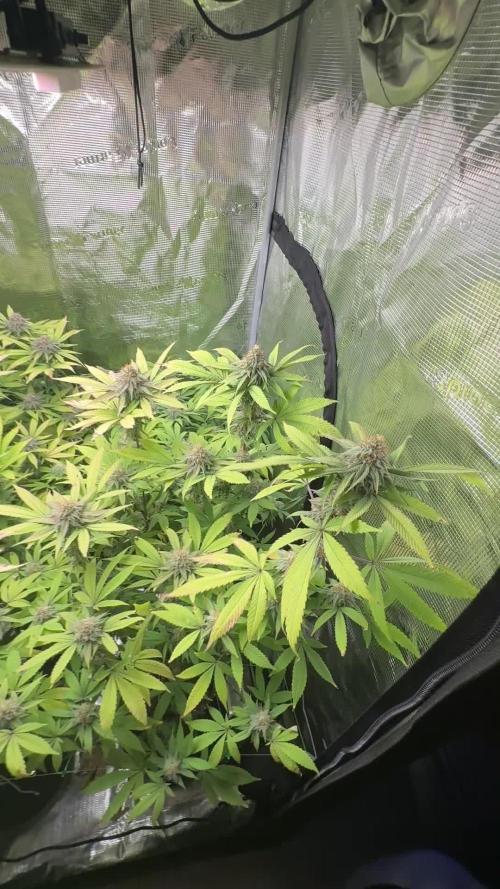
Hello everyone 😎 Week 2 for my girl it’s time for Topping & some LST She is doing very well,growing at fast pace and with a beautiful green colour on the leaves. Have a nice day 😎
Likes
11
Share
7 días . Ph: 5,9-6,0 Ec: 02 - max 0,6 1 semana y ya completamos el pan de raíz. Desde el día 3 riego foliar , knactive , mycochum + orca .
Processing
Likes
18
Share
Oct 26, 2019 Orange Juice (1) – Day 29 Veg/Day 0 Flower (30% Indica/70% Sativa) (63-70 days) Blueberry Headband (2) – Day 29 Veg/Day 0 Flower (70% Indica/30% Sativa) (65-70 days) Cheese (1) – Day 29 Veg/Day 0 Flower (60% Indica/40% Sativa) (50-60 days) Several issues have been corrected in the last 48 hours. Also, a new LST technique I’m trying. First, am PHing everything. The RO water that I use is 7 or above. Not ideal and has caused some nutrient lockout. Second, lowered the light Much closer. At 100% power, my light is best for veg at 24” and for flower at 18”. The light was at around 36” or more from the canopy. Third, I put a weakass fan drawing air down a 2 1/2“ pipe from the top of the grow closet to about 6-8” above the floor. Meant to recycle some of the warm air. Have seen instant results. It is actually easier keeping the environment consistent. My overnight temp is now 20-22C and daytime is 27-25C. Only a 5 degree difference. Have started making tea from Gaia fertilizer, seaweed extract, Epsom salts and Molasses. PH 6.2-6.8. Feeding every second watering.
Processing
Likes
6
Share
@kking6321
Follow
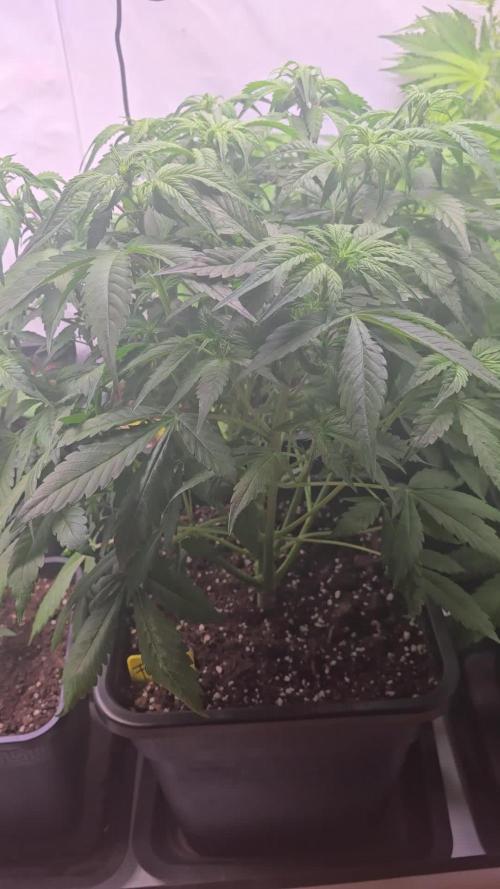
Still taking about 3-4 days to dry out. Most likely due to my lack of adding extra perlite when starting. I think this is causing some pretty big fluctuations in humidity. Going to get a dehumidifier this week with a controller to try and stabilize the grow tent and possibly dry the smart pots faster. Im watering 2 times between each feeding, trying to take it slow with nutes to ensure no issues during flower. All in all I'm feeling pretty good about the progress, as I'm really starting to see the buds coming in and growing in size.
Likes
139
Share
📅 Week 10 | 🗓️ Day 64–70 Day 70 – Papayton 🏀 (2nd week flower) 🔸Papayton is growing vigorously in week 10 and is slightly ahead of Lemon Cherry Runtz in terms of size. The canopy is wider and the spearheads are slightly higher – exactly where the flower clusters are now really taking off. The pictures show densely packed calyxes with long, creamy white stigmas; the sugar leaves are already nicely pollinated and the buds are starting to stack up. So far, everything looks great. 🔸The SANlight remains at 90% and ~30 cm distance (approx. 900 PPFD at the canopy). The leaves appear relaxed, without claws or lightening – so no indication of light stress. I keep the climate rather moderate, with good air circulation through the foliage so that the fresh resin heads remain dry. It's a bit cold at the moment, so I can't quite reach the VPD, but I'm not going to put a heater in, hehe. 🔸I watered as planned with BIO PK from BioTabs – carefully following the manufacturer's instructions. Otherwise, only water. The goal: to push flower formation without compromising leaf health.Depending on how it develops, next time I will either just water it or give it a top dressing with Slizium Flash. 📈 Current Conditions 🌡️🔆 = 24°C 🌡️🌜 = 17°C 💨 Humidity = 69% 🔦 PPFD = 900 µmol (12/12) 🛠️ Setup (unchanged) 💡 2 x SANlight Evo 4-120 @90% ⛺ 120 x120 x 180 Spiderfarmer 🍯 Pots: 18 liter fabric pots 🌱 Soil: Bio-Bizz light mix 💊 Nutrients: BIO Tabs 🌱 “Easy, organic, only-water method. Save 15% with GDBT420. biotabs.nl/en/shop/”
Processing
Likes
88
Share
@No_Clout
Follow
01/08/18 - I fed them all 1 litre each, one of them seems to be praying up but the other two Seem a little bit droopy still. 02/08/18 - #3 is praying like usual and the other two are getting better Day by day I’m going to be giving them another feeding tomorrow, I have seen roots stretching out to the sides of the pots so I might saturate the whole pot. 04/08/18 - horrible sight today looks like rusty cracks in some leaves , not got a clue what this. 05/08/18 - browning has continued since last night and it’s all on the new leafs not the older ones. i fed them without any calmag , so I think it could be a deficiency of some sort (cal/mag).the mad thing is, it’s only two of the girls, one of them is completely fine nice green leaves not yellow marks that turn orange/brown. It definitely has nothing to do with my ph or all three girls would be showing some symptoms seeing as they all get fed with the same soloution.✌️🏻 07/08/18 - everything’s cleared up their was slight nute burn in the process but everything seems a lot better so I decided to start LST. all the new leaves are the colour they should be with no nute burns or calcium deficiency 🙏🏻
Likes
19
Share
Another Defoliation at the end of stretch this week for the Northern and she's now in full bud mode at end of Week 8. 3-4 left I think before the chop and she's just a happy monster. Buds forming nicely on't Chemdawg despite a bit of Nutrient Burn on some of the leaves. Skipped a feed last week and replaced with Molasses only just to help her fight off the excess 2nd Chemdawg looks like she will bud from head to toe a fairly straight forward week for all the girls but started to stink and show their flowers nicely. Head over to www.autobeastmethods.com to find out how you can learn to Maximise your Autoflower. Head to the Forum and say Dr AutoDevil sent you. Happy Growing Gang Everyday Growing is a Day Learning 💚😈 www.instagram.com/AutoBeastMethods Videos of the tent available on my IGTV just too big to upload here they keep crashing.
Likes
17
Share
Cosechas asombrosas con XpertNutrients, el clima no ha ayudado pero ya tengo algo de hierba para fumar. Gran calidad,tiene un aroma muy potente a gasolina y fresas. Estoy deseando darle una calada, mas tarde actualizaré las notas de humo.
Likes
16
Share
She has been a beast and very easy so far. She does like it warm at least 80 and she happy. Using her as a mother plant to gets some clones.
Likes
2
Share
After all research of why plants are going at different rates the only conclusion Conclusion I’ve come to is to do with the fan being too close to the top left Plant and the Seeds to come from different plants but same strain. Will need to go back to royal queen seeds to ask the question??? Leaf burn from wind burn can slow growth of plants
Likes
29
Share
Hope you are well. Thanks for taking the time. Little main line defoliation to focus growth. A cell is a quantum measuring device for light’s frequency to make order from the chaos that light frequencies bring from our environment. A cell performs mechanical resonance, where its intrinsic structures vibrate at specific resonant frequencies when exposed to external mechanical stimulation. Cells possess the ability to sense and respond to mechanical cues from their environment, a process known as mechanosensing. This can involve the activation of signaling pathways and changes in gene expression. Cellular resonance is a component of mechanotransduction, the process by which cells convert mechanical force into a biochemical signal that triggers a cellular response. Plants perceive mechanosensory stimuli, such as vibration and touch, through structures like trichomes (hairs) and specialized ion channels embedded in their cell membranes. Plants are sensitive to frequencies ranging from ultrasound to lower sound waves, such as 250 Hz. The perception depends on various factors, including the stiffness of the underlying tissue, which can be tuned by the plant to perceive specific frequencies associated with environmental cues like insect herbivory. While the exact molecular mechanisms are still being explored, scientists have identified several potential pathways that may be affected by acoustic vibrations in this frequency range: 4000-5000 Hz. Enzyme activity: Sound waves can increase the activity of certain enzymes, such as amylase, and elevate the content of soluble sugars and proteins. Increased stomatal opening in response to specific frequencies can optimize photosynthesis by increasing the plant's absorption of water and CO2. In addition to enhancing drought tolerance, sound vibrations can strengthen plants' overall resistance to stress. Studies have shown that some genes related to stress response can be activated by sound stimulation. The Emerson effect is a phenomenon where the combination of red and far-red light increases the rate of photosynthesis beyond the sum of the two wavelengths used separately. This synergy is important for understanding Extended Photosynthetically Active Radiation (ePAR), which includes the far-red spectrum, because it means a more comprehensive measurement is needed to fully understand light's effect on plant growth. ePAR meters measure light up to 750 nm, which is necessary to capture the far-red light that participates in the Emerson effect. The human eye can detect more shades of green than any other color due to a combination of our cone cell sensitivity and evolutionary history. Our eyes are most sensitive to the yellow-green part of the spectrum, which is the peak of our visual sensitivity, and a large part of our ancestry was spent needing to distinguish subtle variations in greenery for survival. or our primate ancestors, being able to discern subtle differences in green was crucial for survival. It helped them identify edible plants and avoid poisonous ones, as well as detect predators hiding in foliage. This constant need to distinguish shades of green drove the evolution of our color perception to become most sensitive to it. S-cones: Detect short wavelengths, perceived as blues and violets. M-cones: Detect medium wavelengths, perceived as greens. L-cones: Detect long wavelengths, perceived as reds and yellows. The primary reason for our enhanced sensitivity to green is that the peak sensitivities of the M-cones and L-cones are very close together in the green-yellow region of the visible spectrum. This overlap means that green light stimulates both the M-cones and L-cones, creating a more robust and detailed signal for the brain to interpret. In contrast, the S-cones are more isolated and respond to a much narrower band of light, leading to less sensitivity for blues. The brain's visual processing pathways also play a role. Our visual system processes color differences through "opponent channels," which compare the signals from different types of cones. The opponent channel that processes red versus green has a more precise and intricate system than the blue versus yellow channel, leading to finer discrimination in the green part of the spectrum.