Likes
Comments
Share
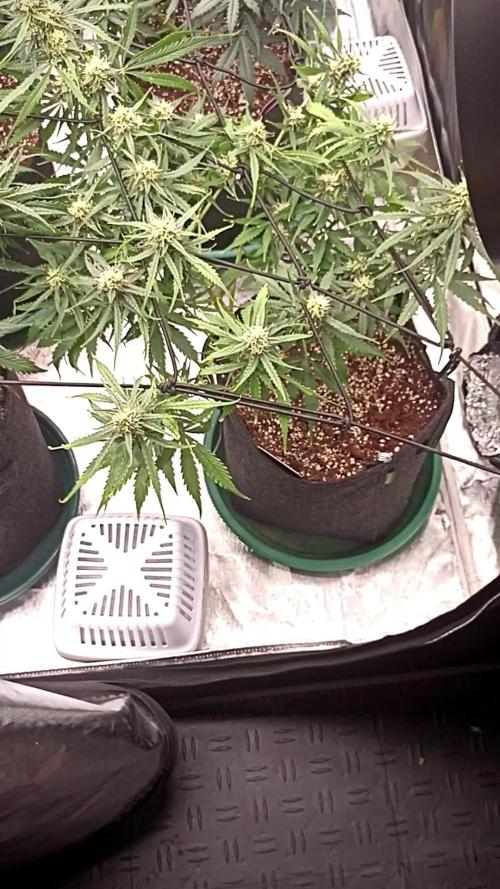
Pictures/Videos updated. Plants looking good. Mimosa has more Amber trichomes, looks like that will be harvested first.
Likes
Comments
Share
@Dabking
Follow
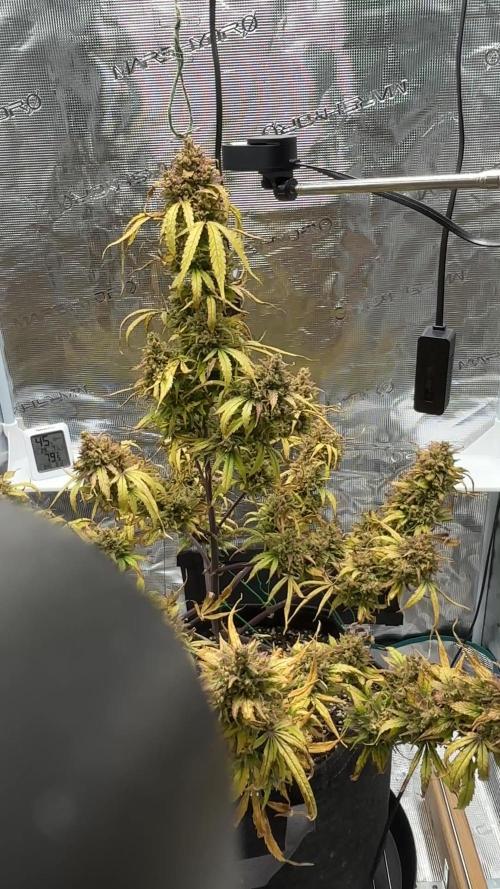
I was told to never judge a strain purely off it's THC percentage. To smell a plant, and what your nose picks out is generally the strain that will jive the best with the endocannabinoid system in your body. This strain exemplifies that. It's only around 17% but the high is amazing. An under-rated strain for sure. Very easy strain to grow. Although the same strain, one looked pretty different and was much frostier despite getting the exact same treatment from seed to chop.
Likes
21
Share
Likes
25
Share
10-05-2021: I am counting today as day One for Veg. Planning to hold them on 18/6 till the 20th of may (ten days) and then switch. Not sure if I will stress them a bit or not, time will tell. Yesterday was hot (26˚C) here so all values have shifted a bit. Won't be a problem as soon as they are on 12/12. Do you notice the lines (air/water) changing position on heat :) Didn't even notice that at first. Also pretty sure I need a more powerful chiller at the moment but will first make an attempt to replace the gas. 13-05-2021: Today I will be replacing my chiller. It doesn't keep up and the temperature of 28˚C is a bit too much. For the rest.. All great 15-05-2021: Added some paper sheets to reduce heat. Seem to work so today I'll go to hardware store and buy something to make a more permanent solution.... I have added some reflective foil to cover the boxes
Likes
27
Share
Hallo Growlegen, wir zählen Blüte Tag 10 und den Blümchen geht's soweit sehr gut 😁 Sie messen jetzt ca 85 cm 📏 Beide wachsen ähnlich, die Gushers hat etwas längere Internodien und Frau Kush ist etwas kompakter und buschiger. Beide haben leichte gelbe Spitzen, aber mein VPD ist auch nicht ideal. 😞 Der PPFD liegt erst bei ca.650 und Lampe bei 60 %- da müsste eigentlich noch was gehen, oder was meint ihr ? ☀️🌤️⛅🌥️ Ein einziges Blatt der Gushers zeigt etwas Calmag Mangel - aber sonst nix zu sehen außer die typische Blüteaufhellung. Der Stretch der letzten Tage war schon ordentlich, aber noch passt die Höhe ✅ Wir freuen uns alle schon auf den Friseur Termin in nächster Zeit (noch 11 Tage Geduld), da muss dringend gestutzt werden im Unterholz ✂️ Grüne Grüße Rocko 💚
Likes
52
Share
Lacewings seemed to have mostly killed themselves by flying into hot light fixtures. I may have left the UV on which was smart of me :) Done very little to combat if anything but make a sea of carcasses, on the bright side its good nutrition for the soil. Made a concoction of ethanol 70%, equal parts water, and cayenne pepper with a couple of squirts of dish soap. Took around an hour of good scrubbing the entire canopy. Worked a lot more effectively and way cheaper. Scorched earth right now, but it seems to have wiped them out almost entirely very pleased. Attempted a "Fudge I Missed" for the topping. So just time to wait and see how it goes. Question? If I attached a plant to two separate pots but it was connected by rootzone, one has a pH of 7.5 ish the other has 4.5. Would the Intelligence of the plant able to dictate each pot separately to uptake the nutrients best suited to pH or would it still try to draw nitrogen from a pot with a pH where nitrogen struggles to uptake? Food for stoner thought experiments! Another was on my mind. What happens when a plant gets too much light? Well, it burns and curls up leaves. That's the heat radiation, let's remove excess heat, now what? I've always read it's just bad, or not good, but when I look for an explanation on a deeper level it's just bad and you shouldn't do it. So I did. How much can a cannabis plant absorb, 40 moles in a day, ok I'll give it 60 moles. 80 nothing bad ever happened. The answer, finally. Oh great........more questions........ Reactive oxygen species (ROS) are molecules capable of independent existence, containing at least one oxygen atom and one or more unpaired electrons. "Sunlight is the essential source of energy for most photosynthetic organisms, yet sunlight in excess of the organism’s photosynthetic capacity can generate reactive oxygen species (ROS) that lead to cellular damage. To avoid damage, plants respond to high light (HL) by activating photophysical pathways that safely convert excess energy to heat, which is known as nonphotochemical quenching (NPQ) (Rochaix, 2014). While NPQ allows for healthy growth, it also limits the overall photosynthetic efficiency under many conditions. If NPQ were optimized for biomass, yields would improve dramatically, potentially by up to 30% (Kromdijk et al., 2016; Zhu et al., 2010). However, critical information to guide optimization is still lacking, including the molecular origin of NPQ and the mechanism of regulation." What I found most interesting was research pointing out that pH is linked to this defense mechanism. The organism can better facilitate "quenching" when oversaturated with light in a low pH. Now I Know during photosynthesis plants naturally produce exudates (chemicals that are secreted through their roots). Do they have the ability to alter pH themselves using these excretions? Or is that done by the beneficial bacteria? If I can prevent reactive oxygen species from causing damage by "too much light". The extra water needed to keep this level of burn cooled though, I must learn to crawl before I can run. Reactive oxygen species (ROS) are key signaling molecules that enable cells to rapidly respond to different stimuli. In plants, ROS plays a crucial role in abiotic and biotic stress sensing, integration of different environmental signals, and activation of stress-response networks, thus contributing to the establishment of defense mechanisms and plant resilience. Recent advances in the study of ROS signaling in plants include the identification of ROS receptors and key regulatory hubs that connect ROS signaling with other important stress-response signal transduction pathways and hormones, as well as new roles for ROS in organelle-to-organelle and cell-to-cell signaling. Our understanding of how ROS are regulated in cells by balancing production, scavenging, and transport has also increased. In this Review, we discuss these promising developments and how they might be used to increase plant resilience to environmental stress. Temperature stress is one of the major abiotic stresses that adversely affect agricultural productivity worldwide. Temperatures beyond a plant's physiological optimum can trigger significant physiological and biochemical perturbations, reducing plant growth and tolerance to stress. Improving a plant's tolerance to these temperature fluctuations requires a deep understanding of its responses to environmental change. To adapt to temperature fluctuations, plants tailor their acclimatory signal transduction events, specifically, cellular redox state, that are governed by plant hormones, reactive oxygen species (ROS) regulatory systems, and other molecular components. The role of ROS in plants as important signaling molecules during stress acclimation has recently been established. Here, hormone-triggered ROS produced by NADPH oxidases, feedback regulation, and integrated signaling events during temperature stress activate stress-response pathways and induce acclimation or defense mechanisms. At the other extreme, excess ROS accumulation, following temperature-induced oxidative stress, can have negative consequences on plant growth and stress acclimation. The excessive ROS is regulated by the ROS scavenging system, which subsequently promotes plant tolerance. All these signaling events, including crosstalk between hormones and ROS, modify the plant's transcriptomic, metabolomic, and biochemical states and promote plant acclimation, tolerance, and survival. Here, we provide a comprehensive review of the ROS, hormones, and their joint role in shaping a plant's responses to high and low temperatures, and we conclude by outlining hormone/ROS-regulated plant-responsive strategies for developing stress-tolerant crops to combat temperature changes. Onward upward for now. Next! Adenosine triphosphate (ATP) is an energy-carrying molecule known as "the energy currency of life" or "the fuel of life," because it's the universal energy source for all living cells.1 Every living organism consists of cells that rely on ATP for their energy needs. ATP is made by converting the food we eat into energy. It's an essential building block for all life forms. Without ATP, cells wouldn't have the fuel or power to perform functions necessary to stay alive, and they would eventually die. All forms of life rely on ATP to do the things they must do to survive.2 ATP is made of a nitrogen base (adenine) and a sugar molecule (ribose), which create adenosine, plus three phosphate molecules. If adenosine only has one phosphate molecule, it’s called adenosine monophosphate (AMP). If it has two phosphates, it’s called adenosine diphosphate (ADP). Although adenosine is a fundamental part of ATP, when it comes to providing energy to a cell and fueling cellular processes, the phosphate molecules are what really matter. The most energy-loaded composition for adenosine is ATP, which has three phosphates.3 ATP was first discovered in the 1920s. In 1929, Karl Lohmann—a German chemist studying muscle contractions—isolated what we now call adenosine triphosphate in a laboratory. At the time, Lohmann called ATP by a different name. It wasn't until a decade later, in 1939, that Nobel Prize–-winner Fritz Lipmann established that ATP is the universal carrier of energy in all living cells and coined the term "energy-rich phosphate bonds."45 Lipmann focused on phosphate bonds as the key to ATP being the universal energy source for all living cells, because adenosine triphosphate releases energy when one of its three phosphate bonds breaks off to form ADP. ATP is a high-energy molecule with three phosphate bonds; ADP is low-energy with only two phosphate bonds. The Twos and Threes of ATP and ADP Adenosine triphosphate (ATP) becomes adenosine diphosphate (ADP) when one of its three phosphate molecules breaks free and releases energy (“tri” means “three,” while “di” means “two”). Conversely, ADP becomes ATP when a phosphate molecule is added. As part of an ongoing energy cycle, ADP is constantly recycled back into ATP.3 Much like a rechargeable battery with a fluctuating state of charge, ATP represents a fully charged battery, and ADP represents a "low-power mode." Every time a fully charged ATP molecule loses a phosphate bond, it becomes ADP; energy is released via the process of ATP becoming ADP. On the flip side, when a phosphate bond is added, ADP becomes ATP. When ADP becomes ATP, what was previously a low-charged energy adenosine molecule (ADP) becomes fully charged ATP. This energy-creation and energy-depletion cycle happens time and time again, much like your smartphone battery can be recharged countless times during its lifespan. The human body uses molecules held in the fats, proteins, and carbohydrates we eat or drink as sources of energy to make ATP. This happens through a process called hydrolysis . After food is digested, it's synthesized into glucose, which is a form of sugar. Glucose is the main source of fuel that our cells' mitochondria use to convert caloric energy from food into ATP, which is an energy form that can be used by cells. ATP is made via a process called cellular respiration that occurs in the mitochondria of a cell. Mitochondria are tiny subunits within a cell that specialize in extracting energy from the foods we eat and converting it into ATP. Mitochondria can convert glucose into ATP via two different types of cellular respiration: Aerobic (with oxygen) Anaerobic (without oxygen) Aerobic cellular respiration transforms glucose into ATP in a three-step process, as follows: Step 1: Glycolysis Step 2: The Krebs cycle (also called the citric acid cycle) Step 3: Electron transport chain During glycolysis, glucose (i.e., sugar) from food sources is broken down into pyruvate molecules. This is followed by the Krebs cycle, which is an aerobic process that uses oxygen to finish breaking down sugar and harnesses energy into electron carriers that fuel the synthesis of ATP. Lastly, the electron transport chain (ETC) pumps positively charged protons that drive ATP production throughout the mitochondria’s inner membrane.2 ATP can also be produced without oxygen (i.e., anaerobic), which is something plants, algae, and some bacteria do by converting the energy held in sunlight into energy that can be used by a cell via photosynthesis. Anaerobic exercise means that your body is working out "without oxygen." Anaerobic glycolysis occurs in human cells when there isn't enough oxygen available during an anaerobic workout. If no oxygen is present during cellular respiration, pyruvate can't enter the Krebs cycle and is oxidized into lactic acid. In the absence of oxygen, lactic acid fermentation makes ATP anaerobically. The burning sensation you feel in your muscles when you're huffing and puffing during anaerobic high-intensity interval training (HIIT) that maxes out your aerobic capacity or during a strenuous weight-lifting workout is lactic acid, which is used to make ATP via anaerobic glycolysis. During aerobic exercise, mitochondria have enough oxygen to make ATP aerobically. However, when you're out of breath and your cells don’t have enough oxygen to perform cellular respiration aerobically, the process can still happen anaerobically, but it creates a temporary burning sensation in your skeletal muscles. Why ATP Is So Important? ATP is essential for life and makes it possible for us to do the things we do. Without ATP, cells wouldn't be able to use the energy held in food to fuel cellular processes, and an organism couldn't stay alive. As a real-world example, when a car runs out of gas and is parked on the side of the road, the only thing that will make the car drivable again is putting some gasoline back in the tank. For all living cells, ATP is like the gas in a car's fuel tank. Without ATP, cells wouldn't have a source of usable energy, and the organism would die. Eating a well-balanced diet and staying hydrated should give your body all the resources it needs to produce plenty of ATP. Although some athletes may slightly improve their performance by taking supplements or ergonomic aids designed to increase ATP production, it's debatable that oral adenosine triphosphate supplementation actually increases energy. An average cell in the human body uses about 10 million ATP molecules per second and can recycle all of its ATP in less than a minute. Over 24 hours, the human body turns over its weight in ATP. You can last weeks without food. You can last days without water. You can last minutes without oxygen. You can last 16 seconds at most without ATP. Food amounts to one-third of ATP production within the human body.
Processing
Likes
26
Share
Esa familiaa, estoy impresionado porque estas skunk están muy compactas, es una cepa increíble, y no la fume todavía, solo hay que verlas no solo lo prietas que van, si no lo tricomas as que están . Hay que felicitar a Zambezaseeds ya que esta variedad es muy estable y sencilla de llevar. Ph controlado, quitamos productos y lavamos raíces, pronto solo agua. Ph controlado, temperatura por debajo de 29 y humedad por debajo del 40%, deseando que estén listas para ver la producción, esss flores pesarán, hasta la semana que viene fumetillas.
Likes
15
Share
I harvested when go began to see some amber trichomes, the plant grew very well, the maturation of trichomes was quite slow. The buds are nice and full bodied and the scent is very sweet and pleasant, reminiscent of gesolmino and strawberry bubblegum.
Likes
149
Share
Hi all the happy people here in GrowDiaries. This is my second cultivation ever and it will be fun to try a bigger space than my closet grow. First, I'm just going to say I'm done with the construction of my new growroom. I put some pictures on the construction here in week one. The room is 2.14 meters by 1.7 meters and has a ceiling height of 2 meters. It provides a floor area of ​​3.6 square meters. I use a 54 Watt Lightwawe T5 for germination and 2 Pcs 400 Watt HPS lamps. I have a channel fan that replaces the room air about 40 times an hour to get a comfortable theme in the room, the air enters a fresh air intake from the outside. The air is purified through a carbon filter to then leave the room to the rest of the basement. Then I use that heat to heat the rest of the basement. I will use 8 pcs 15 liter Autopots to grow with and a 100 liter water tank that supplies the pots of water and nutrition. I will grow completely organically in soil and will watercure my buds to get the best possible medicine for me. But there are no cultivation rooms to be displayed here, so I continue with what is most important. Today I have put my seeds in my moisture dome and hope the seeds have germinated within a few days. I am very excited to see how the new growroom will work and how this Blue cheese Auto from Royal queen seeds will turn out. Blue Cheese automatic cannabis seeds are a cross of Blueberry Automatic and Cheese Automatic that has been perfected over five years of breeding and careful selection. The result is a feminized, autoflowering strain with superior yield, flavor, and effects to either of its distinguished parent strains. THC: 16% CBD: Low Yield Indoor : 325 - 375 gr/m2 Yield Outdoor: 60 - 110 gr/plant Height Indoor: 40 - 70 cm Height Outdoor: 60 - 110 cm Flowering: 7 - 8 weeks Harvest month: 9-10 weeks after planting Genetic Background: Blueberry x Cheese x Ruderalis Type: Sa 35% In 40% Ru 25% Effect: Cerebral and uplifting Climate: Mild .............................................................................................................................................................................................................................................................................................................................................. 2017-09-11. Kl 12.00. Week 4 starts. I have cleaned the whole room for the new week and gave the girls water and nutes. Added videos and pics. Girl nr 1 is 27 cm high and girl nr 2 is 50 cm high and nr 3 is 15 cm high. ------------------------------------------------------------------------------- 2017-09-12. Kl 10.00. New pics and video. Nr 2 has grown 5 cm in 23 h, its incredible. --------------------------------------------------------------------------------------------- 2017-09-13. Kl 22.00. Everything is great in the garden right now. Updated with new video. ---------------------------------------------------------------------------------------------------------------------------- 2017-09-15. KL 10.00. New pics and videos. Girl Nr 1 is 33 cm high, Nr2 is 70 cm and girl Nr is 22 cm. Nr 2 has grown 20 cm the last 3 days. Look at the stem of girl Nr 2 😍 The girls are starting to smell a lot now. Its a intense smell in the grow room. ----------------------------------------------------------------------------------------------------------------------------------------- 2017-09-16. Kl 10.00. The girls grow like crazy, i have to defoliate about 20 leafs a day. Nr 2 is 76 cm tall now, i wonder when she slows down?. Added 2 liters of water and nutes this morning and 2 new videos. ------------------------------------------------------------------------------------------------------------------------------------------------------------------ 2017-09-17. Made a time laps of the girls first 28 days.
Likes
10
Share
Likes
7
Share
Likes
61
Share
MY FIRST GROWBOX MY FIRST SEED MY FIRST GERMINATION MY FIRST CULTIVATED PLANT MY FIRST COLLECTION WHAT A SATISFACTION ... REWARDING AS FEW THINGS IN LIFE .... I MADE IT !!! AFTER A FEW DAYS OF DRYING I DON'T HIDE YOU HAVING PUT SOME FLOWER ON THE LED GRID .... BLEAAA A STRONG FLAVOR OF GRASS AND SOIL .... I WAS A LITTLE IMPATIENT I ADMIT IT .... BUT DO NOT IMAGINE HOW MUCH IT IS ... IT HAS BEEN HARD FOR ME TO FACE ALL THE DEFENSE GROWTH BY EATING MY NAILS ... I HAVE NEVER ATTENDED THE ENTIRE BLOOMING PROCESS AND I WAS UNKNOWLEDGE OF WHAT THE NEXT STEP WOULD BE EVERY TIME AND THEREFORE FOR THE WHOLE TIME I WOULD ASK YOU FROM A PAIR OF LEAVES TO BECOME LARGE AND JUICY GEMS ...... SPECTACULAR ... MAGNIFICENT ... I REMEMBER HOW LONG IT WAS WAS TO PURCHASE GRASS HERE AND IT DID NOT BE UNDEFEATED IMMEDIATELY IN THIS MAGNIFICENT EXPERIENCE ... MY GRASS IS MY GRASS AND THIS I UNDERSTAND IT NOW I HAD FANTASTIC SUPPORT FROM ALL OF YOU THANK YOU ONE BY ONE FOR YOUR VERY PRICE TIPS ... I CUT THE PLANTS AFTER THE TWO WEEKS FLUSH AND I HANGED THEM WITH ALL THE STEM I PERFORMED A DRY TRIMM AFTER FIFTEEN DAYS OF DRYING AFTER TAKING CARE OF MY GRASS I REALLY UNDERSTAND WHAT PASTA IS MADE OF WAUUUUU I HAS A LITTLE HASH ... BUT NOT HAVING GOOD FILTERS IT HAS NOT COME VERY PURE WITH THE REST OF THE WASTE I AM TRYING TO EXTRACT OIL WITH PURE ALCOHOL ... ONCE I EXTRACT I WILL MIX IT WITH A TEN GRAMS OF FLOWER MAKING IT A SPLENDID SMOKE GREETINGS TO ALL MY FRIENDS OF GROWERE VERY HAPPY AND ABUNDANT COLLECTED TO ALL OF YOU
Likes
1
Share
Likes
24
Share
The Apple Betty babies are doing great 😊 I’m very pleased with the results so far, I just wished I would have known they would have such a large stretch, they D almost doubled in size in 14 days. At day 8 I stopped tucking the branches and allowed them to grow up. In hindsight, I probably should have kept going for another couple of days. They continued to stretch rapidly all the way up to date 12 or so, much more than my other strain that I have going as well. At day 10 I cleaned up some of the small bud sites and leaves that were below the 1st trellis. These sites do not get enough light to make anything good, and take away energy from the main tops as they grow and compete. A quick snip here and there will really help the end result. At day 13 I decided to add a second trellis net to provide support to the tops that came up so fast. They seem to have stopped their main stretch faze, and are looking happy and healthy now. I’ve continued my water, water, feed schedule and have not seen any cause for concern. The girls are taking a little over a gallon of water every 72 hours at this point. Humidity is being controlled automatically with my in-line fan and humidifier. RH is set to 57% and temps hover between 77-80 degrees with lights on, and about 70-72 with light off thanks to my furnace being back on for the cooler temps. The 2x4 5 gallon girl is doing great as well. 😊During the stretch, she flourished just as the girls in my big tent did as well. She is going to have some great bud, the branch structure is nicely developed with tight node spacing and large tops. I’ve been plucking off all the lower growth, and tucking leaves as they block bud sites. I will be doing a defoliation next week. Happy Gardening 🇨🇦👊❤️
Likes
6
Share
1 desfolha.. alguns dias de 34 graus tive que deixar aberto teve alguns comidos de inseto.. e estão murchas pois a foto foi pós rega que dá uma murchada. Ambiente em 70% umidade por umas 10h das 24h nas demais vai decaíndo até chegar entre 50 e 40 onde volto o ciclo... Para não ter problemas de pragas e mofos por excesso de dias umidos sem processo de secar como no solo...
Likes
49
Share
@yan420
Follow
FERMAKOR BARREL MIX – BASE IN USE (Testing on the Fantasy Feast girl we pulled out of another diary https://growdiaries.com/diaries/274722-grow-journal-by-yan402 ) (FERMAKOR BASE SYSTEM KOH VERSION diary https://growdiaries.com/diaries/278391-grow-journal-by-yan402) (Urea & Micros on the way — first week running without them) 🍶💧🍶💧🍶💧🍶💧🍶 💧 30 L Barrel – Current Working Mix 🍶💧🍶💧🍶💧🍶💧🍶 Step 1 – Calcium Nitrate (Part A) 7 L warm water (~35–40 °C) → added 45 g Calcinit, stirred until fully clear. That’s the calcium + nitrogen backbone for the feed. Step 2 – FERMAKOR PK Base (Part B) 15 L water in the main barrel → added 30 ml FERMAKOR PK Concentrate, mixed well. This forms the main P + K part of the formula. Step 3 – Combine Solutions Slowly poured the Calcinit mix into the barrel while stirring — no reaction, still crystal clear. That confirms the mix is stable and precipitation-free. 🌿 Step 4 – FPJ / FFJ Batch Added 30 ml homemade FPJ (fish + veg batch) ≈ 1 ml/L. Color shifted to a light-amber tone — looks alive and active. 🍋 Step 5 – Citric Acid Balance Added 1 tsp citric acid after everything was blended to fine-tune pH and help chelate micros later on. 📦 Step 6 – Top Up & Check Filled to the 30 L mark with plain water → pH tested with drops, showing yellow-green — roughly 5.8 – 6.0 range. Nice clean look, stable smell, no residue. 💧 Current Base Ingredients (Active Mix) Warm Water ≈ 22 L total Calcinit 45 g → N + Ca foundation FERMAKOR PK Base 30 ml → P + K support Citric Acid 1 tsp → Chelation + pH balance FPJ / Fish Emulsion 30 ml → Organic enzyme booster Result: clean amber mix, mild and balanced. I’ll let this version run for a week before adding anything. 👀👀👀👀👀👀 Observations and changes 👀👀👀👀👀👀 27.10.25 VW27 noticed some min burnt tips so I decreased Calcium Nitrate 45 to → 40g, decided to add two more elements micros and Epsom salts just to make sure they got everything, Fetrilon Combi 1 (Micros): 0.5 g, Epsom salts: 8 g 28.10.25 VW27 she seems devoid of any deficiencies, seems ready for the flip to 12/12 02.11.25 VW27 girl is looking good so I decided to stop making daily videos and do a standard once a week update. 09.11.25 aVW28 7 days since flip,stretch in full swing, first pistils showing, leaf color deep and healthy. Slight tip burn early week → gone after pH stabilized. Feed stayed clear, no residue, roots clean and sweet-smelling, did what I hope is a last cleanup and pruning🎥 10.11.25 VW29 added Phosphoric acid pH down to the schedule for flowering stage. 14.11.25 FW1 FERMAKOR PK Micros 40 → 50 ml 23.11.25 FW2 got some burnt tips, observe and act accordingly in case it worsens, diluted by 25% for this week. 05.12.25 FW3 about 2 weeks ago Calcium Nitrate 35 g → 25 g, FERMAKOR PK Micros 50 ml → 60 ml 🌱💦🌱💦🌱💦🌱💦🌱💦🌱 🌿Day to day tasks & actions 🌿 🌱💦🌱💦🌱💦🌱💦🌱💦🌱 30.11.25 FW2 – Fed 5l of #1 → 2l runoff 01.12.25 FW3 – Fed 5l of #1 → 2l runoff 02.12.25 FW3 – Fed 5l of #1 → 2l runoff 03.12.25 FW3 – Fed 5l of #1 → 2l runoff 04.12.25 FW3 – Fed 5l of #1 → 2l runoff 05.12.25 FW3 – Fed 5l of #1 → 2l runoff 06.12.25 FW3 – Fed 5l of #1 → 2l runoff 07.12.25 FW3 – Fed 5l of #1 → 2l runoff 💧💦💧💦💧💦💧💦 🌱 Nutrients in 30 L #1 Veg – FERMAKOR 💧💦💧💦💧💦💧💦 Calcium Nitrate (Calcinit / Nitcal): 45 → 40 g → 35 g → 25 g = 1.50 g/L → 1.33 g/L → 1.17 g/L → 0.83 g/L = 207 ppm N / 253 ppm Ca → 184 / 225 → 161 / 197 → 115 / 141 PK Concentrate (FERMAKOR Base): 30 → 40 ml → 50 ml → 60 ml = 1.00 → 1.33 ml/L → 1.67 ml/L → 2.00 ml/L → balanced 1:1 P:K + light micros (from extract) Home-made FFJ/FPJ (Fish + Veg): 30 ml = 1.00 ml/L Epsom Salt (MgSO₄·7H₂O): 8 g = 0.27 g/L → ~26 ppm Mg + ~35 ppm S Fetrilon Combi 1 (Micros): 0.5 g = 0.017 g/L → Fe 0.7 ppm · Mn 0.7 ppm · Zn 0.3 ppm · Cu 0.3 ppm · B 0.1 ppm · Mo 0.02 ppm Phosphoric Acid (pH down) + Citric Acid (chelation): as needed → First set pH with phosphoric acid, then add a little citric only if you want extra chelation Target pH: 5.8 – 6.0 (drop test yellow-green) 📦 TOTAL: Liquids: 60 → 70 → 80 → 90 ml per 30 L = 2.00 → 2.33 → 2.67 → 3.00 ml/L Solids (CaNO₃ + Epsom + Fetrilon): 53.5 → 48.5 → 43.5 → 33.5 g per 30 L = 1.78 → 1.62 → 1.45 → 1.12 g/L 💧💦💧💦💧💦💧💦 YouTube Link: https://youtube.com/-m8h?si=A7x4Zlr2kj-_ga31