Likes
Comments
Share
@Natrona
Follow
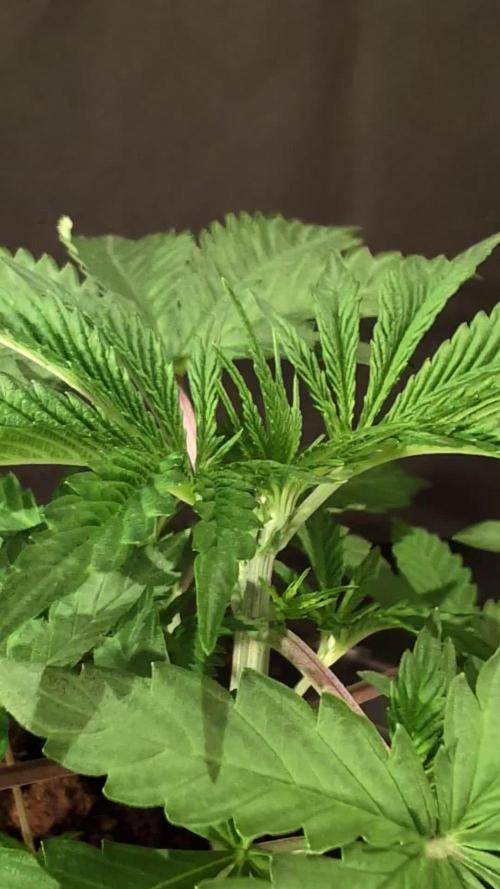
Auto Black Cherry Punch-PyramidSeeds 5/17-23 W6F4 This week I’ve been flushing with plain ph 6.5 water since each plant shows a different level of nutrient issues. All of the black cherry punch gals are in flower with a 45-day window. BCP1 started flower 4/30, which puts harvest June 15th. BCP 5 & 6 are 2 weeks behind BCP1. BCP6 now 24inches tall, started flower on May 14 (~July 1 harvest). BCP5 had a 8 inch stretch this week and is now 20 inches tall. In addition, has started to bloom on May 19. That estimates harvest July 10th. Thanks for stopping by. Stay green, growers love 💚🌿 💫Natrona💫
Likes
Comments
Share
@BruWeed
Follow
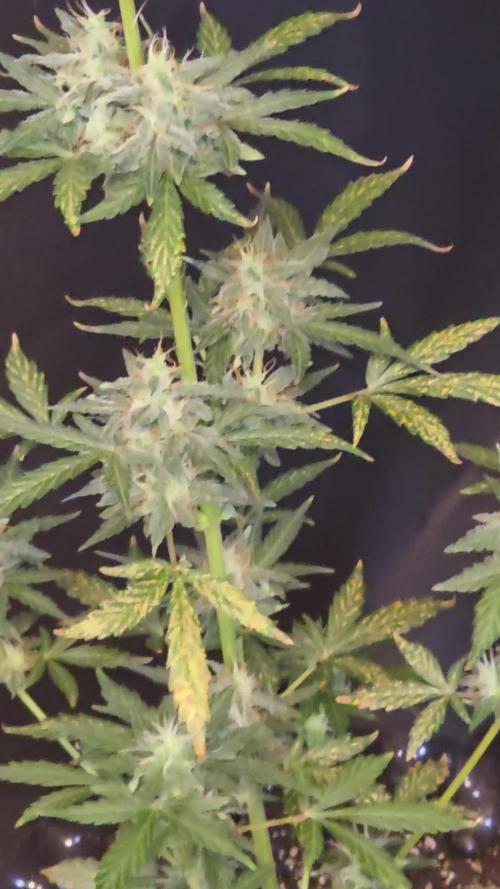
☘️17/11 - La semilla estuvo por 24hs en agua para hidratarse. ☘️18/11 - Puse a germinar la semilla en papel humedo, el 21 de noviembre germino, aprox tenia 3cm. ☘️25//11 - Ya salió el plantin. ☘️27/11 - Ya tiene 3 días de vida, se encuentra perfecta. ☘️Voy a dejarla una semana en Enraizamiento, asi las raices se desarrollan un poco mas antes de pasarla a una maceta de 10L. ☘️Los productos que voy a estar utilizando en todo el cultivo son los de Advance Nutrients. ☘️En crecimiento voy a dejarla 3 semanas con 18/6 de luz. Una vez que ya entre en flora la luz la cambio a 12/12 y el banco de semillas recomienda hasta 9 semanas de floración. ☘️Voy a estar regando con un ph de 5.8 hasta llegar a 6.4. ☘️En estos días estaré publicando mas imágenes de como viene. ☘️Podes seguirme en Instagram como @bruweed_arg para mas contenido.
Likes
4
Share
@NSABND
Follow
Day 43 a new week starts 💪😃👍 Day 44 every single Day a little bit more 😋🙏👍 Day 45 the queens doing well 😃👍 Day 46 cutting the leaves today 😵🙏
Likes
2
Share
We become aware at such times of man's wonderful ability to bring seemingly unrelated elements into harmonic balance, and receive a glimpse into a world where everything exists in conscious sympathetic attunement to everything else. When we listen to a piece of music that seems to strike a beautiful chord somewhere inside us, or view a painting that simply glows with harmonic awareness well executed, we probably do not spare much time to contemplate the wonderfully intricate combination of vibrations that our sensors make it possible for us to perceive. We tend to appreciate the relationship between the parts of something by an awareness of the harmony or dissonance of the whole. This ability enables us to say "what a beautiful house!" instead of "analysis has proven that this collection of building materials exhibits certain elements of harmonic proportion." While this ability to instinctively appreciate the beauty of true harmony has an important role to play in evolution, a more analytical understanding of the laws involved can be most useful. This is especially so if we wish to create works of art where each part exists in true harmony, not only with the other part of that particular whole, but with the universe within which the creator and the created exist. Everything vibrates. From the most dense matter to the most subtle cosmic rays, everything which our senses allow our thoughts to become aware of, can be specified in terms of wavelength or frequency of vibration. These two terms define the same thing, but from different points of view. The following are the approximate wavelengths of various energy carriers: Cosmic rays 0.000,000,001 mm Gamma rays 0.000,000,1 mm X rays 0.000,500 mm Ultraviolet rays 0.003 mm Visible light 0.006 mm Infrared 0.01 mm Sound waves 1 meter Radio waves 300 meters Violet light 400 nm to 450 nm Blue light 450 nm to 500 nm Green light 500 nm to 570 nm Yellow light 570 nm to 590 nm Orange light 590 nm to 610 nm Red light 610 to 700 nm 1 nanometer (nm) = 0.000,000,1 cm = 1/10,000,000 cm If a guitar string is plucked and we hear a sound, it is not too difficult for the human mind to associate this sound with the vibration of the guitar string. With color it is quite different. It is difficult for us to conceive that the color of a substance is not an inherent property of the substance itself, but an indication picked up by our senses of that substance's ability to absorb or reflect the light which happens to be shining on it at that moment. Neither the matter nor the light is colored. What happens is that the brain learns to differentiate between the frequencies reflected or transmitted by the substance the eyes are focused on. The same thing happens with sound. When we say "Oh! Listen, they're playing my favorite song," what we really mean is: "My brain has stored within it a particular pattern of frequencies. I have compared the new information being received with this stored pattern and have deduced the answer that the two patterns are similar within certain specified tolerances." The 'pleasure' involved could have something to do with our running the pre-recorded pattern at the same time, in 'sympathy' with the new pattern as it is received. The word sympathy describes very well our ability to appreciate color and sound. It also describes the reason behind certain elements of harmony. For instance, if a substance vibrating at 100 cycles per second (tone 1) is in the proximity of another substance vibrating at 200 cycles per second (tone 2), we could perceive, if we had the right equipment, a certain sympathetic relationship between the two. We will see from this that there is a uniform doubling of the first tone seen in the second. At various points along the waves, the two are the same in amplitude. At other points, they are at opposite poles to each other. This doubled frequency has more points of similarity to the original than any other frequency except the original itself. If the equipment we had available for measuring these two frequencies was a soundboard amplifier and a pair of ears, then we would hear what would sound to us like one tone. If we had the opportunity to hear one at a time, we would hear that although they sound the same, one is higher in pitch than the other. This characteristic of 'the same but different in pitch', musicians have called the octave. Any two tones produced where one has exactly doubled the frequency of the other is called an octave. Speaking in ratios, an octave would appear then as the ratio 2:1 or 1:2, depending on whether we are talking of an octave up or down. A single note produced by almost any instrument will contain more than one wavelength or frequency. It will have a dominant frequency, the wavelength of which we would call the note's 'fundamental' or 1st harmonic. It will also have a varying number of upper harmonics, gradually fading in intensity into infinity or silence. Natural harmonics always have the same pattern of intervals between them. The interval between the 1st and 2nd harmonic is a perfect octave; between the 2nd and 3rd a perfect fifth; between the 3rd and 4th a perfect 4th; and so on, the intervals becoming smaller and smaller until they lose any relationship with the western 12 tone scale as it exists at the moment. Just as an octave has certain elements of sympathy with its fundamental, so some intervals have been noted to be more perfectly in sympathy with the fundamental than others. The ratio of the 'perfect 5th' or interval of 7 semitones, as it occurs in the harmonic series, is 3:2 or 2:3, while that of the 'perfect fourth" is 4:3 or 3:4. All the tones in the western 12 tone scale can be expressed in terms of the ratio between the upper tone and its fundamental. This would seem to be an ideal way of generating a scale from any given fundamental and several attempts have been made to do this, the Pythagorean system being probably the most well known. Although when working with a single tone instrument playing on its own, the Pythagorean formula works wonderfully well, if we had several instruments tuned this way together and asked them to play almost any western music, we would find that at times they sounded quite out of tune to each other. The lack of flexibility of the various scale systems based on the harmonic series has led to what is known as the 'tempered' scale. This uses as its primary unit of interval the ratio of the octave or 2:1. It then proceeds to divide the interval between any fundamental and its upper octave into 12 smaller intervals by applying the ratio: two to the one-twelfth power, to one (21/12:1). This equals 1.059463094, so by multiplying any frequency by this number, we will obtain the tempered semitone next up from our fundamental. We will also find that any tone twelve semitones up from any other tone, in a scale generated in this way, will have exactly double the frequency. If we took the note middle C on a piano and halved the wavelength, we would have the note C one octave above. If we halved this, we would have the C above, and so on. However, within about 6 octaves, we would find that although a 'sound' was being produced, no human ear could perceive it. If we kept on going, halving and producing upper octaves of our fundamental C, we would proceed through the infrared band, into the visible light spectrum. If we happened to be outside during the day, we would, for one octave only, see the note C with our eyes. The next octave above would already be in the ultraviolet band, and outside the eye's sensitivity range. If we can think of color as being an indication of a substance's vibratory rate or wavelength, we may begin to see a relationship that could exist between the color and sound spectrums. The logical extension of what has so far been said is that there exists a scale in the color spectrum that corresponds exactly to the scale in the sound spectrum, each color tone being an octave of the equivalent note in the sound range. This is not the end of the story but only the beginning. If we can for the moment accept that any wavelength in one band has upper and lower octave stretching out to infinity, then the next question is 'fine, but what shall we use as our fundamental? A particular color? A particular sound frequency?' The musicians among us will probably say 'A 440'. This means that the note A should vibrate at 440 Hertz, or 440 times per second. They would tell us that this is standard pitch has been adopted by most orchestras around the world; pianos are tuned to it, instruments are constructed to formulas based on it, and so to them it would probably seem the most appropriate place to begin. Some of these musicians may know of the battle that is still raging with regards to this being the standard, but few would know why A = 440 Hz was chosen except that it worked when it was set to be a suitable compromise between the many different pitches in use at the time. 432 Hz is said to be mathematically consistent with the patterns of the universe. Studies reveal that 432 Hz tuning vibrates with the universe’s golden mean PHI and unifies the properties of light, time, space, matter, gravity, and magnetism with biology, the DNA code, and consciousness. When our atoms and DNA start to resonate in harmony with the spiraling pattern of nature, our sense of connection to nature is said to be magnified. Another interesting factor to consider is that the A=432 Hz tuning correlates with the color spectrum, while the A=440 Hz is off. Audiophiles have also stated that A = 432 Hz music seems to be non-local and can fill an entire room, whereas A=440 Hz can be perceived as directional or linear in sound propagation. Once you adopt the idea that sound (or vibration in general) can have an equalizing and harmonizing effect (as well as a disturbing effect), the science of harmony can be applied to bring greater harmony into one's life or tune to specific energies. There is a form of absolute and relative harmony. Absolute harmony can, for example, be determined by the tuning of an instrument. The ancients tuned their instruments at an A of 432 Hz instead of 440 Hz - and for a good reason. There are plenty of music examples on the internet that you can listen to in order to establish the difference for yourself. Attuning the instrument to 432 Hz results in a more relaxing sound, while 440 Hz slightly tenses up the body. This is because 440 Hz is out of tune with both macro and micro cosmos. On the contrary, 432 Hz is in tune. To give an example of how this is manifested microcosmically: our breath (0,3 Hz) and our pulse (1,2 Hz) relate to the frequency of the lower octave of an A of 432 Hz (108 Hz) as 1:360 and 1:90. It is interesting to note that 432 Hz was the standard pitch of many old instruments and that it was only recently (19th and 20th century) the standard pitch was increased. This was done in order to be able to play for bigger audiences. Bigger audiences (more bodies) absorb more of the lower frequencies, so the higher pitch was more likely to “cut through”. One of the oldest instruments of the world is the bell ensemble of Yi Zeng (dated 423 BC), tuned to a standard F4 of 345 Hz, which gives an A= 432 Hz. The frequency of 345 Hz is that of the platonic year! Similarly, many old organs are tuned in A=432 as well; for example, St. Peter’s Capella Gregoriana, St. Peter’s Capella Giulia, S. Maria Maggiore in Rome. Maria Renold’s book “Intervals Scales Tones and the Concert Pitch C=128 Hz” claims conclusive evidence that 440 Hz and raising concert pitch above scientific “C” Prime=128 Hz (Concert A=432 Hz) disassociates the connection of consciousness to the body and creates anti-social conditions in humanity. The difference between concert pitch A=440 Hz and Concert A=432 Hz is only 8 cycles per second, but it is a perceptible difference of awareness in the human consciousness experience of the dream we share called existence.
Likes
21
Share
Hey everyone :-). This week she continued to develop very nicely 😍. I started with LST training and topping 😊. The training took it very well and after 1-2 days it grew again immediately 👍. This time it will be an extreme bush 😂👍. It was poured once this week with 1.2 l. Otherwise there is nothing to report this week. I wish you all a lot of fun until the next update. stay healthy and let it grow 😀 You can buy this Strain at https://www.amsterdamgenetics.com/product/kosher-tangie-kush/ Type: Kosher Tangie Kush ☝️🏼 Genetics: Kosher Kush X Tangie 👍 Vega lamp: 2 x Todogrow Led Quantum Board 100 W 💡 Bloom Lamp : 2 x Todogrow Led Cxb 3590 COB 3500 K 205W 💡💡☝️🏼 Soil : Canna Coco Professional + ☝️🏼 Fertilizer: Green House Powder Feeding ☝️🏼🌱 Water: Osmosis water mixed with normal water (24 hours stale that the chlorine evaporates) to 0.2 EC. Add Cal / Mag to 0.4 Ec Ph with Organic Ph - to 5.5 - 5.8 .
Likes
2
Share
Beautiful looking ladies, after 17 days from seed no issues at all, great performance by this 2 ladies, let's see how they keep developing and how big they get before flower! 💚❤️💛👨‍🌾
Likes
31
Share
@MrJones
Follow
These buds were giants, fat and sticky, the aroma of these plants was very robust with heavy aromas with subtle hints of citrus, fruity sweetness, with hints of sour diesel, I could swim in the smell, these buds just blew me away!
Likes
22
Share
@NSCanna
Follow
Not much for feeding this week, accept for the Rezin and some blood meal since she's not as dark green as I would like. Nodes are looking okay so I'm leaving it at current light distance to keep them closer together. Did a large trim and another spray for thrips. Microbe populations are also looking good. Added supplemental CO2
Likes
35
Share
- I didn't weight wet buds. - The trichomes photos have been taken just before the harvest on buds all over the plants. - The hash balls were : a little less than 1cm diameter for the Mandarin Punch#1 and around 3mm diameter for the Mandarin Punch#2 - Drying was made at 20°C and around 50% of humidity. - Humidity in jar around 50% on the first day, temperature around 20°C. MANDARIN PUNCH #1 Veg time : 44 days. Flowering time : 70 days. Total time from seed to harvest : 114 days. Height : 142cm Pot size : 26l Harvest : 61g MANDARIN PUNCH #2 Veg time : 45 days. Flowering time : 67 days. Total time from seed to harvest : 112 days. Height : 123cm Pot size : 10l Harvest : 41g
Likes
8
Share
27/04/2021 (Day 42) Todo viene muy bien, las plantas están comiendo con muchas ganas y consumen unos 15L de solución diario. La preflora está comenzando! Ya se puede observar como van estirando y mostrando bastantes pelos! Los Citizen x 8 están trabajando a un 80% rondado los 500W. 28/04/2021 (Day 43) Se realizo un nuevo cambio de solución, las plantas ya están tirando pelos y los leds están al 80%, se observo un gran crecimiento radicular y las paredes del tallo son increíblemente gruesas y duras. 03/05/2021 (Day 48) Las plantas vienen con un crecimiento optimo pero la flora se está tardando demasiado en hacerse presente, se estima que es debido al estrés que tuvo en semana 3 de vege produjo un retraso de algunos días. Esta semana se incorpora Safe Roots al sistema con la finalidad de que deje la solución lo mas limpia posible. También se realizaron bastantes defoliaciones ya que no existía penetracion de luz teniendo en cuenta el tamaño que están ocupando (85% del espacio de cultivo a 30/35 cm de altura)
Likes
5
Share
Likes
9
Share
6/8 Haven't had to water yet (besides the two tens and I should've held off). It's an overcast day. Perfect for the plants. I've noticed more off shoots of 3 pronged leaves so a few plants will reveg but thats fine. I'm happy with how things are going thus far. These are certainly very resilient strains. I've done some SLIGHT LSTing. EDIT: IT'S BEEN A NICE DAY TODAY. A LITTLE OVERCAST BUT SUNNY AT TIMES. PERFECT WEATHER FOR THE GIRLS. THEY ARE LOVING IT OUT THERE! 6/9 And the girls are lookin' Fiiiiiine. In all seriousness everything is doing pretty good. Even that overwatered pink kush runt in the 10gal is coming out of its little funk. Some of my FIM's turned out amazing! With the reveg of some of these I'll definately have my hands full. Very grateful for smart pots and well draining soil! We've gotten some harsh rain but the girls all seem fine. It's the wind today that's a little worrisome. I may stop over later. I COULD put up tarps around the cage as wind blocks (and have before in the past) but it increases the humidity of an already extremely humid day. These girls are strong. I'm sure they'll be fine. I've found that the tarps typically hurt worse than they help.
Likes
92
Share
Week 3: TrolMaster Chronicles – Transplanting, Growing Strong, and Thriving in PRO-MIX HP 🌱✨ Hey Grow Fam! Another exciting week has flown by in the grow room, and I’m thrilled with the progress! We kicked off Week 3 with our first set of transplants. The Gorilla Melon was transplanted at the end of the week, while the Papaya Zoap is still patiently waiting for its turn to shine. Each plant that’s been transplanted is now comfortably settled in 15-liter Autopots, filled with PRO-MIX HP BIOFUNGICIDE + MYCORRHIZAE, and wow, I’m loving this mix! 🌱 Why PRO-MIX HP is a Game-Changer For those of you unfamiliar with PRO-MIX HP, let’s take a closer look. This soil provides superior drainage and aeration, thanks to its high porosity. The addition of fibrous peat moss and coarse perlite creates an ideal environment for water flexibility. It’s been perfect for the girls as they transition into their final homes. Plus, the biofungicide and mycorrhizae are doing wonders for root development, giving them all the support they need for vigorous growth. The plants are showing off a beautiful, vibrant green, each with its own unique characteristics—no two plants are the same, and I love that! 🌡️ Environment Update: Temps, RH, and More Let’s talk about the conditions the girls are thriving in! We’re sitting at: • Temperature: 26.7°C • Relative Humidity: 62.9% • VPD: 1.30 (I know it’s a bit high, but they’re handling it like champs) • CO2: 800 ppm • pH: 6.18 • TDS: 215 ppm • Solution Temperature: 23.2°C To make things even more efficient, I’ve adjusted the light height, keeping the PPFD around 360 to 400 to save on energy. These beauties are still soaking in the light perfectly, and I couldn’t be happier with how they’re responding. 💧 Watering and Feeding At this stage, the plants are thriving with just enough nutrients to keep them happy. I’ve kept things simple with a balanced solution, ensuring everything stays within the perfect range. The PRO-MIX HP, with its mycorrhizal fungi, is really helping with nutrient uptake and boosting overall health. It’s amazing to see how quickly they’ve adapted! 🌟 Transplants Complete – Progress Feels Incredible! I’m super excited with how everything is shaping up! Most of the transplants went smoothly, and the growth we’re seeing is just amazing. The Papaya Zoap is still waiting for its final move, but it’s growing strong, getting ready for the next step. It’s an honor to work with these genetics—they’re each unique, yet all thriving in their own way. 🌱💚 🌍 Shoutouts and What’s Coming Next I couldn’t do this without the support of my amazing sponsors and all of you, Grow Fam! A huge shoutout to TrolMaster and Aptus Holland for their top-notch gear and nutrients, and of course, to all my followers—whether you’ve been here from the start or are new to the journey, thank you for the love and support! 💚🙏 Don’t forget to check out my Instagram and YouTube, where the Seed to Harvest Series just kicked off! I’m going deep into all the gear, techniques, and day-to-day grow updates you see here. Exclusive content and more are waiting for you on those platforms, so come by and join the fun! Growers Love to everyone, and here’s to another epic week of growth! 💚🌱 Let’s keep pushing the limits and making magic happen. • Nutrition: @aptusholland @aptus_world @aptus_es @aptusbrasil @aptus_thailand @aptus_portugal @aptususa_official @aptusplanttechnz @aptusplanttechaus • Controls: @trolmaster.eu @trolmaster.eu.support @trolmaster.support @trolmaster.agro • Soil: @promix_growers_eur @promix_cannabis @promixmitch P.S. Let’s talk about these new Model One LED bars I’m running. 🌿💡 They’re not just any lights—these are full-spectrum beasts designed to give my plants exactly what they need at every stage of growth. The real magic, though? The dimming feature. With just a quick adjustment, I can dial down the intensity without sacrificing the quality of the light. This means I’m saving on energy costs while still delivering top-tier PAR and maintaining a balanced spectrum. It’s not just about blasting plants with light; it’s about giving them the right light at the right time. By fine-tuning the PPFD (Photosynthetic Photon Flux Density), I’m hitting that sweet spot where the plants thrive, and I don’t have to run the LEDs at full power. So, while I save a bit on electricity, my plants still get the perfect environment to reach their full potential. 🌱✨ This level of control lets me optimize the growth, and trust me, my plants are loving it—just another reason I’m thrilled with the Model One setup. 💚💚💚 Growers Love everyone 💚💚💚
Likes
18
Share
@Hashy
Follow
Most of this week I was away so the tent was on autopilot. When i got back i was pleased to see all 4 strains where still around the same on development. The Amnesia trance is the taller of the 2 AMS autos. She is starting to throw out some nice colours now. I'm fairly confident this one is going to hit my 13 weeks scheduled for it, so not long left. Notes Day 64 nothing away Day 65 autofeed last weeks nutes Day 66 Got back, everything's fine Day 67 manually water Day 68 light strength from 75% to 87% PPFD was 579 Dli was 37.5 now its 634Ppfd 41.1Dli. Day 69 autofeed this weeks nutes Day 70 795Ppfd 51.3Dli Back in a week Take it easy.
Likes
10
Share
@AsNoriu
Follow
Day 71. Biggest by size, but maybe not by overall weight of harvest ;)))) she is most hungry and lost foliage... This girl definetly makes me regret, that i didn't use any nutes ... Smell is weakish, worst from all 3 . Mars TS1000 did a great job to her during veg, but now she spends time under my quantum board. Took most damaged leaves away. 3.5 liters of water goes in. Day 76. 3.5 liters in. Lower part is far from maturity, she needs like 3 weeks still i think. Getting some funky colours ... Happy Growing !!!
Likes
14
Share
@PlantGod
Follow
Today March 10th is day 50! I spend a few hours of work every other day to tie branches and manipulate leaves -white pistols are showing -will secure netting and stop using pipe cleaners to tie down at the end of the week -I have been using nutrients about every other watering -1.5 tsp micro .5tsp grow 1.5 tsp bloom in about 2 Litres of water After 2 weeks. Royal Gorilla is the fastest blooming followed by the Green Gelato. The LSD is slower. The HulkBerry I started 4 days later is blooming ok
Likes
120
Share
Well, this is week five and these lovely ladies are taking off. The only problems I have had (knock on wood) was the autopots valve sticking and flooding occasionally. I think I have them figured out though. Customer service from them is amazing. I will as always update throughout the week. Take care and happy growing. 🙂
Likes
30
Share
Can’t wait 🔥🌬️💨💨💨🍃🍃🍃🍃🍃🍃🍃🍃🍃
Likes
9
Share
@Kayotic
Follow
* Smells very strong now, hint of grape and intense gas scent * Buds are starting to fatten up * Watering twice a day * Supposed to be over 100 degrees today and tomorrow