Likes
Comments
Share
@RdSkM
Follow
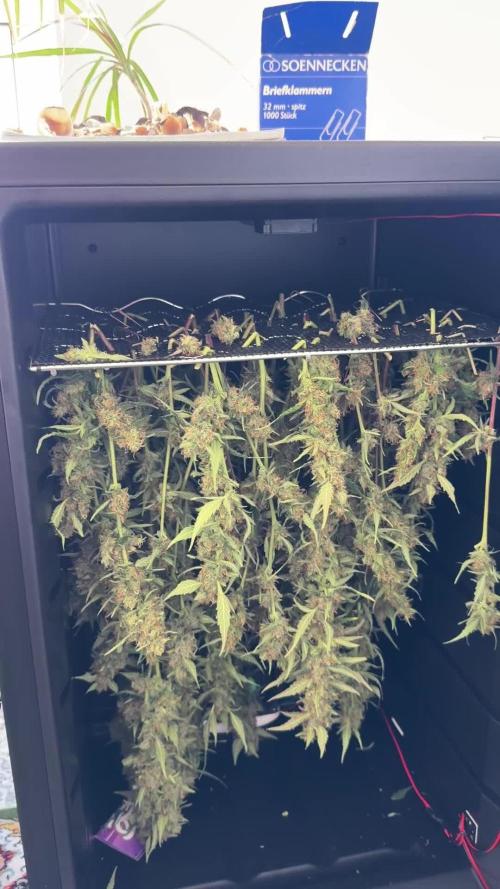
¿Qué opináis, eh?... Otra más de mi colección que se va a proceso de corte y secado (luego de manicurar, claro).
Likes
52
Share
Once again she passes my expectations, late to the show with trichome production. I'm surprised there is purple on the bud, maybe Purpinator does work. I thought I could see hints under the grow lights and thought my eyes were deceiving me, I was just being hopeful. But nah 2 of the 3(under the UV) have developed a beautiful tone of purple. I was never going to bother with a deep freeze but maybe the whole bud will change given conditions, that would be something, fingers crossed. 🤔 was a little skeptical that reducing temps humidity would change density, but it does, buds are solid something I've not been able to achieve before. Rule of thumb is never to surpass 60% RH in the flowering phase and try to progressively reduce it down to 40% in the last 2–3 weeks before harvest. The plant will react as it seeks to protect its flowers, responding by producing denser buds and a higher concentration of resin. Cannabis plants are sensitive to sudden temperature changes, especially in the flowering stage. Extreme heat or cold can impact bud density and overall yields. In nature as a defense mechanism from cold, the plant sensing sudden dips in temperature will attempt to remove the pockets of air within the bud, it achieves this by compacting itself in doing so to better protect itself from cold snaps which are normally indicators in nature that worse weather is on the way. Terpene levels are the highest just before the sun comes out. Ideally, you want as many terpenes present in your plants as possible when you harvest. Cannabis plants soak up the sun during the day and produce resin and other goodies at night. The plant is at its emptiest from "harvest undesirables" so to speak right before the lights on. Boiling cannabis roots during harvesting slows down the drying process. When you boil cannabis roots, it shocks the plant, closing the stomata on the leaves. This prevents massive moisture loss through the leaves, leaving only the floral clusters actively losing moisture at a reduced pace. I've always run a strict 60/60 and it took almost twice as long to dry to a snap than previous grows where I didn't boil for what it's worth. Chlorophyll is good for the plant but not for you. When you harvest the buds, even after you flush them, if you flush them, they’re still filled with chlorophyll. Freshly cut buds are greener than dried buds because they still contain loads of chlorophyll. However, when rushed through the drying process, the buds dry but retain some chlorophyll, and when you smoke it, you will taste it. Chlorophyll-filled buds are smokable, but they aren’t clean. Slow drying gives the buds enough time and favorable conditions to lose the chlorophyll and sugars, giving you a smoother smoke. How the plant disposes of the chlorophyll and sugars by a process of chemically breaking them down and attaching the decomposed matter once small enough to water molecules which then evaporate back into the ether. Time must be given to the process to break down the chlorophyll and sugars. Think of it like optimizing the environment for decay. All the nutrients it could ever need are in abundance, it eats nutrients based on its demand for growth, which is dictated primarily by available light. Plant growth and geographic distribution (where the plant can grow) are greatly affected by the environment. If any environmental factor is less than ideal, it limits a plant's growth and/or distribution. For example, only plants adapted to limited amounts of water can live in deserts. Either directly or indirectly, most plant problems are caused by environmental stress. In some cases, poor environmental conditions (e.g., too little water) damage a plant directly. In other cases, environmental stress weakens a plant and makes it more susceptible to disease or insect attack. Environmental factors that affect plant growth include light, temperature, water, humidity, and nutrition. It's important to understand how these factors affect plant growth and development. With a basic understanding of these factors, you may be able to manipulate plants to meet your needs, whether for increased leaf, flower, or fruit production. By recognizing the roles of these factors, you'll also be better able to diagnose plant problems caused by environmental stress. Water and humidity *Most growing plants contain about 90 percent water. Water plays many roles in plants. It is:* A primary component in photosynthesis and respiration Responsible for turgor pressure in cells (Like the air in an inflated balloon, water is responsible for the fullness and firmness of plant tissue. Turgor is needed to maintain cell shape and ensure cell growth.) A solvent for minerals and carbohydrates moving through the plant Responsible for cooling leaves as it evaporates from leaf tissue during transpiration A regulator of stomatal opening and closing, thus controlling transpiration and, to some degree, photosynthesis The source of pressure to move roots through the soil The medium in which most biochemical reactions take place Relative humidity is the ratio of water vapor in the air to the amount of water the air could hold at the current temperature and pressure. Warm air can hold more water vapor than cold air. Relative humidity (RH) is expressed by the following equation: RH = water in air ÷ water air could hold (at constant temperature and pressure) The relative humidity is given as a percent. For example, if a pound of air at 75°F could hold 4 grams of water vapor, and there are only 3 grams of water in the air, then the relative humidity (RH) is: 3 ÷ 4 = 0.75 = 75% Water vapor moves from an area of high relative humidity to one of low relative humidity. The greater the difference in humidity, the faster water moves. This factor is important because the rate of water movement directly affects a plant's transpiration rate. The relative humidity in the air spaces between leaf cells approaches 100 percent. When a stoma opens, water vapor inside the leaf rushes out into the surrounding air (Figure 2), and a bubble of high humidity forms around the stoma. By saturating this small area of air, the bubble reduces the difference in relative humidity between the air spaces within the leaf and the air adjacent to the leaf. As a result, transpiration slows down. If the wind blows the humidity bubble away, however, transpiration increases. Thus, transpiration usually is at its peak on hot, dry, windy days. On the other hand, transpiration generally is quite slow when temperatures are cool, humidity is high, and there is no wind. Hot, dry conditions generally occur during the summer, which partially explains why plants wilt quickly in the summer. If a constant supply of water is not available to be absorbed by the roots and moved to the leaves, turgor pressure is lost and leaves go limp. Plant Nutrition Plant nutrition often is confused with fertilization. Plant nutrition refers to a plant's need for and use of basic chemical elements. Fertilization is the term used when these materials are added to the environment around a plant. A lot must happen before a chemical element in a fertilizer can be used by a plant. Plants need 17 elements for normal growth. Three of them--carbon, hydrogen, and oxygen--are found in air and water. The rest are found in the soil. Six soil elements are called macronutrients because they are used in relatively large amounts by plants. They are nitrogen, potassium, magnesium, calcium, phosphorus, and sulfur. Eight other soil elements are used in much smaller amounts and are called micronutrients or trace elements. They are iron, zinc, molybdenum, manganese, boron, copper, cobalt, and chlorine. They make up less than 1% of total but are none the less vital. Most of the nutrients a plant needs are dissolved in water and then absorbed by its roots. In fact, 98 percent are absorbed from the soil-water solution, and only about 2 percent are actually extracted from soil particles. Fertilizers Fertilizers are materials containing plant nutrients that are added to the environment around a plant. Generally, they are added to the water or soil, but some can be sprayed on leaves. This method is called foliar fertilization. It should be done carefully with a dilute solution because a high fertilizer concentration can injure leaf cells. The nutrient, however, does need to pass through the thin layer of wax (cutin) on the leaf surface. It is to be noted applying a immobile nutrient via foliar application it will remain immobile within the leaf it was absorbed through. Fertilizers are not plant food! Plants produce their own food from water, carbon dioxide, and solar energy through photosynthesis. This food (sugars and carbohydrates) is combined with plant nutrients to produce proteins, enzymes, vitamins, and other elements essential to growth. Nutrient absorption Anything that reduces or stops sugar production in leaves can lower nutrient absorption. Thus, if a plant is under stress because of low light or extreme temperatures, nutrient deficiency may develop. A plant's developmental stage or rate of growth also may affect the amount of nutrients absorbed. Many plants have a rest (dormant) period during part of the year. During this time, few nutrients are absorbed. Plants also may absorb different nutrients as flower buds begin to develop than they do during periods of rapid vegetative growth. 432 Hz is said to be mathematically consistent with the patterns of the universe. Studies reveal that 432 Hz tuning vibrates with the universe’s golden mean PHI and unifies the properties of light, time, space, matter, gravity and magnetism with biology, the DNA code and consciousness. When our atoms and DNA start to resonate in harmony with the spiraling pattern of nature, our sense of connection to nature is said to be magnified. Another interesting factor to consider is that the A=432 Hz tuning correlates with the color spectrum while the A=440 Hz is off. Audiophiles have also stated that A = 432 Hz music seems to be non-local and can fill an entire room, whereas A=440 Hz can be perceived as directional or linear in sound propagation. Once you adopt the idea that sound (or vibration in general) can have an equalizing and harmonizing effect (as well as a disturbing effect), the science of harmony can be applied to bring greater harmony into ones life or a tune to specific energies. There is a form of absolute and of relative harmony. Absolute harmony can for example be determined by the tuning of an instrument. The ancients tuned their instruments at an A of 432 Hz instead of 440 Hz - and for a good reason. There are plenty of music examples on the internet that you can listen to in order to establish the difference for yourself. Attuning the instrument to 432 Hz results in a more relaxing sound, while 440 Hz slightly tenses up to body. This is because 440 Hz is out of tune with both macro and micro cosmos. On the contrary, 432 Hz is in tune. To give an example of how this is manifested micro cosmically: our breath (0,3 Hz) and our pulse (1,2 Hz) relate to the frequency of the lower octave of an A of 432 Hz (108 Hz) as 1:360 and 1:90. It is interesting to note that 432 Hz was the standard pitch of many old instruments, and that it was only recently (19th and 20th century) the standard pitch was increased. This was done in order to be able to play for bigger audiences. Bigger audiences (more bodies) absorb more of the lower frequencies, so the higher pitch was more likely to “cut through”. One of the oldest instruments of the world is the bell ensemble of Yi Zeng (dated 423 BC), tuned to a standard F4 of 345 Hz which gives an A= 432 Hz. The frequency of 345 Hz is that of the platonic year! Similarly many old organs are tuned in an A=432 as well; for example: St. Peter’s Capella Gregoriana, St. Peter’s Capella Giulia, S. Maria Maggiore in Rome. Maria Renold’s book “Intervals Scales Tones and the Concert Pitch C=128 Hz” claims conclusive evidence that 440 Hz and raising concert pitch above scientific “C” Prime=128 Hz (Concert A=432 Hz) disassociates the connection of consciousness to the body and creates anti-social conditions in humanity. The difference between concert pitch A=440 Hz and Concert A=432 Hz is only 8 cycles per second, but it is a perceptible difference of awareness in the human consciousness experience of the dream we share called existence.
Likes
7
Share
💙 Project Blue Tent – Week 5 Blue Waffle F1 – Pheno A (Folder 13A) Welcome back everyone to another week inside Project Blue Tent! If this is your first visit, welcome aboard. This project is dedicated to exploring the incredible Blue Waffle F1 genetics from Zamnesia while putting the complete Zamnesia ecosystem through its paces. Rather than growing multiple plants as one crop, every phenotype is documented individually, allowing each one to tell its own story despite sharing the exact same environment, nutrients, lighting and care. Unlike our 8×8 Adventure, where different cultivars grow together, Project Blue Tent focuses on understanding every subtle difference between identical F1 genetics. Every week we watch these plants develop, compare their structures, and discover how each expresses its own unique personality. As we like to say... We are not just growing seeds—we are discovering individual personalities. This week has been one of the most exciting since the project began. Plant A has responded beautifully to last week's topping, the feeding adjustments have brought back the deep green colour we were looking for, the SCROG net has officially been installed, and one important upgrade has made the entire irrigation system safer and more reliable. Sometimes the biggest progress isn't measured by the plants alone. Sometimes it's the grow room that evolves alongside them. ──────────────────────── 🌱 Week Five – Everything Comes Together Looking back over the past few weeks, it's incredible to see how quickly everything has started coming together. After establishing a healthy root system and recovering perfectly from topping, Plant A has exploded with vigorous vegetative growth. The canopy has become noticeably fuller, side branches have accelerated dramatically, and every growing tip seems eager to compete for its place beneath the light. One of the biggest improvements this week has been her colour. The slightly lighter green we observed over the previous weeks has completely disappeared after increasing the nutrient strength. The foliage has returned to a rich, healthy green, confirming that the plants were simply asking for a little more food. It's always satisfying when the plants respond exactly as you hoped. Sometimes they don't need rescuing. Sometimes they just need to be heard. ──────────────────────── 🌡️ The Blue Tent Environment The environment continues to be one of the strongest aspects of this project. Even with warmer summer conditions outside, the Zamnesia ecosystem has continued providing a remarkably stable environment, allowing the plants to focus entirely on growing instead of constantly adapting to fluctuations. This week's average conditions were: • 🌡️ Day Temperature: 30°C • 🌙 Night Temperature: 27°C • 💧 Relative Humidity: 58% • ⚗️ pH: 5.8 • ⚡ EC: 1.92 mS/cm • 💨 CO₂: approximately 450 ppm • 💡 Light Schedule: 18/6 • ☀️ PPFD: approximately 350 The Phytonaut LED continues producing an even spread of light across the canopy, while the Grow Environment Controller quietly keeps everything stable in the background. When the environment remains consistent, every adjustment we make becomes easier to evaluate. ──────────────────────── 🥥 Feeding Update This week's feeding program remained wonderfully simple. One of the things I'm genuinely enjoying about growing with the Plagron Hydro line is just how uncomplicated everything is. There are no complicated recipes or endless bottles to keep track of. The plants are currently receiving: • Hydro A – 1.9 ml/L • Hydro B – 1.9 ml/L • Hydro Roots – 1 ml/L Along with very small pH adjustments whenever necessary. That's it. Coming from many years of growing organically in living soil, I've been pleasantly surprised by how stable the nutrient solution remains throughout the week. Once everything is mixed and adjusted, it simply stays where it should. Even better, the increased feeding strength has delivered exactly what I was hoping for. The richer green colour has returned across all four plants, new growth is vigorous, and the entire tent looks happier because of it. Sometimes simple really is better. ──────────────────────── 💧 Learning From Experience – Installing the Drainage System One of the biggest upgrades this week wasn't made to the plants themselves. It was made to the room. Back in Week Three we experienced a small flood caused by the drip irrigation system. It wasn't anything catastrophic—we cleaned everything up with towels and carried on—but it reminded me of something I've always believed. Automation is wonderful. As long as it's supported by good safety systems. Rather than hoping it would never happen again, I decided to improve the entire setup. This week I installed the Mars Hydro Auto Drainage System alongside the existing drip irrigation system. The concept is beautifully simple. The drip system feeds each plant from the main reservoir. Any runoff is collected inside specially designed trays beneath each grow bag. That runoff then flows into a small collection reservoir, where a compact pump automatically sends the water back into the main reservoir. The result is a much cleaner, safer and more efficient system that dramatically reduces the chance of standing runoff accumulating inside the tent. It creates something very close to a closed-loop irrigation system while keeping maintenance incredibly straightforward. Good automation isn't about removing the grower. It's about removing unnecessary problems so we can spend more time observing the plants instead of cleaning the floor. ──────────────────────── 🕸️ SCROG Time Another huge milestone this week was finally installing the SCROG net. Last week's topping created multiple new leaders, and this week those branches were growing so vigorously that it became the perfect moment to begin shaping the canopy. The goal of a Screen of Green isn't simply to hold branches in place. It's about guiding every branch horizontally, creating an even canopy where every future flowering site receives equal access to light. Rather than allowing one dominant stem to race ahead, the screen encourages every branch to become a potential top. Plant A has responded beautifully. Her branches remain flexible, healthy and easy to work with, making the first stage of weaving both enjoyable and incredibly rewarding. The framework is now beginning to take shape. ──────────────────────── 🌿 Plant A Herself Every week this phenotype reveals a little more of her personality. She isn't the largest plant inside the Blue Tent. She isn't trying to be. Instead, she's developing into one of the most balanced plants in the room. Her branching is wonderfully symmetrical, the internodal spacing remains tight, and every new shoot seems perfectly positioned to become another future flowering site. The topping has encouraged vigorous lateral growth, while the improved feeding has given her that rich green colour that instantly catches my attention every time I open the tent. Looking beneath the canopy, her structure is clean, open and well organised, which should provide excellent airflow as flowering approaches. She's becoming exactly the kind of plant I enjoy growing. Calm. Balanced. Healthy. And quietly preparing for what's coming next. ──────────────────────── 👀 Looking Ahead Next week will be all about continuing to guide the branches through the SCROG while allowing the canopy to spread naturally across the screen. Most of the hard work has already been done. Now it's simply a matter of patience, gentle training and allowing the plants to keep doing what they do best. If they continue responding the way they have over the past week, I expect the Blue Tent to become a sea of perfectly level tops before long. Sometimes the biggest improvements don't happen because we force them. They happen because we create the right conditions and allow nature to do the rest. ──────────────────────── 💙 Thank You A huge thank you goes out to Zamnesia for making this entire project possible—from these beautiful Blue Waffle F1 genetics to the complete ecosystem surrounding this grow. A massive thank you as well to Plagron for providing the Premium Coco Growbags and the Hydro nutrient line that is feeding these ladies every single day. A special thank you as well to Mars Hydro for designing the drip irrigation and automatic drainage system that has become such a valuable addition to this grow. Although this isn't a sponsored product, it's one of those pieces of equipment that simply works. After our little flooding adventure a couple of weeks ago, this system has brought an extra level of safety, cleanliness and peace of mind to the grow room, allowing me to spend more time enjoying the plants and less time worrying about runoff management. Thank you to GrowDiaries for giving growers from all around the world a place to document, learn and share our journeys together. And finally… Thank you to every single person reading these updates. Whether you’ve been following since day one, recently joined the adventure, leave comments every week, simply stop by to look at the photos, or even quietly disagree with my methods—you all contribute to making this community what it is. I genuinely appreciate every view, every conversation, every piece of advice, every question, every like, every criticism, and every bit of support. I hope you’re all having an amazing week, and I can’t wait to show you how these beautiful ladies evolve in the next update. Until then… Growers Love, happy growing, and I’ll see you all next week. 🌱💙
Likes
26
Share
Coming to the end of week 2 more photos to up loaded!! New lighting system ended up getting 2 3500k and 2 6500k cobs . Can tell my plants are already loving them fastest growth rate I've seen since my first grow !! Gg4 and 3 are looking fucking amazing 7 outta 8 in solo cups looking good Caramella never cracked kinda pissed but it's whatever ! I have one forgotten cookie by metophstic limited edition soaking so let's see :) . Temps between 77 n 85v Humidity 70 80% 24 hours on Water every 5 to 7 days using a one gal Solo cups get small amounts So far so good :)! Further along updated at the start of week 3.
Likes
7
Share
@Scoota710
Follow
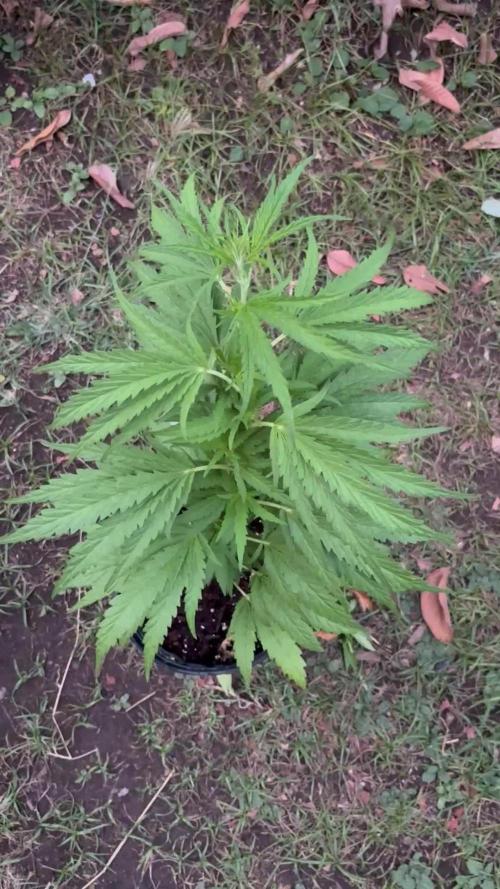
This plant has been a pain in the A**... it started doing LST on itself prior to me topping it. Leaning to the side but growing upwards? Really odd to see.
Processing
Likes
13
Share
This plant has a solid stench of pure ripe lemons. So much aroma and color in every bud, purples, to dark green, to lime green, to solid frost. This one definitely a fun strain to watch grow and tend too for the last few months. She’s definitely a hungry girl, seemed to be the only strain out of the three that accepted and thrived with full feed nutrients. Would definitely recommend this Strain to someone For a nice uplifting day smoke, also seems to do me good for some pain and stress relief.
Likes
8
Share
Servus Moin! Die Pinapple Slush XL hat sich wohl erstmal erholt. Diese Woche ist super Wetter und das nutze ich, sie gleich draußen hinzustellen.
Likes
12
Share
The girls have survived another week ❤️ I did a light defoliation and have been monitoring the RH closely. We have had a very damp week here, and the RH kept climbing and had my fan working hard. They are starting to plump up and fill in 😋. They have also started to slow their drinking habits, instead of watering every three days, it has moved to every 4 now. Just a couple of weeks left, I think I will be harvesting these over Christmas 🎄, and will have some great bud ready for the new year! 🎉🎊🍾
Likes
27
Share
14.12. Day 85 of life. 47 of flower. Dry out. Leaves go yellow. Soaking all she had to the buds. You can see there still fresh phylaxien growing. BTW. Feeling sad to see this. But its a dry summer. BRAINOVERDOSE. TOO MUCH MUHAHA GAGA 😂 😂 😂 😂 I SWEAR: Looking my Northern Lights auto. Thinking.. Hmm looks great like Short Ryder. Hmm looks exactly (bud structure) like her. Maybe there's a lowyrider in her? Muhaha exactly! DR JOINTS lowyrider. But the Lowyrider 2. GREAT. You know Ruderalis? DR. JOINT. brought this holy chalice to the world. 15.12. . 😛 💪 16.12. Annotation.: leaves die but still some fresh white phylaxien. 17.12. Enough juice in the flowers. 18.12. Day 51 of flower. Chop day.
Processing
Likes
16
Share
@MrWolfe
Follow
What an awesome thing to walk in on starting off week three all the girls were praying and just getting so fat, I really need to strip some fan leaves off the mom. They look great, the smaller cuts definitely aren't as good as the 4-6" cuts are, they were MAYBE 3-4" cuts and pretty small, but they are extras anyways so it doesn't matter, just seeing what they do. I'm excited for them to have all this space to stretch out when I pick up another light. Last day of week three and I couldn't be happier, I absolutely have to cut thicker clones , these smaller ones all got a bulbous base? Not sure what that's about but we will see how they develop. They are extras anyways but still nice to figure it all out.
Likes
540
Share
@yan402
Follow
🌸🍏✨🍭🌸🍏✨🍭🌸🍏✨🍭🌸 Hi and welcome to another Kannabia grow! This time I’m running their Apple Fritter (feminized photoperiod). She’s going to veg under 24hr light and be manifolded. Still cleaning the rest of my Candy Cream GF (11.04.25) — going to sow the seed tomorrow (12.04.25) *been lazy, sowed on 14.04.25 🌸🍏✨🍭🌸🍏✨🍭🌸🍏✨🍭🌸 --- 💭❗💭❗💭❗💭❗💭❗💭❗💭 ❗Events & thoughts worth noting❗ 💭❗💭❗💭❗💭❗💭❗💭❗💭 12.04.25 (GW1) – Cleaning + flushing the old coco coir. Might need to add another brick. *No new brick needed ✅ This is how I recycle my coco coir — fast, cheap, no BS. 🌿 Harvest plant ✂️ Chop roots small — they stay in for structure (organic perlite) 💦 Hot water rinse — remove salts & dust 🍶 Pre-soak with light feed:   Micro 10ml   Bloom 0ml   GreenBuzz 10ml   Cal-Mag 60ml   FFJ/FPJ 10ml (new disgusting batch)   pH down (citric acid) ♻️ Media stays — Roots stay — Back in service. 14.04.25 (GW1) – Planted seed in final pot ✅ 16.04.25 (GW1) – Did last tent clean up + setup ✅📸 17.04.25 (GW1) – Seed germinated 🎉📸 — roughly 48hrs in final pot. Solid start👌♥️ 23.04.25 (VW1) – Minimal burnt tips 📸 — not progressing, not a concern. 26.04.25 (VW1) – Started using the new batch of FPJ/FFJ https://growdiaries.com/diaries/266849-grow-journal-by-yan402 30.04.25 (VW2) – Increased TriPartMicro & GreenBuzzBloom 10ml → 15ml 03.05.25 (VW2) – Increased TriPartMicro again 15ml → 20ml, topped the plant, and added final layer of clay pebbles around the base, trimmed side branches and did LST in preparation for "manifold" 📸 08.05.25 VW3 finished manifold📸 13.05.25 VW4 Increased TriPartMicro to 30ml and GreenBuzzBloom to 20ml. 15.05.25 VW4 Done defoliation and LST 📸 18-19.05.25 VW5 pruned all the shoots bellow my "mains" and did a full defoliation📸 24.05.25 VW6 increased GreenBuzzBloom to 30ml 04.06.25 VW7 did a cleanup📸 11.06.25 VW8 increase TriPartMicro to 40ml 17.06.25 (VW9) – Final structure pass 💈🌿 Did a clean perimeter prune + removed weak shoots. Ended up with 12 tops, was aiming for less, but she made the call Didn’t fight it, just shaped it the best I could Airflow’s good, structure’s stable 🛑 No more cuts until post-stretch Pics coming shortly 😘 Flip coming soon — we’ll see how she handles it. 20.06.25 VW9 Switched lighting to 12 hours, may the stretch begin 🤞 22.06.25 VW10 Did a good LST session,made some pics, and came to some conclusions and a small change of plans: Originally planned for 8 mains — long, spaced colas and maybe a couple stronger “titans” if she wanted to go that way. But she’s showing me something else, and I’m not here to fight her — just guide her. Now after stretch, I’m keeping side shoots only if they: Fill real canopy gaps Don’t crowd neighboring tops (minimum 15cm spacing) Aren’t growing into walls or toward the next plant Anything too close, too low, or heading into shade gets removed. No point forcing it. Looks like I’ll finish with 14–16 solid tops, depending on how she settles. I’m just trying to give each one enough light and space to stack properly. No overcrowding, no larf — just letting her do her thing with a bit of structure. Increased Tri Part Micro to 50ml as well. 28.06.25 VW11 one week since I flipped to 12/12 and she is stretching nicely, a bit shy in showing pistils compared to the Fantasy Feast regulars I have in the same tent. 29.06.25 VW11 increased GreenBuzzBloom 30→ 60ml 06.07.25 FW1 TriPart Micro: 50→ 30ml TriPart Bloom: 0 → 20ml Home-made FFJ/FPJ (Watermelon + Pumpkin): 10 → 30ml 12.07.25 FW1 GreenBuzzBloom 60 →40ml, TriPart Bloom: 20 → 60ml, fpj 30→60ml 19.07.25 FW3 Got some bleached tops, been out and about at job interviews and didn't notice a last minute stretch spurt 😭, should recover fine though plenty of time left 😁 22.07.25 FW3 TriPartMicro 30→20ml , TriPartBloom 60→80ml , GreenBuzzBloom 40→50ml 24.07.25 FW3 Cal-Mag 60→40ml 26.07.25 got thrips but handled them with extra airflow and defoliation. 29.07.25 FW4 GreenBuzzBloom 50→20ml, Home-made FFJ/FPJ (new batch) 60→120ml 31.07.25 FW4 Home-made FFJ/FPJ (new batch) 120→200ml 13.08.25 FW6 CalMag 40 →30ml, GreenBuzzBloom 20→0ml 🌱💦🌱💦🌱💦🌱💦🌱💦🌱 🌿 Day to day tasks & actions 🌿 🌱💦🌱💦🌱💦🌱💦🌱💦🌱 09.08.25 FW5 – Fed 5l of #1 at 50%→ 2l runoff 10.08.25 FW6 – Fed 5l of #1 at 25%→ 2l runoff 11.08.25 FW6 – Fed 5l of #1 at → 2l runoff 12.08.25 FW6 – Fed 5l of #1 at → 2l runoff 13.08.25 FW6 – Fed 5l of #1 at → 2l runoff 14.08.25 FW6 – Fed 5l of #1 at → 2l runoff 15.08.25 FW6 – Fed 5l of #1 at → 2l runoff 16.08.25 FW6 – Fed 5l of #1 at → 2l runoff (*RUNOFF reused for tomato plants) 🍶💧🍶💧🍶💧🍶💧🍶 💧 Nutrients in 30L #1 🍶💧🍶💧🍶💧🍶💧🍶 TriPart Micro: 10 → 15 → 20 → 30 → 40 → 50 → 30 → 20 ml = 0.67 ml/L TriPart Grow: 0 ml = 0.00 ml/L TriPart Bloom: 0 → 20 → 60 → 80 ml = 2.67 ml/L GreenBuzz Bloom: 10 → 15 → 20 → 30 → 60 → 40 → 50 → 20 → 0 ml = 0.00 ml/L Cal-Mag: 60 → 40 → 30 ml = 1.00 ml/L Home-made FFJ/FPJ: 10 → 30 → 60 → 120 → 200 ml = 6.67 ml/L pH Down: Citric acid (BuxXtrade) — adjust to ~pH 6.0 📦 TOTAL: 330 ml per 30 L 🔬 11.00 ml/L 🍶💧🍶💧🍶💧🍶💧🍶 ⚙️✂️⚙️✂️⚙️✂️⚙️✂️⚙️ ✂️ Tools & equipment ✂️ ⚙️✂️⚙️✂️⚙️✂️⚙️✂️⚙️ ✂️ 2× MarsHydro SP3000 ⚙️ MarsHydro 150mm ACF Ventilator ✂️ Trotec dehumidifier (big unit) ⚙️ Mini no-name dehumidifier ✂️ Kebab skewers (LST – stainless) ⚙️ Wire + roast skewers (LST assist) ✂️ Scissors (HST) ⚙️ Vacuum (for spills & cleanup) ✂️⚙️✂️⚙️✂️⚙️⚙️✂️⚙️✂️⚙️✂️⚙️ --- 🍏🍪🌬️🍬🍏🍪🌬️🍬🍏🍪🌬️🍬 Apple Fritter (Kannabia Seeds) 🍏🍪🌬️🍬🍏🍪🌬️🍬🍏🍪🌬️🍬 Species: 50% Indica / 50% Sativa Genetics: Sour Apple × Animal Cookies THC: Up to 25% Effect: Euphoric, relaxing, creative Flavor: Sweet, fruity, pastry notes Flowering: 56–63 days Resistance: High Indoor yield: 450–500g/m² Outdoor yield: 600g/plant Structure: Strong, bushy, dense buds
Likes
29
Share
Amazing structured plant, little to no training all dense buds from this cross of Sugar Cane x Velvet Breath.
Likes
3
Share
@GorkedOut
Follow
I did a staggered harvest (chopped the top colas) off 3 of the plants. 1 plant is a few weeks behind on growth so I left that one alone. The colas I chopped looked beautiful. Nice and chonky.
Likes
1
Share
Likes
23
Share
@Chubbs
Follow
420 Fastbuds Week 5 Gorilla Zkittlez Auto Weekly update on these 2 have been wonderful. They both are maturing amazing not showing any real signs of issues. The transition from veg to flower went about as smooth as one could hope for. I did decide to do another defoliation taking off the bigger fan leafs. Also I lollipoped them a bit taking off the first 2-3 nodes allowing more airflow to the topsoil while letting the plant focus more energy on the upper flower sites. Keeping up the same routine as far as light cycle, watering, and preventative maintenance. Happy Growing
Likes
5
Share
The stretch phase is over and the Platinum Zooks is doing fabolous😃 I gave her a heavy haircut (defol & lollipop) @ day 11 of flower. ( she didn't mind ) On day 18 of flower i'm gonna give her, her first Bio-Tabs Compost Tea to give her a little extra push in the back.
Likes
16
Share
@Mrg7667
Follow
Day 53 I dont know how i skipped a whole week? But it happens Plants are looking a little rough, i flushed 2-3 times with just greatwhite and water. Its weird because they got yellow so fast but the tips still look clawed im some spots so im scared to go back to full feed. Slowly added 1ml bioheaven and alga mic then 2ml/l bioheaven and alga mic. Tryingnto get back up to normal feeding
Likes
70
Share
So this is how things are looking for the ladies at the end of Week 6 of Veg guys, I have uploaded a video with more information, any questions just ask in the comments 👍🏾🌱💚 HAPPY GROWING