


Likes
Comments
Share

@der_mycologe
Follow
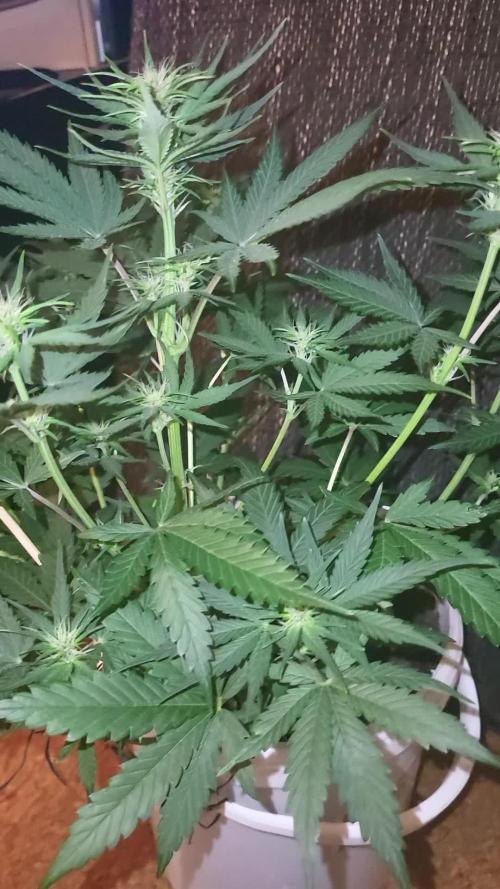
Sie ist jetzt Anfang 6 Woche, sie baut blüten Struktur auf und man kann sehen was kommt ,habe Leichte gelbe spitzen na ja leicht 👀selbst. vll habe ich es mit dem Dünger übertrieben . Aber gut sie sieht fit aus!! Ist übrigens meine erste Autoflower!!!


Processing
Likes
6
Share


@DieDaggaWalm
Follow
This is one amazing grow. Especially in a micro grow with a 5L fabric pot. I’ve increased the GHE bloom and cleaned up leaves at the bottom and fan leaves covering flowers. More light penetration.


Likes
11
Share


@Beedog
Follow
Day 70 Really struggled with high temperatures this week everyday was 33 plus and nights wasn’t much cooler just glad it’s over now got a week left until I have to harvest hopefully they be ready to go by then most of em anyways
Likes
11
Share


@Bncgrower
Follow
Another week almost finished, we are on the final phase and tomorrow I will start watering it only with water, to harvest this little girl later.. See you next week.. 🌱🌱
Likes
7
Share

@XanHalenTGI
Follow
April 11 2026
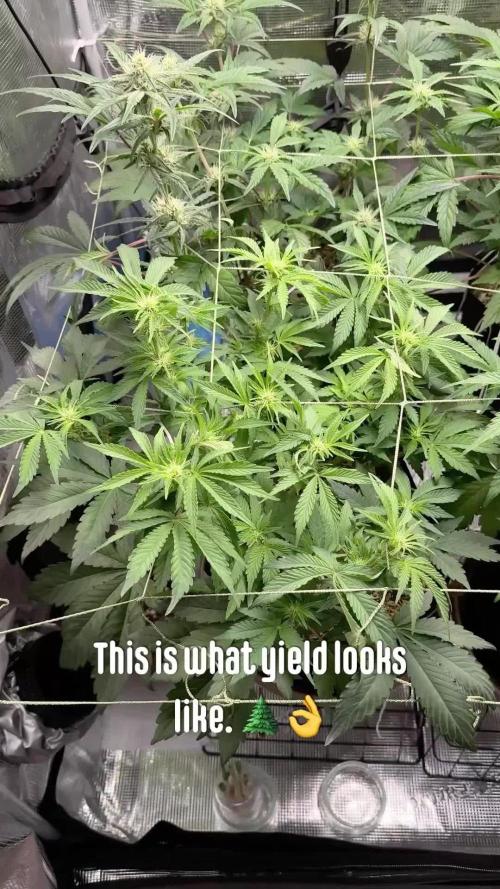
Not a crazy vertical grower in stretch, but these girls sure are flat! They seem to be slower flowering that the MW x GWK, but for maturity, bud-sites are forming well. The plants have shown lighter tops, and very minor yellowing on the newest set of fans, as well as a jump in water intake from last week of close to double.
I have top-dressed Gaia Green 2-8-4 @ 4tbsp/ 3gal pot, watered in with 1.2L of plain dechlorinated tap water. Hopefully yellowing slows and halts within a week, if not, another EWC slurry may be in order.
I'm trying to allow the plant to show me what it needs, instead of following a formula.

Likes
48
Share


@DogDoctorOfficial
Follow
An in to soil she and her sister testers go, i know that for know everything looks the same , apart from the photos, but this will start changing with them growing. For now all of them are growing pretty much the same and now that they move in to soil and start feedings they will start showing the phenotype and genetic differences, but for now all looking great , healthy and strong af!!!
Haded a intro video from seed in to now, including how i transplant and what i use wen doing it so, and from here the moon is no limit for this babes i believe , so stay tuned as this testers they promise to be a interesting ride <3 <3 <3
They are growing great , number 10 moving in to an indica side i think lets see
As always thank you all for stoping by and for supporting me on this journey, i am super passion about growing and fell blessed to have you all with me on this new journey <3 <3 <3
Genetics - Fast Buds Tester 08 09 10 11
Ligth - LUMATEK ZEUS 465 COMPACT PRO
Food - APTUS HOLLAND
#aptus #aptusplanttech #aptusgang #aptusfamily #aptustrueplantscience #inbalancewithnature #trueplantscience #fastbuds #dogdoctorofficial #growerslove
With true love comes happiness <3 <3 <3 Always believe in your self and always do things expecting nothing and with an open heart , be a giver and the universe will give back to you in ways you could not even imagine so <3 <3 <3
All info and full product details can be find in can find @
https://2fast4buds.com/ wen released
https://aptus-holland.com/
https://autopot.co.uk/
https://lumatek-lighting.com/
<3 <3 <3 Growers love to you all <3 <3 <3
Likes
6
Share


@CaaosPLAGRON
Follow
How do they look like ???? I had set I would say that they are at the peak of their maturity ... I think I have collected with the right timing, I will wait for everything to dry properly and will post the last week. (THE COLLECTION) with all the latest information missing ..


Likes
7
Share


@Organic473
Follow
Her growth this week was extraordinary. The extra hours of light works. I will continue her in veg for another 3 weeks. Hoping she is ready before the end of November.

Likes
7
Share


@Uncle_Cabbage
Follow
The 1st week was kind of nerve racking wondering if I did the right thing by popping the seed straight into the soil. Luckily 🍀 everything went smooth, with an exception of me having to leave for a couple of days. I’ll show you an update on how that went on my next post for week 2. Keep your fingers crossed 🤞 for me and please send any advice you guys and gals have in mind. Again this is my first time growing I could use all the advice I can get! 🙏
-Uncle Cabbage
Likes
12
Share


@Aleks555
Follow
Eternity Grow Cup 2025 – Plagron & Zamnesia
Runtz by Zamnesia Seeds – 51 days from seed and 22 days into flowering. 🌱
Our girl is growing beautifully! One of the colas shot up around 20 cm taller than the rest, so we had to bend it down. Thanks to LST and careful pruning of branches and leaves, she’s taken on a really interesting shape. We’re planning another round of leaf defoliation soon to give her even more space to thrive. 🌿
She’s loving the Plagron nutrients, and it really shows – she looks absolutely fantastic! 🙌💚


Likes
9
Share


@HashCakes
Follow
Another great week of growth. Started training down the main. Probably let her grow natural this coming week to see what I'm working with before doing more. Same regime but Watered twice this week.
****I will post this with every update. This was planted with 40 grams of real growers Grow Dots in 4 gallons of RG coco and 1 gallon of BAS 3.0 for an all in one amendment. ****


Likes
42
Share


@MadeInGermany
Follow
Hey everyone 😀.
Another veggie week goes by and they are developing surprisingly well 😃.
Both phenotypes look very nice and have a perfect leaf green.
Both were topped again.
I wish you lots of fun with the update, and stay healthy 🙏🏻🍀
You can buy this Strain at :
https://sweetseeds.es/de/cream-caramel/
Type:
Cream Caramel
☝️🏼
Genetics:
Blue Black
x
Maple Leaf Indica
x
White Rhino
👍
Vega lamp:
2 x Todogrow Led
Quantum Board 100 W
💡
Bloom Lamp :
2 x Todogrow Led
Cxb 3590 COB 3500 K 205W
💡💡☝️🏼
Soil :
Canna Coco Professional +
☝️🏼
Fertilizer:
Green House Powder Feeding
☝️🏼🌱
Water:
Osmosis water mixed with normal water (24 hours stale that the chlorine evaporates) to 0.2 EC. Add Cal / Mag to 0.4 Ec Ph with Organic Ph - to 5.5 - 5.8 .

Likes
1
Share


@BruWeed
Follow
11/10 - comenzó su cuarta semana de floracion.
Su evolución fue muy notoria, de un dia para el otro se desarrolló mucho.
No tuve problemas en ninguna etapa, hasta el momento se encuentra perfecta.
Los cocos son muy resinosos y grandes.

Likes
6
Share


@Groweedo
Follow
Milieu de la 3ème semaine floraison, les têtes sont bien apparentes les plantes en pleine forme, c’est bien parti pour des beaux buds 😍😎💥

Likes
16
Share


@Ultraviolet
Follow
Seedling managing 93F 30%RH, around 20 DLI. Vpd is in the 3's. No I don't recommend.
Signum Magnum.
"A great sign appeared in the sky
a woman clothed with the sun
with the moon under her feet
and on her head a crown of twelve stars.
Sing ye to the Lord a new canticle:
because He has done wonderful things.
Glory to the Father, and to the Son, and to the Holy Spirit
As it was in the beginning, and now, and ever shall be, world without end."
The plant nutrient nitrogen exists in forms with both positive and negative charges. Ammonium (NH4+)(immobile in soil)(Cation) has a positive charge, while nitrate (NO3-) (highly mobile in soil)(Anion)has a negative charge. Nitrogen is unique among plant nutrients in that it can exist in both positively charged (ammonium, NH₄⁺) and negatively charged (nitrate, NO₃⁻) forms in the soil. This makes it a special nutrient. In that it is responsible for providing balance for reactionary trade offs when it comes to ph. Because ph itself in the medium will always slowly drift towards acidicity, such is nature. 80% of nitrogen should be nitrate and no more than 20% ammoniacal nitrogen.
Ca, mg, and K are the big 3 cations related to soil composition, pH & base saturation.
When nitrogen is in the form of ammonium, it can compete with calcium, magnesium, and potassium for absorption sites in the plant root. This competition can lead to a reduction in the uptake of these other essential nutrients. Nitrogen, particularly in its nitrate form (NO3-), can increase soil acidity, which can also affect the availability of calcium, magnesium, and potassium. The form of nitrogen applied (ammonium vs. nitrate) can influence its interactions with other nutrients. Ammonium nitrogen can have a more pronounced negative effect on the uptake of calcium, magnesium, and potassium compared to nitrate nitrogen.
Common forms of ammonium nitrogen include ammonium ion (NH4+), urea, and ammonium compounds like ammonium nitrate, ammonium sulfate, and ammonium phosphate.
Common forms of nitrate nitrogen include potassium nitrate (KNO3), sodium nitrate (NaNO3), calcium nitrate (Ca(NO3)2), and ammonium nitrate (NH4NO3).
Phosphorus is an essential plant nutrient, and its availability in the soil is strongly linked to the presence of oxygen. Plants primarily absorb phosphorus as phosphate (PO4), and oxygen is a key component of this molecule. Furthermore, the availability of phosphorus in the soil can be impacted by factors like soil aeration and temperature, which in turn affect the oxygen supply to the roots.
Phosphorus uptake in plants is most critical during the early stages of growth, particularly within the first few weeks of plant development.
Young plants actively growing tissues have a high demand for phosphorus. They may absorb up to 75% of their total phosphorus requirements within the first few weeks of vegetative growth, with up to 51% of uptake happening overnight, primarily in the first few hours or early nightfall.
⑨Anaerobic root respiration, or respiration without oxygen, is detrimental to plants because it's less efficient and produces toxic byproducts, leading to reduced energy production, nutrient uptake issues, and ultimately, root damage and plant stress.
⑨Anaerobic respiration, unlike aerobic respiration, doesn't utilize oxygen as the final electron acceptor in the electron transport chain. This results in a significant drop in the amount of energy (ATP) produced, which is necessary for various plant functions, including growth, nutrient uptake, and maintenance of cellular processes.
⑨In the absence of oxygen, plants produce byproducts like ethanol and lactic acid during anaerobic fermentation. These byproducts can be toxic to the roots and inhibit their function,
⑨When oxygen is depleted in a medium, the pH tends to decrease (become more acidic) due to the production of metabolic byproducts. This is particularly relevant in biological systems where aerobic respiration relies on oxygen as the final electron acceptor.
⑨When oxygen is scarce, plants may switch to anaerobic respiration. This process produces carbon dioxide (CO2) as a byproduct.
⑨CO2 dissolves in water to form carbonic acid (H2CO3). This acid lowers the pH of the medium, making it more acidic.
⑨Anaerobic conditions can impair a plant's ability to regulate its internal pH, leading to a drop in cytoplasmic pH and potentially cellular acidosis.
⑨The change in pH can also affect the availability of certain nutrients to the plant, as pH influences the solubility of micronutrients like iron, manganese, zinc, copper, and boron.
⑨The lack of oxygen in the plant medium leads to a decrease in pH due to the production of carbon dioxide during anaerobic respiration and impaired pH regulation within the plant.
In plant cells, cellular acidosis, a drop in the internal pH of the cytosol, is a significant stress response, particularly during conditions like flooding or hypoxia. This acidification can be triggered by a decrease in oxygen levels, leading to the production of metabolic byproducts like lactic acid and CO2. The plant's ability to tolerate and recover from these conditions depends on its cellular mechanisms to regulate pH and mitigate the effects of acidosis. When plants are subjected to low oxygen environments, such as those experienced during flooding, anaerobic metabolism, which produces lactic acid and ethanol, becomes the primary source of energy. This can lead to a build-up of these acidic metabolites in the cytosol, causing a drop in pH.
OXYGEN
Atomic oxygen (single oxygen atom, O) is the lightest form of oxygen, as it has the lowest mass of the oxygen molecules. Oxygen also exists as a diatomic molecule (O2) and an allotrope called ozone (O3), which have higher masses due to the number of oxygen atoms combined.
Atomic Oxygen (O):
This refers to a single oxygen atom, which is the most fundamental form of oxygen.
Molecular Oxygen (O2):
This is the common form of oxygen we breathe, consisting of two oxygen atoms bonded together.
Ozone (O3):
This is an allotrope of oxygen, meaning it's a different form of the same element, consisting of three oxygen atoms bonded together.
Since atomic oxygen has the fewest oxygen atoms, it naturally has the lowest mass compared to O2 or O3.
Ozone (O3) Lifespan:
Ozone has a relatively long lifespan in the stratosphere, particularly at lower altitudes. For example, at 32 km in the middle latitudes during spring, ozone has a lifetime of about 2 months.
Oxygen (O) Lifespan:
Atomic oxygen, on the other hand, has a much shorter lifespan. At the same altitude, its lifetime is about 4/100ths of a second.
Ozone-Oxygen Cycle:
The ozone-oxygen cycle involves the rapid exchange between atomic oxygen (O) and ozone (O3). UV radiation can split molecular oxygen (O2) into atomic oxygen (O), which then reacts with O2 to form ozone (O3). Ozone can also be photolyzed by UV radiation, creating atomic oxygen again, which can then react with O3 to reform O2.
Dominant Form:
The partitioning of odd oxygen (Ox) between ozone and atomic oxygen favors ozone in the lower stratosphere. This means that a much larger proportion of odd oxygen exists as ozone than as atomic oxygen, especially in the lower stratosphere.
Recombination:
Atomic oxygen has a high energy and reactivity. When it encounters another oxygen atom, they can combine to form O2. This process releases energy, contributing to the heating of the atmosphere.
Ozone Formation:
Atomic oxygen can also react with molecular oxygen (O2) to form ozone (O3). Ozone plays a significant role in absorbing harmful UV radiation.
Other Reactions:
Atomic oxygen can react with various other molecules in the atmosphere, like nitrogen (N2), water (H2O), and carbon dioxide (CO2), forming different compounds.
UV light below 240nm (peak 185nm) creates ozone (O₃) through a process called photolysis, where UV light breaks down dioxygen molecules (O₂) into single atomic oxygen atoms (O). These single oxygen atoms then react with other oxygen molecules to form ozone (O₃). Specifically, UV-C light with wavelengths shorter than 240 nm can cause this photolysis.
UV light with wavelengths between 240-280 nm, (peak 254 nm) breaks down ozone (O₃) into dioxygen molecules (O₂) and atomic oxygen atoms (O). 280nm does not have the energy potential to break apart the stable bond of (O₂) into enough (O) to make (O₃)
At ground level, atomic oxygen (single oxygen atoms) has a very short lifespan. This is because it's highly reactive and quickly combines with other molecules to form stable diatomic oxygen (O2) or other compounds. While the exact timeframe varies depending on the specific circumstances, its lifespan is typically measured in nanoseconds or picoseconds.
Likes
7
Share


@Crwfz1
Follow
Great grow went as planned for the most part as usual little one and big one were both great smoke so stinky and sticky ! Always love running theese