


@Tonino
Follow
long storie this week what i though was foxtail was finally my girl going back in veg take a minute to figure out why thanks to my wolfpack we finally figure there was a problem whit my timer for a reason unknown the switch for 1am to 2:30 am were rise so in the middle of the night the light was lighting for 90 minute so that completely flip my plant back to veg so now this is fix but the girls are doing some reflowering on top of flower its looking weird will see how it goes stay tune
as for her she's not ready looking at trichomes
Smooth Smoke Feminised Seeds by the cannabis seeds breeder Tropical Seeds, is a Photoperiod Feminised marijuana strain. This Feminised seed grows well in Indoors, Outdoors conditions. This strain has (Pakistan Chitral Kush x Nepal Highland P3 ) x Pakistan Chitral Kush Genetics. It has a Unknown THC Content. The CBD content of the strain is Unknown. This strain can be used to treat a variety of medical conditions including, Pain.
BREEDER Tropical Seeds
GENETICS (Pakistan Chitral Kush x Nepal Highland P3 ) x Pakistan Chitral
VARIETY Mostly Indica
FLOWERING TYPE Photoperiod
SEX Feminised
GROWS Indoors, Outdoors
FLOWERING TIME 55 - 60 days
MEDICAL CONDITIONS Pain
MEDICINAL PROPERTIES Especially good for pain relief.
TASTE / FLAVOUR Berry, Candy, Sweet, Vanilla
EFFECT Powerful, Relaxing


@Andres
Follow
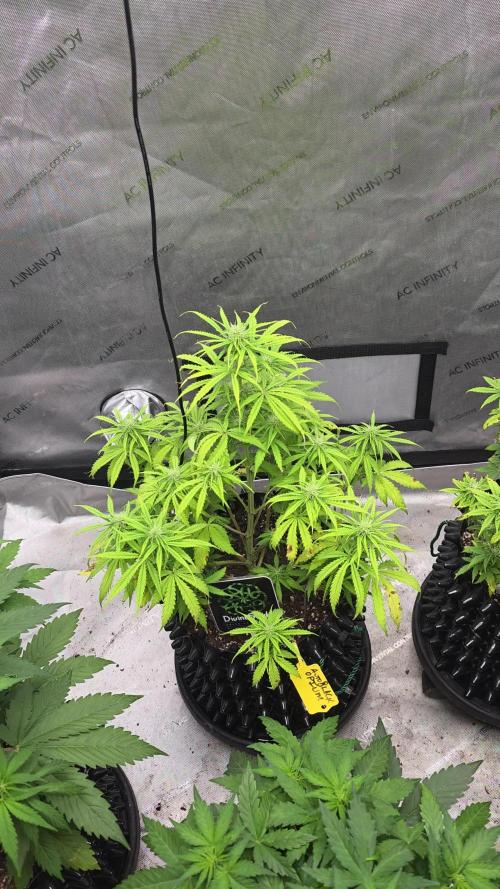
I would believe this variety again ... I think it could be better ... and do not make some mistakes in it ... I recommend it to all growers ...



@Natrona
Follow
Divine Seeds Auto V.2 Contest
👉Sponsored Grow👈
Auto Black Opium
W8F3 7/20-26
My Black Opium shows signs of distress with pale green/yellow leaves and spots. The damage, while less severe than Big Demon’s nutrient issues, continues to spread. Last week I asked a question to what was happening to my Divine Girls. Many indicated the soil was now depleted as it is now in flower with higher PK (phosphorus and potassium) demands. I immediately sprayed with banana juice 2x per day for 3 days while continuing to dry the soil with a fan. Leaves continue to show more spots in the leaves.
Another responder indicated I overwatered creating a lock out. How could this happen? I followed the same watering schedule every 2 or 3 days. The only change in this grow is adding the super soil to the base. Further research on living soils indicates that living soils like super soil, ancient soil and other nutrient dense mediums need less frequent waterings as the organic matter holds moisture while still allowing proper drainage. Lesson learned With living soils water once per week and monitor for additional water needs. She will not produce as well as one would expect due to my negligence.
I discovered that super soil naturally balances PH of water, eliminating the need for manual adjustments. This simplifies the growing process and ensures healthier plants. Yes, I like the water only with super soil.
As I learn more about organic growing hopefully, I will learn to identify what problems are before they get unmanageable. Autos have a shorter lifecycle and are less forgiving of mistakes. In the future, I might try a photo run where I can train High-stress-Training (HST) techniques and have more flexibility to correct errors.
Thank you all for your continued support and encouragement. Your likes and comments motivate me to keep sharing my journey. Let’s continue to learn to grow together!
Stay green, growers love 💚🌿
💫Natrona💫



@DogDoctorOfficial
Follow
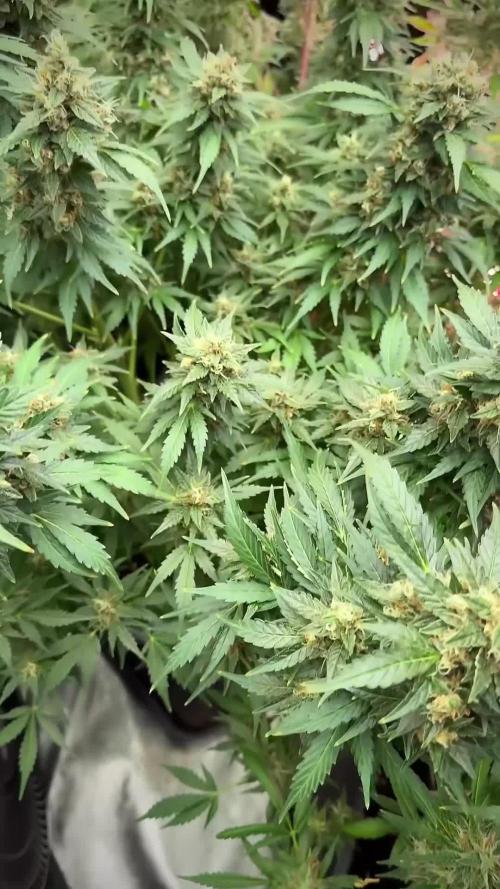
12/12 from seed. Week 12 overall. Week 8 of flower.
And Cosmic Noodles is doing exactly what a finisher should do.
No drama.
No panic.
No chasing numbers.
Just a massive plant, a controlled fade, and a very clear push into the final stretch.
She is not limping to the finish.
She is arriving with weight.
⸻
🍜 The Final Reduction
This week, everything comes out except Pure Zym.
No bloom feed.
No boosters.
No extras.
No correction bottles.
No late flower chasing.
Just enzymes.
And time.
At this point, the goal is no longer to build.
The goal is to finish clean.
She has already done the hard part.
The bulk is there.
The frost is there.
The density is there.
Now the plant is simply being allowed to use what she has already stored.
That’s the shift this week.
Less input.
More observation.
Less pushing.
More finishing.
And for a plant this far along, that is often the better move.
⸻
🌱 Why Keep Pure Zym In
Because even when feed stops, the root zone is still working.
Pure Zym stays because the medium is still alive.
Microbial activity does not stop just because bottles do.
At this stage, enzymes still help break down residual organic matter in the root zone, keep the medium cleaner, and support a softer transition as the plant begins consuming what remains available.
That matters even more when the soil is not treated like disposable media.
Because it isn’t.
This soil still has a second job after this run.
It goes outside.
It gets reused.
It feeds vegetables.
It stays alive.
And whether it is hard science, soft biology, or just grower instinct — keeping that soil active until the end has always made sense here.
Not everything needs to be sterile to be effective.
Sometimes the better approach is simply not killing what is still working.
⸻
? Living Soil, Second Life
That has always been part of the rhythm.
What finishes the room does not leave the cycle.
It just changes jobs.
Once this run is done, that soil goes back outside and keeps working somewhere else.
Different crop.
Same biology.
Same purpose.
So yes — keeping the medium active late matters.
Not just for this harvest.
For what comes after it too.
Call it practical.
Call it circular.
Call it habit.
Either way, dead soil has never been the goal.
⸻
📉 EC Down, pH Up, Eyes On the Plant
This is where the spreadsheet starts losing authority.
EC is down.
Input is nearly gone.
pH has drifted upward into that 6.8–7 range.
And right now, it is not being forced back down.
Not because numbers do not matter.
Because context matters more.
At this stage, the plant is finishing.
Uptake is slowing.
Demand is lower.
Feed has been reduced.
The root zone is doing less work than it was two weeks ago.
So yes — on paper, some of these numbers would make people uncomfortable.
In practice?
The plant looks exactly like a plant that is finishing correctly.
Still drinking.
Still praying.
Still stacking.
Still fading evenly.
Still moving from top to bottom without confusion.
That matters more than chasing a perfect chart in the final stretch.
Room VPD is a reference.
Leaf response is the truth.
And this room continues to be read by plant behavior first, numbers second.
As always.
⸻
🌡️ Conditions Stay Stable
Nothing changed in the room because nothing needed to.
Conditions remain steady.
No dramatic swings.
No forced stress.
No late-stage environmental tricks.
The room is stable.
The plant is stable.
The finish is stable.
And late flower stability is one of the most underrated parts of a clean finish.
No heroic adjustments.
No panic corrections.
No reinvention in the last chapter.
Just consistency.
⸻
️ A Proper Finisher
And this one is a beast.
Not “good structure.”
Not “nice tops.”
A beast.
Huge central cola.
Heavy side stacking.
Dense flower formation.
Thick terminals.
Real weight from top to bottom.
This is one of those plants that stops being judged branch by branch and starts being judged as mass.
Because the whole frame is carrying.
She is not finishing in isolated tops.
She is finishing as a full plant.
That matters.
The top is heavy.
The mid is real.
The lowers are still worthwhile.
And the entire plant is moving together.
That is what a complete finisher looks like.
⸻
❄️ Frost, Density & Finish Quality
And she is not just big.
She is finishing properly.
Dense flower.
Heavy resin.
Excellent frost coverage.
Strong calyx development.
Good terminal formation.
Real weight in the hands.
The important part now is that she is not only stacking size — she is finishing with quality.
That is the difference between a plant that looks impressive and a plant that actually delivers.
This one does both.
And whether part of her gets dried or part of her gets frozen, she has already made the case for both.
That decision can wait.
Right now, the only job is to let her finish.
⸻
🍂 The Fade Is Real — And It’s Everywhere
The fade is already underway.
And more importantly, it is happening correctly.
Not isolated.
Not patchy.
Not confused.
She is fading from top to bottom.
Across the plant.
Across the canopy.
Across the frame.
That matters.
A uniform fade tells a very different story than a stressed collapse.
This is not random yellowing.
This is not deficiency panic.
This is senescence.
The plant is reallocating.
The cycle is closing.
The finish has started.
And she is doing it evenly.
That is exactly what you want to see here.
⸻
💡 Canopy Light Matters
And once again, the lesson stays the same:
Canopy lighting matters.
When the full frame is finishing together, it shows.
When lowers stay relevant, it shows.
When the plant matures with less separation between top and bottom expression, it shows.
Uniform development is not an accident.
Top-to-bottom consistency like this is one of the clearest arguments for proper canopy penetration when the setup allows for it.
Not mandatory in every room.
But when possible, absolutely worth it.
This plant makes that case on her own.
⸻
📘 Week 12, Cosmic Noodles
This is what the late game should feel like.
Calm.
Heavy.
Controlled.
Predictable.
Close.
No overreaction.
No bottle panic.
No forced finish.
Just a large, healthy plant using the last of what she has and moving toward the end exactly like she should.
And that is all this week needed to be.
⸻
⏭️ What Comes Next
Next week should bring more fade.
More color loss.
Less drinking.
More swelling where it still matters.
And a clearer final read on timing.
She may finish next week.
She may ask for a little longer.
Both are still on the table.
What should not happen is panic.
No sudden overfeeding.
No late corrections.
No chasing green back into a plant that is already doing what finishing plants are supposed to do.
From here, the job is simple:
Watch the leaves.
Watch the resin.
Watch the pace.
Then cut when the plant says so.
⸻
🤝 Thank You
To the long-time followers.
To the new ones.
To the quiet readers.
To the loud ones.
To the skeptics.
To the supporters.
To the critics.
To the growers who watch closely.
To the ones who question everything.
To the ones who simply keep showing up.
To GrowDiaries.
To the community.
To the sponsors.
To the gear.
To the tools.
To the genetics.
To everyone following the process, whether they agree with every choice or not.
Thank you.
The room keeps teaching.
The plants keep answering.
And this one is not done speaking yet.📡 DELETED @ 1K Please stay tuned.we never quit https://www.youtube.com/@TheDogDoctorOfficial NEW 🙏 Thank you for your patience and continued support.
FOR DISCOUNT CODES AND MORE JUST FOLLOW THE LINK https://website.beacons.ai/dogdoctorofficial
📲 Don’t forget to Subscribe and follow me on Instagram and YouTube @DogDoctorOfficial for exclusive content, real-time updates, and behind-the-scenes magic. We’ve got so much more coming, including transplanting and all the amazing techniques that go along with it. You won’t want to miss it.
GrowDiaries Journal: https://growdiaries.com/grower/dogdoctorofficial
Instagram: https://www.instagram.com/dogdoctorofficial/
YouTube: https://www.youtube.com/@dogdoctorofficial Deleted by Youtube - https://www.youtube.com/@TheDogDoctorOfficial NEW
Vimeo : https://vimeo.com/dogdoctorofficial Under construction stay tuned ⸻
Explore the Gear that Powers My Grow
If you’re curious about the tech I’m using, check out these links:
🔆 Lighting & Environmental Control
• Future of Grow — Advanced LED lighting technology
https://www.futureofgrow.com/
DISCOUNT CODE: DOG20
• Lumiflora — Under-canopy LED lighting
https://lumiflorade.com/
• TrollMaster — Environmental controllers and automation gear (past collaboration)
⸻
Genetics
• Zamnesia Seeds — Genetics used in this project
https://www.zamnesia.com/
⸻
🌱 Soil, Substrates, Boosters & Root Support
• Plagron — Substrates, bio mixes, and supportive products
https://plagron.com/en/
⸻
🎒 Storage, Curing & Preservation
• Grove Bags — Curing and storage solutions
https://grovebags.com/
⸻
📸 Photography Equipment & Tools
(Not sponsors, but part of my creative toolkit)
• Sony A6700
• Sony full-frame macro lens + few more
• Stacking photography workflow - learning
• iPhone (for behind-the-scenes shots)
We’ve got much more coming as we move through the grow cycles. Trust me, you won’t want to miss the next steps, let’s push the boundaries of indoor horticulture together!
As always, this is shared for educational purposes, aiming to spread understanding and appreciation for this plant. Let’s celebrate it responsibly and continue to learn and grow together.
With true love comes happiness. Always believe in yourself, and always do things expecting nothing and with an open heart. Be a giver, and the universe will give back in ways you could never imagine.
💚 Growers love to all 💚
📸 P.S. – The Eye Behind the Lens
All photos in this diary (for now — except for the ones showing the camera, which I took with an iPhone) are taken with a Sony A6700 paired with a Sony full-frame macro lens and a few more.
Photography is part of the story — it’s how we share the fine textures, the glow, and the quiet details that words can’t always capture.
I’ve also started experimenting with photo stacking — a technique where multiple images, each taken at a slightly different focus point, are layered together to create one perfectly sharp image from front to back.
It’s not digital enhancement or AI; it’s pure photography — a way to reveal the plant’s beauty in microscopic depth, from trichome to petal.
You’ll even see a few shots of "ghost me" capturing the shots — camera, lens, setup — because every grow deserves not just to be cultivated, but documented like art.
FOR DISCOUNT CODES AND MORE JUST FOLLOW THE LINK https://website.beacons.ai/dogdoctorofficial
NEW DISCORD - Official Server Invite Link : https://discord.gg/ksjAkA5T74


@MadeInGermany
Follow
Info:
Unfortunately, I had to find out that my account is used for fake pages in social media.
I am only active here on growdiaries.
I am not on facebook instagram twitter etc All accounts except this one are fake.
Have fun with the update.
Flowering day 47
since time change
to 12/12 h.
Hey everyone 😃.
The lady looks beautiful 😍.
The buds get thicker and thicker 👍.
They smell incredibly delicious 😬.
It was poured twice with 1.4 l.
The tent was cleaned and the humidifier refilled.
I wish you a lot of fun and all the best 👍
You can buy This Strain at :
www.Zamnesia.com
☝️🏼☝️🏼☝️🏼☝️🏼☝️🏼☝️🏼
Strain
Gelato clone from mother (Zamnesia )
☝️
Genetics: Wedding Cake x Gelato x Gelato 33
Vega lamp:
2 x Todogrow Led
Quantum Board 100 W
💡
Bloom Lamp :
2 x Todogrow Led
Cxb 3590 COB 3500 K 205W
💡💡☝️🏼
Soil :
Canna Coco Professional +
☝️🏼
Fertilizer:
Green House Powder Feeding
☝️🏼🌱
Water:
Osmosis water mixed with normal water (24 hours stale that the chlorine evaporates) to 0.2 EC. Add Cal / Mag to 0.4 Ec Ph with Organic Ph - to 5.5 - 5.8 .


@StickyThumbz94
Follow
I’m Missing a lot of pics but so far the grow has been great. This is my second grow and first organic grow. Started in early feb. vegged for almost 9weeks. I haven’t had any major issues with this strain whatsoever, will definitely grow again. Has a sweet fruit, gassy and earthy smell. Smells amazing can’t wait. Hoping to yield a few ounces hopefully she bulks up some more before harvest.

shorts_status_processing


@Dunk_Junk
Follow
So this week I took the decision to bend over her cola to clear the lights. I didn't want to scrape any THC off when she's moved 😂
Week 2 of flowering is going well. She's doing her thing.


@Dunk_Junk
Follow
Well she was a bountiful harvest!!!
It wasn't the purple phenotype though.
Fantastic plant though!!!!!!!!!!!!!!!!!!! 💪


@MicroHidroGrow
Follow
Día 19.
Las Tropicana han reaccionado muy bien. Aproveché para hacerle LST a una y HST a la otra. Las Polaris estaban revegetando, así que esos las demoró. Pero ya empezaron a estirar. Además a una le tuve que cortar la rama principal y dejar 2 laterales, dado que estaba muy maltrecha.
Mantuve la solución nutritiva de la semana pasada y la voy a cambiar hoy o mañana seguramente. Voy a tener que esperar para pasarlas a floración, ya que tengo una mudanza en unas semanas. Así que la floración va a ser post mudanza.
shorts_status_processing


@CannabisAprendiz
Follow
Hola con esta semana ya quedamos al dia con el seguimiento ya que estaba atrasado en el tiempo. Se nota una producción de resina notable en esta genética que nos ha gustado mucho por su olor y estructura de las plantas .
hemos creado un video por cada una de las 14 plantas del seguimiento, hay varias muy llamativas que están "pre-seleccionadas" para mantener a futuro, el olor que se llega a sentir es muy florar y dulce, si tienen alguna pregunta no duden en preguntar saludos.
Hello with this week we are already up to date with the follow-up since I was late in time. There is a remarkable resin production in this genetics that we liked a lot for its smell and structure of plants.
We have created a video for each of the 14 floors of the follow-up, there are several very striking that are "pre-selected" to keep in the future, the smell you get to feel is very flowery and sweet, if you have any questions do not hesitate to Ask greetings.


@Dunk_Junk
Follow
This is the frostiest plant I've ever grown. She is incredible.... Got a few weeks to go though.


@jamaljackson
Follow
Here we are a week and a few days later. One of the Forum Stompers didn't come up. It was probably my fault, I could have given them some more time in the DVD case before putting them in the cubes but I was excited! I germed another one and that one has popped up just fine.
Growth up top is pretty slow, and some of the plants seem a little droopy. Their roots just started to grow out of the net pots so maybe that has something to do with it? Or maybe because they are right at the end of the light cycle for the day?
I've got roots that I can see on 3/4. For at least one of the plants the rhizo-core net pots seem to be doing what it's supposed to. I've got a nice set of roots crawling their way towards the bucket right down the side of the inner cone. Going to switch the rez out Sunday and start them on some really low strength nutes.
I got the red frog air diffusers in the mail and went and bought a new air pump, these things are awesome. They make a ton of tiny bubbles to the point where it's almost a foam on top of the water. I'm hoping the roots love all the extra oxygen.





@ArtisticGrown
Follow
Aye yoooo, how we doing? We are feeling good headed into week eight of flower.
Last week was a great week. About towards the end of the week I harvested the 2 dolphin Waxs 🐬
I'm still in awe with how fast of a bloom she was. I think I got a little trigger happy. But we are living and learning and have clones of this mom. This tent is on fire. I'm loving all the different phenotypes. I've found a keeper with each strain, the purple hues with pink under tones on the isorin. Documenting the characteristics And changes that happen within temperature, Environment, DLI,swollen Caylaxs. Color fade.
The rest of this week.I will be giving her water 💧
Sugar water ph 6.5
Thankful for this week! This grow. Thankful and greatful. These are some for real fire!
Beanpatchseeds.com
Check out what they got going on! I love their
May-Trix and all of their Gear! Support the Homies!!!
Much love!! Happy growing yall! Staying focused on the mission and greatful to be this far! Gonna keep grinding and staying focused! These ladies deserve it 👏 🙌 ❤️ ♥️
Came in and added some new pics! I cut the battle Axe down and the Isorin coming sooon!!!



@Ultraviolet_
Follow
Remember that, however you are played, or by whom, your soul is in your keeping alone. Even though those who presume to play you be kings or men of power, when you stand before God, you cannot say, 'But I was told by others to do thus,' or that virtue was not convenient at the time. This will not suffice. Remember that.
Day:18
84°F and 65% RH (VPD) for the vegetative stage. Approximately 1.15kPa(assuming leaf temperature is about 2°F cooler than the air), which falls right into the ideal vegetative sweet spot (0.8kPa to 1.2kPa). At 1.15kPa, plants can draw water and nutrients efficiently without risking stress or wilting. It keeps the leaf pores (stomata) open, allowing for ideal carbon dioxide intake and maximizing vegetative growth. VPD is determined by the leaf's temperature, not just the ambient air. Because leaves usually run 1° to 3°F cooler than room air under bright grow lights, my actual VPD will be slightly lower, closer to the 1.0kPa mark. As she transitions from vegetative growth to flowering, one can gradually lower the humidity (to around 45–60%) and drop temperatures slightly to prevent disease from settling inside dense buds when they appear.
Night:6
At 70°F and 60% relative humidity, Vapor Pressure Deficit (VPD) is 0.86 kPa. This is right on the cusp of whats optimal for the vegetative stage. During the nighttime, plants generally close their stomata and undergo cellular respiration rather than photosynthesis. Transpiration slows to a near stop, making VPD less critical at night than during the day. However, maintaining a nighttime VPD between 0.8 and 1.0 kPa is highly beneficial in that it ensures the air is dry enough to prevent powdery mildew or bud rot, but moist enough to keep the plant from undergoing unnecessary stress. This range keeps the environment comfortable for cellular processes and prevents large atmospheric swings. Keeping it all flowing.
(Not pushing them yet, these are photoperiods)
The optimal soil (root zone) temperature for cellular root respiration and nutrient uptake in cannabis is between 68F & 72F This narrow range balances biological energy production (cellular respiration) with the dissolved oxygen levels in the soil, maximizing plant growth and health. Warmer soils hold significantly less dissolved oxygen. When soil temperature exceeds 74F oxygen depletion occurs, inhibiting cellular respiration almost entirely, At 68-72F root cells generate optimal adenosine triphosphate (ATP) via respiration to power root-tip elongation and the active transport of water and nutrients.
Too Hot (Above 78F) Root respiration increases, demanding more oxygen, while the water's oxygen-carrying capacity drops. This creates a prime environment for anaerobic pathogens and Pythium (root rot).
Too Cold (Below 60F) Root metabolism and cellular respiration slow to a crawl. This severely impairs nutrient and water absorption, leading to yellowing, wilting, and phosphorus deficiencies.
A lot depends on whether it's automatic or photoperiod; with photoperiod, there is not as much of a need to push "hard" as the real countdown only begins once the flower is initiated. Automatics, on the other hand, the chronological "clock" begins ticking the moment the seed germinates. It is of critical importance that the seedling growth gets off to the races, understanding that early growth is like compound interest, which will pay off come harvest. This reality is why getting autoflowers "off to the races" early on yields such exponential benefits. The "compound interest" is directly related to the surface area of the leaves. Larger, faster-growing seedlings process more light and build bigger root networks early on, which translates into an explosion of vertical and lateral growth during their short vegetative window.
The margins for error are so thin with autoflowers; this early-stage momentum depends on several critical practices. Seedlings exposed to increased atmospheric CO2 levels early in life will develop at an increased rate. To effectively "extend" or optimize the capacity of Photosystem II (PSII) for increased photosynthetic efficiency. In standard oxygenic photosynthesis, Photosystem II (PSII) is naturally limited to the red-light spectrum, peaking at 680nm. Extending its light-harvesting capacity past 700nm into the far-red region requires bypassing the natural limits of standard chlorophyll a. Adding 730 nm (far-red) LEDs alongside standard red/blue lights has been shown to increase canopy photosynthesis by 20–30% in several crops by acting synergistically with shorter wavelengths. However, the limitation is that excessive, pure IR/Far-red light (without accompanying red light) can trigger the "shade avoidance response," causing plants to grow tall, weak, and spindly rather than robust. Utilizing infrared light (specifically the 700-750 nm far-red range) is a viable method to boost photosynthetic efficiency. It acts as a bridge to allow PSII to utilize a broader spectrum of light, breaking the traditional 700 nm barrier. UVR8-mediated signaling (often in conjunction with CRY proteins) triggers protective mechanisms that maintain the stability of the photosynthetic apparatus (including LHCII and reaction center proteins), thus ensuring that the efficiency of Photosystem II remains higher in UV-B-exposed plants compared to plants lacking this receptor. ΦPSII indictates the rate of electron transfer from water to plastoquinone, which drives the production of ATP and NADPH. There is a close link between ΦPSII and the true rate of CO2 fixation (Φ*co2).
ETR stands for Electron Transport Rate. It measures the speed at which electrons are moved through the thylakoid membranes in a plant's chloroplasts during the light-dependent reactions of photosynthesis. Infrared light (particularly Near-Infrared or NIR) improves cellular energy by interacting directly with the electron transport chain (ETC) in mitochondria. This process boosts adenosine triphosphate production, which acts as a metabolic coefficient multiplier by accelerating enzyme activity dramatically.
Extend then multiply.
Far-Red photons interact with plant photoreceptors to accelerate the plant’s biological "clock" or trigger a shade-avoidance response. Autoflowers don't use the plant's biological clock, although the IR will initiate a shade avoidance and make them stretchy. You can just add equal measures of 660nm-680nm to negate the shade avoidance effect. Replacing nights' "darkness" with a combination of IR+ and 660nm. Because autoflowers don't require a dark period to flower, many growers just blast them with light. 18/6 24/0. However, this ignores the plant's metabolic rhythms, where daytime photosynthesis (light reactions) must be perfectly balanced with nighttime carbon fixation and assimilation (Calvin cycle) to avoid bottlenecking plant development. Cellular respiration is a 24/7 process, but it can only function while the plant has the free oxidative capacity to do so. A 100% photosynthetically active leaf cannot perform cellular respiration. The viral trend of defoliation of every leaf that isn't "getting enough light" is of great detriment overall, putting 100% of the cellular respiratory "workload" and responsibility on the 0/4/6 hours of darkness in sub-optimal conditions for enzymatic activity. Photosynthesis captures nearly 100% of the initial energy as carbon, while cellular respiration is the process that unlocks 90% of that captured energy into usable ATP so the plant can use it. Respiration is considered roughly 30% to 40% efficient. It captures enough of the potential energy in glucose to synthesize around 30 to 38 ATP molecules per glucose molecule. The remaining 60% to 70% of the energy in the sugar is not captured in ATP; instead, it naturally escapes into the environment as heat, which helps regulate plant temperature. In plants, the primary enzymes of the Electron Transport Chain (ETC) and the ATP synthase complexes are typically adapted to function optimally in warmer temperatures (roughly 25°C to 35°C depending on the specific plant strain). As temperatures rise within this physiological range, molecular collisions increase, speeding up respiration and ATP production. The cannabis plant has a branched respiratory pathway. During heat or cold stress, plants activate Alternative Oxidase (AOX). AOX burns sugars to dissipate energy as heat rather than coupling it to ATP production. This pathway actually functions optimally at elevated temperatures to help protect the cell from the damaging build-up of Reactive Oxygen Species (ROS) during heat stress. Enzyme activity generally scales with heat; there is a strict biological limit. If canopy temperatures in a grow room exceed 40°C, the enzymes and their supporting lipid membranes lose stability. Not saying you need to go crazy, just optimize nights the same as we optimize days.
Phosphorus is the driving force behind early seedling development. It acts as the "energy hub" of the plant, directly driving cell division, robust root growth, and the creation of DNA. Without an adequate, easily accessible supply early on, the plant's overall growth potential and final yield can suffer permanently.
E=MC2 looks like a simple multiplication problem; it describes a fundamental physical truth: mass and energy are the same thing. The equation doesn't just calculate a value; it reveals that mass is effectively "congealed" energy. Energy is just numbers. Energy isn't a physical "substance" you can hold or touch. It is essentially an abstract, calculated number that we assign to a system to predict how it will change, interact, or move. A numerical label we attach to matter to track how it behaves. Because the universe runs on laws of symmetry (specifically, that the laws of physics don't change over time), a single global number must be conserved. We call that number "energy".
We don't grow; we facilitate energy conversion.
How well a seedling grows is essentially down to how much knowledge one can acquire to increase the level of conversion to occur. Applying knowledge effectively requires intuition, which comes from hands-on experience. A seasoned stoner learns to read subtle signs—like a slight change in leaf turgor (stiffness), subtle color shifts, or the specific texture of the soil—before a textbook diagnosis can be made. Ultimately, growing is the application of botanical science blended with active observation. Knowledge dictates your potential, but adaptability and attentiveness to the plant's immediate environment determine your results.
1.618 nature mathematically optimizes quantum energy transfer and light absorption efficiency within the photosynthetic machinery, as it naturally dictates energy scaling hierarchies and resonance dynamics. External vibration or electromagnetic wave that perfectly matches a plant's natural frequency directly influences plant growth. Low-frequency sound waves and targeted electromagnetic fields stimulate cellular processes and boost photosynthetic efficiency
Does it produce better yields?
How long is a piece of string? As long as you cut it. But isssss the juice worth the squeeze? The quantum framework of the IVM seems to think so. Good enough for the quantum firmware, good enough for the DNA software. Genetics are not dictated; they are expressed; the rate of that expression is dictated by the environment in which growth occurs.
Quantum Coherence in Photosynthesis occurs When a photon of sunlight strikes a leaf, the energy it carries must travel to a reaction center to be converted into chemical energy. This process operates at nearly 100% efficiency. If the energy moved in a traditional "bunching" or random hopping manner, a large portion of it would be lost as heat. Instead, plants utilize quantum superposition. The energy particle (exciton) doesn't just take one path; it exists in a wave state and explores multiple pathways simultaneously. It essentially "chooses" the most efficient route to the reaction center simultaneously. Research shows that molecular vibrations and the specific network arrangements of chlorophyll molecules (like the naturally evolved Chlorophyll A & B ratios) actively protect against energy overflow, optimizing light capture across different light intensities. Enzymes are the biological catalysts that speed up chemical reactions within a plant's cells, allowing them to grow, metabolize, and repair. Rather than relying solely on the classical kinetic energy of molecules colliding, plants use quantum tunneling. Subatomic particles like electrons and protons (hydrogen ions) can literally "teleport" through energy barriers that they normally wouldn’t have the energy to climb over. This makes vital metabolic reactions happen far faster than classical physics could ever explain.
Chloryphyll b has peak absorption at 460nm (Blue) and at 647nm(Red). If we take the blue peak wavelength 460nm and a UV-B, UVR8 peak absorption wavelength 285nm, Tryptophan-285 (W285) Sensing protein. 460/285=1.618 Φ If we take chlorypyhll b's Red absorption peak 647nm and a UV-A of 400nm, we get 647/400=1.618 Φ. "Structure of light". The cryptochrome photoreceptor (CRY) is a UV-A/blue light receptor that shares this dual sensitivity with several other biological structures and functions, including significant sequence similarity and a common evolutionary ancestor with DNA photolyase enzymes. These are light-activated enzymes that use blue/UV-A light to repair DNA damage caused by UV-B radiation in plants. Synergistic. But Shhh, it's a secret.
Effective quantum efficiency of photosystem II, often denoted as ΦPSII, represents the proportion of light absorbed by Photosystem II (ΦPSII) that is actually used in photosynthetic electron transport. It is a key indicator of how efficiently a plant is using light for photosynthesis, as opposed to losing it as heat or fluorescence. ΦPSII (effective quantum yield of photosystem II) functions primarily as a "multiplier" (a coefficient of efficiency) rather than an additive factor when estimating the overall photosynthetic electron transport rate (ETR). Multipliers are considered far more beneficial than additions because they generate exponential growth, leverage existing resources to their full potential, and create sustainable, self-multiplying capacity, rather than just incremental, linear increases. This fascinating observation is rooted in the intersection of subatomic geometry, fractal scaling, and quantum dynamics. In specific molecular arrangements—such as in conjugated polymer networks or biomolecular architectures—the Golden Ratio (PHI) naturally dictates energy scaling hierarchies and resonance dynamics. Mathematically tied to the fine-structure constant, which defines the strength of the electromagnetic interaction. The Golden Ratio can be mapped geometrically as the Golden Angle (137.5 degrees) in atomic structures, linking the charge of the electron to fundamental quantum constants like Planck's constant.
Electromagnetic.
The Golden Angle (137.5): This angle is derived from the Golden Ratio (1.618). It is the smaller of two angles created when a circle is divided such that the ratio of the arcs equals the Golden Ratio.


@Tryhard1988
Follow
Should of taken a cut of this one absolute fire she smell and getting better each week i started my flush a bit early so I'm going to take her as long as possible if I get ten days from now be buzzing


@JackSkellington
Follow
le vedo lente oggi e una settimana buona di fioritura e non vedo ancora quasi niente...volevo dargli qualche stimolatore...ma ho paura di mandarle in overfert perche presentano sempre un verde abbastanza scuro solo su altri esemplari sono più chiare...una sembra aver sviluppato una carenza da come si vede in foto...
l esemplare a cui avevo dato il bio grow a reagito bene ora vedro se darglielo ancora +bio bloom vedremo


@nonick123
Follow
🚀 4 clones de Blueberry Pie F1 Fast seleccionados por @stacksfarmsltd - https://www.instagram.com/stacksfarmsltd
🚀 Breeding by @seedsmangenetics - https://www.seedsman.com/eu-en/blueberry-pie-f1-fast-feminised-seeds-sman-blpi-fast-fem
💦 BioTabs 15% DISCOUNT code "GDBT420" biotabs.nl/en/shop/ @biotabs_official
🌱Substrate PRO-MIX HP BACILLUS + MYCORRHIZAE @promixmitch @promixgrowers_unfiltered
💡2 x Mars Hydro FC1500 EVO Led Grow Light (2024 NEW FC 1500-EVO Samsung LM301H 150W LED) - https://marshydro.eu/products/fc1500-evo-led-grow-lights/ - https://www.amazon.de/dp/B0CSSGN5D8?ref=myi_title_dp


@MadeInGermany
Follow
Hi everyone :-)
This week the buds developed super ;-) All are beautiful 😍.
Super genetics 👍.
Blue Cheese pheno 1 is slowly coming to an end :-)
This week I will start to use up the remaining nutrients and harvest in 10-14 days ;-)
Everyone else needs something else :-) have fun with the videos, stay healthy 🙏🏻 and let it grow 🌱


