



@Elguacho420
Follow
Muy buenos humos a tod@s…
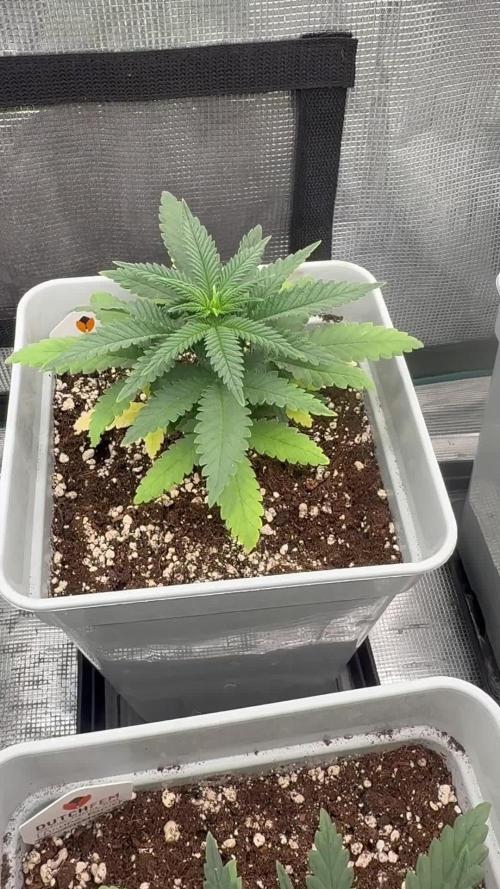
Las plantas avanzan bien pero no como nos esperábamos. Alguna de ellas nos está dando problemitas por falta de agua o de nutrientes, no queremos excedernos debido a experiencias pasadas pero tememos quedarnos cortos.
En el último riego no hemos aumentado los nutrientes si no que hemos vuelto a las bases anteriores ya que conocemos cómo funcionan y queremos ver cómo responden. No sabemos el porqué pero hay dosa que está como cogollando y eso es curioso, una fast de sweet, pero como hemos dicho en semanas anteriores no somos expertos solo queremos ver crecer las plantas y es algo que nos gusta mucho pero cada planta es un mundo y reacciona de distinta manera aunque llevemos el control de riegos y de más, cada una es diferente, y eso es muy bueno… 😎
Los riegos están siendo estables y hemos aumentado la cantidad de agua, pasando de 300ml a 350 ml, debido a la demanda de las plantas. El agua la estamos manteniendo siempre a un pH de 6,0.
En general estamos contentos con la evolución. Pero pendientes de ver su evolución para controlarlas y mejorarlas.
Hasta la semana que viene que volveremos con más avances ( dudas y problemas 😜)
SALUDOS PARA TOD@S🌱💀💨


@autofloweronly
Follow
Jelly cak3 I can’t wait. She smells dank and look great. I can’t wait. Jelly cak3 smells more like fruity cak3. I smell grape I smell berries I smell cherries I can’t wait jelly cak3


@Roberts
Follow
Well 85.9 grams of goodness. Has a great smell and flavor. Very head heavy smoke. If you like high thc or even fruity buds this is a good one to grow. If anyone is interested in any fast buds strains my affiliate link is
https://myfastbuds.com/?a_aid=60910eaff2419
If anyone is interested in a Viparspectra light I can send you to a affiliate link, and look for discounts though my affiliate program as well. Please direct messages me for more information please.
Thank you grow diaries community for the likes, follows, and subscriptions on my YouTube channel. I really appreciate the support. 🌱🌱🌱 happy growing 🍓🍌🍓🍌🍓🍌🍓🍌


@HowtoBubatz
Follow
It’s the third week of vegetation, and both plants are growing like crazy! 🌿
They’re super healthy and pushing forward with lots of energy. I’ve been feeding them with the BioBizz nutrient schedule for veg and adding Root Juice to boost their root development. 🌱💧
I’m trying different LST (low-stress training) techniques with both plants.
For one, I’ve applied LST to the entire plant, bending the main stem to get more light exposure across the canopy. 🌿🔄
The other plant is a bit different—I’ve only used LST on the lower branches to encourage better side growth while letting the main stem do its thing. 🌱📈
Both plants are responding really well, and I’m excited to see how these different techniques impact their development. Things are looking promising! 😁✨


@GreeneScene
Follow
During the middle of this week I decided to stop the outward training of the branches & the allow vertical growth for beginning bud site formation . I don’t want to miss the beginning flower stretch kinda need it 😂.
Decided to break the apical dominance of the main stem by LST’ing down . I noticed it was leagues ahead of the rest of the plant because it hung over the side of the pot so since I need to start slowing it’s vertical growth I figure now Is also time to get the rest of the canopy to catch up leaving me to space things accordingly later when/if necessary .
Also decided to go ahead and do my 1st & last additional feeding since these girls where planted all I’ve had to do this grow was water when dry & train her to the best of my abilities.
Week 6 on the GreenSceene in the books 📚 thanks for stopping by .





@AsNoriu
Follow
Day 43. Light is on max output, heat enormous and they RUN !!!! thought intensity will stop them a bit , but i think i do only worse ... We have +30 heatwave in UK, i live in attic , so for 4 more days everything will be out of control.
Watered today. 6.3 phed water.
I love simple and affordable Mars Hydro products, if you can cope with heat TSL2000 can do magic in your tent !
Will update after heat wave us over. Should be in 4 days back to +20 ;)))
Day 45. They GROW !!!! Distance is insanly small, but i have 30 cm of space left, wont move light for a week, then i will try to have 20 cm at least again.
Planing last top up, need two more waterings before it, so it should be on last day of this or first of next week.
Thinking to take down all LST at that time, need pots to breath better, too thin fabric, they dont keep form.
Day 47. Drink every two days !!! 4 liters goes to nothing !!! Huge, still streching, tops almost rubbing TS2000, heat 30 inside, humidity 65-68 ..... will need heavy clearing again !!! Bomb getting stacked !!!
Happy Growing !!!!


@MadeInGermany
Follow
Hey everyone :-).
This week she continued to develop very nicely 😍.
I started with LST training and topping 😊.
The training took it very well and after 1-2 days it grew again immediately 👍.
This time it will be an extreme bush 😂👍.
It was poured once this week with 1.2 l.
Otherwise there is nothing to report this week.
I wish you all a lot of fun until the next update. stay healthy and let it grow 😀
You can buy this Strain at
https://www.amsterdamgenetics.com/product/kosher-tangie-kush/
Type:
Kosher Tangie Kush
☝️🏼
Genetics:
Kosher Kush
X
Tangie
👍
Vega lamp:
2 x Todogrow Led
Quantum Board 100 W
💡
Bloom Lamp :
2 x Todogrow Led
Cxb 3590 COB 3500 K 205W
💡💡☝️🏼
Soil :
Canna Coco Professional +
☝️🏼
Fertilizer:
Green House Powder Feeding
☝️🏼🌱
Water:
Osmosis water mixed with normal water (24 hours stale that the chlorine evaporates) to 0.2 EC. Add Cal / Mag to 0.4 Ec Ph with Organic Ph - to 5.5 - 5.8 .


shorts_status_processing


@zZzfromspb
Follow
как видите малышкам все очень нравиться!пока подгиб сделал только парочкам девок остальные плотные и мне их страшно гнуть.


@AustinRon
Follow
LJ 2Q24 Flower Week 4
Start of Week:
- [Sun Jul 21, 2024, LJ 2Q24 22:F:4:1]
- Plant Heights: [ 21 , in]
End of Week:
- [Sat Jul 27, 2024 LJ 2Q24 28:F:4:7]
- Plant Heights: [ 25, in]
Resin Bloom to 6 ml/gal (base)
EC 2.7 # MAX EC for Lemon Jeffery (w/ First Resin Bloom)
__
Sun Jul 21, 2024
LJ 2Q24 22:F:4:1
DEHU Water (EC 0.0) Bloom Week 4, EC 2.7, Boosted Nitrogen (+2ml/gal)

__
Mon Jul 22, 2024
LJ 2Q24 23:F:4:2


EC: 2.7, RLA Heavy Bloom Week 4 - Boosted Nitrogen (2 ml/gal)
Plant-Heights:
- 2: [ 19, in]
- 1: [ 21, in]
- 4: [ 24, in]
__
Tue Jul 23, 2024
LJ 2Q24 24:F:4:3
Coco, Ron, Coco. Switch boost to Calcium (+2 ml/gal)
Let’s boost CaMg through weekend …
- [x] Collect DeHu Water - Bleach Collection Container, Replace
- [x] Filter DeHu Water
- [x] Tidy up Grow Room
- [ ] ADD Overhead CloudRay (Oscillating Fan)
- [x] Mix 1.5 GALLONS ( Increases Ca, +2ml/gal, ~2%/17.8% - 11% Ca Boost)

__
Wed Jul 24, 2024
LJ 2Q24 25:F:4:4

__
Thu Jul 25, 2024
LJ 2Q24 26:F:4:5

__
Fri Jul 26, 2024
LJ 2Q24 27:F:4:6

Hydro Only might be the Nitrogen Load early LJ Needs . . .

I think the stretch is dome. 16” Loght distance, 90%. dimmmer. Humidity crankin.
__
Sat Jul 27, 2024
LJ 2Q24 28:F:4:7


@Mosquito_Haarlem
Follow
Haar laatste week,
Wat een gigantische schoonheid zeg!!
Haar toppen zijn keihard en zitten vol thc!
De hoofdtop is te zwaar, zonder ondersteuning valt ze om.
Wat is dit weer een geweldige strain van Zamnesia!
Ik ben echt supertevreden.
Ik zal meer foto's updaten dus hou het in de gaten! ❤️


@MrAutoflower
Follow
Plants are not doing great, more like an absolute disaster. The height is app. 51 cm and 34 cm measured from the top of the soil, far to small and not growing anymore. I think I drowned them a few weeks ago, wasn't paying attention when watering my 2 Sour Diesels and Humbold Seed Headband. Posted some random pictures and a video from the last few weeks, hope you like them anyway.


@StarLorr
Follow
Welcome to my Ðivine ØĠ Ķush diary.
In this diary:
Seeds: sponsored by Ðivine Șeeds
Media: Promix HP
Nutrients: Advanced Nutrients, Diablo Nutrients.
Light and Weather: Şun☀️and Mother Earth.🌎
___________________________
Feeding:
Tue 09Jul: 8L nutrients pH'd 6.5
Sat 13Jul: 10L water not pH'd
Sun 14Jul: 10L water not pH'd
Mon 15Jul: 17L water not pH'd
*please note that most water only feedings are 2L at the time throughout the day in bottom saucer*
___________________________
Another beautiful week, besides Wednesday's flood😅 it poured so much rain that my Tuesday morning feeding got flushed out and was in the bottom saucer Thursday morning😳😂that was a first for me.
All is good with my Ðivine Ladies, just me anxious to see them buds coming out.
______________________________
Thanks for stopping by, likes and comments are appreciated!👊🏻😎
Keep on growin!
Keep on tokin!!!
😙💨💨💨💨💨



@DutchGlobalCitizen
Follow
Week 7 Flower (Estimated)
We're having a grand celebration this week!
My American growmies, in particular, might be interested in this small piece of our shared history.
But first...
Alisha & Kenisha
As this diary continues, Alisha and Kenisha remain our two familiar reference plants.
Both continue progressing steadily through flower, with more pistils beginning to age and increasing flower development visible throughout the canopy. As always, these observations come from a population that receives little intervention beyond rain, sunshine and occasional watering during drier periods.
Kenisha continues to hold her lead in height, despite having started as the smallest of the selected females when they were transplanted outdoors. Alisha remains slightly more compact but continues building flowers at a similar pace.
One thing that continues to stand out is the relaxed nature of this population. These plants were never bred for grow tents or feeding schedules. For generations they survived under Caribbean skies with varying degrees of care, and they still seem perfectly comfortable doing exactly that.
Nothing dramatic happened this week.
Which, for an old heirloom population growing outdoors in the tropics, is often a very good thing.
Island Notes
The First Salute: When A Small Caribbean Island Acknowledged A New Nation
For most GrowDiaries readers, St. Eustatius is probably just a small Caribbean dot on a map.
This week, that changes.
This week we celebrate Statia Day, the national holiday of St. Eustatius. While it is an important event for island residents, its history extends far beyond our shores.
The story begins during the American Revolutionary War.
On November 16th, 1776, the American brig Andrew Doria sailed into the harbor of St. Eustatius flying the flag of the newly declared United States.
The island's commander ordered Fort Oranje to respond with an eleven-gun salute.
That exchange became known as The First Salute.
For many Americans, the event holds special significance because it is often regarded as the first formal international recognition of the United States flag and, by extension, the young American republic.
But the salute itself was only the visible part of a much larger story.
Long before the Andrew Doria entered the harbor, St. Eustatius had already become one of the busiest trade hubs in the Americas. During its peak years, the island earned the nickname The Golden Rock because of the enormous volume of international trade passing through its port.
Merchants from around the world arrived to buy, sell and exchange goods. Among those goods were weapons, gunpowder and military supplies.
The American revolutionaries desperately needed those supplies.
St. Eustatius was one of the few places where they could obtain them.
In that sense, the Andrew Doria did not arrive at a random island by accident.
The First Salute was not the beginning of a relationship.
It was a public acknowledgment of one that already existed.
Trade routes, merchants and supplies had been flowing between Statia and the American cause long before the cannon smoke drifted away from Fort Oranje.
Britain noticed.
The island's commercial success and its role in supplying the American rebels generated increasing anger from British authorities. Those tensions eventually contributed to military action against the island and the decline of the Golden Rock era that had made Statia famous throughout the Atlantic world.
History can be surprisingly unforgiving.
A tiny volcanic island helped support a revolution thousands of miles away.
The revolution succeeded.
The island paid a price.
Today, Fort Oranje still overlooks the harbor where the Andrew Doria once appeared. The cannons remain. The flags still fly. And every year Statia Day gives the island an opportunity to celebrate a chapter of history that connected this small Caribbean trading post to the birth of a nation.
As the United States approaches the 250th anniversary of its independence, that connection is likely to receive renewed attention.
And for those reading this diary from elsewhere in the world, you now know a little more about the island where this old Caribbean sativa population has quietly evolved for generations.
Final Thoughts
While Statia Day takes center stage this week, Alisha and Kenisha continue their slow journey toward maturity beneath the same trade winds that have crossed these islands for centuries.
The flowers continue to develop.
The celebration continues.
And somewhere between history, culture and cannabis, another week passes in the Caribbean.
"The cannons fell silent long ago. The trade winds never did."


@Chubbs
Follow
Weekly update on these gorgeous ladies. They're super close to being finished. I'd say probably this week some will be harvested and put into the Cannatrols to dry and cure. The smell is so sweet and dessert like, it's wild. One that I find to make great extracts so I think I'll pull some out for just that. All in all Happy Growing