


Likes
Comments
Share


@DogDoctorOfficial
Follow
🍬🌿 8×8 Adventure – Week 14
Candy Rain Auto by Zamnesia
The Solo Survivor Is Getting Closer… But She's Not Fooling the Microscope! 😂🔬🌸💚
Welcome back to another chapter of the 8×8 Adventure! 🌱💚
And oh my goodness…
OUR CANDY RAIN! 🍬😂🌸
This girl just keeps giving us something to talk about.
She's still beautiful.
She's still developing.
She's still showing us those lovely flowers.
And she's getting closer to the end of her journey.
But, of course…
She wouldn't be Candy Rain if she didn't give us a little surprise along the way.
😂😂😂
Because just when you start thinking that a plant is approaching the finish line, she decides to throw fresh white hairs all over the place.
Everywhere!
🌸?🌸?🌸
And naturally, the first thought is:
"Girl… are you starting another round?"
😂😂😂
Not so fast!
Because although those fresh white pistils might make her look like she's trying to start something new, the trichomes are telling a different story under the microscope.
And that's precisely why we don't judge a plant's readiness by one visual clue alone.
Candy Rain is getting close.
Very close, I believe.
My current feeling is that this could be her final week, but that's an expectation, not a promise.
We'll keep looking, keep observing, and let the plant tell us when she's ready.
No rushing.
No guessing based on white hairs alone.
And definitely no letting Candy Rain fool us just because she's decided to grow a fresh set of little white flags!
😂🍬👑
So let's give our beautiful solo survivor the spotlight she deserves.
────────────────────────
🍬 WEEK 14 – THE FINISH LINE IS GETTING CLOSER
If you've been following Candy Rain from the beginning, you already know that this girl has developed her own personality throughout the 8×8 Adventure.
Our solo survivor.
Our beautiful green girl.
Our plant that seems determined to fill herself with flowers.
And now, here we are, approaching what may be the final chapter of her flowering journey.
She's still beautiful.
She's still carrying those developing flowers.
And she's still giving us new details to observe.
The most noticeable thing this week?
Those fresh white pistils.
?🌸
They're appearing across the plant, and if we were judging solely by the pistils, we might be tempted to think she still has a long way to go.
But that's exactly why I don't want to make that assumption.
Different cultivars can behave differently as they approach maturity. Some continue producing fresh pistils late in flowering, and that alone doesn't necessarily mean the entire plant has restarted its flowering journey.
We need to look at the whole picture.
The flowers.
The overall development.
The trichomes.
And how everything is progressing together.
Candy Rain is getting closer, and the microscope is helping us understand where she actually stands.
She's not quite ready yet.
But I have a feeling we're approaching the final stretch.
🍬🌿🔬
────────────────────────
? WHITE PISTILS EVERYWHERE – WHAT IS SHE TRYING TO TELL US?
Honestly, Candy Rain…
What are you doing?
😂😂😂
We're trying to work out whether you're approaching the finish line, and you decide to throw fresh white hairs all over your flowers.
?🌸?🌸?
I find this fascinating because I've seen this behaviour in some cultivars before.
As flowering progresses, certain plants continue producing new pistils even when other signs suggest they're getting close to maturity.
That doesn't automatically mean something is wrong.
It also doesn't automatically mean the plant needs several more weeks.
Fresh pistils are one observation, not the entire verdict.
And this is where experience, patience, and looking at several indicators become important.
I don't want to pretend that every cultivar follows the same visual script.
They don't.
Some plants give you a fairly straightforward progression.
Others keep surprising you.
And Candy Rain?
Well…
She's clearly decided to keep us guessing.
😂🍬👑
The white hairs are part of the story, but they're not the whole story.
────────────────────────
🔬 THE MICROSCOPE TELLS A DIFFERENT STORY
This is where things get interesting.
When I look at the trichomes under the microscope, the picture isn't quite the same as the one suggested by all those fresh white pistils.
She's not ready yet.
And that's an important distinction.
I don't want to call harvest simply because the plant looks close, because the pistils have changed, or because I'm getting impatient to finish another chapter of the 8×8 Adventure.
😂🌱
The trichomes give us another useful piece of information about flower maturity, and they need to be considered alongside the overall condition and development of the plant.
They don't magically tell the entire story on their own, either, but they help us make a much more informed assessment than judging by pistil colour alone.
So, for now, Candy Rain stays where she is.
We're observing.
We're checking.
We're comparing what we see with the progression from previous weeks.
And we're letting the evidence guide us.
My feeling is that this may be her final week.
But if she needs more time, she gets more time.
The calendar doesn't decide when a plant is ready.
The plant does.
🔬🍬🌸
────────────────────────
⏳ MY GUESS? POSSIBLY THE FINAL WEEK!
I'm going to put my expectation out there.
I think this could be Candy Rain's final week.
There.
I've said it.
😂🍬👑
But please underline the word "could" in your mind.
This isn't a fixed harvest date.
It's my current impression based on what I'm seeing as I follow her development.
The fresh pistils are one part of the picture.
The trichomes are another.
The overall progression is another.
And when I put all those observations together, I feel we're getting very close.
But we'll see.
Time will tell.
And if Candy Rain decides she needs a little more time, then we'll keep watching her.
I'm not interested in forcing a finish just because I've made a prediction in a diary.
😂
I would much rather be patient and document what actually happens than pretend I knew the exact day in advance.
That's the beauty of keeping weekly records.
We can share our expectations while staying honest about the uncertainty.
So, Candy Rain…
If this is your final week, let's make it a beautiful one.
And if you need a little longer?
We'll be here.
🍬💚🌿
────────────────────────
💚 STILL OUR BEAUTIFUL GREEN GIRL
One thing that hasn't changed is how much I enjoy looking at this plant.
She's still beautiful.
She's still got that lovely green presence.
And her flowers continue to catch my attention.
There is something satisfying about following a plant for weeks and seeing how the small changes gradually add up.
At first, you're watching the plant establish herself.
Then the structure develops.
The flowers appear.
The flowers become more substantial.
The details become more interesting.
And eventually, you reach this stage where every new observation makes you wonder how close she is to the next chapter.
That's where Candy Rain has brought us.
She's not just a photograph from Week 14.
She's the result of everything that happened before it.
And I love being able to look back at those earlier updates and compare them with what we're seeing now.
🍬🌿💚
────────────────────────
🍬 OUR SOLO SURVIVOR HAS COME A LONG WAY
Let's not forget where this story started.
Candy Rain has been our solo survivor throughout this part of the 8×8 Adventure.
And she has certainly made the most of her place in the room.
She's developed her own flowering structure.
She's filled herself with beautiful flowers.
She's shown us her own rhythm.
And she's continued to surprise me throughout the journey.
I originally called her our solo survivor because she was the one standing there on her own in this particular genetic group.
But sometimes I look at her and think she doesn't seem particularly interested in the word "solo."
😂😂😂
She's one plant, yes.
But she's given us plenty to photograph, plenty to discuss, and plenty to observe.
And now she's approaching the final stretch.
Whatever happens next, she's already given us a beautiful story to follow.
────────────────────────
💡 SAME ROOM – SAME PHOTONS – HER OWN RESPONSE
And once again, let's return to one of the foundations of the 8×8 Adventure.
Candy Rain is sharing the room with the other plants.
The same general environment.
The same 12/12 light schedule.
The same overall nutritional approach.
The same expanded lighting setup.
And yet, she continues to express herself in her own way.
🍬☀️🌿
The two additional Future of Grow Black Series 600W fixtures remain part of the room's expanded lighting setup.
We're using that additional capability with controlled output rather than simply running everything at maximum.
Our recent target has been around 1,500 PPFD across the upper canopy, with the actual intensity varying according to canopy height and position.
Lumiflora also contributes additional light deeper in the canopy.
And Candy Rain is receiving those same general lighting conditions as the rest of the room.
But her response is her own.
That's one of the things that continues to make this project interesting.
The room provides the shared stage.
The genetics provide the individual performance.
Some plants stretch.
Some stay compact.
Some develop at one pace, while others follow a different rhythm.
And even when they appear to be approaching the same stage, they can show different signs along the way.
Candy Rain is giving us another example of that.
Same room.
Same photons.
Different story.
────────────────────────
🔴 FAR-RED, DEEP-RED & OUR 15-MINUTE LIGHT ROUTINE
Now, let's talk about another part of the room's lighting routine.
We've been using far-red and deep-red lighting as part of our end-of-day approach, including a 15-minute red-light period after the main lights go off.
The idea behind this routine is to influence the plants' light signalling at the transition into the dark period and help create a consistent end-of-day transition.
But there's an important distinction here.
Red light, deep-red light, and far-red light aren't interchangeable terms.
They're different parts of the light spectrum, and plants can respond to them differently.
Red light is commonly associated with photosynthetic activity and plant light signalling.
Far-red light is particularly relevant to phytochrome signalling, which helps plants interpret changes in light conditions and the transition between day and night.
The response depends on the spectrum, intensity, duration, and the plant's wider environment.
So when we talk about our 15-minute period, we're talking about a deliberate lighting routine we're testing and using in this room.
We're not claiming that fifteen minutes is a universal magic number, or that every plant will respond in exactly the same way.
As always, we observe the plants and consider the whole environment.
🌿🔴🌙
────────────────────────
🌙 HELPING THE PLANTS TRANSITION INTO NIGHT
One of the reasons people experiment with end-of-day far-red is the way plants use light signals to interpret their surroundings.
Plants don't simply know that it's nighttime because somebody switched off a lamp.
They respond to changes in the spectrum and intensity of light, and those signals can influence different aspects of plant development.
Far-red light can shift the balance of phytochrome states, helping plants interpret the transition from light to darkness.
That's the scientific idea behind using far-red as part of an end-of-day routine.
In our setup, we're using a 15-minute period after the main lights go off as part of that transition.
I like experimenting with the lighting environment, but I also want to keep the claims realistic.
The response isn't identical across all cultivars, and the effects depend on the conditions and how the light is delivered.
So this is part of our approach and observation, not a guarantee that a particular result will happen.
And Candy Rain is still following her own path within that shared environment.
🍬🌙🌿
────────────────────────
☀️ THE EMERSON EFFECT – WHEN RED AND FAR-RED WORK TOGETHER
Now, let's bring in a fascinating piece of plant science: the Emerson effect.
The Emerson effect describes how photosynthesis can become more efficient when red light and far-red light are supplied together than would be expected from their individual effects alone under certain experimental conditions.
Why?
Because photosynthesis involves two cooperating photosystems, known as Photosystem II and Photosystem I.
They absorb light most effectively in different, overlapping parts of the spectrum.
When suitable red and far-red wavelengths are provided together, they can help balance the activity of these two photosystems.
In simple terms, they can work together more effectively than either wavelength would suggest on its own.
That's the fascinating part.
Plants don't respond to light as if every photon operates in isolation. The spectrum matters, and different wavelengths can interact with the plant's photosynthetic machinery in different ways.
☀️🔴🌿
However, we should keep the science precise.
The Emerson effect is a specific phenomenon demonstrated in photosynthesis research. It doesn't mean that adding any red or far-red light automatically increases yield, improves flower quality, or guarantees a faster finish.
The result depends on the spectrum, intensity, duration, and wider growing conditions.
And the 15-minute end-of-day routine we're using is a separate practical lighting choice. We shouldn't assume that it directly reproduces every condition used to demonstrate the Emerson effect.
I find the science fascinating, and it's one more reason I enjoy experimenting with lighting rather than thinking of every LED as simply a bright lamp.
Different wavelengths can have different roles.
The way we combine them matters.
And the plants' responses are worth observing.
💡🌿🔬
────────────────────────
💡 MORE THAN JUST SWITCHING THE LIGHTS ON
This is what I enjoy about the lighting side of the 8×8 Adventure.
We can talk about the main fixtures.
We can talk about PPFD.
We can talk about canopy position.
We can talk about red and far-red wavelengths.
We can talk about the transition between light and darkness.
And we can look at the plants and ask how they are developing under the overall conditions.
But I don't want to credit every little change to one specific light or one particular setting.
The plant is responding to the whole environment.
Genetics.
Light.
Nutrition.
Temperature.
Humidity.
Water availability.
And the way all those factors come together.
Candy Rain's fresh pistils are interesting, but I wouldn't automatically attribute them to the red-light routine.
We don't have enough evidence to make that claim.
Instead, we keep documenting what we see and avoid turning a coincidence into a conclusion.
That's how I want to approach these experiments.
Curiosity first.
Observation second.
Conclusions only when the evidence supports them.
💚🔬🌿
────────────────────────
⚗️ NUTRITION – THE SAME FOUNDATION CONTINUES
Candy Rain remains part of the same overall nutritional approach used in the room during this stage.
The recent feeding notes were:
🌱 Plagron Terra Bloom – approximately 2.3 ml/L
🌱 Power Buds – 1 ml/L
🌱 Green Sensation – 1 ml/L
🌱 Sugar Royal – 1 ml/L
⚗️ pH adjusted as required
The recent solution readings were around pH 6.02 and EC 2.14 mS/cm, although the exact values can vary with the latest mix.
These are the room's recent reference values rather than a claim that every reading has remained identical throughout the week.
As Candy Rain gets closer to the end, the important thing for this diary is to keep documenting her actual condition rather than assuming that all plants need the same final timeline.
She's her own plant.
She's shown us her own behaviour.
And we're continuing to observe her accordingly.
🍬🌿💚
────────────────────────
🌡️ RECENT ROOM CONDITIONS
For context, the room's recent reference conditions have been approximately:
🌡️ Day air temperature: 26.5°C
🌙 Night air temperature: 26°C
💧 Relative humidity: 61%
🌱 Substrate temperature: 25°C
💦 Nutrient solution temperature: 25°C
⚗️ pH: approximately 6.02
⚡ EC: approximately 2.14 mS/cm
💨 CO₂: approximately 693 ppm
💡 Light schedule: 12/12
? Pot size: 15 litres
💧 Watering: approximately 1.4–1.45 litres per plant per 24 hours
These are the recent room figures, not a claim that every parameter has been measured at exactly the same value during every moment of Week 14.
The overall environment remains shared with the other plants still in the room.
And while Candy Rain approaches her finish, the rest of the 8×8 Adventure continues.
Same room.
Different plants.
Different timelines.
🌿🍬💚
────────────────────────
👀 WHAT I'M WATCHING NOW
At this stage, I'm keeping an eye on the overall progression rather than allowing one feature to dictate the entire decision.
? The fresh white pistils.
🔬 The trichomes under the microscope.
🌸 The development and appearance of the flowers.
🌿 The overall condition of the plant.
📸 The changes compared with previous weekly photographs.
All these observations help build a more complete picture.
The fresh pistils are certainly interesting, but they don't automatically mean she has restarted flowering or that she's far from maturity.
The microscope currently suggests she's not quite ready.
And my feeling is that she's getting very close.
That's where we stand today.
No drama.
No premature conclusions.
Just watching Candy Rain as she approaches the next chapter.
────────────────────────
🔮 WHAT COMES NEXT?
My guess is that we may be looking at Candy Rain's final flowering week.
But, as always, we'll let time tell us whether that expectation is correct.
If she is ready, we'll document the next stage.
If she needs longer, we'll continue observing.
Either way, there's no reason to force a date simply because I made a prediction.
😂🍬
And while Candy Rain is approaching the finish line, the rest of the room is still doing its thing.
The 8×8 Adventure continues.
Each plant gets her own diary.
Each phenotype gets her own spotlight.
And each one gets to show us how her story unfolds.
────────────────────────
💭 FINAL THOUGHTS – CANDY RAIN, DON'T LET THOSE WHITE HAIRS FOOL US!
Week 14.
Candy Rain Auto by Zamnesia.
🍬👑🌸💚
Still beautiful.
Still developing.
Still getting closer.
And still finding ways to keep me guessing.
😂😂😂
Those fresh white pistils are appearing all over the place, but the microscope is giving us a different perspective.
She's not ready just yet.
And although I suspect this could be her final week, I'm not going to pretend that I know for certain.
The plant gets the final say.
That's the rule.
We've also been continuing our lighting experiments, including the 15-minute red-light period after the main lights go off, with far-red and deep-red wavelengths forming part of our wider lighting approach.
The science behind plant light responses is fascinating, especially when we look at phytochrome signalling and the Emerson effect.
But we're keeping our observations separate from our assumptions.
We're not claiming that the lighting routine caused her fresh pistils, nor that it guarantees a particular harvest outcome.
We're simply documenting the environment, watching the plants, and learning as we go.
And that's what the 8×8 Adventure is all about.
Twelve plants.
One shared room.
Different genetics.
Different expressions.
And individual stories that never stop being interesting.
🍬🌿💚
So, Candy Rain…
Keep doing your thing, girl.
We'll keep watching those trichomes.
We'll keep admiring those flowers.
We'll keep taking our photographs.
And we'll wait until the evidence tells us you're ready.
You might be approaching the finish line.
You might need a little more time.
Either way, you're still beautiful, and you still deserve the spotlight.
🍬?🌸🔬
Let's give our solo survivor the love she deserves.
Let's appreciate the journey.
Let's stay curious.
And let's see what next week brings.
────────────────────────
🙏 THANK YOU
As always, a massive thank you to everyone following the 8×8 Adventure. 💚🌱
Thank you to GrowDiaries for giving us the space to document these individual plant journeys and share our observations with growers around the world.
Thank you to Zamnesia for the Candy Rain genetics and for giving us this beautiful solo survivor to follow.
Thank you to Plagron for supporting the room with the growing media and nutrition used throughout this adventure.
A huge thank you to Future of Grow for supplying the additional Black Series 600W fixtures and giving us the opportunity to explore this expanded lighting setup. 💡☀️🌿
Thank you to Lumiflora for helping bring additional light into the deeper areas of the canopy.
Thank you to TrolMaster for helping us monitor and manage the room environment behind the scenes.
And thank you to everyone who reads, comments, asks questions, shares experiences, and follows these girls week after week.
It genuinely means a lot. 💚
If you'd like to join our growing community, you're more than welcome to come and say hello on Discord:
https://discord.gg/dogdoctorofficial
We have growers with different levels of experience, conversations about all kinds of growing topics, competitions, prizes, giveaways, and community discount codes.
But above all, we're building a place where people can feel welcome.
You don't need to be an expert.
You don't need to have a huge garden.
You don't need to speak every technical language.
You can ask questions, share your experience, join the conversation, or simply hang out and listen.
There's no level you need to reach before you're welcome.
Respect, curiosity, and a willingness to learn are more than enough.
We love talking about this plant, sharing what we know, learning from one another, and enjoying the journey together.
It's becoming a beautiful community, and we'd love to have you with us.
💚🌱🤝
Growers Love, my friends. 💚🌱
See you next week in the 8×8 jungle…
where the photons keep flying, the plants keep surprising us, and Candy Rain is still throwing fresh white hairs around like she hasn't heard that we're getting close to the end.
😂🍬?🌸
Keep shining, girl.
We'll let the microscope have the final word.
💚🔬✨

Likes
59
Share


@AsNoriu
Follow
Day 22. Girl is getting somewhere ;))
Finally got fan and he is noisy, so no wind supplement for this girl ...
Planning to water her today . 50 ml of 6.3 pH water will go in.
Last video when i turn pot upside down, if any roots will appear - i will write here.
Day 26. Side branches started to grow, no sex signs yet ....
Day 27. 70 ml 6.3 pH water in. I got my "in" too ;)))
Happy Growing !!!

Likes
21
Share

@AestheticGenetix
Follow
This whole grow cycle I never added anything to the soil. I tried my first living soil set up with worms and cover crops. I didn't do anything but water from begining to end which is actually pretty crazy now that I think about it.
Around day 3 of drying. The conditions are favorable. We have to open our windows at night to cool the house down so it's really been up to nature as to what the humidity and temperature will be. Right at this moment rh is it's in the 70s because of morning dew.
But I'm also curious about how the "new" way to dry with cannatrol etc is based on dew point rather than straight 60 60.
I've never achieved straight 60 60 but I've had 67 60 and 80 60 but the main thing is to keep the rh around 60%
I'm curious to see how this turns out. She lived in nature and now she dries by nature.

Likes
16
Share


@SAC87
Follow
Day 28:
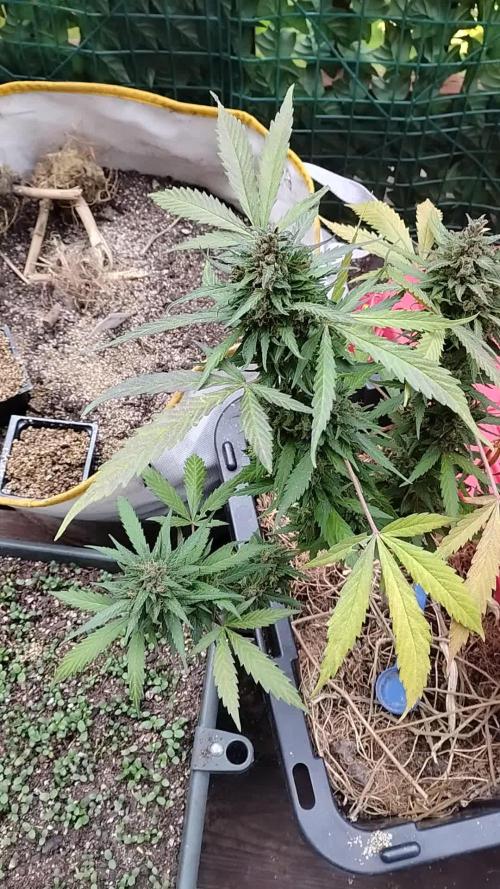
I got home from 10 days of holidays and these girls had cruised along as if I had been there with them the whole time. They are very happy, especially the middle one. The small one on the right has always been small, is what it is. She could be a stack little shorty. Time will tell. I did a feed today, top dressed according to Gaia Green at 15 ml/ gal of media which should last approx 2 weeks. I also added a bit more 444 just to make sure there’s enough N during this stretch phase. All 3 have pistols showing and are starting to flower. I was unable to train as much as I’d have liked but is what it is. Sometimes the more indica strains I’ve done are negatively effected by topping and excess training. I removed a couple huge fans that were shading too much of the plant. I also am trying a “super cropping” of top fans to get them out of the way but still save them as a nute source if they need. We’ll see how it goes.
The Vipar spectra xs2000 is killling it as usual. As I’ve said 50 times it’s super powerful and I’ve had to raise the light above recommended height as I started to see leaf edge curl and light stress. No problem at all tho, better too powerful and raise it than too weak and have loose buds.
I did a micro top just to stop excessive apical meristem stretch and leaving all the other lower branches too low for effective light absorption or burn on the top cola.
Happy Growing 🌱
Likes
57
Share

@AsNoriu
Follow
Day 85 since seed touched soil.
Trim jail !!!
2.40 cm of hanging buds !!!
Happy Growing !!!


Likes
11
Share


Likes
12
Share


@HIAZ_urbanbudfarmer
Follow
Saturday 16-11-24 , Flowering day # 53 week 8. Harvest day!
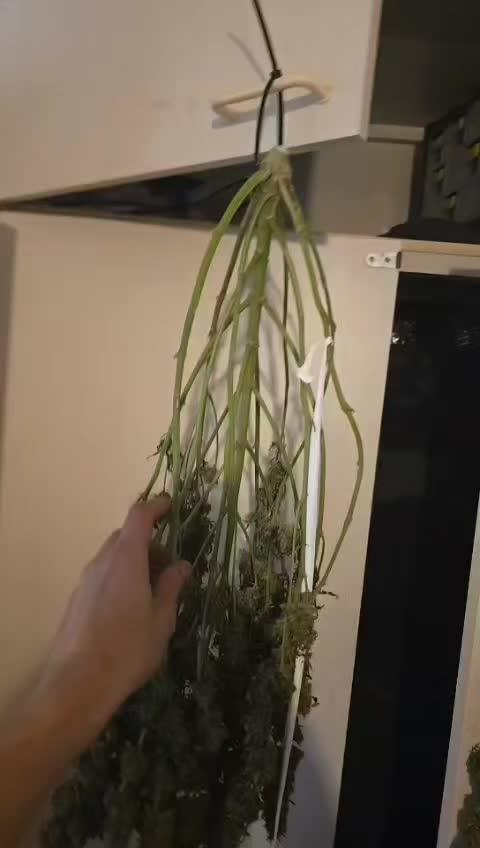
Cut branches off plants & hung the 2 front plants off the light.
Put scrog net back in with a large flyscreen laying on top, & spread branches from the back plant over it. This allows complete air flow around the buds. Running a single oscillating fan beneath pointing to the bottom.
Temperature is around 24°C & RH is 55%
Likes
Comments
Share


Likes
16
Share


@Northern_Ent
Follow
Aug 9: Lemon Cream Kush is doing fine and is starting to stretch a bit. I’m surprised how much it grew last week.
Got the UV led lights from AC Infinity going. The sunlight gets weak here quickly starting in mid-August and the UV helps form trichomes. Used it last year and it seems to help. Nice weather days only as these lights are not intended for outdoor use.

Likes
16
Share


@ShowsWorld
Follow
Critical Kush is a strain that is potent, and with it come a few side effects, although none of them are very serious. This indica-dominant strain can sometimes make you feel parched as it can leave you with a dry mouth, which is usually coupled with a case of dry and itchy eyes.
Likes
25
Share


@Luna91
Follow
Hey Guys,
Finally the Harvest time arrived, and it was way harder than I imagined!!
I thought It’ll be fun to cut and trim but It was something that needed lots of attention and patience, getting near a kg bud, trimming and hanging them, checking on other buds in the jar and feeding my 2weeks baby plants , while keeping the area clean and out of reach of my dogs!! Everything was extremely in a Rush in a couple of days. But Im totally happy with the results. I set up the grow tent to 20degree and 55% relative humidity with two fans from each corner, I hope I get the best outcome when I see finally find them dry. I already smoked it up and the smell & taste is undescribable ... smell of pineapple is all over the place, my Grinder is full of it. Slowly gets me high without attacking and keeps it up to hours.. very strong Sativa feeling, Very fruity and such a sweet good strain. I just love it and will definitely grow the same strain Again & I’m Very happy that I chose this Strain for my first grow.
Thanks a lot for watching these girl’s journey guys.... I’ll update more photos later when I weight them dry.
Happy Growing
Likes
10
Share


@nonick123
Follow
Día 35 (10/06) N/A
Día 36 (11/06) Se va a quedar un pequeño gran cogollo porque ya se ha detenido el strecht
Día 37 (12/06) N/A
Día 38 (13/06) Avanza la floración para estas pequeñas
Día 39 (14/06) Riego 150 ml de H20 pH 6,5
Día 40 (15/06) N/A
Día 41 (16/06) 500 ml de Té de Floración con Healthy Harvest 8 ml/L + Insect Frass 16 ml/L + Melaza 1 ml/L
💦Nutrients by Lurpe Solutions - www.lurpenaturalsolutions.com
🌱Substrate PRO-MIX HP BACILLUS + MYCORRHIZAE - www.pthorticulture.com/en/products/pro-mix-hp-biostimulant-plus-mycorrhizae
Likes
7
Share

@Cannussy
Follow
7/13/25 - 7/16/25
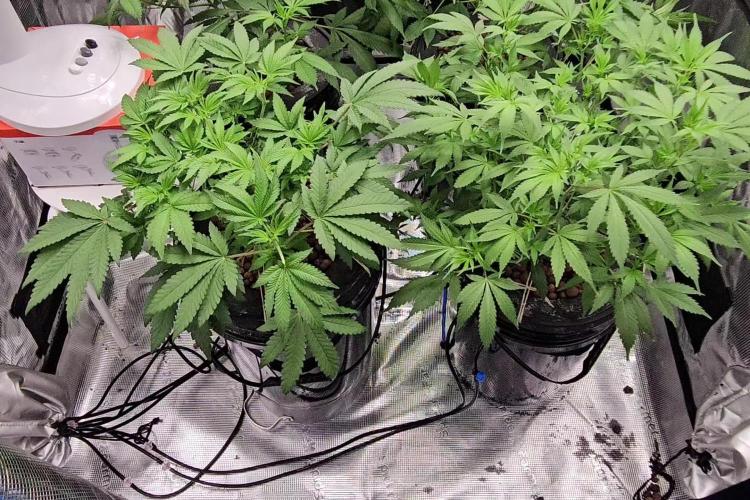
Flipped as another strain is gonna be a problem otherwise. Very stumpy and thicc lady, already smells very funky and rotten. Now we wait and see what emerges in flower.
7/17/25 - 7/19/25
One hungry girl, she is on 100% feed rn. And god she stinks, really gives u burning nostrils. I know copycat is a sensitive topic in the breeder world but he knows his shit. I am abaolutely going to get more of his shit.

Likes
6
Share


@Gromie
Follow
Started the new nutes a few days ago w/ epsom salt. Before that, for a day & a half, I used plain pH'ed water & trimmed off affected leaves. Such a slow grow 😕

Likes
4
Share


@Ohio_Autoflowers
Follow
This plant man. Had to remove the 2nd and 4th node branches because they just weren’t doing anything. Stems were bright purple and the buds were tiny. Decided it was best to just chop them off. Buds are plumping up nicely. She is actually at day 72 right now. Think she’s got 7-10 days left, we’ll see.

Likes
3
Share


@nag4wa
Follow
Still raising feeding content, ended this week with 1.8 EC. Plant still looks like it could get some more nutes. FIMed the taller plant and picked some fan leaves

Likes
1
Share


@Growandroots
Follow
Wochenbericht – Pflanzprojekt (12. Woche – 4. Blütewoche)
In der zwölften Woche setzen die Pflanzen ihre Blütenentwicklung fort, doch die niedrigen Temperaturen bleiben eine große Herausforderung. Trotz aller Bemühungen ist es schwierig, ein konstantes Klima in der Box aufrechtzuerhalten.
Um die Auswirkungen der Kälte zu minimieren, habe ich beschlossen, provisorisch einen Unterboden zu bauen, damit die Töpfe nicht direkt auf dem kalten Boden stehen. Dies sollte helfen, die Wurzeln besser zu schützen und die Temperatur in der Nähe der Pflanzen zu stabilisieren.
Leider zeigen einige Blätter Anzeichen davon, dass sie von der Kälte betroffen sind. Dies äußert sich in leichten Verfärbungen und einer geschwächten Blattstruktur. Dennoch entwickeln sich die Pflanzen weiterhin vital, und die Buds zeigen langsames, aber kontinuierliches Wachstum.
In den nächsten Tagen liegt der Fokus darauf, die provisorischen Maßnahmen umzusetzen und die Pflanzen so gut wie möglich vor der Kälte zu schützen, um die Blütenentwicklung zu fördern.



Likes
12
Share


@Jays_Not_Here_Man
Follow
Nearing the finish line! OMG these ladies are blowing me away 😳 the Tricomes are carpeted, the buds are fat and dense. I’ve been. Tapering off all the nutrients and feeding ph’d water until I get 10-15% runoff from the pot to help break up the pockets left behind and to use up what’s left in the plant. Have some very distinct phenos, all of them are stellar but there are a few standouts… won’t be much longer 🇨🇦👊❤️
