Likes
Comments
Share
17.06.20 (28 DÍAS) Empezaron a salir los primeros pistilos y se está estirando bastante 23.06.20 (34 DÍAS) La Red Critical Auto empieza a mostrar sus primeros buds violetas.
Likes
52
Share
@Rangaku
Follow
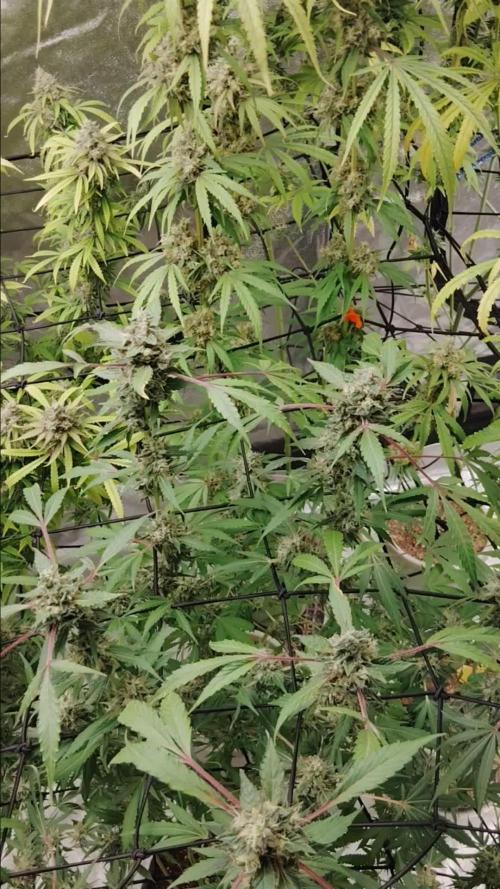
Same same again this week with more nice purple colours and chunky frosty buds .
Likes
50
Share
Week 5: Transplant Time & Root Power! Oh man, this was one of those weeks! We transplanted all five phenos into bigger pots, and let me tell you, they’re thriving! (Check out the complete video episode for all the details 😉). The girls are looking amazing, all pretty much the same size for now, so I don’t have any favorites yet—but let’s see what the future holds! For photos, I used both my Nikon P900 and Sony A6000, with a bunch of lenses and filters to preserve the true colors—these LEDs are powerful! Current Setup & Conditions This week, they’re still chilling with their sisters in the big tent, but in about a week, they’ll be moving into the TrolMaster ecosystem for even better environmental control. Watering: pH 6.06, EC 0.96 Temperature: A bit cold , but it is what it is. We’re facing some freezing outdoor temps (as shown last week in the frosty veggie garden pics!), yet these Runtz are holding strong like true champions. 💪❄️ Nutrition: Still on the Aptus Clean Program, with: Regulator System Clean RO Water Conditioner All-in-One Liquid Root Development: The Real MVP! Let’s go deep on roots! The mycorrhizae in the Pro-Mix soil has been working its magic, and I’m still boosting them further with a touch of Aptus Holland Mycor Mix. The root development on this transplant was insane—super white, healthy, and ready to explode with growth. What Are Mycorrhizae? The word “mycorrhiza” comes from Greek: • Myco- meaning fungus • Rhiza- meaning root Mycorrhizae are a type of beneficial fungi that form a symbiotic (mutually beneficial) relationship with plant roots. These fungi extend far beyond the root zone, creating an underground network that helps plants absorb water, nutrients, and improve overall health. This is not a single species but rather a whole category of fungi, mainly divided into: 1. Ectomycorrhizae – Live on the outside of plant roots, forming a sheath around them. Common in trees like pines and oaks. 2. Endomycorrhizae (Arbuscular Mycorrhizae, AMF) – The most beneficial for most crops and cannabis. These penetrate root cells, forming structures inside the roots that exchange nutrients. Where Are Mycorrhizae Found in Nature? Mycorrhizae naturally occur in forests, grasslands, and undisturbed soils worldwide. They play a crucial role in maintaining ecosystem balance by helping plants access nutrients from the soil. In a natural environment, plants are constantly forming relationships with these fungi. However, in modern agriculture, excessive tilling, chemical fertilizers, and fungicides have reduced their populations, making supplementation necessary in many cases. How Do Mycorrhizae Work? Once mycorrhizae colonize a plant’s roots, they start forming an underground fungal network called the mycelium. This network extends the plant’s reach into the soil, acting as a second root system. Benefits of Mycorrhizae: ✅ Enhanced Nutrient Uptake – Mycorrhizae help plants absorb phosphorus, nitrogen, and micronutrients that would otherwise be unavailable. ✅ Improved Water Absorption – The fungal network can reach deeper into the soil than roots alone, helping plants survive drought conditions. ✅ Stronger, Healthier Roots – They promote thicker, more robust root systems, reducing transplant shock. ✅ Better Soil Structure – They produce glomalin, a protein that improves soil aggregation and helps retain moisture. ✅ Natural Pest & Disease Resistance – Healthy plants with strong mycorrhizal relationships tend to be more resistant to soil-borne pathogens. How Mycorrhizae Help in Cannabis & Gardening In controlled growing environments, using mycorrhizae is a game-changer. Since cannabis relies heavily on phosphorus, the enhanced nutrient uptake provided by mycorrhizae is especially beneficial. Best ways to apply mycorrhizae: • At transplant – Dust roots with mycorrhizae powder or mix into soil. • As a soil drench – Some liquid formulations allow fungi to colonize even after planting. • Mix into your growing medium – Using pre-amended soil like Pro-Mix HP Mycorrhizae ensures roots have early access. Pro Tip: Mycorrhizae need living roots to survive! Avoid using synthetic fungicides or excessive chemical fertilizers, as they can kill the fungi. Think of mycorrhizae as a natural root booster. They’ve been around for hundreds of millions of years, helping plants thrive in all conditions. By using them in cultivation, you’re mimicking nature, ensuring your plants grow stronger, healthier, and more resilient. When used correctly, mycorrhizae can increase yields, improve plant health, and reduce the need for synthetic inputs—making them a must-have for any serious grower! Can’t wait to see how they’ll look in the next transplant! I made a few changes to my improvised photo studio, including a pink background for now—because why not? Let’s keep things fun and full of color! 🌸📸 Massive gratitude to all our sponsors and of course, a special shoutout to Zamnesia, Plagron, and Grow Diaries for making this amazing cup happen. 🙌 And to the community—followers, supporters, lovers, haters—I love you all! ❤️ Let’s keep pushing forward, learning, and making this grow legendary! Stay Tuned for More! Next week, i may be moving them into bigger pots and getting them into their final environment. You won’t want to miss this next stage! See you all next week—stay tuned, keep growing, good luck to all and let’s make history together! 🚀🌱 Genetics - Runtz https://www.zamnesia.com/6000-zamnesia-seeds-runtz-feminized.html Nutrients - Plagron https://plagron.com/en/hobby - Aptus Holland https://aptus-holland.com/ Controls - Trol MAster https://www.trolmaster.eu/ LED - https://www.futureofgrow.com/en LED - https://www.thinkgrowled.com Soil - https://www.promixgardening.com/en Germination - Cannakan https://cannakan.com/?srsltid=AfmBOopXr-inLXajXu3QFgKXCXXos4F1oEvScjMKIB5MR5dk8-GJ-F49 DOGDOCTOR 15% off Smoking Papers - https://ziggioriginal.com/ Terpene saver - https://grovebags.com/ As always thank you all for stopping by, for the love and for it all , this journey of mine wold just not be the same without you guys, the love and support is very much appreciloved and i fell honored with you all in my life With true love comes happiness Always believe in your self and always do things expecting nothing and with an open heart , be a giver and the universe will give back to you in ways you could not even imagine so As always, this is shared for educational purposes, aiming to spread understanding and appreciation for this plant. The journey with nature is one of discovery, creativity, and respect. Let’s celebrate it responsibly and continue to learn and grow together! Growers Love To you All 💚 #EternityGrowCup #RuntzHunt #GrowersLove #CannabisCommunity #AptusHolland #ProMixSoil #TrolMaster #Zamnesia #Plagron #ZiggiPapers #Grovebags
Likes
14
Share
@Toughpuff
Follow
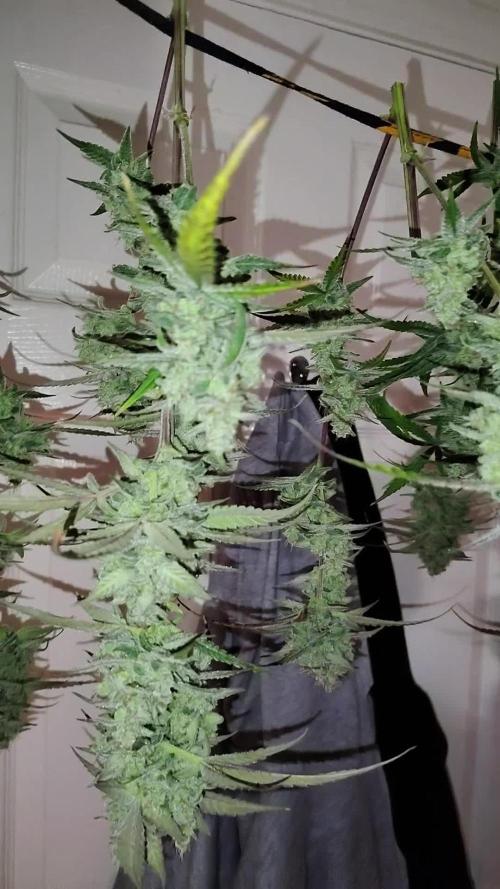
Very good plant to grow 8/10 for me 💯💯🔥 very high yielding with a crazy yield of 131grams of 1 plant very tall and skinny but dense buds 🙏🏽
Likes
244
Share
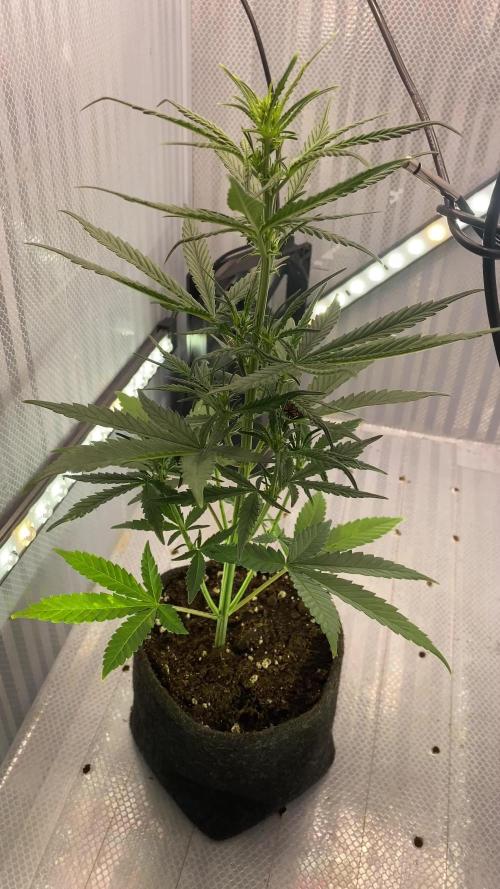
Man i am so happy that i decided to enter this Supafreak journey, i am more and more in love with these one , she is just perfect and amazing. For now i keep bending leafs here and there and tryng to fill up the 3x3 canopy before i take some clones and flip her in to fruit mode. with the week coming to and end i fell like she is moving great with means that provably i will veg her for 2 mb 3 more week max lets see added a video of just me and my plants hope you guys enjoy the ride i fell humble that you all stop here to see my Freaky Freak <3<3<3 thank you <3 <3 <3 As always thank you all for stopping by , for the love and for it all, i fell blessed to have you all with me for one more love journey, and a different one form the rest i did so far <3 <3 <3 Thank you Thank you Thank you , you guys are great and have been amazing , thank you for everything <3<3<3 #aptus #aptusplanttech #aptusgang #aptusfamily #aptustrueplantscience #inbalancewithnature #trueplantscience #dogdoctorofficial #growerslove
 With true love comes happiness , Always believe in your self and always do things expecting nothing and with an open heart , be a giver and the universe will give back to you in ways you could not even imagine so <3 <3 <3 <3 <3 <3 Growers love to you all <3 <3 <3
Likes
55
Share
What's in the soil? What's not in the soil would be an easier question to answer. 16-18 DLI @ the minute. +++ as she grows. Probably not recommended, but to get to where it needs to be, I need to start now. Vegetative @1400ppm 0.8–1.2 kPa 80–86°F (26.7–30°C) 65–75%, LST Day 10, Fim'd Day 11 CEC (Cation Exchange Capacity): This is a measure of a soil's ability to hold and exchange positively charged nutrients, like calcium, magnesium, and potassium. Soils with high CEC (more clay and organic matter) have more negative charges that attract and hold these essential nutrients, preventing them from leaching away. Biochar is highly efficient at increasing cation exchange capacity (CEC) compared to many other amendments. Biochar's high CEC potential stems from its negatively charged functional groups, and studies show it can increase CEC by over 90%. Amendments like compost also increase CEC but are often more prone to rapid biodegradation, which can make biochar's effect more long-lasting. biochar acts as a long-lasting Cation Exchange Capacity (CEC) enhancer because its porous, carbon-rich structure provides sites for nutrients to bind to, effectively improving nutrient retention in soil without relying on the short-term benefits of fresh organic matter like compost or manure. Biochar's stability means these benefits last much longer than those from traditional organic amendments, making it a sustainable way to improve soil fertility, water retention, and structure over time. Needs to be charged first, similar to Coco, or it will immobilize cations, but at a much higher ratio. a high cation exchange capacity (CEC) results in a high buffer protection, meaning the soil can better resist changes in pH and nutrient availability. This is because a high CEC soil has more negatively charged sites to hold onto essential positively charged nutrients, like calcium and magnesium, and to buffer against acid ions, such as hydrogen. EC (Electrical Conductivity): This measures the amount of soluble salts in the soil. High EC levels indicate a high concentration of dissolved salts and can be a sign of potential salinity issues that can harm plants. The stored cations associated with a medium's cation exchange capacity (CEC) do not directly contribute to a real-time electrical conductivity (EC) reading. A real-time EC measurement reflects only the concentration of free, dissolved salt ions in the water solution within the medium. 98% of a plants nutrients comes directly from the water solution. 2% come directly from soil particles. CEC is a mediums storage capacity for cations. These stored cations do not contribute to a mediums EC directly. Electrical Conductivity (EC) does not measure salt ions adsorbed (stored) onto a Cation Exchange Capacity (CEC) site, as EC measures the conductivity of ions in solution within a soil or water sample, not those held on soil particles. A medium releases stored cations to water by ion exchange, where a new, more desirable ion from the water solution temporarily displaces the stored cation from the medium's surface, a process also seen in plants absorbing nutrients via mass flow. For example, in water softeners, sodium ions are released from resin beads to bond with the medium's surface, displacing calcium and magnesium ions which then enter the water. This same principle applies when plants take up nutrients from the soil solution: the cations are released from the soil particles into the water in response to a concentration equilibrium, and then moved to the root surface via mass flow. An example of ion exchange within the context of Cation Exchange Capacity (CEC) is a soil particle with a negative charge attracting and holding positively charged nutrient ions, like potassium (K+) or calcium (Ca2+), and then exchanging them for other positive ions present in the soil solution. For instance, a negatively charged clay particle in soil can hold a K+ ion and later release it to a plant's roots when a different cation, such as calcium (Ca2+), is abundant and replaces the potassium. This process of holding and swapping positively charged ions is fundamental to soil fertility, as it provides plants with essential nutrients. Negative charges on soil particles: Soil particles, particularly clay and organic matter, have negatively charged surfaces due to their chemical structure. Attraction of cations: These negative charges attract and hold positively charged ions, or cations, such as: Potassium (K+) Calcium (Ca2+) Magnesium (Mg2+) Sodium (Na+) Ammonium (NH4+) Plant roots excrete hydrogen ions (H+) through the action of proton pumps embedded in the root cell membranes, which use ATP (energy) to actively transport H+ ions from inside the root cell into the surrounding soil. This process lowers the pH of the soil, which helps to make certain mineral nutrients, such as iron, more available for uptake by the plant. Mechanism of H+ Excretion Proton Pumps: Root cells contain specialized proteins called proton pumps (H+-ATPases) in their cell membranes. Active Transport: These proton pumps use energy from ATP to actively move H+ ions from the cytoplasm of the root cell into the soil, against their concentration gradient. Role in pH Regulation: This active excretion of H+ is a major way plants regulate their internal cytoplasmic pH. Nutrient Availability: The resulting decrease in soil pH makes certain essential mineral nutrients, like iron, more soluble and available for the root cells to absorb. Ion Exchange: The H+ ions also displace positively charged mineral cations from the soil particles, making them available for uptake. Iron Uptake: In response to iron deficiency stress, plants enhance H+ excretion and reductant release to lower the pH and convert Fe3+ to the more available form Fe2+. The altered pH can influence the activity and composition of beneficial microbes in the soil. The H+ gradient created by the proton pumps can also be used for other vital cell functions, such as ATP synthesis and the transport of other solutes. The hydrogen ions (H+) excreted during photosynthesis come from the splitting of water molecules. This splitting, called photolysis, occurs in Photosystem II to replace the electrons used in the light-dependent reactions. The released hydrogen ions are then pumped into the thylakoid lumen, creating a proton gradient that drives ATP synthesis. Plants release hydrogen ions (H+) from their roots into the soil, a process that occurs in conjunction with nutrient uptake and photosynthesis. These H+ ions compete with mineral cations for the negatively charged sites on soil particles, a phenomenon known as cation exchange. By displacing beneficial mineral cations, the excreted H+ ions make these nutrients available for the plant to absorb, which can also lower the soil pH and indirectly affect its Cation Exchange Capacity (CEC) by altering the pool of exchangeable cations in the soil solution. Plants use proton (H+) exudation, driven by the H+-ATPase enzyme, to release H+ ions into the soil, creating a more acidic rhizosphere, which enhances nutrient availability and influences nutrient cycling processes. This acidification mobilizes insoluble nutrients like iron (Fe) by breaking them down, while also facilitating the activity of beneficial microbes involved in the nutrient cycle. Therefore, H+ exudation is a critical plant strategy for nutrient acquisition and management, allowing plants to improve their access to essential elements from the soil. A lack of water splitting during photosynthesis can affect iron uptake because the resulting energy imbalance disrupts the plant's ability to produce ATP and NADPH, which are crucial for overall photosynthetic energy conversion and can trigger a deficiency in iron homeostasis pathways. While photosynthesis uses hydrogen ions produced from water splitting for the Calvin cycle, not to create a hydrogen gas deficiency, the overall process is sensitive to nutrient availability, and iron is essential for chloroplast function. In photosynthesis, water is split to provide electrons to replace those lost in Photosystem II, which is triggered by light absorption. These electrons then travel along a transport chain to generate ATP (energy currency) and NADPH (reducing power). Carbon Fixation: The generated ATP and NADPH are then used to convert carbon dioxide into carbohydrates in the Calvin cycle. Impaired water splitting (via water in or out) breaks the chain reaction of photosynthesis. This leads to an imbalance in ATP and NADPH levels, which disrupts the Calvin cycle and overall energy production in the plant. Plants require a sufficient supply of essential mineral elements like iron for photosynthesis. Iron is vital for chlorophyll formation and plays a crucial role in electron transport within the chloroplasts. The complex relationship between nutrient status and photosynthesis is evident when iron deficiency can be reverted by depleting other micronutrients like manganese. This highlights how nutrient homeostasis influences photosynthetic function. A lack of adequate energy and reducing power from photosynthesis, which is directly linked to water splitting, can trigger complex adaptive responses in the plant's iron uptake and distribution systems. Plants possess receptors called transceptors that can directly detect specific nutrient concentrations in the soil or within the plant's tissues. These receptors trigger signaling pathways, sometimes involving calcium influx or changes in protein complex activity, that then influence nutrient uptake by the roots. Plants use this information to make long-term adjustments, such as Increasing root biomass to explore more soil for nutrients. Modifying metabolic pathways to make better use of available resources. Adjusting the rate of nutrient transport into the roots. That's why I keep a high EC. Abundance resonates Abundance.
Likes
Comments
Share
@BlaKX
Follow
Hallo Growmies und Willkommen zur Woche 5 von Guava Runtz Auto 🍈 Sie hat ordentliche Verzweigungen entwickelt und beginnt die Blüten Produktion mittlerweile!
Likes
8
Share
I really enjoyed being able to show others my work and the ability to always remain a student of the game. I plan on doing another grow soon
Likes
14
Share
The Amnesia haze 2 is turning light green yellowish some told me it could be deficiency or it could be just flowering taking energy from the leaves but I’m not sure I used Gaia green bloom recently thinking it would help I’m going to too water that haze from here out the other have and sour I’m going to continue to bottom feed I took some trichome pics I don’t think there ready yet but I think I’m getting close to the date I feel the the amnesia haze 2 is going to hit 90+ days tho kind of hope not cause the other haze and sour are probably going be done sooner I want to fry them all at the same time March 7th I think the haze #2 and Sour d is ready but the other Haze is not I’m pretty sure I have another week pre maybe even two for it to be near ready I need the tent to harvest and dry what’s ready I’m going try leave the ready ones in for another week in hope it doesn’t mess them up
Likes
4
Share
Наконец примудрил обдув для растихи. На днях придет изолонтейп для шумоизоляции. Немного переделаю выдув и поменяю уголь в фильтре 6й день от перевода на 12/12. Растет активно, но я ее загибаю в ковёр, так как неоднократно были проблемы с недостаточностью высоты бокса. Так что пусть лучше будет поменьше)) По опыту могу сказать, что до зацветания ещё больше 10ти дней. За это время успеет несколько раз ещё порвать бокс. Лью сейчас удобрения Simplex Coco в минимальной дозе на вегу. Растению хорошо, и в дренаже ппм не растёт. Так что едем дальше))) Из проблем, только отсутствие нормального обдува для расты. Со дня на день придется что-то решать с этим.
Likes
40
Share
@MrJones
Follow
47th Parallel Crowly's Comet 🔹⊱╮🔹╰⊰🔹 GROW Started 03.10.24 INFORMATION 🔹╰⊰´🔹⊱╮🔹 🌞Environment - Maintaining 80F and 65%Humidity 🌾Training - Nothing this week just letting the seedlings veg out. ⚱️2-Gallon 📊6.2 PH 💧 Feeding - Using Horti Grow 8-11-21, Bloom 5-15-26, Late Bloom 0-24-26, Cal 12-0-0 🌞Medic Grow Smart 8 760 Watts 🕷️ IPM - CannControl from Mammoth and Mosquito Bits as needed 🔹⊱╮🔹╰⊰🔹 PLANT UPDATES 🔹╰⊰´🔹⊱╮🔹 📝 Notes - These girls have completely transformed into their new buckets and have started to drink up, increasing the amount of fertigation, (Nutrients and H20), and defoliation to expose the lower growth. 🗓️03.29.24 Maintaining Temps and Humidity - Plants are Looking Great! 🗓️03.30.24 Today fed with Hort-Grow @ 3.3 GRMS Per Gal, and Horti-Cal @ 2.5 GRMS Per Gal. I defoliated the plants to water them better and the middle growth could get more light and develop. 🗓️03.31.24 Maintaining Temps and Humidity 🗓️04.01.24 Today fed with Hort-Grow @ 3.3 GRMS Per Gal, and Horti-Cal @ 2.5 GRMS Per Gal. Check out the amazing growth and recovery after the defoliation! 🗓️04.02.24 Maintaining Temps and Humidity, watching these ladies are just nailing the veg phase. 🗓️04.03.24 Today fed with Hort-Grow @ 3.3 GRMS Per Gal, and Horti-Cal @ 2.5 GRMS Per Gal 🗓️04.04.24 Maintaining Temps and Humidity, closing out week 2 of veg and these ladies will need to be defoliated again, this new nutrient line from Greenpnaet is killing it, and so easy to use! ╰⊰🔹╰⊰´🔹⊱╮🔹╰⊰🔹╰⊰🔹STRAIN INFORMATION🔹⊱╮🔹╰⊰🔹╰⊰🔹╰⊰🔹⊱╮ Crowley's Comet / https://www.47thgenetics.com/product-page/crowley-s-comet-10-fem-birdseeds It's everyone's favorite piece of space rock, Crowley's Comet! The culmination of reversing our Matterhorn cut off Mr. Crowley to Intergalactic Runtz, and the results were out of this world (I had to do it). These ladies were slow to start, but once they hit their stride they put any worries we had to rest. Compact, short-framed, and robust. They pack beautifully boulder-like flowers that reek of garlic and sickly sweet cotton candy. Dark green to a mosaic of purples, yellows, and silvers. Frost production is off the charts, the internode spacing is tight, and they certainly will impress in their last few weeks of flower. This is one of our favorite crosses in the new fem lineup. If you're looking for your hype fix, here you go. Yield: Heavy to XL Flower Time: 63 days Feeding Schedule: Heavy
Likes
9
Share
@Joesgrows
Follow
Day 23 I made many mistakes this is my second indoor grow I showed a glimpse of my first in the video . Day 23 she is starting to finally get taller I had my light way to close so she wasn't getting any taller at all just fat anyways now she'll start growing have mer some fish emulsion three days ago then the hairs are Poppin so I gave her a teaspoon of more bloom.
Likes
31
Share
2024-08-24 Very good Conditions Outdoors, Its warm/hot and sunny in the daytime, in the Nights its already kinda like autumn- cold but dry so absoltely perfect for the Girls One Plant moved under a Roof and into a SCROG they are drinking arund 2-3 liters ( sitting only in 15l Growbags The outdoor Girl behaves like growing in ground, spectacular and she builds lovely Floweringsites i think 3 more Weeks and she can be harvested in my garden standing 2 Tangerine Snow Plants One was growing Indoors, and was already harvested, and is revegetationg now and it looks promising The other Plant was the most Time of her life Outdoors, and is in flower for week 2 now ( almost week 3 because . the outdoor lady drinks and eats a lot She sits in a 15l Smartpot, and drinks around 5liters per day ( i have to give her water twice a Day because its quite hot. shes around 160 cm tall and shows already lovely buds ( entering week 3 of flower) i need to get more of these Genetics for next year, shes one of my favourite Genetics but thats what i tell every week to me the perfect plant. BREEDER INFO Tangerine Snow F1 Fast Feminised is a 75% sativa, four-way cross of (Boost x Tangelo) with (Lavender x Power Plant). This Fast F1 hybrid is bred from Cali genetics and boasts great citrus terps, high resin production for extracts, high levels of THC, very good yields and excellent mould resistance. Tangerine Snow F1 Fast can be grown indoors as well as outdoors. Indoor flowering times are between 8 - 10 weeks while harvest time in northern latitudes is during September while in the southern hemisphere growers will be harvesting during March. Recommended climate regions are hot, dry, humid and warm. These are tall, semi-branched plants that grow in excess of 200cm and display a high degree of vigour with very good uniformity. In common with many other heavily sativa-dominant strains, Tangerine Snow F1 Fast offers excellent resistance to mould as well as to plant pests and diseases. The combination of citrus terps and plenty of resin makes thi a very good extract strain with the 'washing' method delivering very good yields of hash. The citrus terpene profile is reminiscent of mandarins and tangerines and also has sweet candy notes. THC production has been lab-verified at a strong 24% while CBD is low. The effect is uplifting and energising, perfect for use during the day and early evening.
Likes
25
Share
@NONSENSE
Follow
🎄🎄🎄 Good day, bud lowers 👨‍❤️‍👨 👨‍❤️‍👨 👨‍❤️‍👨 👨‍❤️‍👨 🌲 Continues to stretch the girls in ScrOG. Within a week, the plant bummed to growth, look what happened! 🌲 ✂️ I do defoliation once a week, because it is difficult to fit such a plant under the net. ✂️ 💚 The buds are gaining mass really fast. I was surprised comparing Monday and Friday pictures. ⭐⭐⭐⭐⭐⭐⭐⭐⭐⭐ ✅ Harvest is coming. Therefore, the last watering with fertilizers will be next week, then only clean water and delicious things like sugar. ✅✅ 🙈 Are you ready to guess the result? In this report, the variety is revealed in full force. 🙈 🌲 Almost all trichomes are cloudy, there are practically no amber ones. New stigmas are still springing up. 🌲 ☢️ The plant very actively began to take nutrients from the leaves - the yellowness is noticeable. ☢️ 🌝 Please check this week pictures and small video I made for you .,🐛
Likes
70
Share
@IstrGrow
Follow
The weather in my country suddenly got warmer unexpectedly. That's why I'm having problems with the temperature. Still, it seems to be going well for now. I watered on the 51st day. I will do it again today and with full fertilizer.
Likes
8
Share
I finally named her... Sarah Lee. 😁 I moved her upstairs where I can control the environment better. Michigan weather is a beast and my basement was a bad idea for a summer tent grow. The AC upstairs is making her happy and helps with humidity. So boom. She is flowering nicely! 😍 Water (pH 6.58) about 1.25 gal every 2 days now. She's thirsty. Still not full strength on Nutes, next water maybe more Tiger Bloom. I still use vinegar for pHing. No issues at this time, except humidity. Oh, and my cat is obsessed. I'm not wanting to smoke cat hair, so I put up curtains. I'm also not upset I didn't do any LST. This plant is thriving. Next time I will try LST. I just want to get good bud off an inside grow. 😊 Going into week six and I'm super excited. 😎👍🏼🌱 One last thing. I changed her light schedule to 18-6. I was 19-5 and read a blog where the grower increased dark an hour at flower and it really bulked the buds. We'll see. GL y'all.
Likes
122
Share
@Mr_Di
Follow
Starts 5th week of bloom my friends! ———— During last week: 1 cut all lower branches for finish cleaning under net 2 Flushed at day and start a PK Booster to cure an early K deficiency. 3 cleaned reservoir of solution and added ext.filter for water treatment 4 cut some clones ———————— For this week: 1 removed Big Bud 2 added over drive 3 added a PK booster 200ppm 4 cut some fan leaves to have a better light penetration 5 decreased Hr%: during day max 50%, during night max 65% Environment: -Air flow - extractor during day and 1 fan for in air flow (linked to a 20 mm mist maker) -Nr 2 oscillating fan (secret jardin 20w - extractor (blauBerg site on bottom of tent for under net airflow) -Temp : 5 thermoigrometrs - constant in function of distance to canopy (24-27’C during day) -HR% : in-air fan is linked to a mist maker (20mm) and an HR% probe then 1 other mist maker (timered with the light ballast) - Smell : Carbon filter in tent and carbon filter and ozone generator (Cornwell electronics 500 mg/h) out in room
Likes
15
Share
It is a fantastic plant, very strong in its growth, easy to cultivate, root system is not comparable to the others I have here...💪 It has an incredible fullness predominating over the others 😏 The productivity is really great being the heaviest I have harvested 😎 Now it's waiting to try it out 👌 Thanks to everyone who enjoyed this girl... And good vibes and trips to all!🙏🙌 👊
Likes
18
Share
8/9/25 looking pretty good and smelling not too shabby