


Likes
Comments
Share


@SurSideCrew
Follow
The NEW fruto de la colaboración con el famoso Sherbinski, nos esperabamos una joya especial dado al alto precio y el hype que tuvo nada mas ser presentada en el Spannabis. Por desgracia nos salio un Pheno bastante vigoroso, muchas ramas pero pocos internodos, se estira mucho en flora y al no cambiar micho de color no fue nada especial para la vista. El producto final fueron cogollos esponjosos con bastante resina pero terpenos muy flojos. Terps a Cookies, cremoso dulce y un toque picante /especiado. High bastante regular. Precio/Calidad = Malo (no recomendable)





Likes
19
Share


@RDWCGrowing
Follow
Week 1 Day 1 - 8/12/2023
1st Water change Day! Such a special time it is when you remove the little bit of Nutes that you gave them as an appetizer and you give them their first real meal.
Added
39 Gallons of Water to my system
SILICA= .5mil/Gal = 19.5 = 20mil
Root Drip = 1mil/Gal = 39mil
Cal Mag= .25mil/Gal = 9.75 = 10mil
FLoraMicro= 3.0mil/Gal = 114mil
FloraGro = 2.0mil/Gal = 78mil
FloraBloom = 2.0mil/Gal =78mil
ORCA= .5mil/Gal = 19.5 = 20mil
Week 1 Day 2 - 8/13/2023
Everything is looking good the roots are making thier way to the water and the new grow is looking nice and green.
Week 1 Day 3- 8/14/2023
Everything is right on track, they are looking beautiful and in the praying postition all leaves happily lifting towards the light.
Week 1 Day 4- 8/15/2023
Looking beautiful today and looked like she could use her first haircut.. gave her a TOP off. Roots are laying in the water everything is looking right on track..
Week 1 Day 5- 8/16/2023
walked in and the humidity was under 60.... ohh noooooo.. So I added 2 humidifiers to the tent and attached them to my InkBird controller which is set to 62. She had roots nicely in the water.. this grow is on!!!
Week 1 Day 6- 8/17/2023
Humidity was a little low this morning, so I refilled the humidifiers. Other than that, the temp looks great, the PH looks great, the PPM looks good the plant is in the praying position and all damage from the little drowning seems to have been fixed. Happy Happy.
Week 1 Day 7- 8/18/2023
Yay.. week 1 in the books, roots in the water growth has started first hair cut given and both side nodes are growing. Everything is looking good and on track.. A lot better than week one of the last grow when I had them drowning week 1.
Really excited on how this grow is going to come out.
Likes
27
Share

@RDWCGrowing
Follow
5/16/2023
Week 6- Day 1 of Flower (Day 103 overall)
I just watched them grow!!! Sometimes you really can sit back and enjoy the fruits of your Labors and just enjoy watching them Bud...
5/17/2023
Week 6- Day 2 of Flower (Day 104 overall)
Ground Hogs Day!
5/18/2023
Week 6- Day 3 of Flower (Day 105 overall)
Ground Hogs Day! Just let them grow and enjoying the fruits of my work upfront. I am keeping an eye on the Humidity. It was at 68 today I am currently running 2 dehumidifiers in the tent so will just keep a close eye on it.
5/19/2023
Week 6- Day 4 of Flower (Day 106 overall)
I found a couple Sucker buds trying to form so I plucked them out of existence. Other than that Water Change Day tomorrow.
5/20/2023
Week 6- Day 5 of Flower (Day 107 overall)
Water Change Day!! Since I am changing the water today I decided to do some heavy defoliation and make sure I take a really good swipe at all the sucker buds lower than the first net forming.
I added 36 gallons
Mammoth Silica = .5Mil/Gal= 18Mil
Root DRIP = 1Mil/Gal= 36Mil
CalMag= .5Mil/Gal= 18Mil
FloraMicro = 4.3Mil/Gal= 155Mil
FloraGro= 4.3Mil/Gal= 155Mil
FLoraBloom= 6.5Mil/Gal= 234Mil
LiquidKoolBloom= 2.5Mil/Gal= 90Mil
TPS SIGNAL= 4.0Mil/Gal= 144Mil
ORCA = .5Mil/Gal= 18Mil
Water Temp= 69.5
Tent Temp= 74
Humidity =66 ** I have two dehumidifiers running on Ink bird controllers to try and keep the humidity down as well as I did a heavy defoliation today. In late in flower I like to keep the humidity above 45 but below 60.
5/21/2023
Week 6- Day 6 of Flower (Day 108 overall)
They are looking Great!! Frost is coming in everywhere buds are developing nicely!! Brown hairs everywhere! I didn't do anything I just looked at them and apricated the ability to be able to grow today..
5/22/2023
Week 6- Day 7 of Flower (Day 109 overall)
Auto Pilot engaged.. Just sit back take a few pics and enjoy the Grow!!!!!
Got to do a whole bunch of nothing today but enjoy...

Likes
27
Share


@Smokepurple137
Follow
I'm happy with the progress they have made, all have responded well to defoliation and LST. I'll be adding a few more light nutrients at some point this week. The gorilla zkittles is shorter than the rest but looks very sturdy and has plenty of bud showing already, I think this is because it started flowering maybe 7days before the rest and in them 7days the rest shot up rapidly! I'll update daily and try get some nice videos with lights out.

Likes
Comments
Share

@BudBeat
Follow
Die Runtz Punch ist erstaunlich kraftvoll und wächst sehr stabil und ohne zu zicken. Zwar ist sie von allen dreien die Kleinste, aber dafür wachsen ihre Seitentriebe sehr stabil heran. Die Blütenansätze lassen erahnen, wie fett die Blüten werden können. Ich bin super happy mit der Entwicklung.

Likes
5
Share


@Deli_Weed
Follow
Esta semana engordaron bastante las flores, los últimos dos dias de esta semana deje de regar con nutrientes, pura agua 🚿 para empezar el flush
Likes
108
Share


Likes
7
Share


@OwlGang_Uk
Follow
Gorilla Glue #1 - Harvest Comment - I Am Very Satisfied With What I Got, I got 3 ounce 7 grams - I Uses Advance Nutrients PH perfect In veg then I switch to the iguana juice organic juice for the flowering stage. I notice a much more slower growth when I switch to organic nutrients.00

Likes
6
Share

@BossberryFarms
Follow
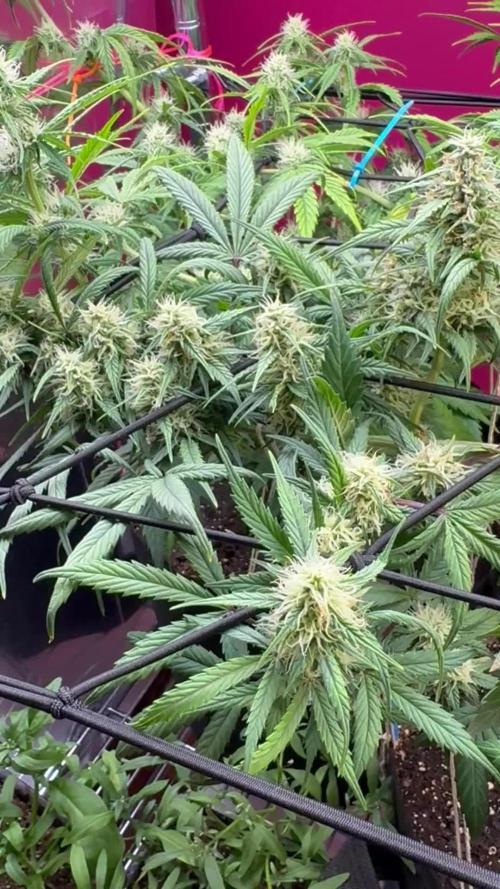
Welcome to Week 8! All seems to be going well. Two of the Apple Betty plants have fan leaves that are yellowing, but I think it’s because they are getting close to harvest time (about 2 weeks out).
I’m trying to maintain a temp of 75-80F and 60% humidity.
Likes
140
Share


@MrJones
Follow
MrJones - Slurricane #7 S1
🌱Slurricane #7 S1
@inhousegenetics_official
👨🌾🏽GD Grower: MrJones
🔹🔹🔹🔹🔹🔹GOALS🔹🔹🔹🔹🔹🔹
🌞Environment - 75/80℉ and 55% Humidity
💧 Feeding - Advanced Nutrients Organic
⚗️Soil - 50% Ocean Forest / 20% Tupur Royal Gold / 10% Earth Worm castings / 10% lobster Compost / 10% Additional Perlite
🍃Training / Will be topping, Cloning, and creating larger plants, and placing to flower under a trellis
🕷️ IPM - Will be using Green Cleaner" 1 OZ per Gallon, and CannControl from Mammoth alternating between product each month for Integrated Pest Management.
💡Mars Hydro LED / Veg Geeklight Monster Board 480W V4 / Flower 480W FC 4800
🔹🔹🔹🔹🔹🔹🔹🔹🔹🔹🔹🔹🔹🔹🔹
📜 Rambling - Week 4 letting the ladies develop their long legs, will be putting them into 3-gallon pots by week's end.
🔹🔹🔹🔹🔹🔹🔹🔹🔹🔹🔹🔹🔹🔹🔹
▶️ Sunday - 02.28.21 / Fed with 4 ounces of Advanced Nutrients
▶️ Monday - 03.01.21 / Fed with 4 ounces of Advanced Nutrients
▶️ Tuesday - 03.02.21 / Fed with 4 ounces of Advanced Nutrients
▶️ Wednesday - 03.03.21 / Fed with 4 ounces of Advanced Nutrients
▶️ Thursday - 03.04.21 / Fed with 4 ounces of Advanced Nutrients, these girls are looking for another much larger home! Will be trying to work on that today.
▶️ Friday - 03.05.21 / Fed with 4 ounces of Advanced Nutrients, I am just amazed at how well these girls are growing, Advanced Nutrients are just kicking ass!
▶️ Saturday - 03.06.21 / Transplanted the ladies over into 5 -5-gallon pails, - used Pr-Mix HP. this stuff feels amazing, watered in with standard AN regiments, feeling like I will have to lower these ladies down to the bottom of the closet, going to let them get leggy!
🔹🔹🔹🔹🔹🔹🔹🔹🔹🔹🔹🔹🔹🔹🔹
📜 Cultivar Information - In House Genetics - Slurricane #7 S1
🔹🔹🔹🔹🔹🔹🔹🔹🔹🔹🔹🔹🔹🔹🔹

Likes
47
Share


@GreenHouseLab
Follow
These ladies are looking damn fine and of the two they are what seems identical - 👍 Sweet Seeds for gen stability.
Both were topped 7 days ago and the inside lower nodes all removed. I’m only looking for A,B grade colas on both.
Stay safe, keep the ✌️

Likes
Comments
Share

@Lvnsource
Follow
Feed Log:
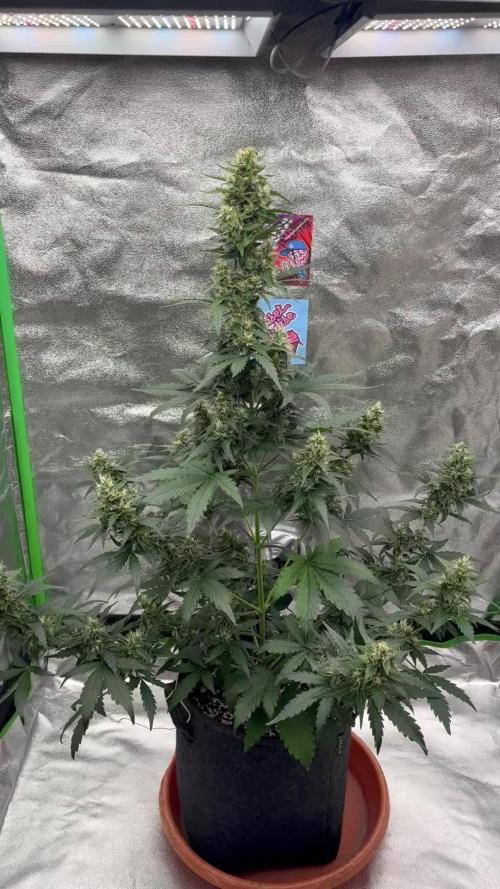
D:48 - 6L + 2L - [pH 7.0] Si[1.8ml],Algo[0ml],HakaphosB[1.5g], HakaphosR[4.0g],Ca[0.3g/L/]Mg[0.2g/L] INPUT; [1.774 EC] OUTPUT; 4.2L pH 6.2 [2.004 EC] previous irrigation: D:42
Will exclude grow next irrigation! :)
Likes
37
Share


@DaddyPrime2
Follow
5/27 curious to see where this week ends up at
5/29 the one plant indoors is packing on weight. The one I put outside to finish (possibly stupid) seems to be maturing faster but bulking slower. She's seemed healthy this whole time. Not even a burnt leaf tip
5/31 attempting to take pictures in different lighting to get a better idea for yall viewers
Likes
32
Share


@MadeInGermany
Follow
Info:
Unfortunately, I had to find out that my account is used for fake pages in social media.
I am only active here on growdiaries.
I am not on facebook instagram twitter etc All accounts except this one are fake.
Have fun with the update.
Flowering day 33
since time change
to 12/12 h.
Hey everyone 😃.
Another wonderful week goes by :-).
The lady is developing very well.
The flowers begin to develop properly and already smell very nice 🙂.
The day before yesterday was the last time 1 g of GHSC Powder Feeding per L substrate was added :-).
That should last to the end now.
Of course, she continues to receive GHSC enhancers 👍 every 14 days.
The tent was cleaned every day just like the humidifier was refilled every day.
I am very curious how it will develop in the coming week and until then I wish you a lot of fun with the new update.
Stay healthy 🙏🏻 and let it grow 🍀🙏🏻
You can buy this Strain at :
www.Zamnesia.com
Type:
Banana
☝️🏼
Genetics:
OG Kush x unkown
👍
Vega lamp:
2 x Todogrow Led
Quantum Board 100 W
💡
Bloom Lamp :
2 x Todogrow Led
Cxb 3590 COB 3500 K 205W
💡💡☝️🏼
Soil :
Canna Coco Professional +
☝️🏼
Fertilizer:
Green House Powder Feeding
☝️🏼🌱
Water:
Osmosis water mixed with normal water (24 hours stale that the chlorine evaporates) to 0.2 EC. Add Cal / Mag to 0.4 Ec Ph with Organic Ph - to 5.5 - 5.8 .
Likes
50
Share


@DogDoctorOfficial
Follow
And like a Clock this gir at day 30 or so began flowering, she is a beast , a big beast and a tall one, non so ever she is beautiful and her grown so fur have been nothing but outstanding, very curious to see were these one is going <3 <3 <3
And as the week passes the room starts to get full and in need of some urgent defoliation, and these girl is no exception in there and she is asking for a new air cut
As always thank you all for stoping by and for supporting me on this journey, i am super passion about growing and fell blessed to have you all with me on this new journey <3 <3 <3
Genetics - Fast Buds Tester 2311
Ligth - LUMATEK ZEUS 465 COMPACT PRO
Food - APTUS HOLLAND
#aptus #aptusplanttech #aptusgang #aptusfamily #aptustrueplantscience #inbalancewithnature #trueplantscience #fastbuds #dogdoctorofficial #growerslove
With true love comes happiness <3 <3 <3 Always believe in your self and always do things expecting nothing and with an open heart , be a giver and the universe will give back to you in ways you could not even imagine so <3 <3 <3
All info and full product details can be find in can find @
https://2fast4buds.com/ wen released
https://aptus-holland.com/
https://autopot.co.uk/
https://lumatek-lighting.com/
<3 <3 <3 Growers love to you all <3 <3 <3
Likes
7
Share


@XoticGROW666
Follow
( RUNTZ X F1DURB X GUSHERS )🍬🌈🍨🍧
PURP KICKIN INN END #WEEK4
CANT WAIT TILL THE BUDS SWELL UPP!!
SUPA INTENSE CANDY TERPS THIS ROUND
NOT BIG BUDS BUT SUPA HIGH IN BRIXX LEVEL WITH ALL THE ORGANIC CARBON INPUTS!! PPM 900/1200 1.2 max
(Face Off OG x Watermelon Zkittlez) X (Runtz x F1 Durb x Gushers) 🍉🍬🌈🍧🍨🍦
LIL PRUPLE TINT WIT MOUTH WATERING SUGARY TERPS KICK INN END #WEEK4 BY WEEK 7/8 SHE WILL BE PURPLE PURPLE WIT SUPER INTENSE CANDY MOUTH WATERING TERPS CANT WAIT TILL SEE THEM BUDS SWELL UPP!! PHENO A/B
NOT BIG BUDS BUT SUPA HIGH IN BRIXX LEVEL WITH ALL THE ORGANIC CARBON INPUTS!! PPM 900/1200 1.2 max

Likes
6
Share


Likes
4
Share


@Ultimatebeginner
Follow
Ich habe die Erde austrocknen lassen und sie noch 3 Tage in dunkeln gelassen und Dan abgeschnitten auf gehongen habe mal 2 Knospen Nass getrimmt und Rest mache ich trocken trimmen weil ich im Internet gelesen habe das es die Qualität besser erhalten bleibt deswegen mach ich Bilder wenn sie fertig getrocknet sind. Aber die 2 nass trimmungen sehen echt schön aus😁😁😁😁✌️🏼✌️🏼✌️🏼✌️🏼