


Processing
Likes
Comments
Share


@TheVerdini
Follow
Coming along nicely. Large number of bud sites, starting to grow but still far from mature. Nice aroma every time I open the tent. Starting to become a bit frosty.

Likes
5
Share


@SoulGrownBotanicals
Follow
Been a great couple months. Lol. Coast of Maine feed has been great with a smidge of Gaia green powerbloom. She's fed about every two weeks. The tsp per gallon is of soil she's in. Not really an exact measurement because I just kinda grab some with my hand and mix it with my homemade horse compost and top her off. She seems to be happy though.

Likes
2
Share


@LittleBigTrees
Follow
New growth is fast soon I will put into a 20 litre pot and give her more space to spread out.

Likes
3
Share


@Weedzoks
Follow
Welcome everyone
Here is the diaries of a friend, this is his first culture.
He chose for this session five Hulkberry from Royal Queen Seeds, a BubbleGum offered by Zamnesia, as well as a Big Bang Auto from GreenHouseSeeds.
All these ladies are under HPS 600W, 150cm square area.
Here we go!


Likes
13
Share


@Alpha_Green
Follow
Some of you may have wondered:
Why do I use CO2 at average 950 ppfd μmol/m2/s (moral flow)?
The answer is quite simple. Because of lack of space in some regions of my cultivation area, I simply cannot keep the ideal distance to my Sanlight high-performance lamp, due to some height growth of various strains. And so some of the main colas have ppfd values of 1250 μmol/m2/s and even more...
So this is how I manage to achieve and compensate for such high radiation levels even with a CO 2 balance. And I have to say, my strategy to avoid various light stress symptoms works just fabulously. In combination with CO 2 implementation, my babies are simply unbeatably insensitive to light. Thats it!
Beginning of 3rd week flowering:
Again feeding my babies by 36 hours fermented potions of Bio Tabs Kompost Tea PK-Booster (15 g pro Liter) and added:
5ml Orgatrex/Liter
1 Spoon of Bactrex
1 Spoon of Mycotrex
1 Spoon of Mycco-Vital
1 Spoon of Dynomyco
A little tip for those who are interested in small modifications that have a big difference or influence - on the result - effect - beauty - health - taste! Before adding microorganisms or beneficial bacteria or Mycorrizae and Trichodermas, please use oxygen-saturated water. On the one hand, unwanted chlorine gases evaporate and the small world of the microbiome becomes even faster and more rewarding in compost tea to sprout.
Last but not least for this week, I would like to introduce my reasons, why I prefer growing biologically and sustainably.
First of all, it’s something which suits very well in these times/days we are living now. Sustainability is a big need and task for our planet. 🌎 Nature means life. Our home, the air we breathe and everything that surrounds us. Not just today. Hopefully tomorrow as well.
Maybe I'm starting to protect our environment on a small scale, but maybe I can also make a big difference at all.
If you change the way you look at things, the things you look at change...
I thought about what’s the difference, between Mineral Feeding and Super Soil Feeding.
It’s very easy. Biologically Growing is a similar process than the natural soil activities out there in the lap of nature’s. So plants has to work and interact with the microorganisms and microbiomic communities in the soil. So the plants will never get lazy like the lazy ones of mineral feeding growers.
If you grow biologically, you will feed the soil first and the microorganisms will support every parameter next to your plant conditions. And that will generate an unbelievable spectrum of Terpenes and Trichomes you will never forget.
It’s the same comparison, when you daily visit McDonalds and you eat only fast food. How does your body and mind react on this shit for money?!?!
May I invite you to think about it…
See you next week dear Growmies! Have a nice Weekend and take care…
Peace out!
Addendum for Day 53:
At the moment we unfortunately have another winter onset here in Germany. This means that I am forced to take additional heating measures due to structural facts in order to be able to keep the temperatures constant. After all, just tonight the thermometer climbs again to -1 degree Celsius.
In addition, my exhaust air system runs out of my bedroom terrace and I therefore grow winter and summer with the patio door open. Well, sometimes I experience real weather-related challenges. But all in all, no problem...
"Where there's a will, there's a way."
Addendum to pouring out the fermented PK tea: I always administer half a liter of lukewarm aerated water with 3.5 ml of cannazyme per liter to each plant. This means that the "root machine" is not supplied with supplies unprepared and the nutrient solution can thus also be better distributed in the soil. Since I also work with cloth shoes, I spray them evenly moistened everywhere with water that is also warm before pouring them out from the outside. This has the advantage that the moisture stays where it should: in the pot!
... I did the math today ;-) We are still in week 7 until this Friday. And week 8 starts on Friday! OMG... still so much time yeahh!
Today my Fast Buds Sour Jealousy and Sweet Seeds Big Devil and Dark Devil Automatics arrived. I'm looking forward to it.
This time Fast Buds next Time Sweet Seeds. Love them too. Very beautiful genetics.
Today a review video of the beginning of week 3.
At the time of the pictures, I had minor signs of nitrogen excess. (Light peaks first at the crown of the roof and then slightly continuing to the middle section.) I then painstakingly racked my brains as to why this could be. I found that very slight dry spots had formed and therefore the root found small accumulations of nitrogen that caused its problems. But then, when I carefully homogeneously checked the moisture content in the substrate, the problem evaporated again. However, they had not shown any loss of growth rate during this time. Nevertheless, they developed as expected.
They Strawnanas had no problem with that.
In the end, I always have a hard time killing them. But I guess that's the way things go.
We live and die.
We come and go.
But it's not there yet. ;-)
Tomorrow is day 56.
Tomorrow’s updating day!
Can't wait to see their progress.
Have a good time and see you tomorrow… 🏽🕊️
🏽 ☮️🕊️


Likes
16
Share


@Foggedaboudit
Follow
10 weeks total for the first phenos and a bit more than 11 for the last one! I could have easily gotten double the projected yield on these had I not neglected them but whatever I pulled is rock hard, dusted in sugar and smells absolutely stupendous! You did it again FastBuds!
Likes
3
Share


@mistaminista420
Follow
Sorry I got mixed up with the weeks (newbie on growdiaries as well). So it took 8 weeks of vegetation to come to the latest pictures. Unfortunately only one plant made it. I lived in warmer regions before and used empty car tires as a pot for a long time, they were usually been able to grow three plants and more in it but that’s another topic. This is my first grow in colder conditions. Around week 6 of vegetation I started adding BioBizz Grow to the water.


Likes
16
Share


@GYOweed
Follow
It's getting bigger. If i dont flip to flower i think in fucked but didnt get a clone yet :(
Likes
12
Share


@2Stones1Bird
Follow
Checkout my Instagram @smallbudz to see the Small budget grow setup for indoor use, low watt, low heat, low noise, step by step.
She started germination Monday 14/10/2019 straight into the soil, after 3 days she turned into a little sprout.
23/10/2019 - Struggling a bit to maintain good veg RH (55-65), currently between 45-50, humidifier on the way. PH was also to high about 7.5-8.0, already fix it to 6.5, with a drop of lemon juice.
24/10/2019 - Noticed little flies on the tent, going to add sticky trap.

Likes
17
Share


@Dunk_Junk
Follow
Only 3cm growth this week but she's bushed out a fair bit and pushed out some new leaves. 💪

Likes
23
Share


@Chi_K24
Follow
Hey guys, allot happened this week. Mid week on Wednesday I did a major heavy defoliation, she was very bush and allot of internode growth. I clean up everything and allowed more light pen. Also nipped any undesired off growths. Shaping how I want the plant to grow. Basically lollipoping.
As you can see I also started to install 4x 1/2 bamboo sticks to help support the plant once she gets bigger. I had problems last year late into flower and don't want to repeat same mistake.
I also amended the pots with 70/30 ratio of 444 to 284 @ 2tbs/gal.
Iv only water once in the past 7 days with the Aquabak. Not enough data to review the product. We will see.
Other than that we have had plentiful thunderstorms and have not required to water. Thanks to the felt pots, they did not get flooded with the amount of rain we got. Prolly 50-100mm worth of rain.
Thanks for updates. Enjoy the photos and vids
Likes
13
Share


@DeepRootsGrowTrees
Follow
JOANNE'S CBD / ROYAL QUEEN SEEDS
WEEK #20 OVERALL
WEEK #8 FLOWER
This week she's looking good and she's doing great her buds are getting bigger and they even got a little trichome coverage just a few more weeks!! Stay Growing!!!
Thank you for stopping by and taking a look it's much appreciated!!!
THANK YOU ROYAL QUEEN SEEDS!!!
JOANNE'S CBD / ROYAL QUEEN SEEDS


Processing
Likes
24
Share


@Cogollo_eu
Follow
**Encontrarás la traducción a español al final de la descripción**
If you like this week, please hit a like, it costs you nothing! 👊. Thanks in advance 😉!
From/Desde: 16/09/19 || To/Hasta: 22/09/19
From day/Desde día: 56 || To day/Hasta día: 62
-----IMAGES & VIDEOS-----
V1 - Compiled all growing timelapses into a complete growing video, hope you like it mates!.
V2 - My apologies about the quality of this video buddies, I didn't choose a very good place to record it, and also the GoPro released the manual configured blocked exposure, so there are many color differences among days, as every day upon lights on the GoPro make a new exposure and temp adjustment (The light is 3,000k i don't know why the GoPro read it different daily).
V3 - I'm still learning to record some cool videos, as for example @MyrceneDream ones 👊, and many others.... I'm not doing it well at time.
-----WEEK SUMMARY-----
Hard work times drain my time for the plants and to make content, sorry about that.
At last flowering started, as can be shown in the weekly video, the first 3 days after the full switch to 12, she stayed in a frozen state, no much growing or movement at all. Since the 4th day she started to grow at high speed, a bit more than a cm/day. She's really looking awesome, making some bold branches and defining every part of the plant very well.
Some weeks ago I told that the smell went too strong at home, but it lowered to normal levels last week, now she's smelling more and more each day again ;).
I can say about Alice.K, that I had 0 problems or weird things along the current 9 weeks, she suffered very high temperatures, some insects, and also i'm going hard with nutes, I'm cycling EC reaching 2 sometimes, and she didn't show any excess signs at time, I'm not telling that they're not going to exist on Alice, but not at time, if i see some, i will stop and re-adjust.
Also she has responded very well to every prune or cut I've maded to her, and the distribution is perfect, I'm in love with the form she developed. while i was thinking on 4 external main colas with 12 secondary decent Satellites, she's developing 2 awesome central colas, with 4 secondary and very decent sub-colas, and then 10 excellent satellites, and many small ones that i will cut later on (Already cutted many below the SCROG net).
-----WATERING CALENDAR-----
18/09/19 (Day 58) - 3,000 ml with Tarantula, Piranha, Rhino Skin, Big Bud, Bud Candy & Bud Ignitor @ (1.1 E.C. | PH 6 | 25.7ºC)
22/09/19 (Day 62) - 4,000 ml with Silica Power, Organic Bloom, PK Booster, Bloom Stimulator, Pro Active, Bud Ignitor, Bud Candy, Bud Factor X & Sensizym @ (2.1 E.C. | PH 6.4 | 25.8ºC)
*****ESPAÑOL*****
Por favor, si te gusta esta semana dale un like, no te cuesta nada 👊. ¡Gracias por adelantado 😉!
-----IMÁGENES Y VÍDEOS
V1 - He compilado todos los timelapses de crecimiento en un vídeo de 1 minuto, espero que os guste!.
V2 - Debo disculparme por la calidad de este vídeo compañeros, no escogí una buena posición para situar la cámara y esta además perdió el bloqueo de exposición que le pongo, por lo que al realizar un auto-ajuste automático a diario, hay diferencia en la exposición y el color entre los vídeos de cada día. No entiendo por que siendo siempre la misma luz de 3.000 k la cámara la interpreta diferente cada día.
V3 - Todavía estoy intentado aprender ha hacer buenos vídeos, como pueden ser los de @MyrceneDream 👊 entre muchos otros por ejemplo... De momento no me salen bien, ya iré mejorando.
-----SUMARIO SEMANAL-----
Estoy teniendo tanto trabajo que me está dejando muy poco tiempo para las plantas y para realizar contenidos, lo siento.
Por fin empezó la floración. Como se puede ver en el vídeo semanal, los 3 primeros días de la floración la planta se mantuvo en un estado vegetativo (sin crecimiento). A partir del cuarto día a empezado a crecer a gran velocidad, de momento más de 1 cm al día. De verdad que se ve maravillosa, está engordando bien las ramas y definiendo su partes muy bien.
Hace algunas semanas comenté que ya estaba apestando toda mi casa y aún estaba en crecimiento. El olor fue disminuyendo hasta niveles normales y esta semana de nuevo está volviendo a incrementar su olor día a día.
De momento debo remarcar que en 9 semanas de cultivo que van, la Alice.k me ha dado 0 problemas o cosas raras. Ha sufrido de altas temperaturas, algunos insectos y he empezado a ir fuerte con los nutrientes. Estoy ciclando la EC en los riegos, sobrepasando los 2 en algunos casos, de momento no ha mostrado ningún signo de exceso. Con esto no quiero decir que no los vaya a mostrar si sigo así, pero de momento no lo ha hecho, si en algún momento empiezo a ver signos, ya frenaré y reajustaré.
También es un planta fuerte y con capacidad de recuperación rápida, eso se puede observar en los vídeos perfectamente. Y lo increíble es la distribución que ha adquirido, mientras yo pensaba en una estructura con 4 colas exteriores principales grandes y 12 satélites centrales pequeños, ella me ha sorprendido formándose con 2 cola centrales enormes (para el tamaño del cultivo), 4 colas exteriores grandes y un montón de satélites de tamaño superior al que esperaba, más adelante cortaré los que se queden más retrasados (de momento he cortado mucho de lo que quedaba por debajo de la red)
-----CALENDARIO DE RIEGO-----
18/09/19 (Día 58) - 3.000 ml con Tarantula, Piranha, Rhino Skin, Big Bud, Bud Candy & Bud Ignitor @ (1,1 E.C. | PH 6 | 25,7ºC)
22/09/19 (Día 62) - 4.000 ml con Silica Power, Organic Bloom, PK Booster, Bloom Stimulator, Pro Active, Bud Ignitor, Bud Candy, Bud Factor X & Sensizym @ (2,1 E.C. | PH 6,4 | 25,8ºC)

Likes
11
Share

@Count-Dooku
Follow
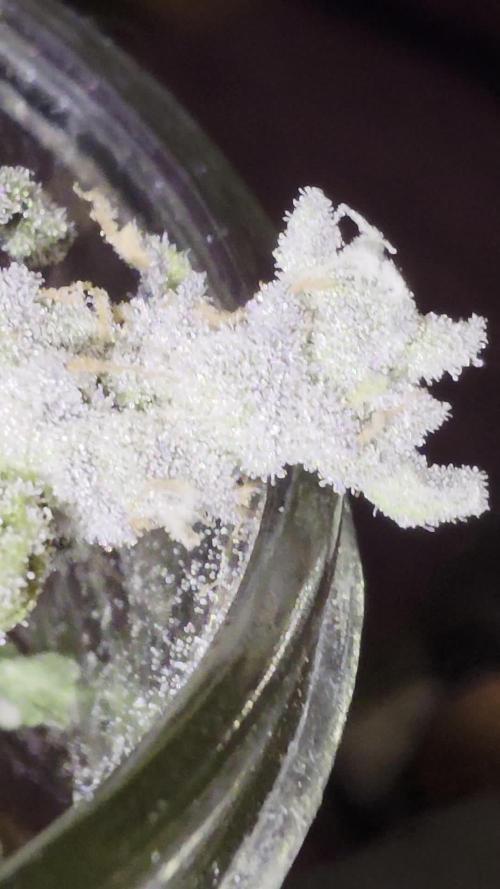
Frosty as heck but small buds, I might run it again with no lst and see if it gives bigger buds. Easy trimmer.


Likes
175
Share


@love_2_grow
Follow
Day 15
Today I switched the lights from the Seedling program to the Growth program. I measured around 640 PPFD at the canopy level so a bit high for early veg but I will leave it where it is now and keep an eye out for light stress, and raise the lights if I have to.
I also added a second USB fan for increased circulation. USB fans are great when the plants are small and you don't want the stronger winds that the regular clip fan generates. I also started the clip fan but directed it towards the lights to help keep them a bit cooler.
I adjusted the extractor fan from 60 secs Off/30 secs On to 30 secs Off/30 secs On in order to remove more hot air. This will have to be tweaked further and I'll monitor my temps to figure out a suitable setting. It becomes a balance between temp and humidity. I really wish I had a system where I could set a target VPD and then the system would automatically adjust temps and humidity to follow that target. Not practical in my small setup though but maybe one day...
Temps are always an issue in my setup as I have two powerful lights inside one small tent without AC. I have set the light cycle so that the lights are on during the night but off during the day to help to balance the temp a bit. I'm also considering getting some extension cables and put the LED drivers outside the tent to see if that helps to bring down the temps a bit further. Later in the grow I will use CO2 so that will help a bit against higher temps.
Finally, I watered the plants as they were getting a bit dry. The left plant got 1 liter and the right plant 1.5 liters as the sensor reported that that pot was a bit drier. I reckon it has to do with the plant being larger (almost double the size of the other plant!) I should also really get my ass in gear and hook up the Blumat system so I don't need to worry about hand watering.
Day 16
Nothing to report really except some additional growth, both vertical and horizontal.
Day 17
Watering time again. Gave them 6.2 pH water this time and once again more to the right plant as it drinks more. I guess around 1.3 liters for the left plant and 2 liters for the right one. I tried putting in my small USB humidifier into the tent but I soon realized that it can't share the USB power that the fans are running on so will have to get another USB power cable in there. Didn't expect that small humidifier to use that much power. Oh well, that's a job for another day.
Day 18
The girls are thirsty it seems as I had to water again today according to the Blumat sensors (I really, really need to install my Blumat system as soon as possible but should get the last bits that I need in a day or two). I gave them 2.5 liters of water (pH 6.7) and once again a bit more to the right plant.
I also was able to squeeze in my tiny humidifier into the tent even though the tomatoes are still in there. Turns out that all I had to do was to switch the USB power adapter from the old Samsung one that I used to a more powerful iPad charger. Now it works just fine to run the fan and the humidifier on the same power. The reason why I'm using a small USB humidifier instead of a proper one is simply due to the lack of space in my small tent. This (very basic) humidifier is the smallest one I could find yet have a decent size tank so I don't need to fill it up all the time.
Day 19
The cover crop EXPLODED since yesterday so the first thing I had to do today was to cut that back a bit. I also started brewing some compost tea (AACT). I mixed together worm castings, rock dust, biochar, lime, bentonite, neem meal, kelp meal, and molasses and will leave it brewing for 24 hours and then feed it to the plants tomorrow. Would have liked to add alfalfa meal as well but haven't been able to find any. I usually put my seed starter warming mat under and taped to the brewing bucket to increase the tea temperature and microbial activity.
The plants are doing their thing, a little bit taller and a little bit wider. I will probably top the right plant next week but not sure about the left one as it is smaller so might need another week.
Day 20
The compost tea was ready today after 24 hours of brewing. I fed each girl with around 3 liters of tea (pH 6.8) and as I wasn't planning any foliar feeding this time around I kept the tea unfiltered. So that everything that went into making the tea ended up as a top dressing. I guess I don't have to water for a couple of days after this.
Not much change is plant size but the leaves are filling out.
Day 21
Today was completely uneventful so not much to report except that I probably will top the right plant tomorrow as it is up to 5 nodes.

Processing
Likes
16
Share


Likes
21
Share


@MadeInGermany
Follow
Flowering day 42
since time change
to 12/12 h .
Hey guys :-)
A lot happened this week :-).
The buds develop really nicely .
The scent wafts through the whole room when I open the tent 💚.
This week was poured 3 times with 1 l each (nutrients see table above) This week there was the maximum amount of fertilizer, which will be slowly reduced from next week :-) .
Have fun with the update and stay healthy 🙏🏻
👇🏼👇🏼👇🏼👇🏼👇🏼👇🏼👇🏼👇🏼👇🏼👇🏼👇🏼👇🏼
You can buy this Nutrients at :
https://greenbuzzliquids.com/en/shop/
With the discount code: Made_in_Germany you get a discount of 15% on all products from an order value of 100 euros.
👇🏼👇🏼👇🏼👇🏼👇🏼👇🏼👇🏼👇🏼👇🏼👇🏼👇🏼👇🏼
You can buy this strain at :
Clearwater Seeds
Water 💧 💧💧
Osmosis water mixed with normal water (24 hours stale that the chlorine evaporates) to 0.2 EC. Add Cal / Mag to 0.4 Ec Ph with Organic Ph - to 5.8 - 6.5
MadeInGermany

Likes
Comments
Share


@DaddyPrime2
Follow
10/9/24 more colors are showing. its mostly just purpley pink on the tips of the fan leaves but its spreading a bit and she should have a week or so left depending on how mold and everything happens
10/13 this may be the last week. weve got continous rain coming and theyre coming up on the final stretch. i want them to go 60+ days for more color but may chop
10/14 chopping the rest of her. shes got nice cloudy trichomes. taking the tops and gonna leave the bottoms to ripen. i may try to reveg her


