The Grow Awards 2026 🏆 




Likes
Comments
Share
@Soter
Follow
Day 57:
5 days of running RO water, and the ladies starts to show some minor Calcium deficiency, and Phosphorus Excess. at least this is what I think it is. About the Phosphorus Excess goes also very well with BIG plants advice against running Stimulus and Bud explosion at the same time. I have been done this for 2 weeks. (they actually have one week of this in early flowering in the feeding schedule, but generally advise against it) So I will take Bud Exp. out in the next mix. For the Calcium deficiency I will ad some more B, as I already are on the low side of the recommendation.
The mix with RO water is a little tricky. before I've added only half the dosage, but now it seems like I need to ad accordingly to schedule, to make up an EC of 1.2 I am still adding 2x1 L for every lady a day
Day 59:
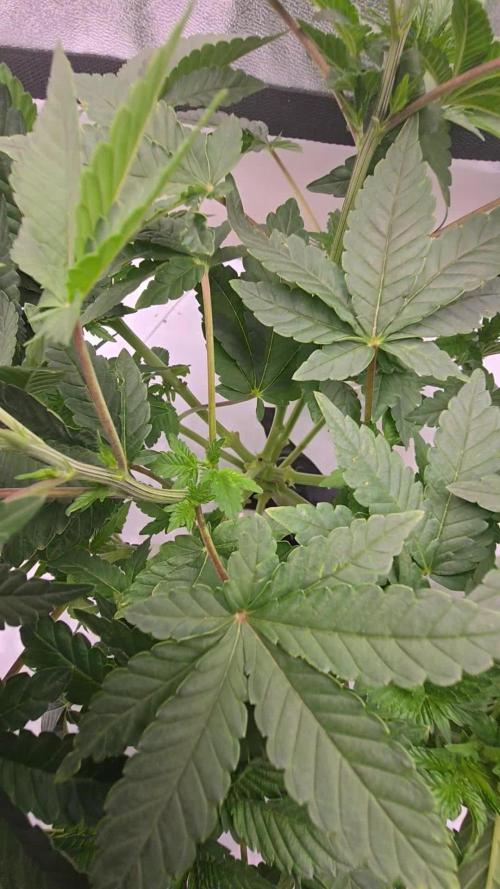
All ladies received another LST training.
I have received the Mars Hydro TS 3000W and set it up.
Day 63, the Fat banana, is killing it, it is a beast, OMG it is so bushy and around 65 cm high now, but the flower is still small. the biggest one has some dark color on the leafs expanding from the flower. The main stem is so thick. around 3 cm. I took all ladies out today and I notice that the FB was almost dry. perhaps it is not getting enough water. I will increase the fertigation to 3 times a day for the FB
Day 63 the Stress killers are also looking amazing and just smell good, very citrus
Trimmed out all the lover and small flowers, I don't think they will develop.

Likes
63
Share
@AsNoriu
Follow
Day 126. She is down.
That girl lived 90 days from seed touching soil. Its part of my Control Garden for proving/finding RQS strain issue.
For 3 weeks veged bag seed plant who spent 75% of his life not under direct light, sometimes even in shade and under most intense air fan , she is GOLD !
Cure day. She could go two weeks longer, but ... 96 g ;))) again, i can only look and admire. Crazy strain. Update on night shift ;)


Likes
2
Share
@Green_Peace
Follow
Increased Buddy to 1mm p/l. Really impressed with these nutrients so far, there's been no problems or defeciences the entire grow. All plants look happy, healthy and green. This plant is on the left of the timelapses.


Likes
25
Share
@Sators
Follow
Day 50. Mix some fish blood, bat guano and eggs shell mix and add to nutrients and let it turn to super tea. Have look how it is going on…
Day 52. Watering with before recorded nutrients mix option..
Day 55. Watering with 2.5L nutrient mix and for balance pH level add extra 0.5mL ph down.
Likes
4
Share
@Elguacho420
Follow
Buenas a tod@s... Bueno otra semanita más de estas hermosas nenas, ya más grandes y empezando a desarrollar sus frutos, la verdad q están creciendo muy bien, sin problemas, aunq hay veces q la temperatura este un poco alta las voy controlando y van muy bien, este cultivo yo creo q promete para bien... Me gusta ver buenos resultados cada vez q empiezo un cultivo nuevo, super contento y las niñas tanbm... 🙌🏻🙏🏻💀😎💪🏻 Buenos humos para tod@s...🔥🔥💨💨
🇦🇷🤝🏻🇪🇦

Likes
15
Share
@McKush420
Follow
Still working away to fix the nute deficiency I came into just after new years. Dense buds are still forming and calyx swell is beginning on original internodes. The sweet smell is like a brick wall when opening the tent. Keeping humidity down by opening a port on the side of my tent and adding an extra fan works well. This has been a great learning grow for me. I'm amazed the number of tops this strain has been able to produce. Next time I will be using air pots or something similar.


Likes
7
Share
@Krissci
Follow
Haven't done much with this...
Shee look lovely..
All others done..just this strain left..
Onlyaugar water going forward
Likes
13
Share
@ThCvibez804
Follow
Yo today me and my lady haf a Smoke Session Today And The Vibez Was Great Check The Video

Likes
10
Share
@Uneasy
Follow
14.10--> Their growth accelerated considerably after pot transplantation. Topping tomorrow
15.10--> Topping
17.10--> They got over the topping stress quickly

Likes
7
Share
@logangrowgan2020
Follow
Plant is growing awesome. Tying down as she grows along with the idea she'll stay nice and short in my cramped tent.
Watering every two or three days by removing from tent and placing in tub overfull of water - letting it feed from the bottom for a couple hours.
Central stem/trunk looks strong and vigorous. Excited to see how the next week shakes out, should start flower 👽🤗🤗
Likes
18
Share
@BufoAlvarez
Follow
7/19 I’ve come upon the realize that I had been under watering to an extreme degree. I have since adjusted accordingly today and hope they look better tomorrow.
Did remove some leaves and then found out I really shouldn’t have, hopefully I didn’t stunt them.i believe they are now flowering and next watering I will be adding some tiger bloom at very low strength. the newts I’ve given them have shown tip nute burn often and I have been very minimally watering so my conclusion is my soil was so full of nutes I could have waited until now most likely to start my first feedings. I’ve read about this and w ocean forest this seems to be the trend. Still really happy about the progress. Peace
Likes
6
Share
@ThinkDankGenetics
Follow
She's finally gone into flower turn into a nice little bush and was a breeze to train I have started to do leaf stripping cause of environmental and cause of how fat the leaves are let's be honest a blurple light isn't the best light 🤣 but seriously this should be a lesson for me I like challenges we will see what we can yeild.
Edit- been topped dressed on 1-10-24

Likes
18
Share
@TheCannaProphet
Follow
~ FASTBUDS CHEMDAWG AUTOFLOWER~
'The history of the Chemdawg strain starts in the early 90s where a group of cannabis breeders from Colorado were following a band on tour and took some of their weed with them, they had named this weed “chem bud” due to the unique chemical and diesel flavors.
When they got to one of the shows, they sold a couple of grams to a group of friends who quickly realized those were some special buds and, lucky for them, the buds had a couple of Chemdawg seeds (before they actually knew what they were) which they stored.
When one of the friends, who was also a cannabis grower, went back to his home on the East Coast, he germinated some of the seeds and started selecting the best phenotypes to continue developing those genetics even further.
As you may know by now, his effort paid off, and soon enough there were two versions of this strain going around, one was Indica-dominant and the other was a Sativa-leaning hybrid.
Both of these versions quickly spread around and several breeders developed new strains with these genetics, getting known by almost every cannabis consumer, becoming extremely popular and giving birth to a lot of famous strains such as Sour Diesel and OG Kush, although this isn’t confirmed, several old-school growers swear by it.' *content credit to FastBuds
_______________________________________________________________________________________________________________________________________________________________________________________________________________________________________________________________________________________________________________________________________________________________________________________________________________________________________________________
The Spec's:
'These precious genetics were boosted by the Fast Buds team to provide a super tough, potent, and easy-to-grow strain.
This Chemdawg Auto from their 'Originals' line grows around 90cm and is very resilient to diseases and colder climates but watch out because if you’re growing outdoors, your neighbors will be able to smell it easily!
This strain can be cultivated even by beginner growers due to it requiring minimal maintenance and can produce up to 400gr/m2 in 8-9 weeks, this is one of the shortest varieties FastBuds offers and can be the perfect choice for those growing on a balcony or in a limited grow space.
As soon as the trichome production starts, you can expect a terpene profile that resembles a mix of chemicals that is a delicious blend of diesel, gasoline, and petroleum.
With up to 20% THC, you can expect a super potent high that will take you into another world and leave you there, while you relax with a strong corporal high that will leave your whole body melting, a perfect effect to relax after a long day of work or inducing a good night of sleep.' *content credit to FastBuds
~Chemdawg Auto~
Genes: Sativa 20%/Indica 80%
Genetics: Chemdog Autoflowering
Flowering: 8 – 9 weeks
Harvest: 350 – 400 gr/m2
Height: 60 – 90 cm
THC: Up to 20%
CBD: < 1%
Autoflowering: Yes
________________________________________________________________________________________________________________________________________________________________________________________________________________________________________________________________________________________________________________________________________________________________________________________________________________________________________________________
THE SETUP:
~Planted into Jiffy Peat Pellets that were hydrated with de-chlorinated water with SuperThrive added then ph'd to 6.0 @ 80℉
~Grown 100% organic in 10g fabric pots with Mother Earth 70/30 Coco/Perlite medium amended with 2tbs/g of Down To Earth 4-4-4 / 2 cups/g of Earthworm Castings / 1tbs/g of Dr. Earth Flower Girl 3-9-4, 1tbs/g of Dr. Earth Bat Guano, 3/4 cup of Down To Earth Azomite and 1 tsp/g Down To Earth Fish Bone Meal.
~24hr light cycle during Germination / 19/5 light cycle for Vegetation and 12/12 for Flower
~Straight water ph'd @ 6.2-6.8 when needed and weekly Compost Tea's.
________________________________________________________________________________________________________________________________________________________________________________________________________________________________________________________________________________________________________________________________________________________________________________________________________________________________________________________
WEEKLY UPDATES:
9/6- Day 37 of flower and harvest time is fast approaching with her trichomes, which are now checked daily, maturing rapidly being 80% milky now with the remaining being clear.
Daily watering's continue with 1g of straight de-chlorinated water ph'd to 6.7 @74℉ and also I'm turning her pot 1/4 turn daily as well.
9/8- Well, her trichomes are right about where I like them to be and she's ready for 48hrs. in the dark before I chop and hang her to dry for 10-12 days.
I'm watering her with 1g of straight de-chlorinated water ph'd to 6.7 @74℉ and will continue to water her while she's in the dark (cannabis continues to carry on with it's growth processes even while in the dark) so that her medium doesn't completely dry out. Keeping her watered will also help to extend her drying time to that ideal 10-12 day target.
This should be some epic smoke as her buds are absolutely crystalized with trichomes and her smell is AMAZING! 😛💚
9/10- Well she's been in the dark for 24hrs. now with 24 more to go. I'm keeping temperatures in the low to mid 60's℉ and the RH @ 45%. Tomorrow is 'Chop Day'! I'll be taking some pic's of her when she comes out of the dark and during harvest...Stay tuned, this is some 🔥!
I am continuing to water while she's in the dark with 0.5g of straight de-chlorinated water ph'd to 6.8 @67℉ to keep her hydrated.
9/12- Well she's out of the dark where she spent roughly 60 hours. I kept the temp's @ 64℉ and the RH at 45%.
After I brought her out I shot a few pictures of her, then plucked off all of the shade leaves. I then cut her off at her base and hung her whole. I'll keep the RH in the room @ 50% for the first 24hrs., then raise it to 55-60% for the remainder of the drying. I have the temperatures in the Dry Room at a constant 65℉ to help preserve the terpenes.
Hopefully she'll take 10-12 days to dry to the point that she's ready to be trimmed and jarred! Stay tuned for the harvest of this phenomenal cultivar! 💚🔥
~Thanks for stopping in! Things are wrapping up and harvest is right around the corner....Stay lifted and be Blessed! 😎🙏~
Likes
50
Share
@Reyden
Follow
La White Runtz è andata a salire più di tutte con un gambo principale enorme e i vari rami laterali anche loro vanno su molto verticali senza aprirsi per cercare luce✨ Anche le foglie prendi sole sono enormi, ieri le ho bagnate con 0.6L 1500ms/cm ph 6,6 (21ºC) usando fertilizzanti Atami e Canna
La prossima volta sciacquio e poi saliamo a 1600 EC 😃🙌🔱💯💚🎬✨

Likes
2
Share
@KeemBboomin
Follow
I gave them a feed about two weeks ago I think I’m going to give them one more feed next week and let them puff up. I water them about every 2-3 days except on of my bubble gum plants she drinks a little slower than the others but she’s still nice and healthy.
Tent #1 has 2 Bubblegum and a Amnesia Haze
Tent #2 has 1 GMO Cookies, 1 Peanut Butter Pie x Royal Kandy( I won this seed on 420 so?)
As well as a plant I got from a friend and brought back to life to see what she rewards me with


Likes
154
Share
@CBD_Sweden
Follow
@FAST_BUDS,
Hi all the happy people here in GrowDiaries.
This is my second cultivation ever and it will be fun to try a bigger space than my closet grow.
First, I'm just going to say I'm done with the construction of my new growroom.
I put some pictures on the construction here in week one.
The room is 2.14 meters by 1.7 meters and has a ceiling height of 2 meters.
It provides a floor area of 3.6 square meters.
I use a 54 Watt Lightwawe T5 for germination and 2 Pcs 400 Watt HPS lamps.
I have a channel fan that replaces the room air about 40 times an hour to get a comfortable environment in the room, the air enters a fresh air intake from the outside.
The air is purified through a carbon filter to then leave the room to the rest of the basement.
Then I use that heat to heat the rest of the basement.
I will use 8 pcs 15 liter Autopots to grow with and a 100 liter water tank that supplies the pots of water and nutrition.
I will grow completely organically in soil and will watercure my buds to get the best possible medicine for me.
But there are no cultivation rooms to be displayed here, so I continue with what is most important.
Today I have put my seeds in my moisture dome and hope the seeds have germinated within a few days.
I am very excited to see how the new growroom will work and how this new secret CBD plant from @FAST_BUDS, will turn out.
..............................................................................................................................................................................................................................................................................................................................................
Update 2017-08-15. Both seeds have germinated and planted in small pots inside the humidity dome.
I'm so glad it worked so well and now it's just hoping they'll start growing and become 2 big healthy girls :)
...............................................................................................................................................................................................................................................................................................................................................
Update 2017-08-16. I have mixed my own soil today. Its 40% sieved peat harrow H2-H4 0-30 mm, 45% sieved peat harrow H4-H6 0-30 mm. 5% sand and 10% of compost soil. And i use 15% of perlite and mix it all together.
....................................................................................................................................................................................................................................................................................................................................................
2017-08-21 The 2 sisters are doing great, Nr2 is a bit after Nr1 . Some new pics.
............................................................................................................................................................................................................................................................................................................................................................................
2017-08-23. Transplanted from humidity dome and the small germinating pots to 15 liter autopots.
................................................................................................................................................................................................................................................................................................................................................................................
2017-08-27. The girls have settled in to there new home of the 15 liters autopot after a little transplant chock. Now the real week 1 starts for me and the girls. 4 new pics.
---------------------------------------------------------------------------------------------------------------------------------------------------------------------------------------------------------
2017-08-29. New movie of the girls. Its no water for 3 days now so the roots develop more and match the plant above the soil. The temp controlled fan is awesome, its easy to set what temp you like to have in the room. Right now its 28 celcius. And humidity is 56%.
--------------------------------------------------------------------------------------------------------------------------------------------------------------------------------------------------------------------------------------------------
2017-08-29.
Hello to you who read my diary, I just want to say that I am pleased that you have chosen to check in with me and in my diary.
I just want to say that I do this for myself and for a steady flow of my medicine.
Everything you read and see in my diary is 100% honest and I will never distort or beautify anything here.
I document my crops so that I can learn from my mistakes and also to look back at those different crops.
I try to update with pictures every day and with text if something special has happened in the garden.
This is my strainhunt for the best medicine and the beginning of my journey with cannabis and the cultivation of it.
-----------------------------------------------------------------------------------------------------------------------------------------------------------------------
2017-08-30. Cleaned the room this morning, just vacuuming and cleaning with chlorine solution. Im testing the fan to control temp and humidity, it works great.
Added some pics with measurements and a movie. Everything is looking great right now.
-----------------------------------------------------------------------------------------------------------------------------------------------------------------------------
2017-08-31. New video of the girls.
-------------------------------------------------------------------------------------------------------------------------------------------------------------------------------
2017-09-01. New pics and videos. Gave each of the girls with 2 ml Alg-A-Mic, 4ml Bio-Grow, 4ml Bio-Heaven and 10 ml Formulex mixed in 2 liters of water.
I hope they like it :)
-------------------------------------------------------------------------------------------------------------------------------------------------------------------------------------------------------------------------------------------
2017-09-02. New pics and the girls liked the water and nutrients yesterday.
-----------------------------------------------------------------------------------------
2017-09-03. Video of the girls this morning.
Kl 16.00. Did some defoliation on the girls. Videos added.
KL. 23.00. New video.