


Likes
Comments
Share


@Shrek2onDVD
Follow
This little lady had some trouble shedding the seed shell, which caused it to skew slightly. I helped take the shell off and she straightened out pretty quickly. Took about 3 days from germination to open up. (temps were a little low)

Likes
101
Share


@Ferenc
Follow
Day 80, 2nd of December 2020:
Hi there! Ladies are cool everything is alright. In one week buds strated doubeling and the developement is dope haha.
The 2 Zamnesia ladies are pretty Gelato is so nice bushy and the smell is great as well.
Kalini Asia will be a green pheno I think and she my be hermied a bit on me.... I am still waiting to see I see some strange develepement lets say.
Sweet Seeds girls are dope unfortunately Red Mandarine and Tropicanns poison don't show any sign of colouting yet but it is okay even if they green phenos.... It may happen in the end of the flowering cycle let's see.
Basically that's all I wanted to share.
Oh yes... this one:
All good the lamp is now on 11 hours and off 13 hours. Every week 15 minutes was taken off and after 4 weeks here we go. Strated 12/12 and now 13/11 wanted try to imitate the nature as the light days are getting shorter.
Fertilization has changed no more epsom salt from this week and I will stop giving nitrogen as well from next week.
Great job Sweet Seeds and Zamnesia! Nice genetics :) Lovely plants!


Likes
49
Share

@Salokin
Follow
GMO × Triangle Mints BX – Week 20 Veg | ScrOG Installed, Stripped and Ready
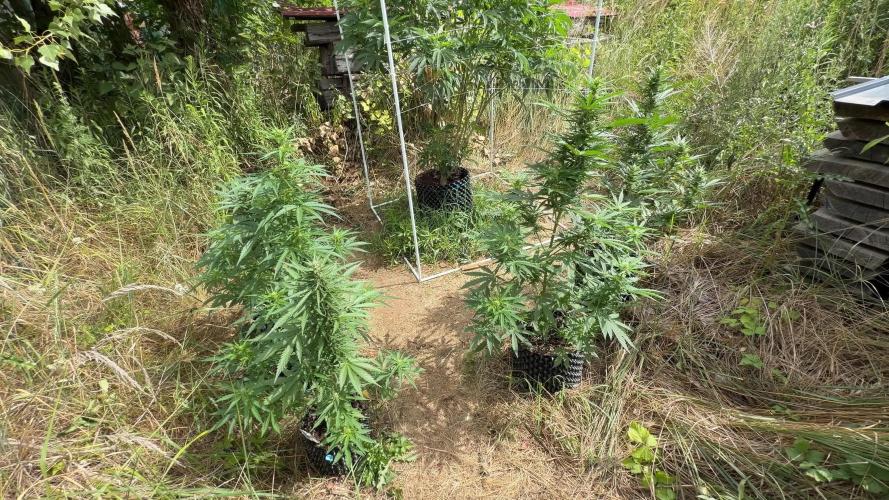
Big week. The lower canopy got stripped right back — everything below the net level cleared out to focus all energy upward into the tops. Looking at the stems from underneath is genuinely impressive: thick, woody trunks with real bark texture and heavy branch junctions that show exactly how much biomass this plant has built over the past five months. She looks more like a small tree than a cannabis plant at this point.
A ScrOG frame has been built around her and the tops are being worked through the net. At 165cm she's already pushing through it and there's still time left before transition to fill the frame evenly. Once she flips, every shoot sitting in that net is a potential main cola.
Daylight has dropped to 16 hours — down from the solstice peak and slowly ticking in the right direction. Transition shouldn't be far off now.
Nutrient schedule unchanged: CANNA Aqua Vega 3ml/l, CalMag Agent 1.1ml/l, Aptus Regulator 0.1ml/l, EC 1.2 mS/cm, pH 6.2. Watering holding at 25L per feed. Day temps 25°C, nights 18°C.
The coming week looks mostly dry and warm — up to 29°C, nights around 15–16°C, winds light throughout. Good conditions for her to settle into the net after this week's work.
Updates every Sunday. Stay tuned. 🌿
Likes
11
Share


@Chubbs
Follow
420 Fastbuds
FBT2303 Week 4
Weekly update for these two beautiful plants. Both seem about the same height though one is definitely more stacked. I did do a major deforliation on both taking off most bigger fan leafs, even though you can't tell. I'll probably do another mild one as they transition into flower as I'm starting to see pistols forming. I did up the water/feeding to 2000ml every other day alternating from nutes to just ph'd water. All in all Happy Growing

Likes
44
Share


@RakonGrow
Follow
Note :
+ jegliches Zubehör wird in der GermniationsWoche aufgelistet . Zeitraffer Videos folgen immer nachträglich.
+ videos werden so geschnitten das nur ein geschlossenes Zelt erscheint , ergo Fehlen paar reale Minuten (ca 1 Std) .
Day 64:
Die Nacht war kalt und die Ventilatoren an . Ergebnis , der Hauptrieb der viel ventilation abbekommt ist wunderschön dunkel geworden.
Bilder hinzugefühgt um mal den Vergleich zu haben , beide haben die gleiche Bedingung , sowohl Dünger als auch Licht . Nur das Zoe mehr Wind abbekommt und damit halt eine kältere Nacht erhalten hat .
Wir sehen das es wohl keine wirklichen defiziete. Es ist ein verhalten auf die Kälte.
Day 65:
+ 1.75 Liter Flaschenwasser
+ + Dünger für Blühte
+ + + Canna Terrar Flores (Achtung wirkt wie PH-)
+ + + Canna Boost
+ + + Cannazym
+ + + Canna Rhizotonic
+ + + Canna PH+
+ + PH 5.91
Day 66:
Das viele Licht zeigt wie es aus allen Seiten der Buds wächst . Das ist nicht gerade ein Qualitätsmerkmal , eher ein Quantitätsmerkmal . Aber ich möchte auch wissen wie stark sich das auf die Qualität auswirkt .
Die Schwester hinkt zwar kräftig hinterher wegen ihrem Wasserschaden, aber zum Rauchen allemal gut .
Leichte Cal-Mag Probleme werden sichtbar .
Day 67:
+ 2 Liter Flaschenwasser
+ + Spülung
+ + + Canna Boost
+ + + Cannazym
+ + + Plagron PH-
+ + PH 6.0
Day 68:
keine besonderen Anzeichen , die Luftfeuchtigkeit ist so zwischen 60% bis 64% . Geht gerade nicht anders . Ist jetzt aber zum abreifen auch nicht Schlimm . Dafür sind die Temperaturen bei konstanten 26°C
Day 69:
Alles läuft nach Plan. Kein defizit, ergo , es wird nur rest Dünger in der Erde abgebaut.
Day 70:
+ 2 Liter Flaschenwasser
+ + Dünger für Blühte Generative Phase III
+ + + Canna Terrar Flores (Achtung wirkt wie PH-)
+ + + Canna Boost
+ + + Cannazym
+ + + Canna Rhizotonic
+ + + Canna PH+
+ + PH 5.91

Likes
12
Share


@Krissci
Follow
Day 5 -
Fr1 need LST to gain the best yield front he lowest buds...I don't usually let the stem grow so vertical
FR2 has a very nice frame .no real training needed.
Likes
62
Share


@MeaCulpa
Follow
Happy new year!
I switch to water in a week and then rinse for 2 weeks. Everything looks good so far.
The only thing that worry me a little is the high humidity.
In the small tent I have almost always under 50% humidity in the evening,
In the large tent it is rarely below 60%-65%. Although my filter is supposed to make 243m³/h, my tent construction is probably too much for it.
With 90% outside humidity since weeks, it's really a battle against windmills.
I hope nothing gets moldy.

Likes
77
Share


@Basementganja
Follow
Flowering slowly, likely due to the roots having low PH(4-5)..
I flushed her a few weeks back.. I'm done experimenting with nutrients for now; I had better results, with less issues with just using the basics.
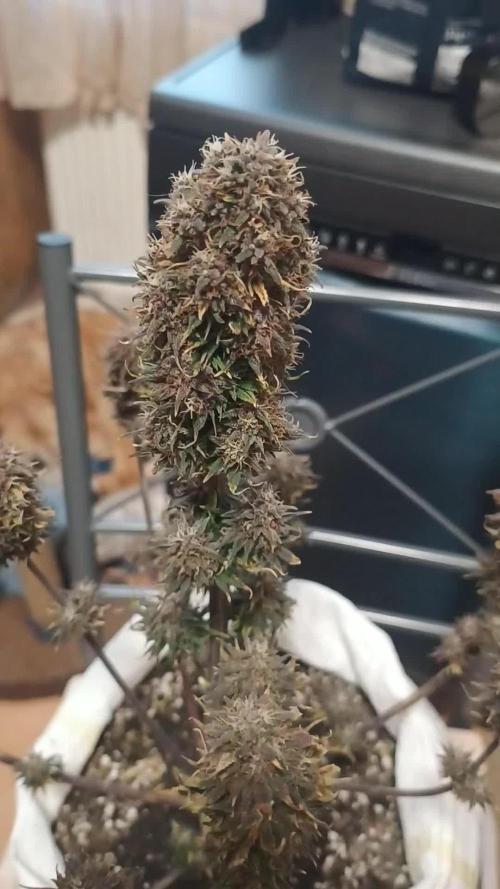
*Special Nug picture - This Bud-site has a different shape/structure compared to every other nug on this plant.. Never seen this before, on any other strain.
Processing
Likes
6
Share


@Silverback_Guerilla
Follow
SUNDAY 5/5:
Rearranged the gardens..have 17 plants in the 4 x 5 now...yowsa!
MONDAY:
Plucked some dead leaves and did a trichrome check on her. She's getting close now! Prolly about 70% cloudy and 5% amber!
TUESDAY:
I observed some white spots on a few leaves here and there, so I sprayed her today with Trifecta Crop Cure, a concoction of a bunch of natural plant oils. I already decreased the humidity in the room to 45% with my new 70L dehumidifier, so I think she'll be fine. I'll spray her again tomorrow and the next day, then I'll have to hope that did the trick, because she is already in the harvest window.
WEDNESDAY:
I watered her today and included a bunch of terpinator, bud candy, bembe, and cha ching. It was her last dose of any nutes...flushing with spring water from here on out.
THURSDAY:
Took a couple of photos and tried installing my new Solacure FlowerPower UVB light, but it was dead on arrival.😢..back to the 15.0 reptile UVB lights for now I guess...

Likes
29
Share

@THcHunteR23
Follow
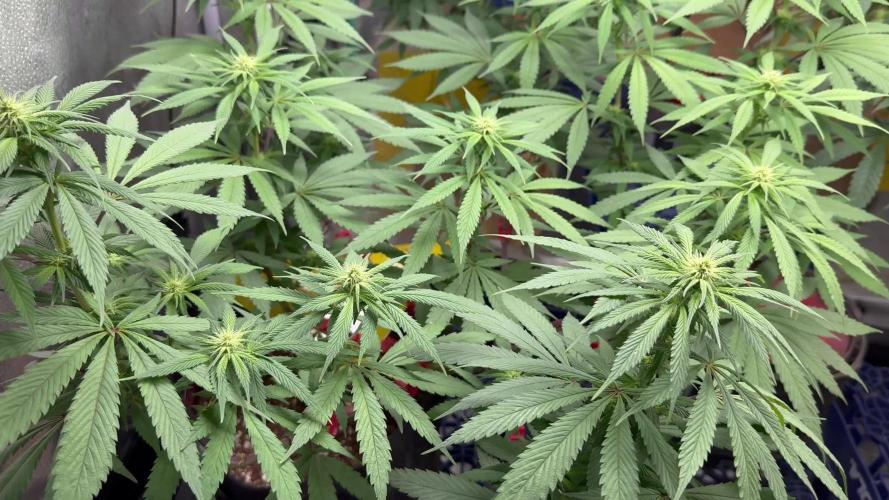
Structure assez compact . Défoliation dans 1 semaine
Vue qu’elle commence à être plus pâle je vais continuer avec Green nutrients à petite dose voir comment elle réagit si c’est ok je vais continuer

Likes
14
Share


@Drgreenthumb627
Follow
against better judgement i topped each of the main branches on day 4 of flower. we will see if she responds negatively but i didn’t want to risk the height

Likes
32
Share


@Grey_Wolf
Follow
Double Grape attempt #2
mephisto genetics double grape
7th January 2021
I have two very distinctly different phenotypes of Double grape 😎
the taller one is really sativa like with it's thin leaves and stretched appearence , whilst it's sister plant is squat
in stature and has thos classic wide leaves from it's Indica parentage.
However so far they both Smell very similiar so I dunno what to make of that but it can't be a bad thing as the smell is very Nice 👌
Not much else to report so will leave it at that.
Thankyou for stopping by 👍

Likes
4
Share


@GODAXE
Follow
27.08.2024
D48 since cutting,
lady starting to bush like their mother, as i did nt have place for 8 massive bush in the tent i proceed to some pruning and set some bud clip.
overall look
GBC #1
16 inch, flowering
GBC #2
16 inch, flowering
GBC #3
16 inch , still in veg, 😰
GBC #4
18 inch, full bud mod 😍
GBC #5
18 inch , full bud mod 😍
GBC #6
19 inch, flowering
GBC #7
20 inch, start flowering👍
GBC #8
18 inch, flowering
i will not weekly uptade, but keep you tuned


Likes
19
Share


@adam_pawloski87
Follow
What another great week it’s been , today is Day 39 from seed an the lil ladies have jumped into preflower 😍! Yesterday gave em the trim up of the unders , kinda popsicled you can say to each one, cause we want to focus on them colas ! This week we should see some more great progress, let them caps start stacking ! Can’t wait to see what we do next week ! Hope you all enjoy an have an amazing productive day! Peace love an positive vibes to y’all Cheers 😶🌫️💨💨💨💨💨🤙🏻

Likes
1
Share


@0JuJu0
Follow
The leaves are a little bit dead but she will be potent. The buds looking great.
Likes
6
Share


@TerpTurtle
Follow
4x4 #1 | Plants are starting to stack bud formations, in week 5 flower
4x4 #2 | Plants are starting to show pistils this week & a active stretch, in week 2 flower
Gyat is very easily managed and both phenotypes are looking great, even the 'finicky' plant
Scat Queen is a herm, I'm still going to run them.. they look good other than. The pheno in week 5 flower smells really good and overall structure is nice but is seeding and I'm seeing the 2nd pheno starting to show similar traits.. this experiment shows it's just not a stable cross from Elev8.
Did some shuffling & added a smaller plant, Sherbie Truffle by Detroit Seed Co in the front right next to Gyat to the left -it is a few weeks behind the others but will fill the space nice. ( Scat Queen back left, Gyat back right and front left, Sherbie Truffle front right )
Keeping the flow smooth growmies 😎


Likes
4
Share

@Nillenium
Follow
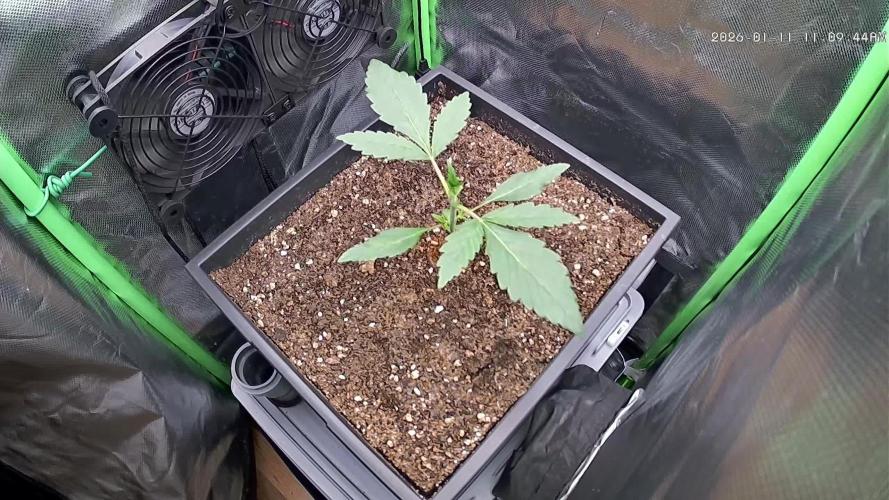
Woche 3 verlief nach Plan. Ich habe immer wieder die neu gewachsenen Sonnensegel vom Hauptstamm entfernt. Gegen Ende der Woche habe ich mit leichtem LST begonnen. An Tag 21 habe ich die ersten mini Stigmen der Vorblüte entdeckt.
Likes
7
Share


@JoseTodoLoco
Follow
I didn't get that much yield and the buds were too fluffy do I decide to use all the buds and trim to do bubble hash, I really enjoyed the entire process.

Processing
Likes
Comments
Share


@MOTB666
Follow
Getting really bushy about 18 inches tall going in this week might be the last week of veg if they keep growing how they are. These girls are getting wide as hell. Will move one of them over to avoid over crowding in the middle next change out of nutrients. They're appetite is getting big
