The Grow Awards 2026 🏆
Processing
Likes
Comments
Share
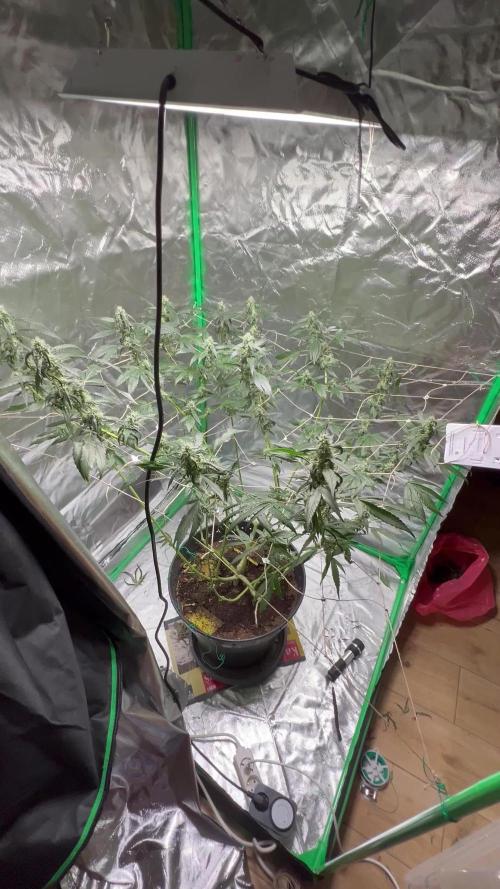
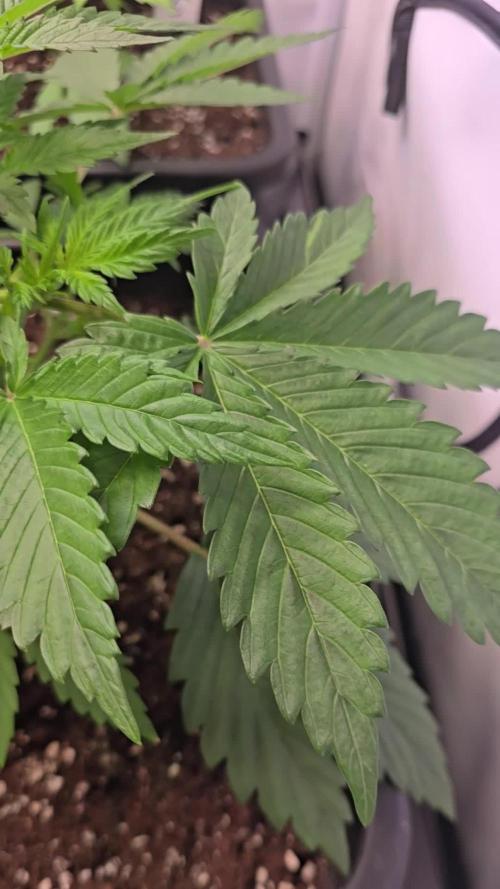
Buenas noticias para esta semana. 1. La semana pasada comenté que tenía una planta desordenada, pues no me había percatado que la karpa tenía un orificio abierto en el techo y estaba entrando contaminación lumínica cuando dormía y por eso estaba débil. 2. Un loco que sabe más que yo, me dijo que las puntas amarillas es algo bueno en mis plantas y no algo malo, por lo que están saludables. 3. Las flores tuvieron un gran avance y ya se notan de mejor tamaño y un excelente aroma. 4. El calor y la humedad hacen que cada planta consuma 2 lts de líquido al día. 5. Voy a iniciar Pk1314 esta semana que sigue. Malas noticias 1. Ya no tengo mota seca jajaj Buenos humos
Likes
6
Share
@BossHogg6
Follow
I started using Botanicare Hydroguard to take care of the roots and it works great. Got them back healthy. The light leaks to the reservoir have hopefully been resolved as well. The smell coming from the box isn't too strong and will catch you off guard here and there, but not too noticeable. You can also get a good look at the trichomes forming on the buds and leaves.
Likes
2
Share
@ChiTaN
Follow
Girls are healthy and juicy,getting ready for the light switching,changing pots and also some defo probably 💚🌱
Processing
Likes
12
Share
@BloodBath
Follow
I will be focusing this diary on the smoothie strain but you’ll be seeing some other plants in the tent that are not the same strain. I only have room in this tent so bare with me. There are 2 Smoothie, 1 CNC, and 1 Stardawg (dog). The smoothie are the two bigger ones in the back of the tent. Now, the Smoothie from FastBuds is just killin it right now. Since I popped the beans they have done nothing but show signs of greatness. I don’t think this one is gonna slow down much either. I’m going to push these plants harder than my last harvest. I had a really really amazing harvest last time. I was even able to pull sap out of all 4 plants. 2 Zkittles and 2 LSD-25. This was all done by feeding at the right times and keeping a “moist” soil. Also I want add that I ran pretty much the entire line of Nectar for the Gods at a little less then the recommended ratios. This time I plan on going a tiny bit over the recommended ratios just to see what these plants will do. Trust me, if the plants have a bad response I will go back to the recommended ratios. The reason I want to do this is because I really think these auto strains can handle a lot more than a regular flowering cycle plant would. They can handle more stress, that’s for sure. When do you think I should add a compost tea into my regimen? Soon or wait till the plant is a little larger?
Likes
11
Share
Just doing her thing, perfect color, perfect shape, buds forming at a rapid pace, crystals showing up, beautiful times ahead :)) Cant be more excited than i am at the moment
Likes
26
Share
@Hawkbo
Follow
These are doin pretty good. The 2 mac x's are doing the best and look promising. The rocstar breath and purple candy paint are a little smaller but doing well. Added some TNB co2 to give them a boost.
Likes
28
Share
Happy Holidays! Week 4 flower and not much to report. Didn’t do anything special, just water from drip, about 1 gallon over 24hrs. Drip turns on 4x during lights on. Light seems to be hitting everywhere fairly even. 2x TSW 2000’s are at about 75%, 18-20” from canopy. I might turn them up to 100% and see how they react for the final push and then turn them down again nearing the end. I will also top dress again soon for the last time. Fungus Gnats are around but I wouldn’t say it’s an infestation, just got to put in a few more traps and I think the “Grub Grenade” is taking care of the soil. There is a 2” layer of straw mulch to help keep them off the surface comfortably. Sour Diesel genetics from Blimburn are strong, thick branching, frosty, sweet & sour smell right NOW, nice internode spacing for light penetration required less defoliation. Thanks for the view! Keep calm and grow on!
Likes
7
Share
One of them could be a keeper.
Likes
42
Share
@rhodes68
Follow
Typical Green Crack harvest, lot of leaves but easy otherwise Lack of tent space really hurt her yield, guessing 25% less due to it Dry weight for Plenty 322 grams nice easy final trim rock hard nugs Two clones follow The clones nearly identical both weigh in at 710 grams wet in dry yield later Clones yielded 287 grams dry
Likes
170
Share
@nonick123
Follow
Día 42 (27/02). Riego 1,25 Litro H20 + Wholly Base 2,5 ml/l + Solid Green 1,5 ml/l + Rise Up 0,5 ml/l de Gen1:11 TDS 898 PPMs - pH 6,5 (mínimo ajuste con pH+ para subirlo desde 6,2) Plantas sedientas con un intervalo de riego cada 4 días. A partir de ahora regaré cada 3 días Día 43 (28/02) Las ramas crecen muy rápido y se van colocando para recibir el máximo posible de luz. Es impresionante su evolución día a día! Día 44 (29/02) Han crecido 17 cm desde que cambié a 12/12. Alucinante! 😍😍😍 Día 45 (01/03) Riego 1,25 Litro H20 + Wholly Base 2,5 ml/l + Solid Green 1,5 ml/l + Rise Up 0,5 ml/l de Gen1:11 TDS 891 PPMs - pH 6,25 Añado un poco de substrato al top y a los bordes de la maceta antes de regar, porque se ha compactado ligeramente. Día 46 (02/03). Las plantas siguen su crecimiento imparable. 3 cm al día 😍 💦Nutrients by Gen1:11 - www.genoneeleven.com 🌱Substrate PRO-MIX HP BACILLUS + MYCORRHIZAE - www.pthorticulture.com/en/products/pro-mix-hp-biostimulant-plus-mycorrhizae 🎚️Controlled by TrolMaster TCS-1 Tent-X System Main Controller - https://www.trolmaster.com/Products/Details/TCS-1
Likes
5
Share
The stretch phase is over and the Platinum Zooks is doing fabolous😃 I gave her a heavy haircut (defol & lollipop) @ day 11 of flower. ( she didn't mind ) On day 18 of flower i'm gonna give her, her first Bio-Tabs Compost Tea to give her a little extra push in the back.
Likes
8
Share
Well all is good and moving along.. remember its more like week 9 now. i will start flushing in a few days maybe
Likes
13
Share
Likes
8
Share
@Ninjabuds
Follow
Code ; NINJABUDS for a discount on ELUFAH lights The spectrum from ELUFAH is really making the plants grow really well My papa Payton I have growing under the ELUFAH uap-1500 along with the ELUFAH Saturn ring under canopy light. I recently put the plant back in a 2x2 I did have 2 plants but the other plant needed up being male. No need for the larger tent still.
Likes
3
Share
Likes
56
Share
What's in the soil? What's not in the soil would be an easier question to answer. 16-18 DLI @ the minute. +++ as she grows. Probably not recommended, but to get to where it needs to be, I need to start now. Vegetative @1400ppm 0.8–1.2 kPa 80–86°F (26.7–30°C) 65–75%, LST Day 10, Fim'd Day 11 CEC (Cation Exchange Capacity): This is a measure of a soil's ability to hold and exchange positively charged nutrients, like calcium, magnesium, and potassium. Soils with high CEC (more clay and organic matter) have more negative charges that attract and hold these essential nutrients, preventing them from leaching away. Biochar is highly efficient at increasing cation exchange capacity (CEC) compared to many other amendments. Biochar's high CEC potential stems from its negatively charged functional groups, and studies show it can increase CEC by over 90%. Amendments like compost also increase CEC but are often more prone to rapid biodegradation, which can make biochar's effect more long-lasting. biochar acts as a long-lasting Cation Exchange Capacity (CEC) enhancer because its porous, carbon-rich structure provides sites for nutrients to bind to, effectively improving nutrient retention in soil without relying on the short-term benefits of fresh organic matter like compost or manure. Biochar's stability means these benefits last much longer than those from traditional organic amendments, making it a sustainable way to improve soil fertility, water retention, and structure over time. Needs to be charged first, similar to Coco, or it will immobilize cations, but at a much higher ratio. a high cation exchange capacity (CEC) results in a high buffer protection, meaning the soil can better resist changes in pH and nutrient availability. This is because a high CEC soil has more negatively charged sites to hold onto essential positively charged nutrients, like calcium and magnesium, and to buffer against acid ions, such as hydrogen. EC (Electrical Conductivity): This measures the amount of soluble salts in the soil. High EC levels indicate a high concentration of dissolved salts and can be a sign of potential salinity issues that can harm plants. The stored cations associated with a medium's cation exchange capacity (CEC) do not directly contribute to a real-time electrical conductivity (EC) reading. A real-time EC measurement reflects only the concentration of free, dissolved salt ions in the water solution within the medium. 98% of a plants nutrients comes directly from the water solution. 2% come directly from soil particles. CEC is a mediums storage capacity for cations. These stored cations do not contribute to a mediums EC directly. Electrical Conductivity (EC) does not measure salt ions adsorbed (stored) onto a Cation Exchange Capacity (CEC) site, as EC measures the conductivity of ions in solution within a soil or water sample, not those held on soil particles. A medium releases stored cations to water by ion exchange, where a new, more desirable ion from the water solution temporarily displaces the stored cation from the medium's surface, a process also seen in plants absorbing nutrients via mass flow. For example, in water softeners, sodium ions are released from resin beads to bond with the medium's surface, displacing calcium and magnesium ions which then enter the water. This same principle applies when plants take up nutrients from the soil solution: the cations are released from the soil particles into the water in response to a concentration equilibrium, and then moved to the root surface via mass flow. An example of ion exchange within the context of Cation Exchange Capacity (CEC) is a soil particle with a negative charge attracting and holding positively charged nutrient ions, like potassium (K+) or calcium (Ca2+), and then exchanging them for other positive ions present in the soil solution. For instance, a negatively charged clay particle in soil can hold a K+ ion and later release it to a plant's roots when a different cation, such as calcium (Ca2+), is abundant and replaces the potassium. This process of holding and swapping positively charged ions is fundamental to soil fertility, as it provides plants with essential nutrients. Negative charges on soil particles: Soil particles, particularly clay and organic matter, have negatively charged surfaces due to their chemical structure. Attraction of cations: These negative charges attract and hold positively charged ions, or cations, such as: Potassium (K+) Calcium (Ca2+) Magnesium (Mg2+) Sodium (Na+) Ammonium (NH4+) Plant roots excrete hydrogen ions (H+) through the action of proton pumps embedded in the root cell membranes, which use ATP (energy) to actively transport H+ ions from inside the root cell into the surrounding soil. This process lowers the pH of the soil, which helps to make certain mineral nutrients, such as iron, more available for uptake by the plant. Mechanism of H+ Excretion Proton Pumps: Root cells contain specialized proteins called proton pumps (H+-ATPases) in their cell membranes. Active Transport: These proton pumps use energy from ATP to actively move H+ ions from the cytoplasm of the root cell into the soil, against their concentration gradient. Role in pH Regulation: This active excretion of H+ is a major way plants regulate their internal cytoplasmic pH. Nutrient Availability: The resulting decrease in soil pH makes certain essential mineral nutrients, like iron, more soluble and available for the root cells to absorb. Ion Exchange: The H+ ions also displace positively charged mineral cations from the soil particles, making them available for uptake. Iron Uptake: In response to iron deficiency stress, plants enhance H+ excretion and reductant release to lower the pH and convert Fe3+ to the more available form Fe2+. The altered pH can influence the activity and composition of beneficial microbes in the soil. The H+ gradient created by the proton pumps can also be used for other vital cell functions, such as ATP synthesis and the transport of other solutes. The hydrogen ions (H+) excreted during photosynthesis come from the splitting of water molecules. This splitting, called photolysis, occurs in Photosystem II to replace the electrons used in the light-dependent reactions. The released hydrogen ions are then pumped into the thylakoid lumen, creating a proton gradient that drives ATP synthesis. Plants release hydrogen ions (H+) from their roots into the soil, a process that occurs in conjunction with nutrient uptake and photosynthesis. These H+ ions compete with mineral cations for the negatively charged sites on soil particles, a phenomenon known as cation exchange. By displacing beneficial mineral cations, the excreted H+ ions make these nutrients available for the plant to absorb, which can also lower the soil pH and indirectly affect its Cation Exchange Capacity (CEC) by altering the pool of exchangeable cations in the soil solution. Plants use proton (H+) exudation, driven by the H+-ATPase enzyme, to release H+ ions into the soil, creating a more acidic rhizosphere, which enhances nutrient availability and influences nutrient cycling processes. This acidification mobilizes insoluble nutrients like iron (Fe) by breaking them down, while also facilitating the activity of beneficial microbes involved in the nutrient cycle. Therefore, H+ exudation is a critical plant strategy for nutrient acquisition and management, allowing plants to improve their access to essential elements from the soil. A lack of water splitting during photosynthesis can affect iron uptake because the resulting energy imbalance disrupts the plant's ability to produce ATP and NADPH, which are crucial for overall photosynthetic energy conversion and can trigger a deficiency in iron homeostasis pathways. While photosynthesis uses hydrogen ions produced from water splitting for the Calvin cycle, not to create a hydrogen gas deficiency, the overall process is sensitive to nutrient availability, and iron is essential for chloroplast function. In photosynthesis, water is split to provide electrons to replace those lost in Photosystem II, which is triggered by light absorption. These electrons then travel along a transport chain to generate ATP (energy currency) and NADPH (reducing power). Carbon Fixation: The generated ATP and NADPH are then used to convert carbon dioxide into carbohydrates in the Calvin cycle. Impaired water splitting (via water in or out) breaks the chain reaction of photosynthesis. This leads to an imbalance in ATP and NADPH levels, which disrupts the Calvin cycle and overall energy production in the plant. Plants require a sufficient supply of essential mineral elements like iron for photosynthesis. Iron is vital for chlorophyll formation and plays a crucial role in electron transport within the chloroplasts. The complex relationship between nutrient status and photosynthesis is evident when iron deficiency can be reverted by depleting other micronutrients like manganese. This highlights how nutrient homeostasis influences photosynthetic function. A lack of adequate energy and reducing power from photosynthesis, which is directly linked to water splitting, can trigger complex adaptive responses in the plant's iron uptake and distribution systems. Plants possess receptors called transceptors that can directly detect specific nutrient concentrations in the soil or within the plant's tissues. These receptors trigger signaling pathways, sometimes involving calcium influx or changes in protein complex activity, that then influence nutrient uptake by the roots. Plants use this information to make long-term adjustments, such as Increasing root biomass to explore more soil for nutrients. Modifying metabolic pathways to make better use of available resources. Adjusting the rate of nutrient transport into the roots. That's why I keep a high EC. Abundance resonates Abundance.
Likes
8
Share
Likes
52
Share
@MeaCulpa
Follow
Hey everyone. I made one video with flash and one without as last week. So far everything seems to be good. The buds look very impressive. I never expected it.