


Likes
Comments
Share


@Phenohunter88
Follow
Week started off well. Day 50 and no major hiccups. Lets get to that finish line soon!
Day 51 - Everyone is healthy and great. CDLC is really putting on the weight now. All five of them are stellar.
MB #1 stopped stretching and her nugs are starting to swell. She is one fast lady. The other Miracle Berry Remix looks like it will stretch some more and so does the Mango Smile. Strawberry and CDLC have a ways to go but they are blowing up.
I am feeding everyone every day at least 2 liters of the above mixture. Depending on coloration (light green to dark green) I will change the nitrogen content. These things are eating phosphorous up like candy. I have experienced NO nutrition burn. All of my issues thus far have been underfeeding due to PH issues. I have a theory that I want to feed them as much as possible regardless of feed schedule and fear of nutrition burn. Ensuring a healthy root system with proper PH and monitoring Potassium in your watering should give the best results. I am finding that the only nutrient that cause the physical representation of nutrition burn (burned tips) is too much Potassium. I think I stated it before but Nitrogen toxicity doesn't burn tips and Phosphorous is really difficult to overdose your plant with. Pinpointing this is extremely important I feel. Are there any other growers who find this to be true?
Day 53 - Everyone is great. Notable things from today...Mango Smile is sad cuz I gave her a hair cut and Strawberry Nuggets revealed a massive nitrogen deficiency after I gave her a hair cut. I switched to bloom nutrients too early on her. Upped her nitrogen PPM for today's feeding and hoping I didn't stunt her too badly. Lot's of node sites though.
Day 54 - Mango Smile was just being a diva. Today her entire canopy was an inch higher...and she shows no signs of swelling yet. She's gonna end up going over 90 days for sure. My Maxigrow got moisture in it...so it went bad. I went out and bought some NPK Raw Grow for my Strawberry Nuggets. She is so hungry I feel bad. She is the only one I fed today. Everyone else was fine. Pistils on MB#1 are turning orange/brown. She might be ready at day 70. MB#2 will be right behind her. They are quite fast for being so big. CDLC is looking great. Didn't take a photo today but she is getting frosty and her flower stretch is on. Humidity is a little high in tent since I added additional pots with soil in them. I turned up my light to around 80% and the humidity tanked. Temperature went up to about 81F. I think we can manage that. I'm not seeing any signs of heat stress or fox tailing.
My lights are powered by two HLG-600H drivers. Theoretically, I have 1200 Watts in the tent. Just to clarify since the journal won't let me specify my wattage for the QB96s. They can go up to 250 Watts each with active cooling.
Day 55 - Moved everyone in the tent around to increase airflow. Trying to keep everyone off the walls but Miracle Berry Remix 1 is taking over the tent. Probably going to have to supercrop soon. Miracle Berry 1 smells deeply of berries. No gas or funk smell. Smells like a blue raspberry slurpee.


Likes
18
Share


@Grower_Of_Persia
Follow
week intel:
its time for second pruning they grew up too fast and need second pruning as below :
first i remove big fan leaves and only leaves then let them rest for 1 day then the second part of pruning will get done that is removing branches based on these conditions:
1-if the branch is very low and never can make it to the top ,
2- if branch is in shade even after pruning fan leaves ,
3- if there are too many branches at the small space then non of them will get resources so if there is no space for branch then , they must get remove.
everything is perfect!
stresses :
pruning big fan leaves and lower branches + a little E.C stress around 1.7 once a week
feeding:
i feed them 3 times this week with this order :
day 1 : i feed them heavy with silicate +base nutrients(calcium & micros + Bloom) about 884 ppm - 1.7 e.c to cause a little stress.
day 3 : i feed them low dose of Feeding Booster + Karbo Boost around 325 ppm - 0.6 e.c to let them recover a little but not fully recover still a little stress will caused.
day 5 : i feed them with low dose of Top-Max + B-52 around 213 ppm - 0.4 e.c to let them recover the stresses to get ready for another stress next week.
guide of the week :
no more stresses from now on till the end and from next week i'll reduce the amount of nitrogen and calcium to below half to the end.

Likes
4
Share

@Ninjabuds
Follow
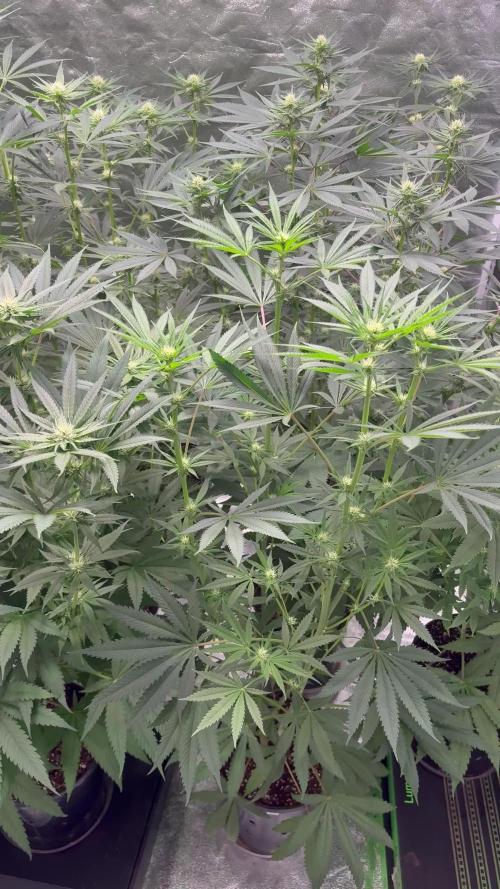
Week three of flower is off to an amazing start! At day 22, the ladies are looking incredibly healthy. They're praying like crazy, reaching for the light, and stacking nodes like it's their job. The buds are starting to plump up, and the trichome production is getting intense. I'm so excited to see how they develop over the next few weeks!

Likes
7
Share


@MrsGreen_98
Follow
Second grow ever - Not seen much about Diablo xl but know it’s a cross between jack herer and big devil #2. Excited to see how this one goes.
Wed 3rd March -
Placed Diablo XL into ph balanced water and put in a warm dark place for 24 hours
Thur 4th March -
Seed has sunk after 24hours have made my own propagation kit which I will place in a blacked out tub for the next 3 days. I will check up on it every day to see if soil is still damp.
Fri 5th March -
No sprout today if she doesn’t sprout by tomorrow night I will give some light to give her energy.
Sat 6th March -
Still no sign will put light on tonight. Happy growing.
Sun 7th March -
Wooo! She’s showing signs of sprouting can see she’s trying to get out her she’ll casing. Excited to see what I wake up to tomorrow!! 🍁

Likes
36
Share


@nonick123
Follow
Día 2 (03/06) A su marcha haciendo las raíces...
Día 3 (04/06) N/A
Día 4 (05/06) N/A
Día 5 (06/06) A su marcha haciendo las raíces...
Día 6 (07/06) N/A
Día 7 (08/06) Elimino la cúpula de humedad al estar en el día 7
Día 8 (09/06) Riego con 100 ml de H20 con Wholly Base 1,25 ml/l + Solid Green 0,50 ml/l + Rise Up 1 ml/l de GenOneEleven
🌱Substrate PRO-MIX HP BACILLUS + MYCORRHIZAE - www.pthorticulture.com/en/products/pro-mix-hp-biostimulant-plus-mycorrhizae

Likes
98
Share


@DogDoctorOfficial
Follow
And my army as arrived lol its IPM time with in this case is not preventive but its attacking a situation !!!!
In my humble opinion wen growing in organics one fight life with more life and in this case i broth the big guns, i am talking about applying nematodes (steinernema faltiae) with you cant see at naked eye but will do they’re job on the soil and take on a microscopical way, i also am introducing some beneficial bugs to be more exact the stratiolaelaps scimitus they are machines killing trips, soil flies and a bunch of other plages we dont want around our girls and i also invited some Noseilus Californicus as a preventive for Any kind of non beneficial mites. With this i recipe i have faith my girl will be in control until the end of the run were i can clean it all up good !!!
Appart from the bugs situation and that this girl is always starving dont ask me how but just in case i start adding NPK in liquid mineral way lol she is doing amazing to my eyes, i mean the bud formation its amazing , i can already see a canopy full of golf balls , she is not an easy one to grow but i believe she will compensate me with amazing fruits, lets see … <3 <3 <3
As always thank you all for stoping by, for checking my journey , for the love support and for it all, i am blessed and humble with you all.
Just a reminder , all i grow is medicine for myself, for me and for my best friend with is me nothing to sell, so don’t even ask.
All info and full product details can be find in can find @
https://ganjafarmer.com
https://aptus-holland.com/
https://marshydro.eu/
#aptus #aptusplanttech #aptusgang #aptusfamily #aptustrueplantscience #inbalancewithnature #trueplantscience #Ganjafarmer #growerslove
With true love comes happiness 💚🙏 Always believe in your self and always do things expecting
nothing and with an open heart , be a giver and the universe will give back to you in ways you could not even imagine so 💚💚💚
More info and updates @
https://growdiaries.com/grower/dogdoctor
https://instagram.com/dogdoctorofficial
https://youtube.com/channel/UCR7ta4DKLFMg2xxTMr2cpIg
💚💚💚Growers love to you all 💚💚💚

Likes
2
Share


@KeemBboomin
Follow
Everything is not as accurate as I would like to say, but I wanted you guys to see what I can do
Likes
8
Share


@Aldo90
Follow
I was going to upload the process, but the wiser side of me said no. So I've edited it out and some of the evaporation process can be seen. Bho/wax/honey whatever we care to call it


Likes
26
Share


@HowtoBubatz
Follow
The buds are noticeably swelling up, getting thicker and more solid every day. They’re really starting to take on that dense, compact form I’ve been hoping for.
It's amazing to see them take shape, becoming more compact and substantial.
The plant seems to be doing really well overall—healthy, vibrant, and strong. Every day, I'm noticing more trichomes forming on the buds.
It’s a sure sign that everything is progressing nicely, and resin production is in full swing.
I’m eager to see how things will unfold in the coming weeks. The excitement is building as I get closer to the final stages. Can’t wait to see what’s next!🌱

Likes
3
Share

@Hren_Morjovii
Follow
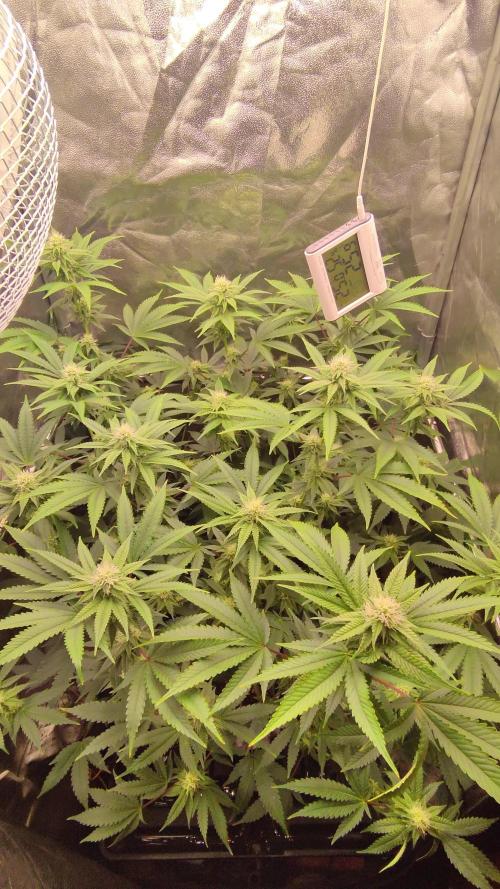
Шишки каменные, очень твердые.
Клон, один раз пролил дельта 9, 6 млл. Решил долить овердрайв который стоит уже больше года без дела, хватит примерно на неделю.
Растиха немного подгорела из-за редких поливов. Сегодня поставлю таймер, будет 3 полива в сутки вместо одного.
Likes
16
Share


@UK_Grows
Follow
Really feel let down by these genetics. The bud structure is atrocious and the trps are pretty much non existent.
Processing
Likes
2
Share


@XoticGROW666
Follow
G41 4/5WK IN FLOWER
INSANE CORNETTO SUNDAE ICE CREAM TERPS OF HER FEED COMPOST TEA N SST TEA ONLY
MY BEST PHENO G41 EVER HANDS DOWN ;)


Likes
20
Share

@ElBrujoTHC_Official
Follow
✂️ Harvest Day – Permanent Marker (Zamnesia)
Cosecha de las fotodependientes.
Ha llegado el momento de cosechar las Permanent Marker fotodependientes.
Tras un final de floración largo y bien controlado, con lavados de raíces y una maduración sin prisas, se ha tomado la decisión de cortar en el punto exacto que buscaba para esta genética.
Las plantas ya se encontraban a punto de caramelo desde hace varios días, pero se decidió esperar un poco más para aumentar el porcentaje de tricomas ámbar y terminar de redondear tanto el efecto como el perfil terpénico.
🔬 Motivo de la cosecha
La decisión se ha basado en la observación directa de tricomas, no en el calendario:
-Tricomas mayoritariamente lechosos.
-Presencia clara de tricomas ámbar, especialmente en las flores superiores.
-Pistilos prácticamente oxidados.
-Cogollos completamente formados, densos y duros.
+Aroma intenso y bien definido.
En este punto, la planta ya no estaba produciendo masa floral nueva, sino afinando resina, terpenos y madurez, señal clara de que era el momento correcto para el corte.
🌿 Estado de las plantas en cosecha.
Las Permanent Marker han llegado al final del ciclo:
-Con lavado de raíces completado.
-Sin signos de estrés.
-Hojas perdiendo color de forma progresiva y natural.
-Energía completamente enfocada en las flores.
Todo indica que el cierre del cultivo se ha hecho de forma progresiva y controlada, respetando los tiempos de la genética.
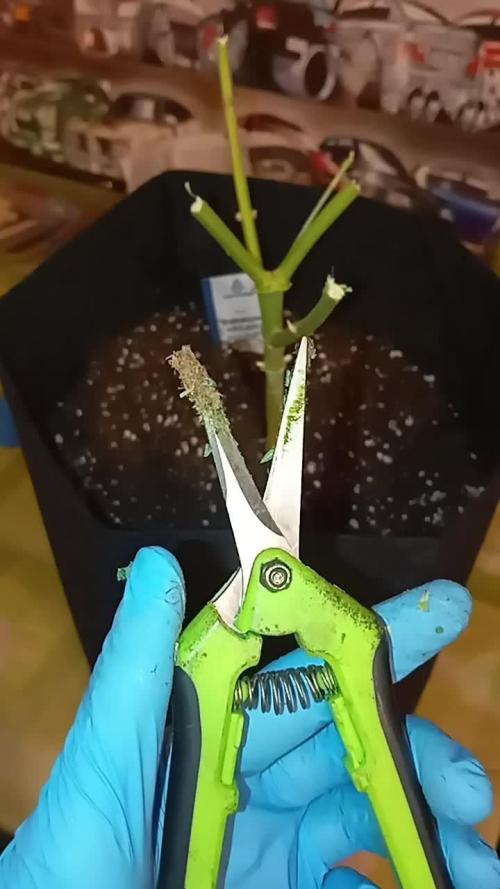
✂️ Proceso de corte.
La cosecha se ha realizado con calma, cuidando cada planta y evitando manipulaciones innecesarias para proteger la resina.
A partir de aquí comienza una fase tan importante como el cultivo: el secado, donde se buscará conservar al máximo todo el trabajo realizado durante la floración.
Muy satisfecho con el resultado de estas Permanent Marker y con cómo han llegado al final del ciclo 🌿🔥
Likes
16
Share

@XoticGROW666
Follow
NICE BLACK-OUT FADE TIPS BURN HERE & THERE CUD AVE TAKEN HER XTRA MORE WK BUT THE OUTDOOR WEATHER WAS TOO RISKY!!

Likes
7
Share


@Ryno1990
Follow
This big beautiful girl Purple Goat Cheese from Goat Genetics has been such an amazing grow so far she is so stinky an sticky an I love it smelling of straight sourness she is getting her last week of nutrients before flush an then harvest an I can't wait

Likes
15
Share


@ssjmatix
Follow
Nuevos brotes siguen apareciendo y el lst empieza a dar resultado, largó los primeros pelos, no sé si es pq se estresó y quiere florecer o si solamente sexó

Likes
75
Share


@Jef79
Follow
EMERALD TRIANGLE SEEDS
ROYAL PURPLE KUSH AUTO
Genetics - Black Afghani x Bubba Kush
Yield - Medium
Indica/Sativa/Ruderalis - 75/15/10
Height - Medium
Pathogen Resistance - Pests
Harvest - 55 days
Flavor - Fruity, Peppery, Sweet
Great auto strain.. Grew very well through veg and bloom.. Had no problems with her at all, she produced some very nice flowers and yielded the most out of all 4 strains..lovely classic kush taste and smell to her with a good initial kick from the smoke following a relaxing more couched feeling.. Great for relaxing.. My first strain from Emerald and im very happy with the results from her..
https://www.viparspectra.com/?aff=454&utm_source=affiliate
https://partners.viparspectra.com/create-account?ref=454
Coupons -
code: Itxsgdvip
code: JEF
https://www.amazon.com/dp/B08CHCFCG1?ref_=ast_sto_dp


Likes
5
Share


@69XINEYESEEKAYX69
Follow
A lot of growth this week waiting for the next new growth before I FIM the ladies, they are taking off!


