Processing
Likes
Comments
Share
@GrowGuy97
Follow
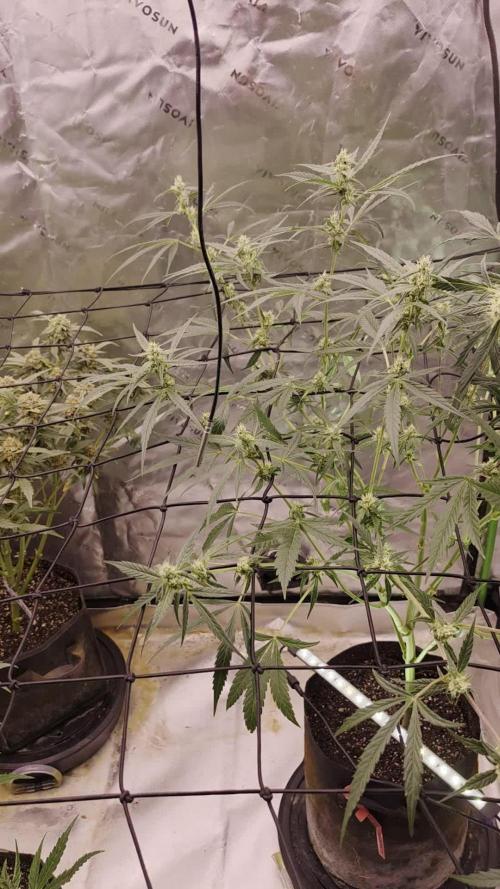
Day 28 - RH 58% Temp 81F . Ladies are growing great, they are really starting to turn into little bushes & the double mainline is going strong 💪🏻 Thanks for following friends & make sure to check back for daily updates! Happy growing✌️🏼🌱 Day 29 - RH 57% Temp 78F . Couldn’t be happier with the growth! Day 30 - RH 60% Temp 78F . Everything is looking great! Day 31 - RH 51% Temp 78F . Watered today with PH at 6.5, all 3 ladies are doing amazing!👍🏼 Day 32 - RH 53% Temp 81F . Considering topping the ladies tomorrow not sure yet! Still growing beautifully! Day 33 - RH 52% Temp is 80F - Bushing out like crazy & growing strong! The double mainline seems to be bouncing back as well! So far very impressed with this strain😍👍🏼 Day 34 - RH 56% Temp is 79F - Decided to top the two bushy plants today, they also got fed today with PH about 6.3
Likes
2
Share
The nighttime VPD does not need to mirror the daytime VPD. Daytime VPD dictates the pull of water and nutrients, while nighttime VPD acts mostly as a prevention tool. A high nighttime VPD increases the risk of the leaf temperature dropping below the dew point, which can trigger bud rot and powdery mildew. Switched down to 12's hours of light mid-week, changed spectrum, increased light intensity from 840umol up to 1150umol at current height. Overnight from 800ppm to 1500ppm, morning compensation point (microorganisms) 46-47 days from germination, she fills the canopy herself, once the apical dominance is broken. Measuring a plant's overnight CO2 emissions provides an accurate estimate of its dark respiration rate. Because photosynthesis stops in the dark, you are isolating the respiration process, which allows you to gauge how much stored energy (glucose) the plant has consumed and estimate the scale of oxidative phosphorylation. Oxidative phosphorylation is the final stage of respiration that generates the bulk of the plant's ATP (90%) and relies directly on the oxidation of these respiratory substrates NADH and FADH2 along with the consumption of oxygen. From a thermodynamic standpoint. Growth is an energy-capturing process, and the rate of that growth is bound by the available free energy (Gibbs free energy) and the First Law of Thermodynamics. While the ceiling or upper limit is dictated by free energy (such as photosynthetically active radiation), the actual amount of growth relies on how the plant balances that energy with other limiting factors. These are often described as the nine cardinal parameters of plant growth. 4 Above, 5 Below. If any one of the 9 becomes bottlenecked, the entire plant's cycle is restricted. Operating an 80F+ environment at night to force rapid carbon conversion comes with major drawbacks, as the biochemical processes work differently than the deductive logic suggests. While raising nighttime temperatures to 80F indeed accelerates respiration and speeds up the conversion of captured sugars (sink activity), doing so also radically increases the plant's overall metabolic baseline. If the plant's metabolic rate is artificially forced too high via heat, it can actually "burn" through more energy than it managed to assimilate during the day. This leads to carbohydrate starvation, stretching, and a net loss in final biomass yield. 400 ppm is near the standard ambient level; the plant's stomatal intake is the primary limiting factor, not the dark-reaction enzymes. To push 45 DLI without burning out the plant. Trying to force the conversion of a massive daylight DLI in a compressed time frame (12 hours) becomes highly inefficient because the Rubisco enzyme simply hits a saturation limit. To successfully convert a 45 DLI into dense, productive mass, the ambient CO2 generally needs to be elevated to the 1000 to 1200ppm range. This creates a steeper concentration gradient, driving the stomata to inhale CO2 fast enough to match the high photon energy. It's not all about the amount of light, but the ratio too, as this will dictate growth through the ratio of phytohormones. In order for correct bud development, there needs to be a correct ratio of RGB. Different wavelengths have different penetration depths. When one grows using top-down lighting, only the entire canopy is limited to 2-3 layers of leaf, meaning there will only be correct bud development in those layers, regardless of getting 45DLI. The biomass potential of a plant is linked to root mass. Generally, when a plant reaches its maximum biomass, you can help to chop off parts of the plant that are in less than efficient areas of the plant (low light) so that it can create new biomass growing towards the light. Strength is the maximum potential, and power is the rate of conversion. You can have the biggest veg period of 18 weeks, and it means nothing, as soon as you start flowering, the chronological clock starts ticking, the only metric that matters to bud size is how much energy you convert each cycle, not by how long it took you to build the framework, it helps a lot nonetheless. Not saying anyone should not defoliate for a reason, only that you should have one, and at the right time. Don't defoliate 30+% on autoflowers or 4 weeks into the flower period and expect an increase in yields; it doesn't work like that. There is room for dictating growth patterns and clearing out overcrowded nodes, but it needs to be done in veg because once that timer starts and buds start growing, it's all just energy conversion. One barely needs to defoliate at all in a 4x4 because with side lighting, turning a 2d canopy penetration into a 3d, even lower buds are 90% the quality and density of top ones. The rate of photosynthesis and the ultimate density of lower buds aren't just about the sheer number of photons PPFD. The specific ratio of R:G:B dictates canopy penetration and drives different photochemical reactions. The Electron Transport Rate (ETR) measures the speed at which electrons are driven through Photosystem II (PSII) during photosynthesis. The ratio of Red, Green, and Blue (RGB) light heavily dictates this rate. Plant leaves continuously perform cellular respiration regardless of the time of day, using energy and oxygen to fuel essential metabolic maintenance. If you over-defoliate, the remaining canopy may be unable to produce enough net sugars during the day to offset the constant respiratory demands of the plant. Must balance fixation with assimilation; there's no point in capturing 45 DLI if you only convert 20% every cycle due to an extreme lack of respiratory capacity to perform cellular oxidative phosphorylation. You can have a 4x4 canopy or a 4x4x4 canopy, yes, we know that side lights are not as effective at absorption from the sides or underneath, but it's not about DLI, it's never been just about efficiency, it's about the penetration ratios of RGB that drive ETR of/photosynthesis and trigger correct bud development. The size of each bud is its own ability to perform the ETR required for its own personal growth, and bud development is dictated by the ratio of RGB. It drives localised growth and acts as a regulatory switch for that development. Turgor pressure is another very important factor in understanding if you want big buds, for it is the "steam engine" that dictates the rate of bud expansion. Simply, a lot harder to achieve metabolically at ambient 75F than at say 86F Because buds have less chlorophyll, they do not suffer from the same photosynthetic shutdown that over-exposed, light-stressed leaves do. They can soak up direct light energy to swell in density and size. Their tolerance to intense light is heavily limited by the temperature and humidity, but if you can control those temps and keep the rot away, buds have a much, much higher tolerance to high light than leaves. Beneficial to hammer with high light before trichomes appear. Balancing this with trichome maturity is key for rich terpene and flavonoid profiles, want it just right, somewhere in the middle, not too much, not too little. Find cannabis plants can defoliate themselves come harvest, given the right signals. Every last ounce of potential is recycled into buds by the plant itself (senseceance), given you can keep the level of conversion high enough to prompt a need to do so. Get the canopy @ optimal PPFD range, 45-55DLI, then let the plant "stretch" the stems into a "PPFD range much higher, one that leaves don't like to grow in, but buds thrive in. What is optimal for a bud is different from what is optimal for a leaf photosynthetically. Genes provide the blueprint, but the environment dictates how, when, and if those genes are expressed. Must first signal the condition to increase the expression you want to exist through stress and response, cause and effect. A well-buffered CEC medium prevents extreme nutrient swings, allowing plants to maximise their dedicated genetic expression. A plant is either genetically expressing "growing" or "recycling" genes based on its nutrient starvation level in the medium. Constantly toggling between "growing" and "recycling" hormonal states creates a futile cycle that wastes valuable metabolic energy. Plants rely on sophisticated biochemical switches to manage this trade-off and prevent rapid fluctuations that disrupt that balance. This energy inefficiency is a recognised biological challenge. Plants avoid this costly "flip-flopping" by using hierarchical master regulators (like the TOR and SnRK1 protein kinases) that act as strict molecular switches. These networks enforce cellular commitment to either growth or survival, preventing mixed signals. This is something that was missing from previous grows. Under nutrient-rich conditions, TOR promotes protein synthesis, cell division, and structural expansion. Under starvation, TOR is inhibited, and SnRK1 is activated. This triggers autophagy—where the plant breaks down old macromolecules and organelles to scavenge and reallocate essential nutrients to critical sinks. "What's the point in flushing?" The core idea behind a PK booster is to deliver a massive, concentrated surge of P&K exactly when buds are swelling in conjunction with a N starvation. Because these are short, targeted windows, the nutrients must be highly bioavailable so the plant can process them immediately. As soon as you go "organic," that's out the window. Much slower release, uncontrolled, very difficult to "spike". to cause the ratio that will initiate a response. High-volume PK spikes rely strictly on the immediate uptake capabilities of mineral fertilisers. Making it far less efficient in organic/living soil setups. When you use organic nutrients, it changes the dynamic with which the plant delivers and trades its nutrients; organic is always releasing new nutrients into the immediate EC. This prevents a lot of autophagic responses from occurring due to a constant stream of new nutrients into the immediate medium's EC. This can prevent nutrient starvation from being signalled. PK boost is essentially just N starvation, triggering an autophagic response. Concentrated ratio of P&K while tapering off the Nitrogen base. To the plant, the sudden drop in Nitrogen registers as a severe environmental stressor—essentially, the beginning of starvation protocols. She aggressively strips nutrients and proteins from older leaves and vegetative structures and shuttles them directly to the developing flowers and fruit. Ta daaa. Call it a PK booster and sell it. Nothing to do with the P and K itself, it's the ratio immediately available in the medium triggering a nutrient recycling mechanism within the plant itself; all the "booster" sells is the trigger to the signal. PK BOOST with 50% ammoniacal N signals floral maturation. PK BOOST with N starvation signals nutrient recycling/sinking. Very difficult to initiate a response when organic nutes are doing their thing. It takes 4x5x more water significantly to leach or wash ammonia out than it does nitrates. This can prevent triggering N starvation from having its normal impact. Manipulating the C:N ratio in the medium. One autophagic response has multiple potential signal triggers. Nutrient starvation is not an option.
Likes
49
Share
@smzzz
Follow
Hey everyone ! We are close to the end, I guess the next week will be the last one. the "weak one" start to be realy beautifull now, and i don't think anymore she will give a lot less than the others. Can't know, i have to be patient one more week ! My favorite had a crazy pop up of new white hairs, looks like she want to continu this flowering ! but i'll can't wait only for her, i have to cut the 3 at the same time. So i'll see the next week :) Can't wait ! see ya next week
Likes
21
Share
The girls have really gotten bushy so some light defoliation this week and they’re developing nicely starting to flower however one of the girls is lagging behind. Feed have has been 1ltr every other day (or until the pots are light and can easily pick up with one hand) My PH is 5.6-5.8… EC 1.6-2.0
Likes
7
Share
Just getting started on the right foot. Coco and bags sterilized and flushed thoroughly with 0.7EC at 6.0pH solution. Will transplant tomorrow once the coco drains down a bit. Plants look great and excited to push down the accelerator. 4/2 - transplanted into 3 gal and watered in. 4/4 - Reservoir cleaned, sanitized, and online. Switched to tap water (0.3EC) and nutes at 0.8EC for total of 1.1. Ph 5.9. New feed pump installed (no more getting electrocuted when I put my hand in the bucket. YAY!) and 5" watering rings installed. PPFD 550. 4/5 - really quite chuffed. PPFD to 600 and they are looking great. Moved Zoey up 2" to match canopy height. 4/6 - switched Silica Boost to foliar spray at rate of 40ml / gal in RO water, pH to 5.8
Likes
74
Share
@Ferenc
Follow
Day 15- 4/10/21: Welcome to the first day of the 3rd week.... Happiness.... big one. They look amazing.... really so some changes: Lamp is set to be on 150W approx 60% of the full power..... enough..... they love this ViparSpectra XS2000.... So Do I..... Himidity stays on approx 60% Ventilation is fine every 2 hours switched on for 5 min.... Watering like 0.06 l per day.... Started some fertilization also with Bat Guano, Biobizz family /before someone ask why I use BioBloom and Top Max in veg just beacuse lol/ And... Epsom salt.... Ratio can be found just scroll down.... And yes, I do it on Tuesday and Saturday except the Epsom just 1x a week the rest then 2x for now. All of them are beautiful and the first LST has been done basically just bent them to the right or left haha for now except Afghani Gold and Spliffs Strawberry because they are basically just 2 weeks old so too young to be trained. I assume Blue Berry has a little funny deficiency but I am sure she will be okay anyways I will colour her back lol with some magic nutrition 🤣🤣🤣 I am happy ;) As you can see 2 of them are smaller /Afghani Gold, Spliffs Strawberry/ because they are younger: planted 1 week later as the first germination failed. Pictures sYs everything so not much more to say... ;)
Likes
45
Share
@Magich
Follow
These big bad buds keep swelling day by day. Just went under 12 hours today. One branch broke partly off, fixed and wired it up.. hoping not to get strong winds.. still thinking about some kind of transparent rain cover.. any ideas? If i had had more space and time, the plants could have been trained so much better! I also feel like i made a pretty good environment, with the good soil and perlite, and the kelp meal and basalt flour - and additional nutrients. I read that organic nutes give better taste and terpenes, and chemical give higher potency. So I’m hoping for the best of both worlds with these buds..
Likes
4
Share
@fusetea
Follow
day 73 any advice or comments ?
Likes
27
Share
@Major
Follow
God is great in his goodness he helps me to repel the onslaught of evil 😂😂😂
Likes
18
Share
@PPFDaddy
Follow
The legendary Runtz is getting louder by the day. Every time I unzip the tent it’s like stepping into a fruit-candy store… except this one hits you in the face. It’s so sweet and intense that I keep leaning in for “just one more sniff” until my nose (and stomach) basically tap out. Candy vibes turned up to max.Bud development is going great: they’re stacking, getting denser, and putting on size. They’re also not the classic “textbook” buds, the shape is pretty unique. A few tops look a bit foxtaily, but I’m calling genetics on this one, not stress, because she’s looking happier than ever and everything’s staying nicely in range.I’m pretty sure this is her final flowering week. Under the scope the trichomes are almost all cloudy, only a few still clear, and I’m starting to spot some amber, so yeah, the countdown is officially on.That’s all for now. Tips, thoughts, and “I’d do it differently” comments are always welcome. Happy growing everyone!
Likes
7
Share
🇩🇪Wintergrow Update ❄️🌱 Die Permanent Chimera wurde am Sonntag geerntet und trocknet aktuell in DryFerm Bags – richtig schöne, kompakte Buds geworden 🔥 Bin mega gespannt, wie sie nach dem Curing performt. Die anderen Ladies, Roswell Code, durften noch eine extra Woche genießen und ihr volles Potenzial ausbauen 💪 Sie haben jetzt ihren ersten Flush hinter sich und gehen langsam aber sicher in den Endspurt. Man sieht richtig schön, wie sie jetzt ausfaden und die letzten Reserven mobilisieren – genau so stellt man sich das zum Ende vor 👌 Wenn alles nach Plan läuft, fällt am Wochenende die Axt ✂️🔥 Alles in allem ein richtig solider Run, bin mehr als zufrieden 🙏 Jetzt heißt’s: Endspurt und dann genießen 😎 🇬🇧Wintergrow Update ❄️🌱 The Permanent Chimera was harvested on Sunday and is currently drying in DryFerm Bags – turned out with some really nice, dense buds 🔥 Super excited to see how she develops after curing. The other ladies, Roswell Code, got to enjoy an extra week to fully mature 💪 They’ve now had their first flush and are slowly heading into the final stage. You can clearly see them fading now and using up their last reserves – exactly what you want to see towards the end 👌 If everything goes as planned, harvest day for the rest will be this weekend ✂️🔥 Overall, a really solid run – more than happy with the results 🙏 Now it’s all about the final push and then enjoying the rewards 😎
Likes
9
Share
We start week 3 of bloom!! Goofiez 2 amor compound genetics it’s the champions!!
Likes
37
Share
Hello Growers and Tokers! 👋 👩‍🌾 🧑‍🌾.🔥💨 Another week in flower, except for the height there isn't much progress with her. True sativa plant, thin leaves, big internodals spacing and she won't stop stretching.. 😪 I'm sure that if she keeps that up, she'll be towering over the other ladies. i'll have to raise the lights and raise my other ladies so that they're not too far from the lights. I've already moved her to the back where the tallest girls are, that way i want incline the lights a bit for better light distribution. Pictures taken on day 20, I did a light defoliation on the bottom, taking out all that growth that won't receive enough light penetration. Watering every other day like always.. That's it for this week, isn't much more to say.. Hope you all have a great day! One love!
Likes
17
Share
Gracias al equipo de AnesiaSeeds, Marshydro, XpertNutrients y Trolmaster sin ellos esto no sería posible. 💐🍁 Sticky Boof: Prepárate para dejarte llevar por Sticky Boof, nuestra última obra maestra que está poniendo el listón muy alto para los amantes de las índicas. Nacida del legendario cruce de Super Boof y Cadillac Rainbow, Sticky Boof es una potente planta con un asombroso 80% de dominancia Indica que promete una relajación sin igual. Prepárate para un viaje épico con el asombroso 37,5% de THC de Sticky Boof. Sumérgete en una cosecha abundante con Sticky Boof, que produce hasta la friolera de 500 g/m² en interior y 800 - 900 g por planta en exterior. Esta variedad es generosa y está lista para llenar tu alijo de cogollos de la mejor calidad. Sticky Boof es todo rapidez y eficacia, acelerando el tiempo de floración en sólo 7 u 8 semanas. 💡TS-3000 + TS-1000: se usaran dos de las lámparas de la serie TS de Marshydro, para cubrir todas las necesidades de las plantas durante el ciclo de cultivo, uso las dos lámparas en floracion para llegar a toda la carpa de 1.50 x 1.50 x 1.80. https://marshydro.eu/products/mars-hydro-ts-3000-led-grow-light/ 🏠 : Marshydro 1.50 x 1.50 x 1.80, carpa 100% estanca con ventanas laterales para llegar a todos los lugares durante el grow https://marshydro.eu/products/diy-150x150x200cm-grow-tent-kit 🌬️💨 Marshydro 6inch + filtro carbon para evitar olores indeseables. https://marshydro.eu/products/ifresh-smart-6inch-filter-kits/ 🍣🍦🌴 Xpert Nutrients es una empresa especializada en la producción y comercialización de fertilizantes líquidos y tierras, que garantizan excelentes cosechas y un crecimiento activo para sus plantas durante todas las fases de cultivo. Consigue aqui tus Nutrientes: https://xpertnutrients.com/es/shop/ 💻 Trolmaster Tent-X TCS-1 como controlador de luz, optimiza tu cultivo con la última tecnología del mercado, desde donde puedes controlar todos los parametros. https://www.trolmaster.com/Products/Details/TCS-1 🍣🍦🌴 Xpert Nutrients es una empresa especializada en la producción y comercialización de fertilizantes líquidos y tierras, que garantizan excelentes cosechas y un crecimiento activo para sus plantas durante todas las fases de cultivo. Consigue aqui tus Nutrientes: https://xpertnutrients.com/es/shop/ 📆 Semana 7: Se aprecian unas lindas preflores hembra, comienza a estirar de forma acelerada. Todo sigue su ritmo y ellas comen bien todos los nutrientes, comienzo a aplicar sugarshot, silica force y enzimas.
Likes
5
Share
@Bili_R
Follow
Yo community! A friend of mine just started a Legal Grow in Germany with his roomate under my Supervision, as it is now Legal to grow in Germany. So I thought about documenting this grow. I've been growing for long time now, but my buddy Bili is a complete newbee at this stuff. I am positive that this "is gonna be huge". We plan on growing 6 plants. Bili is gonna be growing 3 and his roomate also 3 plants. Of course Bili will only care for his own 3 plants and his rommate for the other 3 as it is regulated like that by law. It is Germany where everything has to be like this apparently. lol. This grow will be 2-3 Weeks indoors 51w with low cost 3x17 Watts 4000 k LED Bulbs. (3€ each) Those produce 2500 lumens each, about 147 lm/W 1.45 l pots for the first few weeks indoors. The plants will then go into 5l pots on the window sill until harvest. faced to the south. So far the seeds have been placed into water over night. tomorrow we will put them into the soil. They are all Automatics. Day 2: seeds soaked over night. about 16 hours. The Gelato are already opening their shells.. The others are still closed. All sinked to the bottom over night. We are now planting them into the Soil.:) We soaked 9 seeds. 3x O.B. 4x Kryptonite and 2x Gelato. After cutting the dome off the lamps and counting the LED's (81) it looks like these are 0.21w SMD 31lm per LED (manufacturer says 147lm/w). for bulbs really good little LED's. looks like these are cree 2835 J series or similar types. there are cree 4000k J types that are exactly 31lm wich would be exactly what each LED should produce. (2500/81). Plant in Soil Date was 05 june. 14:00 Today, 2 Days and 10 hours, (58 hours) after planting in soil The 2 Gelatos came to life:) and one Kryptonite basically 3 full days including soaking time. 08.06 at 1:30 is the beginning of VEG Day one We will give them 24 hours light. day 5 after waterglass. Berries still no sign of life. lamp is at 30 cm distance. no signs of stretching. At Day 5 Veg we located the berry seeds and put them into paper towel, cracked them open and scraped the shell. we have enough plants now but nothing to choose from in case a plant has weak genes. So we hope a few berries will make it. probably old Seeds.
Likes
Comments
Share
@Vet_J
Follow
The flowering stage is progressing really well and I’m genuinely happy with how she’s coming along at week 7. The first brown pistils have already started showing on two of the branches, which confirms she’s deep into her flowering cycle now — right on schedule for Glue Gelato Auto. Next week I’m planning to significantly increase the flowering nutrients — particularly Big One and Top Candy, which should really push bud size and resin production from here on. Around the middle of the week I’ll also do a proper defoliation, clearing out the fan leaves that are blocking light from reaching the lower bud sites. The canopy has filled in nicely but it needs opening up to let those buds really fatten up. Water intake has increased quite a bit — I’ve stepped up from one liter to two, and even then the soil is nearly bone dry by early morning. That kind of uptake is a good sign — the roots are clearly healthy and the plant is working hard to fuel bud development. I’ll be watching closely to see if she needs even more as things progress. I’ve also been doing regular branch adjustments, gently repositioning the roped branches to keep the canopy level and make sure every top is getting its share of light. Nothing too aggressive at this point — just keeping things tidy. Week 7 feels like a critical stage now. Pushing the flowering nutrients harder from here should make a real difference in final bud size and density.