


Likes
Comments
Share


@GrowGuy97
Follow
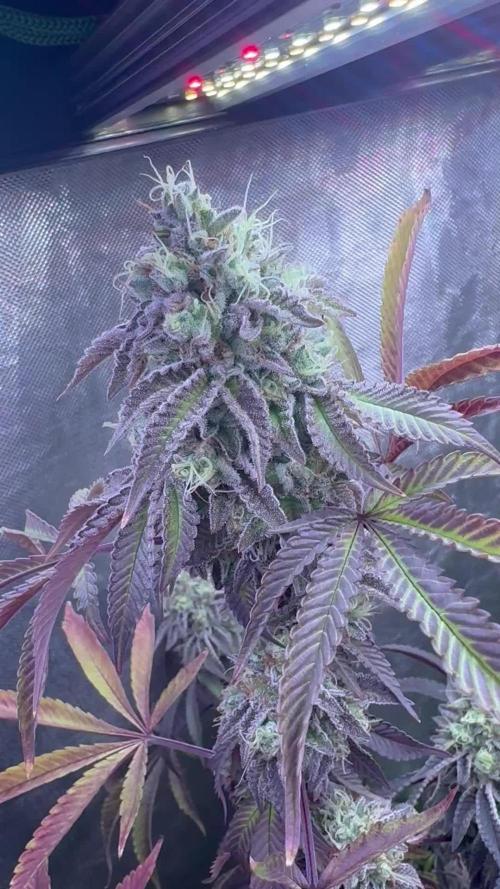
Day 56 ladies are really starting to get some massive buds, tent smells amazing! I can’t wait to see what this harvest looks like😍😍
Thanks for following & make sure to check back for daily updates friends! Happy growing✌️🏼🌱


Likes
15
Share


@Venabr96
Follow
Entrando na terceira semana de floraçao. Planta otima com tons violetas e com otimos galhos.
Como sao de floraçao rapida pulei algumas semanas na tabela de rega na biobizz( sem2 e sem4 ) e esta reagindo otimamente.
Dia 19 floraçao : planta muito volumosa com lindos ramos e frutos com desenvolvimento muito rapido.
Otima para o LST com bastante flexibilidade e rapido crescimento.

Likes
40
Share


@MadeInGermany
Follow
Info:
Unfortunately, I had to find out that my account is used for fake pages in social media.
I am only active here on growdiaries.
I am not on facebook instagram twitter etc All accounts except this one are fake.
Hi everyone :-)
This week it has developed really well again :-).
I didn't train her this week, I'll do it again next week :-).
It was poured twice this week with 1.2 l each time (see nutrient table above for adding nutrients).
I sprayed them all with GreenBuzzLiquida Fast Plant spray.
I also cleaned the entire tent and checked everyone's health.
Fresh osmosis water was prepared and filled into canisters.
Yellow boards against flies have been put up and blue tags to prevent trips.
Unfortunately I still struggle with them but they have become significantly less pushed.
I think in a few weeks the last story should be :-).
Otherwise, like every day, they were looked at and petted for a while ;-).
I wish you lots of fun and stay healthy 🙏🏻
You can buy this Nutrients at :
https://greenbuzzliquids.com/en/shop/
With the discount code: Made_in_Germany you get a discount of 15% on all products from an order value of 100 euros.
You can buy this Strain at :
www.Zamnesia.com
Type:
Runtz
☝️🏼
Genetics:
Zkittlez x Gelato
👍
Vega lamp: 2 x Todogrow Led
Quantum Board 100 W
💡
Bloom Lamp : 2 x Todogrow Led
Cxb 3590 COB 3500 K 205 W
Soil :
Canna Coco Professional +
☝️🏼
Nutrients :
Green Buzz Liquids :
Organic Grow Liquid
Organic Bloom Liquid
Organic more PK
More Roots
Fast Buds
Humic Acid Plus
Growzyme Big Fruits
Clean Fruits
Cal / Mag
Organic Ph - Pulver
☝️🏼🌱
Water: Osmosis water mixed with normal water (24 hours stale that the chlorine evaporates) to 0.2 EC. Add Cal / Mag to 0.4 Ec Ph with Organic Ph - to 5.8

Likes
4
Share


@jahredi
Follow
Well... I had been growing these in a local biosolids medium. Should of researched that earlier 😭 While there are folks who grow in it, it’s not my jam. To many questions unanswered. So...
I did an emergency, bare root transplant to an organic soil! I definitely ripped some of the more fragile lateral roots in the process, so I decided to go ahead and top and do a major pruning to cut down the amount of foliage they have to feed. I figure they’ll either make it or they will not.
Time will tell...

Likes
4
Share


@AustinRon
Follow
El Diablo Week 8 - Flower 6
[Twenty20Mendocino]
(X-Factor X Whiskey Zulu)
Objective
- Trained Plant - @3Nodes - Bend apical meristem to Node 1 Height, 7 STEMS . . .
Week 8 : [ Wed Mar 21, 2025, ED 1Q25 57:B:8:1]
[ Tue Mar 27, 2025, ED 1Q25 63:B:8:7]
24/0 @ Germination through 24 Hour Open Cotyledons (then 18/6)
Germination: 25 Jan 2025
#3A Earliest Harvest Date: Thu Apr 10 2025
#3B Latest Harvest Date:
Mon April 21, 2025
__
Fri Mar 21, 2025
ED 1Q25 57:F:8:1
- No Water Today
__
Sat Mar 22, 2025
ED 1Q25 58:F:8:2
- Full Watering
- 3 Liters
- CalMag Fuel: [ 1 ml, l]
- Silica Skin: [ 1, ml, l]
- Terps Plus: [ 1, ml, l]
- Photosynthesis Plus: [ 1.5, ml]
- Quillaja 60 Powder: [scant]
__
Sun Mar 23, 2025
ED 1Q25 59:F:8:3
- No Water Today
__
Mon Mar 24, 2025
ED 1Q25 60:F:8:4
- No Water Today
__
Tue Mar 25, 2025
ED 1Q25 61:F:8:5
Full Watering
- 3 Liters
- CytoPlus (µNutrients, Kelp, Potassium, Humic Substances): [ 1/2, tsp, gal]. #
- Photosynthesis Plus: [ 4.5, ml, l]
Then, for each Liter Delivered
- CalMag Fuel: [ 1, ml, l]
- Silica Skin: [ 1, ml, l]
- Quillaja 60 Powder: [scant]
__
Wed Mar 26, 2025
ED 1Q25 62:F:8:6
- No Water Today
__
Thu Mar 27, 2025
ED 1Q25 63:F:8:7
- No Water Today #Monitoring, may have only watered 2L Tuesday
Evening - 1 Liter, 2 Liters in the Morning


Likes
25
Share


@Luna91
Follow
Hey There!
Nothing much to say,GOD I can’t wait to taste them!!!! Smell of pineapple is all over my room!! Look at the Digital Microscope!! I know I have at least two more weeks to go!! But simply cant wait🤣 this is my first grow! I studied a lot to make these autoflowers sth worth my time!
Processing
Likes
4
Share


@Big0zGrower420
Follow
Day 49!
Starting to give her just plain water for 2 weeks of flushing. Getting really excited to harvest and then get going on another grow.
See you next week.

Likes
14
Share


@goeser
Follow
At least one if the ladies is ready to harvest. Just made a final check with the microscope and i think she is ready. I could wait a bit more for more amber heads but i think thats ok.

Likes
Comments
Share

@cookingwithninja
Follow
Week 8 pics are just screenshots from vids. Been trying nugs since week 6.
Likes
8
Share


@Jays_Not_Here_Man
Follow
18 weeks from seed to harvest. Love 34 street seeds, quality genetics for a fair price. These garlic cookies showed no disease or pest issues, no mold or powdery mildew. Easy enough to grow, no surprises, no super stretch in flower, but I would recommend training or SCROG to control them. Pungent Pine is what I am callling this smell, over 800 grams wet weight. They are hanging to dry in my tent as I write this, 60 %RH and about 71 degrees of freedom units! Can’t wait to try it out 🇨🇦❤️🌱😎💨

Likes
176
Share


@NuggetPawn
Follow
I started picking for forbidden fruits the day after last week’s post, checking the colas with the scope and only picking tops that were approx 10-20% amber.
As I snipped colas I also removed a lot of upper fan leaves, this is to allow light to reach lower buds for a final ripening.
Once picked, I placed approx 100g in each brown paper bag, folded the top and sat on a rack. I slowly rolled the bags around once or twice a day just so the buds didn’t stick together. Seems to have worked well, no dreaded hay smell to note and nicely dried.
I think I’ll be taking some more colas tops off in a few days time and I’ll keep the plants alive for another week or two, depending on how fast they come along.
I have 4 Mimosa EVO (no diary) about 7 weeks into veg at the moment and I think it would be nice to give them another 2 weeks as I need big plants to make clones from them, ready for the next diary coming soon... hopefully with successfully taken clones 😊

Likes
5
Share


@Jaschkoo0
Follow
She gave me 23 gramm dry which is ig for that i let her outside douring bloom.
Likes
64
Share


@Roberts
Follow
Baked Bomb autoflower is flowering good. She has shown some potassium deficiency signs. I been adjusting her feed. She has been super thirsty as well. It's going fairly well at the moment. Thank you Spider Farmer, and Bomb Seeds. 💣 🤜🏻🤛🏻🌱🌱🌱
Thank you grow diaries community for the 👇likes👇, follows, comments, and subscriptions on my YouTube channel👇. ❄️🌱🍻
Happy Growing 🌱🌱🌱
https://youtube.com/channel/UCAhN7yRzWLpcaRHhMIQ7X4g


Likes
4
Share


@Pokan187
Follow
Have some deficiencies or ph imbalance still troubleshooting.
The pH was off but now everything is back on track. I have some amber on the watermelon, the northern light is milky from top to bottom but no amber yet
The smell is pretty strong
I do not feed the plants at all besides watering them with water from fish tanks.
Made some live soil and added horse manure, homemade bone meal from fish bones, compost from vegetable scraps and black soldier fly frass.
I do not use chemicals on any of my grows.
Likes
57
Share


@Silverback_Guerilla
Follow
11/30 - 12/5:
The bigger Zenzations has the beginnings of a small apex flower. Both Zenzations continue to look great, but the big story is the turn around the Black Jacks have made. They've tripled in height in 2 weeks and have nice, long lower branching. Both Gorilla Girls are stretching well now and have huge fan leaves, so I think they've still got some stretching to do.
I dialed back the lights to 13 hours of daylight on the 4th.
12/6:
I fed them today.

Processing
Likes
22
Share


@Yiyis_Grow
Follow
Hola amigos cultivadores. Buenos humos a todos 🌊🤙
Esta semana tuve algunas dificultades por negligencia mía.
* Perdí aproximadamente 40 gramos contaminados por Botrytis. Llevaba una semana con humedad muy alta y no hice nada al respecto. Acá donde cultivo es muy húmedo y cálido y siempre la Botrytis ha sido mi enemiga. Sin embargo esta vez fue mi culpa, pues sabía de la alta humedad y no hice nada.
Importante mencionar que la Big Kush por su tamaño de flor (enorme) es más propensa a tener problemas con excesos de humedad. Esta cepa hace flores gigantes.
Ya está resuelto y se bajó de 80% a 65% en promedio. Aumenté ventilación, extracción y coloqué un deshunidificador.
* Haciendo cuentas de los días transcurridos, estoy una semana por delante y por lo tanto creo que empecé tarde con el Pk1314. De hecho era notable que las flores estaban muy desarrolladas cuando lo empecé a aplicar. Aún así el Pk ha hecho lo suyo y las plantas han engordado, quizá no lo que esperaba.
Algunas hojas con tonalidades amarillas, algunas propias del consumo de la planta y otras observándola día a día para detectar algún exceso.
Las platas siguen consumiendo en promedio 2 litros de líquido al día, por lo que espero hacer un buen lavado de raíz en una semana aproximadamente.
Buenos humos 🌊🤙


Likes
44
Share

@MadeInGermany
Follow
Info :
Unfortunately, I had to find out that my account is used for fake pages in social media.
I am only active here on growdiaries.
I am not on facebook instagram twitter etc All accounts except this one are fake.
Flowering day 23
since time change
to 12/12 h.
Hey guys :-) .
This week was even more extreme than the weeks before :-).
She has used the stretch to the full and has grown completely out of the net.
So slowly it is getting tight on the ceiling with the lamps 😂.
Tomorrow I have to rebuild a bit so that I can get the lamps up a bit.
As suddenly as the stretch was, the blossoms began to set in.
So I think the strech will decrease significantly now.
This Runtz Phenotype is perfect for the AeroPhonic ScroG :-).
The tank was completely cleaned again and freshly filled (see table for nutrients).
As you can see I have not yet managed to take everything under the net this week, which I will make up for the days.
Otherwise almost everything was checked and checked for health.
I'm really excited about the coming week and until then I wish you all a lot of fun with the update.
Stay healthy 🙏🏻
You can buy this Strain at
www.Zamnesia.com
Type:
Runtz
☝️🏼
Genetics:
Zkittlez
X
Gelato
👍
Vega lamp: 2 x Todogrow LED CXB3590 COB 55 W
1 x Sanlight S2W 62 W
💡
Flower lamp : 2 x Todogrow LED CXB3590 COB 55 W
1 x Sanlight S2W 62 W
💡 ☝️
Grow Aero System : Growtool 0.8
☝️
Fertilizer:
Canna Aqua Vega A + B , Canna Aqua Flores A + B , Rizotonic, Cannazym, CANNA Boost, Pk 13/14, Canna Cal / Mag, Canna Ph - Grow, Canna Ph-Bloom
☝️🌱
Water:
Osmosis water mixed with normal water (24 hours stale that the chlorine evaporates) to 0.2 EG. Add Cal / Mag to 0.4 Ec Ph with ph- to 5.2 - 5.8
💦 💧
Processing
Likes
93
Share


@Ferenc
Follow
14th week, no more fertilization. I will give to this beautiful girl 2 more weeks, so I started flushing. Nothing changes except the fertilization stops. It receives the same amount of water 200 ml 2x a day. Leaves are getting yellow and the buds thicker. Strong, good smell, beautifully coated with THC and all looks good🤪Can't wait to taste this strain! ❤️ Wednesday: Last day of the 14th weeek She is beautiful, no comment it can be seen in the pictures and videos. Minimum 2 more weeks needed to be ready. May be 3. Tomorrow starts week 15. Her height is 43 cm in the end of the week.
