


Likes
Comments
Share


@GrowXown
Follow
Took a bit of a while to upload these seeing as the website had a bit of technical difficulties however i managed to finally get them up. The seedlings are doing well in solo cups going to transplant soon. feeding Bio Bizz fish mix at the moment.

Likes
3
Share


@Ghost17
Follow
Still learning day by day. Felt like I should back track a bit on the amount of nutes I have been feeding so I did almost cut my dosage in half for the past two watering. So far, so good.
Training the girl on the right is a breeze (almost at the point where I would just let her be) but feel the need to keep training her to get down to the girl on the lefts height.
Other than that, knock on wood, things are going well in my opinion!
Another week or so of veg then it's time to flip! Can't wait!

Likes
29
Share


@BioGrowKing
Follow
Die Woche ist wie immer normal verlaufen, auch sie ist schön am blühen :)
Gute 5 cm gröser geworden <<
Bis nächste Woche 👍

Likes
13
Share


@Ferenc
Follow
Really nice plant. Very strong smell, Well THC coated buds and very nice effects. Lovely.

Processing
Likes
12
Share


@Marijuanaisland
Follow
Desculpe não atualizar antes mais muito trabalho neste fim de ano adoro as cores da Red Hot tive ao total 3 Red Hot mais só fiz o diário de uma três feno tipos diferentes todos reds aromas diferentes em todos doce, pungente, frutas tropicais, owwwwww good Nice, a sweet zkitllez está muito bem também tive outras que não fiz o diário. Obrigado a todos


Likes
1
Share

@Mars8_8
Follow
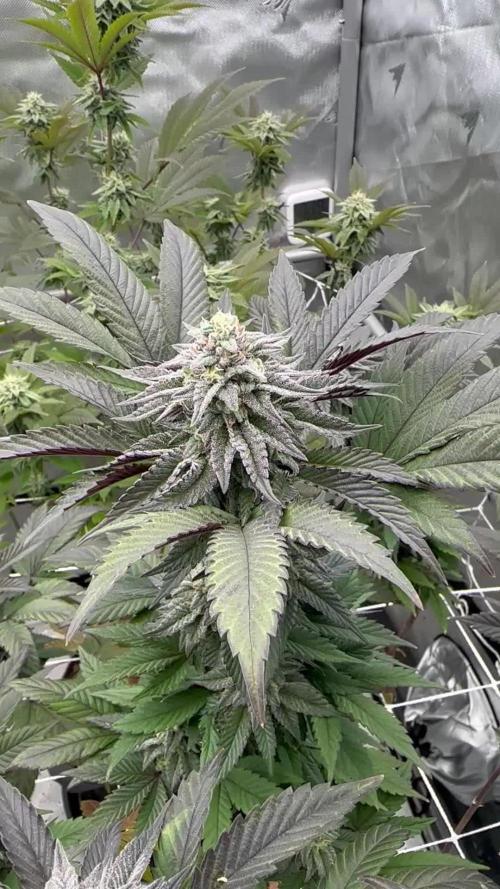
1/9: packing on weight. I let em get a little to hungry before top dressing them, think it was about 3 weeks since last top dressing of 1/4 cup of craft blend BAS in their 3 gallon pots. So gave em a nice tea to catch them up. Added some kashi on top to help speed up the break down process.
Smells are really starting to kick in. Not my favorite. Definitely spicy, limy, piney. But very loud.
A lot of variation in The phenotype. Got 2 short bushy and two long and spread out, and one bushy and green and one bushy and purple. One plant I knocked over during transplant so that could have effected its pheno with stress. But the other is naturally short.

Likes
7
Share


@Scoota710
Follow
I’m happy with what I got, definitely much room for improvement but we will get there little by little

Likes
4
Share

@Colonel_oCoQ
Follow
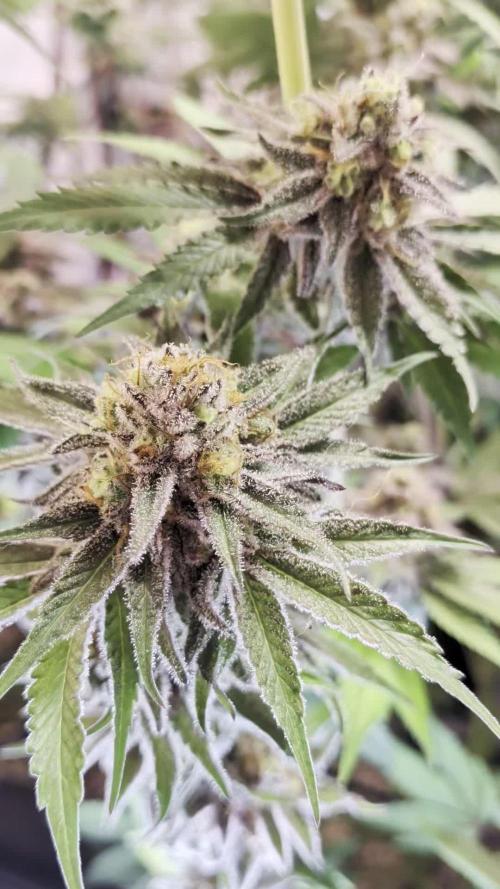
So the finals weeks for the Zillions and Cookie Casket. I already had to harvest 3 top- colas, they were ready. The rest needs a bit more days. After the AN Overdrive switch typically the flowers got new light pestilles, the second level 😅!
I let the PH drift now a lit bit more to 5.8- 6.0 for the last weeks. EC is around 1800-1850. Mimosa Evo will needs at least 2 weeks, maybe 3.😇
EC now down to 1722 as they are getting ready.

Likes
16
Share


@willertex
Follow
📅 D85- 26/01
📜 Only fresh water from now on. She's not yet ready - 3-4 days more I think.
✍️ 0.1 EC
♒ 6 pH
🌊 10 L
📏 95 cm
📅 D90- 29/01
📜 Not yet Ready
✍️ 0.1 EC
♒ 6 pH
🌊 10 L
📏 95 cm


Likes
2
Share


@dopeasstitties
Follow
Flower looking nice. Using GREASE foliar. These are on about day 65 on the Jan. 20th video. Everything is looking good and I'll most likely start the CAKE in a week and finish in 2.

Likes
2
Share


@603grower
Follow
Ceremony-multiverse genetics
Few days ago I took here out of the solo cup. She was in that solo for 6 weeks where she grew like a champ! She now is thriving is a 3 gallon fabric pot . I have yet to done a large watering. I will do that today since the transplant went with out a hitch.
Gorilla juice- Native sun Genetics
Now that the drip set up is dialed the fuck in she is ripping! She has come back from her stress from over and under watering and constantly switching up the feed. We are now set in on hydroponic research vegbloom tap hard along with stax. I do have the life+ but I can already using stash blend so I’m not sure if I’m going to use it.
The girls are healthy and ready to go into flower. I was waiting for my 2x2 to be open up I think I’m just going to use a different tent. I think I’m going to put them in a 2x4 and give them each there own 15o watt light . Really looking forward to see the results from this nutrient line. I spoke with them on the phone and they answered all of my questions and concerns. They have assured me that I will get similar if not better results to my living soil. I don’t know about better but as long as it’s close I will be super happy.
Likes
34
Share


@JonnyKush
Follow
Day 65
past nutrition problems I believe have slowed growth. unfortunately on a plant I think I have problems with the compaction of the soil which has caused too much irrigation. the plant does not eat and a little slower than the others. now after 4 days to dry i will give only datpo water which seems to burn for nutrients, i believe brought about by the fact that they are deposited in the soil. all in all they continue to grow and hope for the best! 💚🌱
Likes
20
Share


@Momgrowsthechronic
Follow
Welcome to the Week 9 update for the Sweet Seeds Cream Mandarine XL Auto’s. This was an eventful week of the grow as I finally gave up on the first two plants suffering with the majority of the powdery mildew. Instead of wiping a single spot off of a leaf it had progressed to wiping multiple spots off of the majority of leaves. It was becoming super time consuming just trying to keep up with not further contaminating the tent. So after fighting the good fight but realizing it was now a losing battle- I decided to harvest the two smallest plants. They were pulled from the tent right at the end of Week 9 and placed in my garage for 3-5 days before they were actually chopped and trimmed in Week 10. My garage is not heated and the temperatures have been around 0-5 degrees celsius so both plants had some time to “chill out" before harvest. Not only did they reek stronger than ever but also seemed to produce additional resin after being exposed to the cold for a few days. I chose not to weigh the wet trimmed bud as it hasn’t amounted to much but after drying for 7-10 days it’s working out to be approximately 1 mason jar of nuggets per plant. I will provide final weights and better pictures of the bud in my final harvest update. Nothing much has changed for the remaining two plants except for drinking a little less water and the humidity has slowly been decreasing as Canada moves into winter. Until next time- stay safe, happy and high! 🇨🇦
Likes
79
Share


@JUNGLE_B4RNS
Follow
Week 18, week 8 of flowering
Final last week. Second week of flush, finishing with using water only since the 2 last weeks. Starting harvest, it will take a few hours to take down everything.
Cellmax BIO Soil and Nutrients did a great job as usual, they can provide big quantity and the quality of an organic growth, making it the perfect BIO solution for your crops.
After testing Mars-Hydro LED during a bit more than a year, using their SP 250, here is my feedback. Their LED has definitely a better light penetration than an HID. Under Mars-Hydro spectrum the plant is able to grow nugs instead of fluffy popcorns in the bottom of the plant. Mars-Hydro has actually the best quality price on the market.... so, in conclusion, I’m rebuilding the room with 6 x Mars-Hydro FC 6500 Commercial Samsung Multi Racking quantum board, nothing can stop me to reach the 2.5gr/watts now 😎
And finally, I would like to say thanks to SPLIFFSEEDS.NL for sending these wonderful genetics. I would definitely suggest and recommend this seeds bank to pro and new growers. The strains are stabilized and traits of the genetic mapping locked perfectly. I’m extremely happy with this crop, well done SPLIFF SEEDS 👏👏👏
________________________________________
Stay tuned for harvest reports folks
________________________________________
For the new growers, in this diary is everything you need to know to recover from a shitty start, to catch back the delay, to avoid a Die-Back after the stretch around week 5 of flowering, see different deficiencies.... and finally harvest a great yield.
________________________________________
Thanks to the followers and for all the Likes 👍 Stay tuned my friends, I promise you an Epic setup for next crop 😎

Likes
Comments
Share


@The_Lonely_Farmer
Follow
So these girls are shorter than expected allthough the 2 girls are of decent height enough for me too flip along side my aptus fed girls.
I have defoliate all areas that covers light getting too the lowers and also removed excess branching too focus energy towards the main tops also did this via a little lst 🌱
One of each plus an extra 412 so hopefully they stick through and make it too harvest which they look too be healthy so far.
I will next defoliate on week 3 of flower and also remove excess plant matter taking up neccasary energy 🌱
Shogun is serving them well so fa!
Lights will be 12/12 tonight
Week 1 flower commences then
Stay blessed 💚
Likes
Comments
Share


@Gardens_of_Of
Follow
She completed the first week of flowering happily and she keeps stretching. Trailers net added to level the canopies.

Likes
34
Share


@PabloTheGrower
Follow
It's done...another one chopped. What a challenge this one. If you follow my grows, you know I love Royal Queen Seeds. I consistently have the best result with RQS strains, plus their services are always great.
That being said I had much expectation for this Strain.
What can I say... for the good point, it smells very sweet, fruity and yields giant long cola, fuuuulll of flower, very sticky and faty faty. . So densily packed that comes with some issues.
First its always demanding for more K, a lot of top leaves yellowing that was hard to control. A long flower period for an auto and it suffered a lot with bud rot ( white mold, not the black one)
It was a first to me. Tried everything from cutting parts to h202 direct on top of the damaged areas but with no success.
That being said I've lost a lot of flower because of it and had to cut at least a week sooner than I wanted..
I will face this challenge again in a near future.
The plant without the root ball weighed 1.2kg.
It's drying know, so let's wait to see what we got...
Overall one of the most productive plants I've tried, as one of the biggest buds I've seen in these colas.
Thank you James and RQS for all the support. You guys are great and a major contribution for the cannabis world.

Processing
Likes
10
Share


@JohnnyGrower
Follow
Esta semana los nutrientes siguen de la misma manera, es notorio el exceso de Nitrogeno por ende se disminuira en los próximos riegos, se realizaron podas apicales en los clones que no les hice anteriormente para que alcanzaran más altura. Dentro de esta semana instalare la malla scrog Kanovi para guiar los vigorosos brotes.
Además esta semana ya esta retomando el crecimiento la planta madre variedad Tangie la cual cumplió su ciclo de propagación por esquejes y porfin florecerá.
Leo comentarios, opiniones y recomendaciones


