


Processing
Likes
Comments
Share


@GrowGuy97
Follow
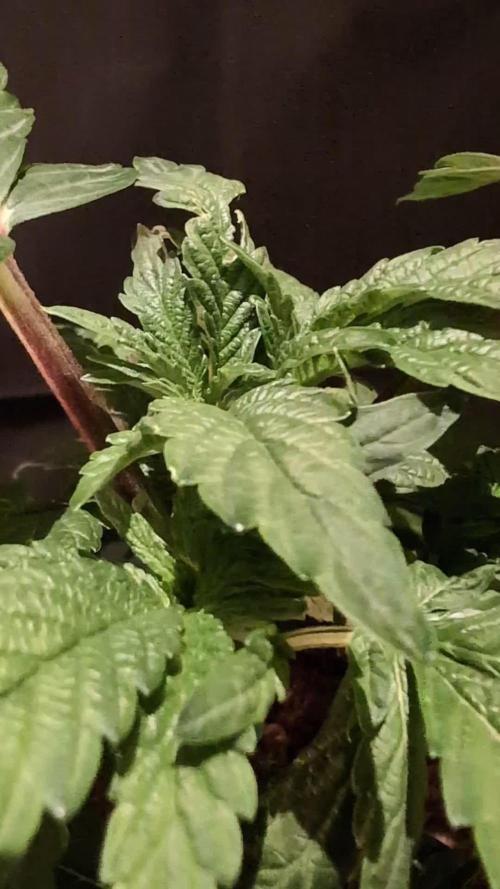
Day 76 Flower day 21 - Ladies are looking extremely healthy & have been growing amazing! All 3 have gotten extremely tall & are all starting to bud, can’t wait to see how they turn out! Thanks for following & happy growing friends!🙏🏼✌️🏼🌱

Likes
10
Share

@GoodTimesOrganics
Follow
Welcome Back!💚
Nach der fünften Woche des Wachstums entwickelt sich die S Apple Apple durch das topping etwas gehämter.
Scheint so, als hätte sie das nicht so gut vertragen / kann aber auch sein, dass ich sie zudem etwas Überwässert habe.
Daher habe ich die Pflanze nun ein paar Tage nicht gegossen und langsam erholt die sich etwas.
Allmählich ist eine reguläre Triebform erkennbar, dennoch bilden sich die Triebe sehr langsam und eng anliegend aus.
Daher habe ich ein paar Beugungselemente an die Seitentriebe angebracht.
Sie fasziniert mich sehr und ich bin so gespannt, ob sie dann auch ordentlich so die Triebe ausbildet.
Ich bin gespannt, wie sich die Pflanze entwickelt.
Diese Woche habe ich die Pflanze zudem noch mit Orgatrex gegossen..
Die Umgebungsgegebenheiten sind OK:
—————
🌞 Temp: 21°C
🌚 Temp: 18°C bis 19°C
💨 RH: 54%
VPD: 0,85 kPa
—————
Viele Grüße 👋
Likes
410
Share


@Rock_n_Roll_Randy
Follow
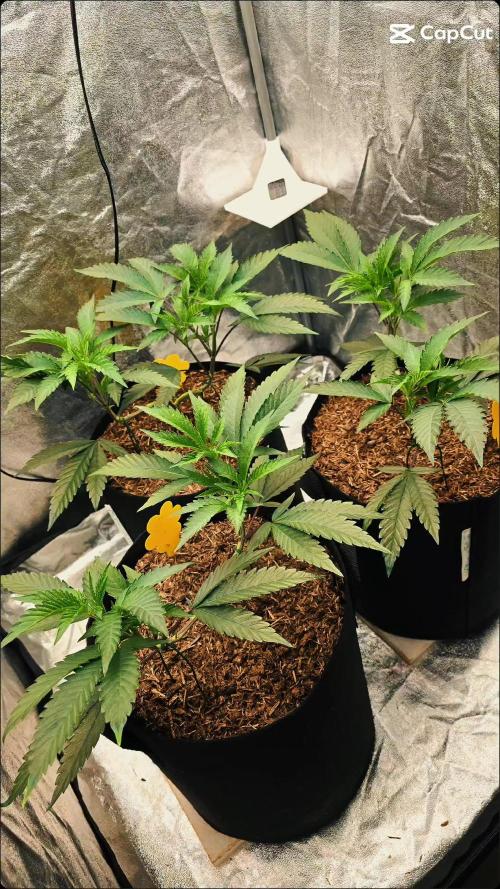
This grow with the TSW2000, FC4800 and 8x8 Grow Tent has come to an end🤘🤘. I'm so happy with the results mars hydro has done👍. Best lights you can get in my opinion and TONS of other people agree with me on this too👍. I always say mars hydro gets em frosty and their lights DID get em nice and frosty and the buds are so tasty and smell awesome🤘. I trimmed up 6 plants so far. Got 9 more to go. And it seems like I get a 1liter Mason jar per plant and is about 2 ounces per plant. Some are a bit more than 2. Not a huge haul per plant but I'm still very happy with it because the quality is amazing. I will never want to use anything but MARS HYDRO. Extremely satisfied with the entire grow with mars. The weed quality is very good and controlling the heat was simple because they don't get that hot. The lights were very easy to setup and so was the tent. I STONGLY recommend any products from Mars Hydro. You will not be disappointed 👍
Thanks for following my grow and good luck to all my friends and remember to have fun with your grows🤘🤘 rock n roll a joint everyone🤘🥁🎸
FOR EVERYTHING MARS HYDRO VISIT:
www.mars-hydro.com
PROMO CODE: rocknroll
VISIT THE ALIEXPRESS STORE:
@marshydro_aliexpress2
Instagram: @marshydropenny
https://youtube.com/channel/UChU5ZWwNi-DvnO3oWVU3ceA
Thanks for taking the time to read and check out my shit🤜🤛
GET THE MAX FROM MARS👍: Welcome one of the newest members of the Mars Hydro family🤜🤛🤘. The Mars Hydro FC 4800 480W LED Grow Light can accommodate up to a 4' x 4' area for flowering. It has OVER 2000 LED chips consisting of the best selling Samsung LM301B diodes which has a Luminous Efficacy of: 220 lm/W
0.2 W, 3 V mid power,
Osram 660nm Diodes, Infrared light and UV LIGHT👍. It boasts the incredible efficiency of 2.8 µmol/J, maximum 2.5gram yield per watt with 30% higher Average PPFD. This High-intensity spectrum is beneficial for plants at all stages - from veg to bloom, and creates Big dense Buds👍. achieve 50% higher yields & quality compared with the old lights! Only consumes 480W for 4x4ft personal grows, and 3x3ft for commerical grow. It comes with a dimmer and daisy chain function with a maximum of up to 15 lights, the master light controls the rest👍. Wide 6-bar design offers even & wide canopy coverage and can maximizes your grow space. slim 180° FOLDABLE DESIGN... YES I SAID FOLDABLE🤘🤣 , making it compact and easy to install, it's IP65 WATERPROOF and will give you no worries while growing in a humid environment and makes it a flexible high performance commercial grow light for enormous SUPER FROSTY yields.😛😛😛. MARS GETS EM FROSTY BOYS👍
AWESOME HEAT DISSIPATION: The Low energy consumption FC4800 growing light has 6 passive-cooled bars and an aluminum heat-sink a removable driver you can upgrade later or have it outside your tent. with zero noise you can save up to 50% in your electricity bill compared to HID's or HPS lights!
It also has a removable driver so you can upgrade it in the future or have it outside your grow space for better heat control in your growroom👍
UPGRADED FULL SPECTRUM: Yield Max Spectrum with enhanced red (Top-Bin Samsung 3000k-5000knm, Osram 660nm Deep Red), speed up blooming & fruiting, perfectly suited for full-cycle growing. The FC4800 LED grow lamp was born for Big Buds, perfect for commercial, grow tent, grow room, hydroponics, and all soil grows.👍
THE BEST SAMSUNG DIODES: THE FC4800 has Top Bin genuine Samsung Osram Diodes, combined with remarkable 2.8 µmol/J Efficacy, 30% higher Average PPFD, 50% less energy consumption, to maximize your yields. They give you a TRUSTED 3 years warranty 100% Satisfactory guaranteed!!!
The MARS HYDRO 8x8 Grow Tent interior is made of a unique diamond design mylar which is highly reflective. (Other companies mylar and reflective rate is as low as 50%, and it won't provide efficient light. They use thick 1680D oxford canvas, and being double stitched, it is tear proof and perfect for locking in the light. Their grow tent keeps 100% of the light inside the tent and helps your plants absorb more light. EXTRA-THICK material means No light leaks or rips at all.👍
Strong Stable metal corner adapters and poles are the trustful supporters of the tent. It's very sturdy, neither rusting or paint flaking off. quick and easy tool-free setup. They use heavy-duty metal zippers, with double layer black lining, by far the best on the market which creates a light-proof seal.
The Easy observation windows are made by double layers of cloth. Observe the growing conditions of your plants without opening the tent and avoid disturbing your plants. The observation windows also serves to dissipate heat and ventilate the air.
The tent includes 2 removable waterproof floor trays to hold soil and water. The removable tray can be taken out to wash easily.
They guarantee the grow tents are easy to install even if you've never done something like this before. Clear Instructions and no tools needed! They also offer 30-day unconditional refunds for quality problems. Just contact their friendly 24 hours customer service 👍


Likes
2
Share


Likes
18
Share


@Cannibalgardens
Follow
The whole grow was full of ups and downs I neglected her basic needs from the get go but she did recover and push along with me.. the growing conditions were not prime and fir that she did me proud .. The buds are tight and have a very nice smell to them .. If I had grown this lady in a bigger pit with warmer temps she would have been amazing ... I'm excited to try her again sometime in the spring hopefully .. the buds I tried a little but of were not bad tasted smooth and cash was white when burned ..

Likes
3
Share

@CheeRz
Follow
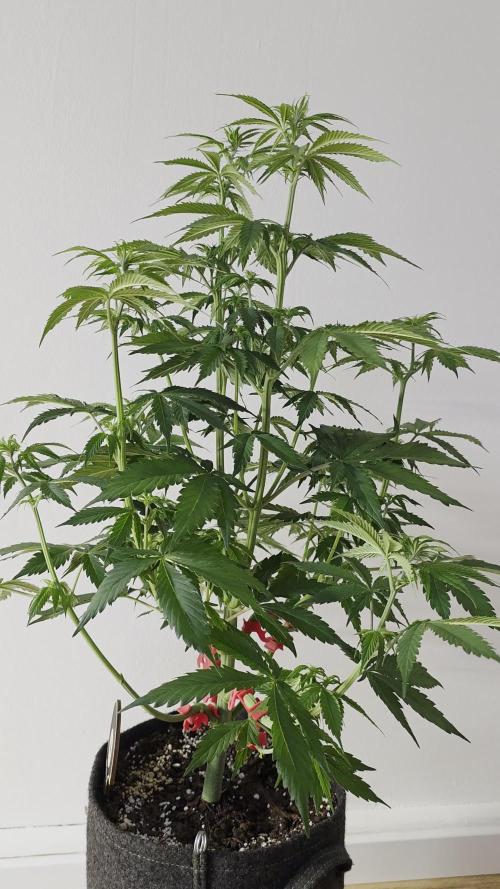
The ladies are doing great and growing well. I'm really happy with the progress so far. They have now reached 60 cm. I plan to install the Scrog net within the next few days to allow them to grow wider.
Likes
19
Share


Likes
33
Share


@Mr_Pgrow
Follow
What an amazing auto to grow.
She gave no problems whatsoever.
She loved her weekly compost extraction watering and responded brilliantly after each.
Although slightly overshadowed by her growing room partner, she still managed a pretty good yield
Weighting in at 52.3g of flower, probably the dencest and hardest buds I've grown so far.
Also pulled 18g of trim for extraction.
Follow me here
https://www.theweedtube.com/user/Mr.PersonalGrow
Likes
17
Share


@SheyTailfeather
Follow
Let's roll it's week 6 😎
To start off,
I want to sum up the last weeks.
The conditions have been changing throughout all this grow.
Overall it was more often sunny then not, so that's a plus.
The negative side was the absence of consistency 😂
There were a lot of days with sun, rain and spicy winds.
Day 35
The Team has grown a lot,
so I'm doing portraits with 3 different perspectives and a profile for each plant.
Springbrunnen will be shot tomorrow,
Rocky in 4 days cause she's 4 days younger.
But Zilla was the first to pop anyways
so I think it's halfway even.
Weather is 18/50 on average with 3h
of sun today
Day 36
Shooting Springbrunnen today.
I couldn't convince the sun to come out at afternoon so the lighting is not the same but I want to shoot them at same age. Lots of winds and rain today.
Day 37
Today winds hit heavy and I made a little video for all the MMA fans out there.. Watch the video
(Zilla at the top is the ref)
Joe rogan voice
"Rocky closes the distance and starts a huge left-right-headbutt combo to the body of Springbrunnen.
Nice body movement in the defense..
OOUH but she felt it, she's tumbling!
But now back on solid feet..."
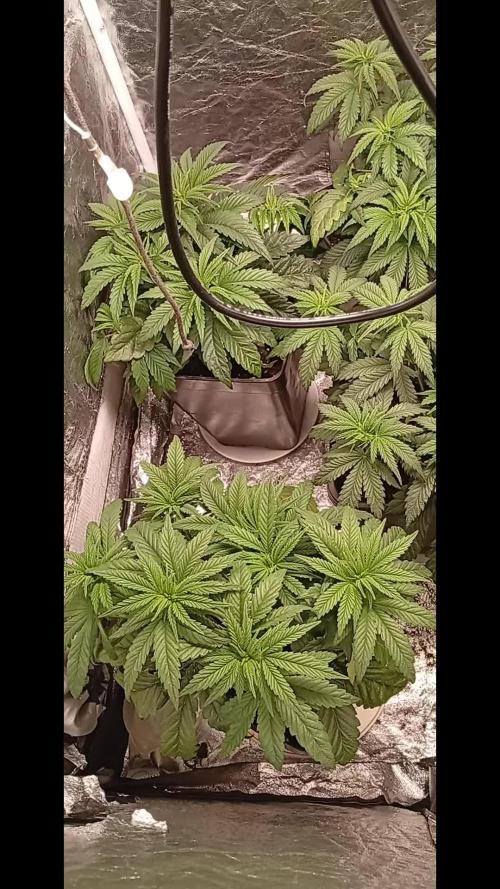
ZILLA (Barney's Farm Gorilla Z Auto)
Height: 49cm
Appearance: Tree-like
Scent: Strong, sweet/candy, hint of woody
Infects: Tiny mildew on bottom leaf in
week 4, now healthy, handful of
flys near the cola.
Nutrition: Thirsty, could take a lot more nutes I guess
Qualities: Super thick and strong, almost like a tree, intense deep green.
Adjustments: daily stretch mid leaves to prepare for leaf tucking,
increase fertilizer to 75% of recommended dosage.
SPRINGBRUNNEN (Kannabia Kickass Auto)
Height: 48cm
Appearence: slim, sharp
the genetics original
name was Bruce Lee and
that hits it 100%!
(her main stem is half the
mass compared to Zilla)
Scent: very strong, lemon, pungent
and a hint of sweet
Infects: Tiny mildew on bottom leaf in
week 4, now healthy, handful
of flys near the cola
Nutrition: medium thirsty, didn't want a
lot of nutes especially in veg
Qualities: good leaf production, fast
Adjustments: watch out to NOT
confuse Zillas feed withhers 😂 Leaftucking mid branches




Likes
48
Share

@Pheno_Minds
Follow
📋 Nach 16 Wochen Gesamtlaufzeit ist heute der Tag der Ernte für die Mimosa x Orange Punch von Barneys Farm gekommen. Die Pflanzen stehen voll im Harz und haben ihr biologisches Ziel erreicht. Ich beende den Run punktgenau und bereite alles für die Trocknung vor. Die Genetik hat über die gesamte Zeit eine beeindruckende Stabilität gezeigt und liefert jetzt zum Abschluss genau das optische Bild, das man von einer Top-Sorte erwartet.
🌡️ Die klimatischen Bedingungen in der Zielgeraden waren stabil und auf den Punkt. Der CO2-Wert lag im Schnitt bei 736 ppm, was den Pflanzen geholfen hat, die Blütenmasse bis zum letzten Tag kompakt zu halten. Maßnahmen gab es diese Woche außer der Kontrolle der Werte keine mehr, die Pflanzen haben nur noch ihr restliches Wasser verbraucht.
📸 Ein Blick auf die Fotos zeigt den hervorragenden Zustand der Buds. Die Blütenstruktur ist extrem dicht und zeigt die typische kompakte Form mit leichten Ausstülpungen an den Spitzen. Die Harzproduktion ist massiv, die Trichome überziehen nicht nur die Blüten, sondern auch die Zuckerblätter wie eine dichte Schicht aus Puderzucker. Farblich hat die Pflanze ein wunderschönes Spektrum von tiefem Violett bis fast Schwarz in den Blättern entwickelt, was einen starken Kontrast zu den hellen, harzigen Blüten bildet. Die Stempel sind fast vollständig braun und zurückgezogen, was das Ende des Reifeprozesses markiert. In der Nahaufnahme sieht man, dass die Trichomköpfe perfekt milchig mit ersten bernsteinfarbenen Einschlägen sind.
✂️ Jetzt geht es in den Trockenraum. Die Buds sind beim Zerlegen extrem klebrig und verströmen ein schweres Aroma von Zitrusfrüchten und süßem Treibstoff. Die Dichte der Blüten ist beeindruckend, da gibt nichts nach, wenn man sie leicht zusammendrückt. Die nächsten Tage verbringen sie bei kühlen Temperaturen und kontrollierter Luftfeuchtigkeit, bevor es ans Curen geht. Ich bin sehr zufrieden mit dem Harzbesatz und der allgemeinen Vitalität bis zum letzten Tag. Das Ergebnis im Glas wird sicher ein Genuss.

Processing
Likes
14
Share


@MG2009
Follow
11/21/2020
Soaked in water 24 hours all seed fell to bottom, put in paper towel over night and 6 out of 10 have sprouted.
In this cross I will be looking for powdery mildew immunity first and foremost. ( goal achieved see week 15)
Also hope to make cookie cake stretch more and bring a sativa influence.
11/28/2020
One week old today 5 out of 10, 6th sprout had stem rot 60% germination. Now hope for 3 girls at least 🙏
Likes
3
Share


@MicroHidroGrow
Follow
Día 26. Estamos en la 4ta semana. Por ahora mantengo la solución y la planta sigue creciendo pero ya está casi para cortar los esquejes. La semana que viene seguro estoy cortando, y ya tengo que preaparar todo para pasar al otro modulo del infoor.
Decidi dejar de aplicar HST y apliqué una recnica con colgantes que bajan las ramas y las mantienen perpendiculares al piso. De esta forma las ramas laterales empiezan a subir. Está técnica me ha dado muy buenos resultados anteriormente.
El crecimiento ha sido acelerado y las ramas estan bastante gruesas.
Mañana voy a cambiar la solución. Vengo realmente contento con los resultados. Este experimento me va a permitir saber cuanto puedo llegar a sacar de este espacio y ver si me permite armar un ciclo para poder llegar a la próxima cosecha con remanente para poder ir guardando variedades diferentes. De paso ya tengo una referencia de cuantas semanas toma hasta poder cortar esquejes, y así saber en que momento poner la próxima semilla.
Puse unas semillas bastardas que tenía, y las pienso mandar a la terraza a florecer directamente en el invierno. Otra experiencia que si bien no ha dado grandes resultados, ha sumado al stock. La semana pasada no llegué a subir mucho. Pero mañana hago un update de cómo se han movido las ramas bajas. En el último video se muestran bien las ramas que pretendo convertir en esquejes. Seguro saque varios, así que habrá para regalar si logramos que enraizen varios.
De por cierto las manchas blancad que se ven, es tierra de distomeas que ha quedado desde la aplicación en 2da semana.
Día 28. Termina la 4ta semana de crecimiento con un muy buen ritmo. Hoy cambié la solución y mantuve la formulación anterior (1g/L de feeding grow y 0,5g/L de green jungle bioestimulante de crecimiento). La planta está fuerte y ramificada. Sostengo que los esquejes se van a cortar un poco antes de lo previsto. Calculando que son 5 semanas de crecimiento y 1 semana de enraizamiento de esquejes, voy a tomar 6 semanas para preparar la próxima madre. Así que siendo esta variedad de unas 10/11 semanas de flora, voy a poner a crecer la nueva madre en la 4ta semana de floración. La planta tiene distancia internodal corta/media por lo que observo, así que es un detalle a tener en cuenta. Ya me empieza a dar la ansiedad de ver que todo va saliendo y quiero ya poder pasar a floración. Va a ser jna nueva experiencia hacer una planta desde semilla en hidroponía, ya que siempre hacía sólo esquejes y la madre la pasaba a tierra a florar en otro lado, debido a que por las raíces no podía sacarla del sistema que tengo ahora. Pero resolví eso y voy a ver por primera vez la potencia de la hidroponia en una planta desde semilla. Le hice corte apical a las dos ramas más largas esperando ver una mayor ramificación, ya que tengo un espacio de 1,2m x 0,55m por llenar y administrar. Espero que todo siga en marcha. Nos vemos en la 5ta semana desde mañana.


Likes
54
Share


@MarsHydroLED
Follow
Day 77 of flower
Week 11
Just waiting for the Afghan hindu kush to finish and will be cutting down the rest.
1 blue dream
1 Afghan hindu kush
Grow light: mars hyrdo tsw2000 at 100% power 14inches above 🌞☀️
Medium: coco coir mix with compost at a 50/50 ratio with 30% perlite added⛰️
Nutrients: fox farm dirty dozen 🦊🚜
Grow space: 4x4x7
Water: tap water (my tap water is allows 110ppm) left out for at least 24hours
Likes
15
Share


@Luckydope69
Follow
Dies ist die letzte Woche der Vegetation. Ich habe zu Beginn noch einmal etwas defoliert und werde es nun die ganze Woche wachsen lassen. Der Triebwuchs ist sehr schön und es wird einen Haufen Spitzen geben.
Likes
14
Share


@Terpyboyz
Follow
Alright lads 💪🏻 so we’re starting week 2 today - the girls are all having there own individual issues the joys or running multiple strains again 😂👌🏻, but we’re all looking really wellz so left side is looking a bit N def hungry still so I’ve upped the bio grow to 2ml and the right side is still showing she’s still got some nutes left from repot as shes good I’ve just left that to 1ml bio grow. All the clones are looking nice lush green, all starting to take shape now🕺 wait another 2 weeks until I start to flower them.. and see which of my keepers are as clones then take cutz off them before flowering my actual clones tent, keep the cutz in a separate tent and start popping more seeds of this next round. Either ripper seeds new limited edition or lit seeds can’t decide..😅, anyways gang cheers for stopping by until next week and we can see some bud formation happing 💪🏻
Update - end of week 2 of flowering - I’ve given them all a fair defoliation and taken a lot of lowers of to start focusing it on them tops. Still looking a bit pale lack of N but we should be okay if it seems keep progressing al just up feed to 2ml per litre. Other than that it’s going fairly smooth.


Likes
23
Share


@Crwfz1
Follow
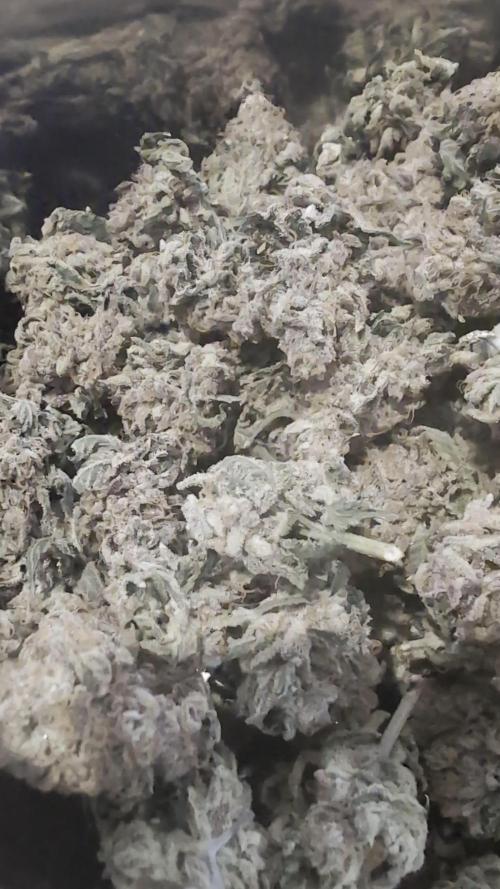
Yooo this stuff did great along with the other fast buds girls great grow and on to the next and now to enjoy this fire ass smoke from some good breeders 🔥😎 @fastbuds @originalsensible
