The Grow Awards 2026 🏆
Likes
16
Share
@Tezza2
Follow
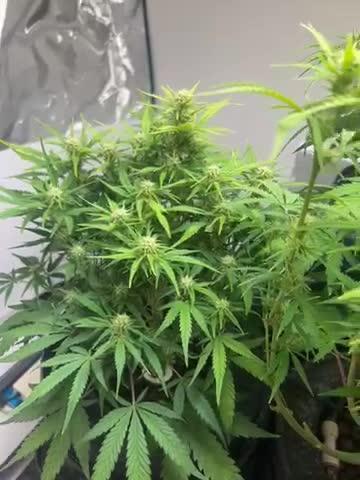
The gorilla glue auto is taking up most of the room in the tent if i didnt have the big purple lemonade auto in there the gorilla glue would take up most of the tent its flowering hard it has alot of tops and lots of bud sites and the purple lemonade auto is flowering nicely i believe it is coming into the fourth week of flower for the purple lemonade auto i had a small sample of the purple lemonade when i trimmed up the bottom half of the plant all the small buds that came off i dried out i smoked the buds and man O man it smashed me hard i had one joint and it made me pass out i cant wait for it to be ready for harvest
Likes
13
Share
@Canadian
Follow
The plant continue to grow incredibly strong and fast from now on I well slow down on grow nutrientes cuz the leaves are very dark green and we are well into flowering meaning they don't need that much not nitrogen anymore. Thank you for reading I will continue to update have a happy grow.
Likes
3
Share
January 26 Gave the plants an increase dose of nutrients on the 25th and today I noticed the FS were getting a bit of burn on the tips so I flushed the soil with about 4 gallons of pH 7 water. They're looking better today. RB has a few crispy lower leaves, I think because it has less soil and dries out quicker. I'll probably have to water it daily. The SwCDLC didn't bat an eye at the increased nutrient level. Both SS's are growing ok. The 3 gallon SS is larger then my micro grow one for obvious reasons. Both of the larger plants showed sex a few days ago so I know they're female and the stretch is underway. Hopefully start getting a few small buds next week!
Likes
214
Share
@DevilsBud
Follow
Anesia Imperium X is small compared to the others will probably put here a week later into flowering. topping is done and doing some last LST on here Probably come flowering time this one and black berry moonrock and headshot will be put in the 100X100X180 with the TS-1000 so they can veg some more Imperium X is getting another home for couple weeks preparing the other room for flowering More photos Tru the week 27/10/21 Transplant the imperium x in 11L fabric pots added 5gram Easy Roots - Mycorrhiza Mix to soil visit www.marshydro.eu for your best gear and use the PROMO CODE: DEVILSBUD Fully marshydro supported Setup: Marshydro GT100X100X180 Marshydro Ts 1000 LED lamp Mars Hydro tent handy info Lock All Light Inside: MARS HYDRO Grow Tent Interior is made of diamond mylar. Non-toxic to the environment, no harm to plants. High-quality 1680D canvas being double stitched, (ALL OTHERS BRAND grow tent is 601D canvas) which is tear-proof for perfect light locking, No light leaks or rips at all. Durability Grow Tent :Stable Metal corner adapters and poles are the trustful supporters of the tent. No rusting nor paint-falling. Quick easy tool-free installation. Carries strong heavy-duty SBS zippers, double layer lining to create a light-proof seal. Easy Observation of your Plants: Special peek👀 window made by double layers of cloths. Observe the growing conditions of your plants without opening the tent and avoid disturbing plants. The peek window also serves to dissipate heat and ventilate air. Removable Tray Keep Clean: The package includes a removable waterproof floor tray to hold soil and fallen leaves. The tray can be taken out easily to wash. Removable and water-proof cleaning easy. Good Ventilation&Fast Assembly: Circular double-sleeved vent holes with adjustable nylon strap for air circulation by exhaust fan, ducting, carbon filter, or reflector. Better allows proper light, heat, and airflow. Quick tool-free installation. Reinforced by a sturdy metal frame to ensure security and stability, supports up to 140lb. Perfectly safeguard your plants to thrive even in winter.
Likes
11
Share
Smooth sailing on this batch deep into flower! Were sitting at 77 days today and they are looking fantastic! Steady feeding flora bloom and flora micro. Also giving them 5ml/gal of advanced big bud. These ladies are FROSTY! Cannot wait till these ladies wrap it up! These cheese are STINKY. Nice small, compact stature but they look fantastic. I have 5 of these girls going and I forsee around 1.75 ounces per plant. Solid little grow.
Likes
11
Share
@Mo_Powers
Follow
it has now clearly gone into bloom. really nice pistols and if it continues like this, it will become really thick buds. it has got a few yellow leaves but that's not bad. it has also grown a few centimetres
Likes
23
Share
So here they are after the long wait, they got soooooo big!! 😍 her massive indica leaves are soaking up all that sun 🌞 she looks really healthy & she's the biggest out the whole plot, that was lucky lol i think next visit will require a little hair cut to allow the light to hit the lower banches 👌 All got a good feed with the Bio Bizz Grow, all got 2ml per/L in 5 Litres of water 💧💧She has a slight aphid problem, my fault i didn't protect her with pesticides before i left but i have sprayed her down with diluted washing up liquid for the minute, until i grab some good shit 😂 i hope you enjoy the tour of the garden, we have Barney's Farm, Fast Buds, RQS & Dutch Passion in there 😍 it's gonna be an epic year! Stay safe 💚
Likes
5
Share
@GrowFunMD
Follow
Harvested Plant #2 and Plant #3 at 11 weeks. Still have #4 and #5 to go. They are just about ready. Been waiting until the leaves turn purple. These plants have been flushing for weeks because I thought they were going to be done sooner, but they haven't missed a beat. They have a very strong, sweet smell. I highly recommend Cobbler Crisp!!!
Likes
6
Share
@IamCy
Follow
She's starting to fatten up nicely! Terps still off the meter,and the roots are ridiculous. Definitely one of the best plants I've ever grown.
Processing
Likes
10
Share
@PisBaked
Follow
Everything is looking amazing! All plants are at 4.5wks -5wks old now. Growth is extremely rapid. PPMS/PH of run off is less than what's going in! Still feeding to run off daily; vacuuming out the water everytime!! They're starting to need close to a gal. each :D I have defoliated & continue to pinch lower plant growth to lolly pop each branch -- I find this the best method hands down for autos.. The canopy for the most part is even with the exception of LSD-25, Fruit Punch, & most importantly; the one GSC (fast buds) -- it is a fucking monster as you can see (tallest plant by FAR). Cant wait to see the buds on what appears to be a Sativa dominate GSC pheno -- this plant was under the same 630w's worth of CMH along with the other GSC -- because it keeps growing, and was starting to developing light burn on leaves closer to the CMH's I've since switched spots with a GG#4 & it's now under two 600w LED's; growth continues to stretch on her, but I'm less concerned now that it's under less intense lighting, with a bigger distance from the lights . Other than that, things are looking to be on track for an epic harvest. Once buds start forming, I will drop the temps on the AC gradually to bring out the colors in GSC/LSD/Fruit Punch -- with lights/fans on full blast I can hold temps as low as 70f / 30% RH with the AC at less than 50% - Will be uploading more pics this weekend!
Likes
2
Share
Comenzamos con la fertilización de nuestras plantas, correspondiendo con la semana 2 de la tabla. Recordad que la semana de germinación no cuenta como vegetativo. Mezclamos 4ml x litro de Grow-Soldier by JUJU Royal BioBizz y 1ml x litro de Green-Mystic by JUJU Royal BioBizz. Total 10 litros, 5 de agua osmotizada y 5 de agua del grifo, mezclados con los 40ml y 10ml, de los fertilizantes. Ajustamos el PH con reguladores BIO, en el caso que sea necesario y regamos todas las macetas. De esta forma aportaremos los nutrientes necesarios para que nuestras plantas puedan comer en el sustrato de de coco.
Likes
78
Share
@Hou_Stone
Follow
Day 61 / Flowering 28 --------------------------------------------- 💧Watering On average I water each pot with: Day 59 : 1 Liter Day 63 : 1 Liter with 0.3 Gram of BoosterPK+ I alternate watering, one with booster in my water and the next without. I add Bioenhancer once every 14 days +/-. I add very few nutrients to my water because I have already placed Bio Nutrients directly in my soil 😉 (BioGrow & BioBloom added on week 1 & 5) ------------------------------------------------------------ 🔥❄️Temperature of the week : Day : 20-24°C (Humidity : 55-70%) Night : 16-19°C ------------------------------------------------------------ 🚀Equipment of the week ⭐️ : Lamp Led 300W : power 95% at 35cm Extractor+ carbon filter ON 24/24h 2 fans ON 12/24h ------------------------------------------------------------ 📜Links : 🍌🌲Banana Krumble seeds : https://shop.greenhouseseeds.nl/feminised-cannabis-seeds/usa-genetics/banana-krumble/ Food for your plants 🔥🔥👍 https://www.greenhousefeeding.com/ ------------------------------------------------------------ ☮️Thanks for your visit💚☮️
Likes
5
Share
Beginning of week 4 so far so good. The girls are reacting well to there training. Vita race from plagron is a game changer. They are super green and healthy everytime I feed them you see the difference.Did some defoliation. Nothing major just removed any leaf overlapping or blocking light to lower parts of the plant.
Likes
8
Share
@Hippity
Follow
They had an hour drive roadtrip today, I hope they didn't get stressed. Moved them to their new home where they are under a 825W Gavita HPS. Today I stopped the Botanium's nutrients and started the Advanced Nutrient's PH Perfect Micro/Grow/Bloom, 1ml of each, inside their 1lt tank. Overall so far they look really healthy, happy, and smell good. This is basically an attempt to grow weed the easiest way possible... I started this grow under my desk with fluorescent tubes ducktaped on it... It's also an experiment to see if it's possible to grow Cannabis with a Botanium. This is an almost completely automatic grow using a simple automatic hydroponic system pot that has an inside timer and waters the plants every 3 hours, and they also claim that it's impossible to overwater the plant with this system. Let's see through this test... The capacity of the pot is kinda small to grow a big juicy tree, so I'm trying to get just a few nugs the simplest way possible... The strain is Green-O-Matic which is one of the smallest cannabis strains ever bred. It consists of some really interesting parents which are White Dwarf, Low Rider, a short Moroccan landrace and a short Ruderalis landrace I hope you enjoy this simple experiment...
Likes
11
Share
@Rob691
Follow
Plants are in dry pode since 8 days Now. I decide to stop flowering besause a few yellow bananas start showing up. That was time. By the way, I taste the fresh weed before making my decision and… damned, it’s a great one !!!!! 😁😁😁😳😳😳😎😎😎
Likes
19
Share
Some trichomes are clear others are turning cloudy , still no Amber. I'll lower the feed from now with a view to harvesting in the next week to ten days .
Likes
52
Share
Once again she passes my expectations, late to the show with trichome production. I'm surprised there is purple on the bud, maybe Purpinator does work. I thought I could see hints under the grow lights and thought my eyes were deceiving me, I was just being hopeful. But nah 2 of the 3(under the UV) have developed a beautiful tone of purple. I was never going to bother with a deep freeze but maybe the whole bud will change given conditions, that would be something, fingers crossed. 🤔 was a little skeptical that reducing temps humidity would change density, but it does, buds are solid something I've not been able to achieve before. Rule of thumb is never to surpass 60% RH in the flowering phase and try to progressively reduce it down to 40% in the last 2–3 weeks before harvest. The plant will react as it seeks to protect its flowers, responding by producing denser buds and a higher concentration of resin. Cannabis plants are sensitive to sudden temperature changes, especially in the flowering stage. Extreme heat or cold can impact bud density and overall yields. In nature as a defense mechanism from cold, the plant sensing sudden dips in temperature will attempt to remove the pockets of air within the bud, it achieves this by compacting itself in doing so to better protect itself from cold snaps which are normally indicators in nature that worse weather is on the way. Terpene levels are the highest just before the sun comes out. Ideally, you want as many terpenes present in your plants as possible when you harvest. Cannabis plants soak up the sun during the day and produce resin and other goodies at night. The plant is at its emptiest from "harvest undesirables" so to speak right before the lights on. Boiling cannabis roots during harvesting slows down the drying process. When you boil cannabis roots, it shocks the plant, closing the stomata on the leaves. This prevents massive moisture loss through the leaves, leaving only the floral clusters actively losing moisture at a reduced pace. I've always run a strict 60/60 and it took almost twice as long to dry to a snap than previous grows where I didn't boil for what it's worth. Chlorophyll is good for the plant but not for you. When you harvest the buds, even after you flush them, if you flush them, they’re still filled with chlorophyll. Freshly cut buds are greener than dried buds because they still contain loads of chlorophyll. However, when rushed through the drying process, the buds dry but retain some chlorophyll, and when you smoke it, you will taste it. Chlorophyll-filled buds are smokable, but they aren’t clean. Slow drying gives the buds enough time and favorable conditions to lose the chlorophyll and sugars, giving you a smoother smoke. How the plant disposes of the chlorophyll and sugars by a process of chemically breaking them down and attaching the decomposed matter once small enough to water molecules which then evaporate back into the ether. Time must be given to the process to break down the chlorophyll and sugars. Think of it like optimizing the environment for decay. All the nutrients it could ever need are in abundance, it eats nutrients based on its demand for growth, which is dictated primarily by available light. Plant growth and geographic distribution (where the plant can grow) are greatly affected by the environment. If any environmental factor is less than ideal, it limits a plant's growth and/or distribution. For example, only plants adapted to limited amounts of water can live in deserts. Either directly or indirectly, most plant problems are caused by environmental stress. In some cases, poor environmental conditions (e.g., too little water) damage a plant directly. In other cases, environmental stress weakens a plant and makes it more susceptible to disease or insect attack. Environmental factors that affect plant growth include light, temperature, water, humidity, and nutrition. It's important to understand how these factors affect plant growth and development. With a basic understanding of these factors, you may be able to manipulate plants to meet your needs, whether for increased leaf, flower, or fruit production. By recognizing the roles of these factors, you'll also be better able to diagnose plant problems caused by environmental stress. Water and humidity *Most growing plants contain about 90 percent water. Water plays many roles in plants. It is:* A primary component in photosynthesis and respiration Responsible for turgor pressure in cells (Like the air in an inflated balloon, water is responsible for the fullness and firmness of plant tissue. Turgor is needed to maintain cell shape and ensure cell growth.) A solvent for minerals and carbohydrates moving through the plant Responsible for cooling leaves as it evaporates from leaf tissue during transpiration A regulator of stomatal opening and closing, thus controlling transpiration and, to some degree, photosynthesis The source of pressure to move roots through the soil The medium in which most biochemical reactions take place Relative humidity is the ratio of water vapor in the air to the amount of water the air could hold at the current temperature and pressure. Warm air can hold more water vapor than cold air. Relative humidity (RH) is expressed by the following equation: RH = water in air ÷ water air could hold (at constant temperature and pressure) The relative humidity is given as a percent. For example, if a pound of air at 75°F could hold 4 grams of water vapor, and there are only 3 grams of water in the air, then the relative humidity (RH) is: 3 ÷ 4 = 0.75 = 75% Water vapor moves from an area of high relative humidity to one of low relative humidity. The greater the difference in humidity, the faster water moves. This factor is important because the rate of water movement directly affects a plant's transpiration rate. The relative humidity in the air spaces between leaf cells approaches 100 percent. When a stoma opens, water vapor inside the leaf rushes out into the surrounding air (Figure 2), and a bubble of high humidity forms around the stoma. By saturating this small area of air, the bubble reduces the difference in relative humidity between the air spaces within the leaf and the air adjacent to the leaf. As a result, transpiration slows down. If the wind blows the humidity bubble away, however, transpiration increases. Thus, transpiration usually is at its peak on hot, dry, windy days. On the other hand, transpiration generally is quite slow when temperatures are cool, humidity is high, and there is no wind. Hot, dry conditions generally occur during the summer, which partially explains why plants wilt quickly in the summer. If a constant supply of water is not available to be absorbed by the roots and moved to the leaves, turgor pressure is lost and leaves go limp. Plant Nutrition Plant nutrition often is confused with fertilization. Plant nutrition refers to a plant's need for and use of basic chemical elements. Fertilization is the term used when these materials are added to the environment around a plant. A lot must happen before a chemical element in a fertilizer can be used by a plant. Plants need 17 elements for normal growth. Three of them--carbon, hydrogen, and oxygen--are found in air and water. The rest are found in the soil. Six soil elements are called macronutrients because they are used in relatively large amounts by plants. They are nitrogen, potassium, magnesium, calcium, phosphorus, and sulfur. Eight other soil elements are used in much smaller amounts and are called micronutrients or trace elements. They are iron, zinc, molybdenum, manganese, boron, copper, cobalt, and chlorine. They make up less than 1% of total but are none the less vital. Most of the nutrients a plant needs are dissolved in water and then absorbed by its roots. In fact, 98 percent are absorbed from the soil-water solution, and only about 2 percent are actually extracted from soil particles. Fertilizers Fertilizers are materials containing plant nutrients that are added to the environment around a plant. Generally, they are added to the water or soil, but some can be sprayed on leaves. This method is called foliar fertilization. It should be done carefully with a dilute solution because a high fertilizer concentration can injure leaf cells. The nutrient, however, does need to pass through the thin layer of wax (cutin) on the leaf surface. It is to be noted applying a immobile nutrient via foliar application it will remain immobile within the leaf it was absorbed through. Fertilizers are not plant food! Plants produce their own food from water, carbon dioxide, and solar energy through photosynthesis. This food (sugars and carbohydrates) is combined with plant nutrients to produce proteins, enzymes, vitamins, and other elements essential to growth. Nutrient absorption Anything that reduces or stops sugar production in leaves can lower nutrient absorption. Thus, if a plant is under stress because of low light or extreme temperatures, nutrient deficiency may develop. A plant's developmental stage or rate of growth also may affect the amount of nutrients absorbed. Many plants have a rest (dormant) period during part of the year. During this time, few nutrients are absorbed. Plants also may absorb different nutrients as flower buds begin to develop than they do during periods of rapid vegetative growth. 432 Hz is said to be mathematically consistent with the patterns of the universe. Studies reveal that 432 Hz tuning vibrates with the universe’s golden mean PHI and unifies the properties of light, time, space, matter, gravity and magnetism with biology, the DNA code and consciousness. When our atoms and DNA start to resonate in harmony with the spiraling pattern of nature, our sense of connection to nature is said to be magnified. Another interesting factor to consider is that the A=432 Hz tuning correlates with the color spectrum while the A=440 Hz is off. Audiophiles have also stated that A = 432 Hz music seems to be non-local and can fill an entire room, whereas A=440 Hz can be perceived as directional or linear in sound propagation. Once you adopt the idea that sound (or vibration in general) can have an equalizing and harmonizing effect (as well as a disturbing effect), the science of harmony can be applied to bring greater harmony into ones life or a tune to specific energies. There is a form of absolute and of relative harmony. Absolute harmony can for example be determined by the tuning of an instrument. The ancients tuned their instruments at an A of 432 Hz instead of 440 Hz - and for a good reason. There are plenty of music examples on the internet that you can listen to in order to establish the difference for yourself. Attuning the instrument to 432 Hz results in a more relaxing sound, while 440 Hz slightly tenses up to body. This is because 440 Hz is out of tune with both macro and micro cosmos. On the contrary, 432 Hz is in tune. To give an example of how this is manifested micro cosmically: our breath (0,3 Hz) and our pulse (1,2 Hz) relate to the frequency of the lower octave of an A of 432 Hz (108 Hz) as 1:360 and 1:90. It is interesting to note that 432 Hz was the standard pitch of many old instruments, and that it was only recently (19th and 20th century) the standard pitch was increased. This was done in order to be able to play for bigger audiences. Bigger audiences (more bodies) absorb more of the lower frequencies, so the higher pitch was more likely to “cut through”. One of the oldest instruments of the world is the bell ensemble of Yi Zeng (dated 423 BC), tuned to a standard F4 of 345 Hz which gives an A= 432 Hz. The frequency of 345 Hz is that of the platonic year! Similarly many old organs are tuned in an A=432 as well; for example: St. Peter’s Capella Gregoriana, St. Peter’s Capella Giulia, S. Maria Maggiore in Rome. Maria Renold’s book “Intervals Scales Tones and the Concert Pitch C=128 Hz” claims conclusive evidence that 440 Hz and raising concert pitch above scientific “C” Prime=128 Hz (Concert A=432 Hz) disassociates the connection of consciousness to the body and creates anti-social conditions in humanity. The difference between concert pitch A=440 Hz and Concert A=432 Hz is only 8 cycles per second, but it is a perceptible difference of awareness in the human consciousness experience of the dream we share called existence.