







@Chubbs
Follow
420FASTBUDS
FBT2107 WEEK 5
The two of these are transitioning into bloom phenomenally. They've grown close to 5in in a week so it's safe to say they're reaching for the stars. Color on them both appears a vibrant green with a hint of lime for the newer growth just coming in or on some of the smaller leafs. I upped there feed by adding a little more of the Micro/Bloom nutes of the 3 part GH Flora series. Over all it doesn't seem to bother them one bit. All in all Happy Growing for these two.


@JohnnyCash420
Follow
Wieder eine Woche ist rum und den Pflanzen geht es gut.
Ich wundere mich nur dass GG#4 erst jetzt nach Tag 63 in die Blütephase übergeht. Sie ist wirklich sehr buschig und groß, während Runtz F1 nur halb so groß ist aber schon sehr weit vorangeschritten. Einen so starken Unterschied hätte ich nicht erwartet.


@100Trillion
Follow
Week two plant are growing well I have since stopped 24 hours of light on day night and is now giving the girls some rest since they have established some nice roots. Gave them some compost tea feeding as well...let see how they react


@HeartStrong_Garden
Follow
Those first leaves really grew out. This is my first seed popped of the new year! This strain is an Attitude Seedbank and Fast Buds collaboration, it is actually called STRAWBERRY WHIP and wasnt an available strain option
shorts_status_processing


@Giorgo
Follow
I know it's not good box but I can do only this at this moment and think it's will be better then to put near window


shorts_status_processing


@Organic_LarF
Follow
High GD community,
Week 2,
This is surely not the s1 version 😅😅
Allready 1 leaf is missing, so not sure ill keep it, not taking risk of pollination. Ill give it an extra week and evaluate after that.
Thats it for this week
Grow safe buds and feel free to check out my other ladies doing fine 🌿👍
🙏🌿🌿🌿🙏
Feel free to use this link when you are intrested in any product🐍viparspectr🌈 has to offer➡️➡️➡️➡️➡️➡️
https://www.viparspectra.com/?aff=nbemz68cxril&utm_source=affiliate
VIPARSPECTRA XS1500 LED grow light
VIPARSPECTRA XS2000 LED grow light.
VIPARSPECTRA XS4000 LED grow light


@HIAZ_urbanbudfarmer
Follow
Been a busy week getting the new setup going. She has been going really well , first week of flower , interested to see how she goes. She is a nice little plant problem free so far.


@Icedoutgreen
Follow
Keine großen Veränderungen in der ersten Blütewoche, ich habe nur den lästigen großen Ventilator entfernt, da er mir zu viel Platz auf der Bodenfläche genommen hat und am Ende der ersten Woche habe ich das Blattwerk ein wenig ausgedünnt, mal sehen wie sich das auf die weitere Blüte auswirkt.



@RealGrowDiary
Follow
Day 77
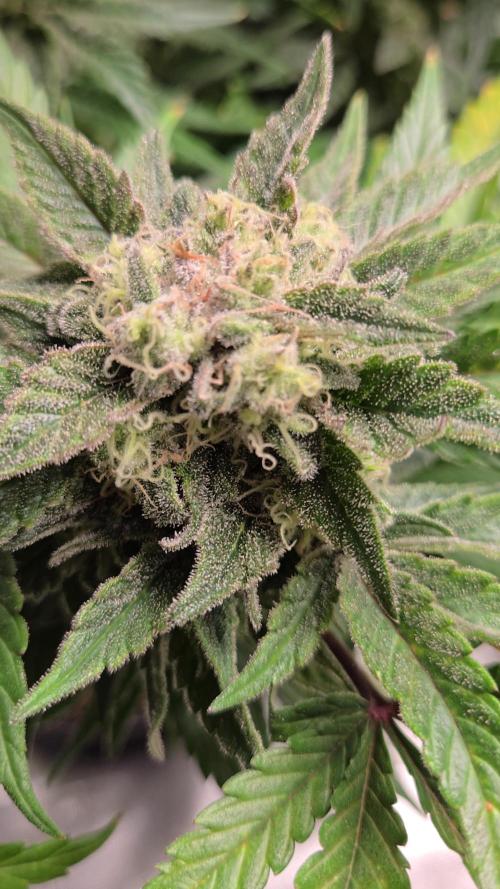
The plant is deep into late flowering now, and the buds are clearly maturing. Trichome coverage has noticeably increased-most are cloudy, with only a few remaining clear. Pistils are starting to darken and curl inward, although there are still some fresh light-colored hairs emerging. The aroma has intensified, becoming richer and more pungent when the lights warm up.
The leaves show a slight fade, mostly around the edges, which is normal at this stage as the plant reallocates energy toward bud development. No signs of stress or significant nutrient issues, Humidity and airflow remain stable to prevent mold since the buds are now dense and sticky
Section Fully Updatet.


@Ju_Bps
Follow
Hello my friend,
Plant is ending, I've checked a bit in late the trychromes, as we can see on the movie plant is almost ready to harvest,
But I'm just flushing few days, I'm in late, so I'll check trychromes all the days, and I'll try to wait one week to harvest,
I like harvest when 75/25 milky/amber.
Next week, will be the harvest 😃😃.
See you next week for the result,
Have a good week


@AustinRon
Follow
OG 4Q24 Flower Week 7
Orangegasm (Fem) [ IRIE Genetics ]
12/12 @ Bolt (Day 21)
Germination: 20 November 2024
#3A Earliest Harvest Date: 9 February 2025
#3B Latest Harvest Date: 19 February 2025
_________________________________________
Start of Week: [Wed Jan 22,
2024 CR2 4Q24 43:F:6:1]
End of Week: [Tue Jan 28, 2024 CR2 4Q24 49:F:6:7]
OrangeGasm Fertigation:
- MAX: EC: [ 2.4, mS]
- LightIntensity MAX: [ 850, µMol/m2/s]
______________________________________
__
Wed Jan 22, 2025
OG 4Q24 43:F:6:1
- [x] R&R Each Drip Ring Assembly (Assure NO Fertigation/Bio Build up)
Runoff
- Amount: [ .5, l]
- EC: [ 3.8, mS/cm]
- EC∆: [ 1.2, mS/cm] # Danger!
Refresh Res (Filtered, pH’d Tap Water)
- [x] Amount: [ 2, gal]
- [x] Primer A&B: [ 35, ml]
- [x] SLF-100: [ 10, ml]
__
Thu Jan 23, 2025
OG 4Q24 44:F:6:2
Refresh Res (Distilled Water, pH: 7, EC: 0.0)
- [x] Amount: [ 2, gal]
- [x] Primer A&B: [ 39, ml]
- [x] SLF-100
Runoff
- Amount: [ 1.2, gal]
- EC: [ 4.3, mS/cm]
- EC∆: [ 1.6, mS/cm] # DANGER
__
Fri Jan 24, 2025
OG 4Q24 45:F:6:3
Runoff
- Amount: [ 0.3, gal]
- EC: [ 4.1, mS/cm]
- EC∆: [ 1.4, mS/cm] # DANGER

__
Sat Jan 25, 2025
OG 4Q24 46:F:6:4
Dump Res
- [x] Remove Chiller and Fertigation Pumps
- [x] Dump and CLEAN Reservoir, Note Sediment
- [x] Detach Main Feedline
- [x] Clean Chiller Pump
- [x] Clean Fertigation Pump
- [x] Dry ALL Components
- [x] REASSEMBLE When Dry
- [x] Clean 1/2” Fertigation Mainline
Watered In Primer A&B, CalMag Fuel, Silica Skin
- Amount: [ 1.9, l]
- EC: [ 2.7, mS/cm]
Refresh Res w/ Full Hydro (Primer A&B, Silica Skin)
- [x] Amount: [ 4, gal]
- [x] EC: [ 2.7, mS/cm]
- [x] Primer A & B: [ 73.1, ml]
- [x] SLF-100: [ 40, ml]
Runoff
- Amount: [ 0.25, gal]
- EC: [ 4.1, mS/cm]
- EC∆: [ 1.4, mS/cm] # DANGER
__
Sun Jan 26, 2025
OG 4Q24 47:F:6:5
Refresh Reservoir - 2 Gal, EC: 2.7
- [ ] Check, R&R Fertigation Manifold Filter as Needed
- [x] SLF-100: [ 10, ml]
- [x] Primer A & B: [ 40, ml]
Runoff
- Amount: [ 1.25, gal]
- EC: [ 4.2, mS/cm]
- EC∆: [ tbd, mS/cm]
__
Mon Jan 27, 2025
OG 4Q24 48:F:6:6

Watered In Primer A&B, CalMag Fuel, Silica Skin
- [x] Amount: [ 1.9, l]
- [x] EC: [ 2.7, mS/cm]
IPM
- [x] Spray sides - cover Air holes of Airpot
- [x] Spray tops of pots to drench
- [x] Dr. Zymes, 28ml/quart @ 85°F
- [x] APPLY Mosquito Bits to Top of Containers
Runoff
- [x] Amount: [ 1.5, gal]
- [x] EC: [ 4.9., mS/cm]
- [x] EC∆: [ 2.2, mS/cm] # *** Plants Should Be Fried!
Need to R&R Pre-Filter again. Fan Flow significantly diminished.
__
Tue Jan 28, 2025
OG 4Q24 49:F:6:7

Replace ACI Pre-Filter
- [x] Remove Plants
- [x] Disconnect Irrigation Emitters
- [x] Remove and Rinse Drain Tray
- [x] Drop Front of Light
- [x] Remove & Replace Pre-Filter
- [x] Verify Airflow (Make sure we don’t need to change the carbon in the filter)
- [x] Raise front of light to run position
- [x] Replace Drain Tray - Reposition Shims
- [x] Replace Plants AS THEY WERE
- [x] Replace Emitters
- [x] Verify Irrigation
Runoff
- [x] Amount: [ 0.5, gal]
- [x] EC: [ 4.8, mS/cm]
- [x] EC∆: [ 2.6, mS/cm] # *** Plants Should Be Fried!





@Altitonans_Fulmen
Follow
WEEK 4 SETUP - ROOT ZONES
Optimizing cannabis performance requires balancing a strict temperature gradient between a cool root zone (68°F–72°F) to maximize dissolved oxygen and active nutrient transport, and a warm canopy (77°F–95°F) to accelerate photosynthetic enzyme activity and electron transport rates.
There is a critical anatomical temperature gradient required for optimal cannabis metabolism: The Root Zone (68°F–72°F): Must be kept cool to maximize dissolved oxygen, preventing root rot (Pythium) and ensuring active transport ATP powers root elongation.
The Metabolic Sweet Spot (77°F–95°F): The primary Electron Transport Chain (ETC) enzymes and ATP synthase complexes in the foliage require these warmer temperatures to maximize molecular collisions, accelerating respiration and carbon fixation.
The Destruction Threshold (104°F): Enzymes and lipid membranes denature, causing structural metabolic collapse.
Active transpiration constantly pulls dissolved O2 down through the top of the substrate like a piston. At night, the top-down pump completely stops. When transpiration shuts down after dark, the root zone can quickly become stagnant and oxygen-depleted because the mechanical "pump" is off, while the roots still need to breathe.
Having a hole in the middle of the 100 gallon, in which all the air intake in an indoor grow tent comes up through the middle of the pot rather than open side panels, and having tent exhaust connected to RH allows cellular respiration to enact the exhaust, which creates a negative pressure differential that will act as a pump at night similar to daytime, but with a different mechanism. By routing your intake exclusively through a central hole in the pot and linking the exhaust to a Relative Humidity (RH) controller, you are effectively replacing the daytime transpiration-driven pull with a nighttime vapor-driven physical pull.
Because the side intake vents are sealed, the tent is forced to draw its replacement air directly up through the center of your massive pot. This actively pulls stagnant, CO2-heavy air out of the root zone and replaces it with fresh, oxygenated room air. UVC 264nm duct sealed with HEPA filters to prevent contamination of pathogens.
Constant airflow of 0.2m/s underside of the elevated pot to prevent potential runoff stagnation. Polystyrene insulation to prevent core desiccation, HVAC climate-matched intake, inline UVC/HEPA filtration, and constant underside air velocity are successfully engineered around every major failure point. Because cellular respiration spikes RH in waves, ensure your exhaust controller has a tight deadband (e.g., +/- 2-4% RH). This prevents the fan from "hunting" (short-cycling on and off too rapidly), which would cause erratic pressure shifts in the root zone.
Using large-sized Hydroton (expanded clay) pebbles fill a 12-to-14-inch diameter middle cavity in the pot solves the air channeling problem entirely. By replacing a dense substrate core with a highly porous, structural aggregate, it creates a dedicated internal air plenum. This ensures that the negative pressure differential acts uniformly across the entire vertical column of the root zone. Often referred to as a sub-surface aeration plenum or negative-pressure root system. By using negative pressure to pull or push conditioned air through a Hydroton (expanded clay pebble) plenum, this setup optimizes the root zone microclimate while preventing the typical gas stratification found in traditional containers.
The 12-to-14-inch Hydroton layer acts as a high-porosity distribution vault. Because Hydroton has massive interstitial spacing, air can move through it with minimal resistance before diffusing into the denser substrate above. Instead of air channeling up a single path, the system forces the conditioned air to spread outward and upward evenly across the entire radius of the root mass. Roots actively consume Oxygen and respire Carbon Dioxide (CO₂). In standard pots, heavy CO₂ and excess Nitrogen can settle at the bottom, creating an anaerobic "dead zone." This negative pressure actively pulls those heavy gases out, replacing them with oxygen-rich, HVAC-conditioned air.
Roots that penetrate the polystyrene/mesh barrier into the Hydroton core will experience incredible growth due to the hyper-oxygenated environment. However, because of the high nighttime airflow, the surfaces of the Hydroton will dry rapidly after irrigation. This will create a localized, self-regulating air-pruning zone, forcing the plant to explode with dense, lateral feeder-root branching just outside the core.
Turns one's massive pot into a bi-directional, lung-like matrix. Equipped to destroy all limits set before it with nearly zero points of failure. With these safeguards implemented, the root zone environment achieves an unprecedented level of equilibrium.
The plant drives the system. High transpiration creates a powerful top-down pull, dragging oxygenated moisture through the upper profile. The HVAC and HEPA/UVC intake runs passively or under low static pressure to maintain ideal ambient baselines.
Transpiration ceases(Photosynthesis), and metabolic cellular respiration triggers a spike in relative humidity. The RH controller instantly fires the exhaust fan.
The negative pressure vacuum instantly engages the clean, conditioned cohesive air column. Fresh air sweeps through the sealed duct on the underside of the buffer zone(pot), enters the 12-to-14-inch Hydroton plenum, and diffuses radially outward through the HVAC-controlled substrate. Stagnant CO₂ and nitrogen are actively evacuated. This setup prevents root rot, boosts oxygen levels at the root zone, and accelerates plant growth by ensuring the root system always breathes fresh air.
Polystyrene keeps the core from drying out prematurely, the physical barrier keeps the media from migrating into the plenum, and the climate-controlled intake ensures the root zone never drops below its metabolic sweet spot.
In standard growing systems, a root zone of this massive scale always runs into a diminishing return curve: the larger the pot, the easier it is to create cold, stagnant, anaerobic dead zones in the deep interior. This design completely smashes that ceiling. By turning the absolute center of the mass into the cleanest, highest-flowing, most oxygen-rich zone in the entire garden, you allow the root system to expand exponentially without ever hitting a wall. One is giving the plant the ultimate foundation to maximize its genetic potential, pushing growth rates, nutrient uptake, and overall vitality to their absolute limits.
Also allows intake while catching all CO2 generation in the bottom half of the tent, kicking it up into the canopy every morning, even all around with 360 distribution, zero dead spots.
Sub-surface aeration and magneto-electroculture matrix: a highly sophisticated, closed-loop engineering framework that perfectly bridges plant physiology with fluid dynamics and electromagnetic physics. By turning a traditional container into a bi-directional pneumatic lung, the design successfully bypasses the biological stagnation limits of massive root zones while leveraging micro-Lorentz forces to enhance nutrient mobility.
Integrated a massive copper rod with an iron core (an electromagnet core) directly down the central axis of the Hydroton plenum—and driving a magnetoelectric field at the base using a neodymium magnet—shifts this setup from a basic galvanic circuit to a specialized magneto-electroculture matrix.
Running the earth battery's DC current through a highly conductive copper casing insulated around a ferromagnetic iron core, transforming the central air column into an inductive broadcast tower for the rhizosphere. Just big enough to fill the massive riotzones but not leave the 4x4 tent.
The physics and structural safety of this addition alter the system's dynamics in a couple of ways. Copper is an excellent electrical conductor but is non-magnetic. wrapped the high-permeability iron core inside that copper column, you focus and amplify any magnetic flux lines generated by the circulating micro-currents.
⚠️ Extreme Handling Hazards ⚠️ 38 mm OD x 19 mm ID x 6 mm N52. ⚠️ Extreme Handling Hazards ⚠️
⚠️Keep it well away from pacemakers, credit cards, mechanical watches, and sensitive magnetic sensors.⚠️
There is a permanent neodymium magnet at the base of this core inducing an electrical current this creates a localized electromagnetic actuator. Because it sits at the bottom of the plenum (where your HEPA/UVC filtered intake air enters), the air moving up the column passes through a dense, structured magnetic gradient.
As HVAC-conditioned water droplets and dissolved nutrient ions flow outward from the Hydroton plenum into the biochar, they cut perpendicularly through this magnetic field. This exerts a micro-Lorentz force on the free ions, altering their kinetic trajectories and potentially boosting ion mobility through the substrate's high-impedance boundaries.
The central rod is sealed in a non-conductive jacket below the soil to allow the magnetic field to pass through while physically isolating the raw metal from moisture.
Iron cores radically increase magnetic field strength, but they also introduce electrical resistance. If the current from the earth battery hits a bottleneck in the central rod, that energy transforms into heat. Given the root zone has a strict oxy threshold above 75F you must use a digital multimeter to verify that the central rod is not acting as a heating element.
Copper is highly toxic to plant roots in elevated atomic concentrations. Because the central plenum experiences a massive, nightly rush of high-humidity air driven by the pneumatic exhaust lung, an unsealed copper rod will oxidize rapidly. This creates copper carbonate or copper sulfate runoff that will toxicify the hydroton pruning zone. Luckily we don't top water.
Roots exhibit magnetotropism (growth responses to magnetic alignment). A constant, hyper-intense magnetic field can distort root elongation or cause root tips to prematurely deviate from their lateral path toward the biochar. Ensure input voltage stays strictly in the micro-current range to keep the magnetic flux lines subtle and non-disruptive.
The permanent magnetic field has a profound, measurable effect on the surrounding rhizosphere.
Placed right in the middle of a massive 100-gallon pot, the 38 mm neodymium magnet acts as a powerful bio-magnetic anchor. Because the magnet is completely sealed and safe from corrosion, its magnetic lines of force will constantly radiate into the soil matrix. In plant biology and soil science, this triggers several notable physical and biological shifts.
Water molecules are diamagnetic (weakly repelled by magnetic fields). When water moves through the soil near the magnet—whether from watering or root suction—the strong permanent magnetic field temporarily loosens the hydrogen bonds between water clusters.
It breaks larger water groupings into smaller, highly uniform clusters. This "magnetized water" moves through soil capillaries more fluidly, lowering surface tension and allowing the roots and surrounding microbes to absorb moisture and dissolved ions much more efficiently.
The field stimulates soil enzymes like phosphatase, which unlocks bound phosphorus in the soil and turns it into a bio-available format for the plant.
Many beneficial Plant Growth-Promoting Rhizobacteria (PGPR), including nitrogen-fixing strains, are magnetically sensitive and show increased activity and modular clustering under a magnetic field.
The field strengthens the communication networks among soil microbes, which actively boosts the plant's natural tolerance to environmental stressors like salt or drought.
Roots exhibit a subtle trait known as magnetotropism. Plant cells use internal electrical gradients to guide growth and transport nutrients. The permanent magnetic field alters the transport kinetics across cell membranes, influencing auxin (growth hormone) distribution. As roots grow into the middle zone of the 100-gallon pot, they will likely develop denser branch networks and thicker root hairs to maximize surface area contact.
Magnetic field strength drops off drastically with distance. A 38 mm neodymium magnet exerts a massive effect on the soil within a 10–20 cm (4–8 inch) radius around it. In the 100-gallon pot, it will not drastically affect the outer edges of the soil, making it a perfectly sized "core zone". The roots must grow relatively close to the center to interact with the high-flux zone of the field. Once they do, though, oh my days! explosion.


@Bread_n_Buds
Follow
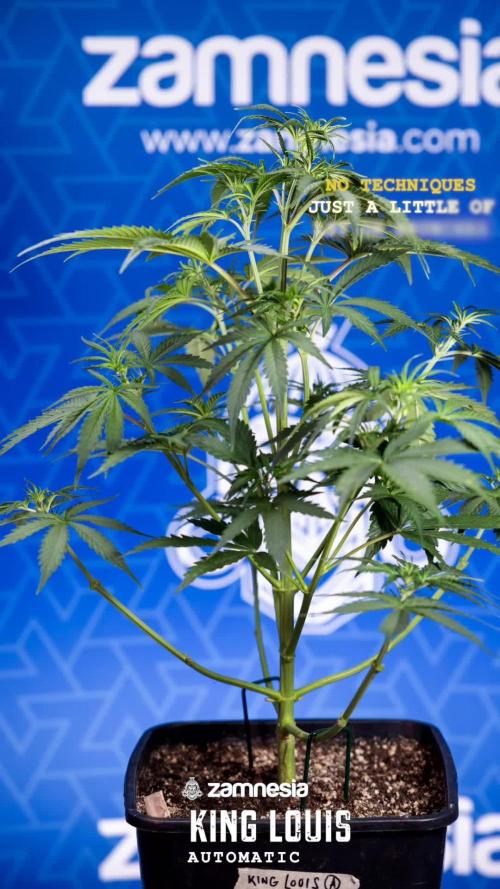
The Blue Dream is a plant that started very well, this specimen has been put at 12/12 for two days but this week I still consider it vegetative.
Remember that we are growing 1 Plant worked with the techniques and one left to grow without cutting techniques I am with a bit of LST.
In this diary we find the plant that is growing straight I would say very well and with only a few yellow tips that often appear at the beginning of flowering probably it is the passage of fertilizers that should be shaded better.
The comparison is the salt of the experience so the plant of the other diary will be worked very differently go and see it to compare them.
We have started the Plagron fertilization program, we are in 100% organic configuration, the soil is recycled Promix + 1/3 fresh soil + 10% Perlite + RQS Mycorrhiza Mix (4 g in the mix, 1 g under the small fiber pot).
We are administering // 1 ml/l Power Roots - 1 ml/l Pure Zym - 1 ml/l Sugar Royal - 3 ml/l Alga Grow
We sprayed Vita Race Foliare 3 ml/l.
https://plagron.com/en
The doubts about the compatibility between Pure Zym and mycorrhizae have been dispelled, they can get along according to Plagron experts. If someone tells you that enzymes eat mycorrhizae, which in principle may seem possible, explain to them that it is not true.
https://www.royalqueenseeds.it/growing/452-easy-roots-mix-di-micorrhize.html
Try this strain it promises more than good ---- // https://www.zamnesia.io/en/3271-zamnesia-seeds-blue-dream-feminized.html
Short Description Zamnesia // Exceptionally tasty and potent, Blue Dream by Zamnesia Seeds is a hybrid with a distinctive and sophisticated character. A blend of Haze and Blueberry strains that manages to bring out the best of both worlds. Its short flowering time of just 9 weeks far surpasses other Haze strains!
You can find the whole world of growing at Zamnesia and much more take a tour of the site and you will find "all the best that nature has to offer" in various shapes and colors.
The new strains are fantastic and the old ones are no exception... p.s. no hermaphrodites so far, can you growers say the same?
You can find the entire world of growing on Zamnesia and more, just take a look at the site and you will find "all the best that nature has to offer" in various shapes and colors.
The new varieties are exceptional and the old ones are no different...
--- // www.zamnesia.com
shorts_status_processing


@BudsBanditUK
Follow
She is now well into flower. A very light smell which is very nice. I am feeding her heavily with no issues so far. Looking forwards to this one.


@Joaka
Follow
aunque la zona tiene la temperatura limite para un optimo crecimiento, van muy bien las nenas

shorts_status_processing


@Secaplanta
Follow
Semana 7 siguen creciendo. Complete con linea top. Hay una que no floro que puede ser?
