


Processing
Likes
Comments
Share


Likes
76
Share


@Nugs_are_us
Follow
Hey all welcome back to sort of week 12 or week 4 of flower!
I have just got home and don’t no what to say...... gold leaf 1 has nanas that seam to have popped and could have wrecked the whole grow 😭
The girls are def hungry as you can see there is some yellowing of the leaves so they will be getting a good feed today and again in 3 days to keep them in the zone. They are stacking up and getting a little fatness to there buds. Frost levels are just starting to kick in and the tent is pungent!!
Well the next few days will be spent watching for signs of any of the other plants turning male on us. Fair to say I’m a little gutted about now as I’m about to chop up a gold leaf that will produce over 4oz of dry buds fingers crossed this diary ain’t over

Likes
16
Share


@GreeneScene
Follow
So I’ve got a fungus gnats problem. Humidity is under control finally. One of the girls is being flushed currently I ran 15g through her 5g pot .
Two other girls are close to where I want them to before I flush I’m waiting for the buds to become dense still.
3 of the girls are finally fattening up the additional liquid amendments I’ve started feeding have certainly helped . I’m still racing against time in one way or the other but I have gained a wealth of experience & have formulated new methods to try in order to get the best results from my style of growing .
The liquid amendments I’m feeding are indeed organic still so no worries 😉 there .
I’m waiting for my yellow sticky traps & rounding out this grow in these next few weeks .
Depending on how long this first girl takes to flush I’ll begin by harvesting 2 plant in a week or 2.
I’m kind of tapped out on this whole posting thing I really was tempted to wait until harvest to do an update . But this is a good journal for me just the same as it is for anywho who stops by so for that reason I’m going to try to stay with it until the end .
Another week on the GreeneScene in the books 📚 rounded out .
Likes
4
Share


@GrowingGiant
Follow
Day 30. Worried about running out of space. I have been tying the plant down perform LST which is helping. Only change in feeding schedule is I have reduced call mag from 5.0 Ml to 3.0 ML and have added big swell by aurora nutrient lines 2.0 ml

Likes
16
Share


@eldruida_lamota
Follow
Vamos familia, hora de cosechar estas gorilla de RoyalQueenSeeds.
No veáis que pinta que tienen las flores están bien formadas y repletas de tricomas.
Estoy deseando probarlas.
El problema han sido las temperaturas las últimas semanas que excedieron los 30 grados.
Aun así salió todo para alante
Agrobeta:
https://www.agrobeta.com/agrobetatiendaonline/36-abonos-canamo
Mars hydro:
Code discount: EL420
https://www.mars-hydro.com/
Hasta aquí es todo , espero que lo disfrutéis, buenos humos 💨💨.


Likes
2
Share

@Ninjabuds
Follow
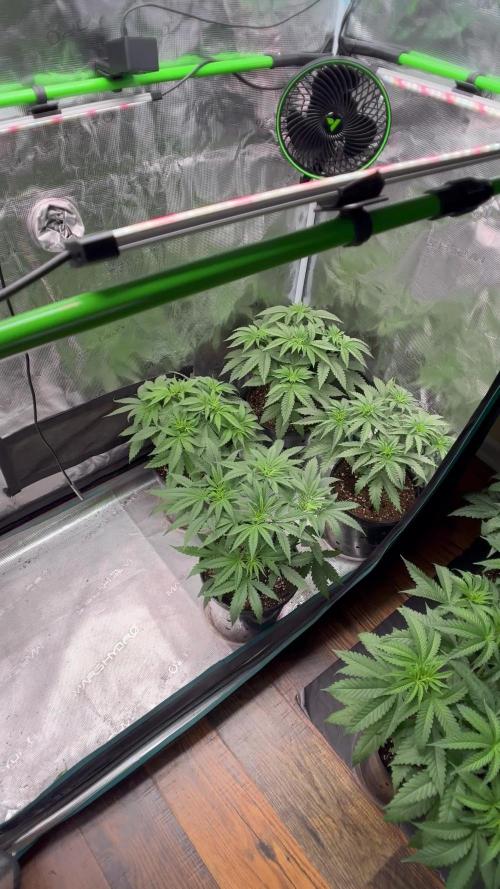
Divine jelly has some really interesting leaves they are pointy and small I can already tell this plant is going to show attributes that are not common. I’m excited to see what kinda exotic looking plant it turns into
It’s day 41 from seed and all of the plants are really thriving
Likes
49
Share


@masterofsmeagol
Follow
IVE MADE MORE VIDEOS BUT THEY JUST DON'T SEEM TO UPLOAD AND IT'S FAR TO SLOW TO DO IT FROM HOME
6/27 Made last week a five day week to get back on track. It's still overcast and rainy. It's not raining a lot bit it's consistent. Despite the weather the plants are doing phenomenal. I'll update later. It's 1pm. It's been raining consistently since 11. Just a sprinkle but it's steady. I'm going to begun uploading the weeks weather on my diary. I may start a new diary for the plants I light depped as they are flowering pretty good. Rain stopped and it's just overcast for now. I looked at some videos and did a comparison of videos one week ago and videos today and HOLY SHIT! WHAT A DIFFERENCE. Especially the light depped 10th planet. Well everything but that was the most significant difference. I'm astonished at the health and growth despite the crummy weather. Continued to rain. Just got harder. Plants are taking it but it's flooding underneath the pallets a little but it will be fine. The light dep however has me concerned. The 10th planet is looking spectacular. The bigger purple punch I'd looking good too. The smaller one though looks to have a pollen sack coming off one of the branches. Considering its not on the otherside I assume it's not just a swollen calyx. I don't mind chucking it especially if that means I don't hurt my other girls so I want to make sure. I sent videos to a few other growers and I'll add a question on here. Those three plants have been isolated from the rest for a few days due to rain. I have the suspect isolated alone until I can confirm. It sucks cause the light Depp was going good and the6ve all got little flowers.
6/28 Well that fucking sucks. ALL THREE plants I tried to light depp hermed on me. I could see male flowers. Luckily I had been keeping a really good eye on them and it was preflowers mostly. At least I caught it. One or two stamines on each plant. Would've been really easy to miss. Only one had STARTED to elongate into a stem so I think I caught it early enough. Plus since all this rain they've been kept in a different location then my big girls. Glad I did that now. Boy the roots looked good on those plants. I just grabbed the stalk and lifted and it came right out of the pot. I held it there admiring it for a minute. This sucks. At least the real plants are doing good. As far as I know. No male preflowers that's for sure. I've got some feedback from other growers and the videos are a little blurry but I had found a light leak and I'm certain these plants hermed. I know I could've tried to save them but I didn't want to risk it. I compared what I was seeing with Google photos and other websites. Aside from the larger ball with its stem, there were also several little bumps besides developed calyxes that were weaving into little buds. Trust me that I wouldn't cut down my plants if I wasn't 110% sure. I might've been able to "save them" but to me it's just not worth the risk.
6/29 I was second guessing myself pretty hard last night due to some responses I got on my light dep and messages I got from other growets. Made my anxiety horrible but I looked on several video's I'd taken again and I know what I saw. I felt better after that. This was after I researched and waited THREE days until I saw the ball on the stem and the groupings of small nubs under a fresh yellow flower. These plants were flowering good and it sucks to lose them. One MAY have been ok but one was a runt and had all the characteristics of a true hermaphrodite. They were only in 3's and I couldn't risk my harvest for an experiment. Still sucks. Oh well. Sun is starting to come out. Plants seem to be doing fantastic. I have one spot on a leaf that looks like a pillar munched on a leaf so I'll probably get the bt out soon as I have a dry day that I can apply it. I'll have to check the weather. I need to start a nute regiment but the plants aren't telling me they need anything yet.
6/30 I fucked up dates or dodnt do it yesterday or it didnt save right so I'm leaving this blank today is the 1st.
7/1 I have still only watered s couple times and I haven't had to feed. This week I'm going to start nutes. I had some external ersonal situations that have kept me from my plants. I'm hoping to get back on track. I noticed some pillar damage so I'll need to dig out the BT. This morning I saw this giant ground hog by my cage. Hated too but had to get rid of him. Of course some of the blowback landed on the leaves of one of my plants. I tried to clean it as best I could. Better than that fat bastard eating everything in one night. I broke a branch either falling around it or bulling through when I was pissed or I LST it the wrong way and the wind broke it against the tomato cage. Nice big branch too on top. I tried to fix it with duct tape but we'll see. The plants need me to spend sometime with them. I need to clean them up. Apply bt and give them their first feeding. I'll update as I go. They don't seem nutrient deficient by any means but I don't think it would hurt to start the nutes.
7/2 Bags were lighter today and if it wasn't going to rain tonight and tomorrow I'd he watering. Plants look great so soil isn't depleted yet I guess. They're growing rather rapidly. The branch I broke didnt make it. Had an idea it wouldn't but I had to try. I waited on the BT on account of the rain. I may go back over and change my mind and water with silica or a mild nute solution or maybe apply the BT. Depends what time I get back. I have some work I need to do over there. There's a few that I need to clean up the bottoms on. Pest damage is minor and limited to one or two plants and a leaf or two only.
7/3 More rain. It was supposed to rain this morning too but it didn't. We got .33in yesterday and through last night so I thought that was ok. Looking back on my previous diaries I'm doing things significantly different than before. I had used a lot more nutes earlier on. This morning I mixed two gallons of 2tsp of big bloom and fed it to the 9 plants in smart pots leaving the container plants as they have much more water in them. Looking back at other diaries I previously had, WPM and septoria by this time not to mention a shit ton of other pests I was fighting by this time. Since I poisoned where the cagexwas multiple times and sprayed the cage before it was moved I luckily don't have that problem yet knock on wood. I'm planning to apply BT tonight to deal with the moth larvae if there are any. I'm looking at plants around this area and im seeimg SOME septoria and pm on raspberry bushes and burdock so it is around. I made sure my cage is not by any other vegetation this year and is sitting on asphalt with the bags on raised pallets. Good thing I did or I guarantee they'd be flooded by now. I've been seeing multiple complaints from maine growers online (AND THEY HAVE HEALTHY PLANTS!) saying this is the worst year ever. Maybe they need a dose of fusarium oxysporum to keep them humble. This is maine. If you don't like the weather just wait five minutes. Meanwhile I'll be doing my sun dance hoping for sun. "Hard to grow cannabis with no sunlight" said another grower on my forum.


Likes
8
Share


@HighOhioAn
Follow
Papaya sherbet what can I say? Has given me a run for my money but the end result is exactly what I wanted. Nice frosty thick: cola beautiful node spacing cannot wait to see how the rainbow melon turns out. Fast buds for life.🔥💯

Likes
14
Share


@ConspiracyFly
Follow
Week 10
Gorilla Cookies Auto (Fast Buds)
Keep getting fatter
Week 10....5 week of flowering (73 days)
It has 64 centimeters
16L
This Week - Defoliation-
Godzilla Cookies (Herbies)
Keep getting fatter
Week 9 Week 3 week of flowering (63 days)
It has 71 centimeters
15L
This Week - Defoliation
Gorilla Glue Auto (Herbies)
It has 25 centimeters
6 Week...1 Week of flowering (38 days)
This Week - LST - Defoliation


Likes
8
Share


@Grow_for_Happiness
Follow
Hot, humid and stormy AF was a good way to describe the past week. Daytime highs were 25-30°C (feeling like 35-40°C) with almost daily thunderstorms in the evenings. Heavy winds, downpours and even a bit of hail to spice up the mix! The girls stood their ground and weathered it all. But then again when you have legs like these two it's hard to get knocked down. Stalk and branches are all thickening up nicely, hoping this means will be able to handle the bud load without netting this year 🤞. Watering every 48 hours and feeding once a week with Reefertilizer Grow. Regular waterings are soaking the pots with a garden hose for a good 3-4 minutes each, and feedings are 12L of nutrient mix on Fridays.
Probably have to do a defoliation this week before these girls push into flower, the insides are getting quite dense.
Happy growing!

Likes
2
Share


@BigGGrows
Follow
she is pushing through the initial HST fimming very well. Nothing seems to slow her down. I am starting 1/4 strength nutes now to help her push through the stress. I also initiated some LST and tied her up, pulling down the branching. The fim job has produced a tripple top crown cola, top new side tops, and 2 new internodal branches, that will be tops down the line. Things are getting interesting folks! Stay tuned!


Likes
82
Share


@WhiteEdge
Follow
23.04.2024
Continue into week 8
Replaced all filters in the system and cleaned them.
Mixed a new batch with the following components:
20+25ml AN Connoisseur Bloom A+B
Total volume: 34 liters
Electrical Conductivity (EC): 1.0
Target EC for this week: around 1.0. Adjustments will be based on plant observations.
Performed one long misting session (3 minutes).
Environmental Conditions:
Outside temperatures going up, today is raining but this week start higher temps and humidity
Wedding Cheesecake: One girl is gonna finish in this week, Two others probably in next. Frutti terps in this, Two pheno in total from 3 girls'
Tropicana Cookies: Phenomenal strain; One girl is going to finish this week and second couple days after . Two pheno in Tropicana's girls
Purple Lemonade: Tall plants, massive producer, all three girls will be in 9 week provably. Here so far all three girl share same characteristics and bud structure
Beautiful and high odor in the room!
Lighting Parameters: PAR Map: Maximum PPFD is 950, minimum PPFD is 650.
VPD: Ranges from -1.1 to -1.2.
Daytime Temperature (DT): 23-24°C.
Nighttime Temperature (NT): 19-20°C.
Leaf Temperature: 21-22°C.
Light Distance: 45-55 cm from the plants.
CO2 Levels: 700+ ppm.
HLG Scorpion Diablo: Set at 70%, positioned at a 45-55 cm distance.
Girls drink less water, so for this week and till the end of flowering new misting timing's
Daytime: ON for 70 seconds, followed by 30 minutes OFF.
Nighttime: OFF for 70 seconds, followed by 35 minutes OFF.
Nutrient Tank (NT):
pH: Maintained between 5.80 and 6.00. Stable PH, small drifting up and downs
EC: 1.05.
Temperature: 19-21°C
25.04.2024
TrolMaster toys arrived! Purchase new DST2E, DSP2E, DSH2E, AMP3+probes. Another DSH2E and DSP2E ordered to complete this grow box!
Replaced all filters in the system and cleaned them.
Mixed a new batch with the following components:
25+30ml AN Connoisseur Bloom A+B. Total volume: 17 liters
Electrical Conductivity (EC): 1.05
Tomorrow Tropicana Cookies harvest! Put bucket with this girl on separate line for flushing
Wedding Cheesecake also finish soon, probably in next week, Wednesday think...
Purple Lemonade still need full week or more...Exceptional odors
Temps and humidity otside start to raises, hope i will finish this run before Tropical heat
Lighting Parameters: PAR Map: Maximum PPFD is 950, minimum PPFD is 650.
VPD: Ranges from -1.0 to -1.1.
Daytime Temperature (DT): 23-24°C.
Nighttime Temperature (NT): 19-20°C.
Leaf Temperature: 21-22°C.
Light Distance: 45-55 cm from the plants.
CO2 Levels: 700+ ppm.
HLG Scorpion Diablo: Set at 70%, positioned at a 45-55 cm distance.
Daytime: ON for 70 seconds, followed by 30 minutes OFF.
Nighttime: OFF for 70 seconds, followed by 35 minutes OFF.
Nutrient Tank (NT):
pH: Maintained between 5.80 and 5.95. Stable PH...
EC: 1.05.
Temperature: 19-21°C
26.04.2024
Connect TrolMaster components into the Tent-X system. Program DSP2E, Temperature DST2E, Humidity DSH2E, as well as the AMP3 sensor with PH and EC probes, are all in place.
After calibrating the probes, AMP3 module works perfectly! It has a quick response in measurements, is accurate, and I am very happy about the possibility of online monitoring of liquid values.
After day off use i can tell that all readings are very consistent, compared with Milwaukee, totally without all over the place measurements. Perfectly steady and on spot receding!
The Program device runs flawlessly all day, and I hope it has solved all the problems I had with DH48-S timers.
The humidity control operates without errors throughout the day, and it’s nice to see in the app when the module is active.
Raise light as much as i can..50-55cm from canopy. Set off misting time from 30min to 35min @ day time , and from 35min to 45min @ night time
Flush Tropicana Cookies' for one more day, tomorrow harvest, prepared tent for drying with humidifier , ventilation and temperature and humidity controllers
PAR Map: Maximum PPFD is 850, minimum PPFD is 500.
VPD: Ranges from 1.0 to 1.1.
Daytime Temperature (DT): 23-24°C.
Nighttime Temperature (NT): 19-20°C.
Leaf Temperature: 21-22°C.
Light Distance: 45-55 cm from the plants.
CO2 Levels: 700+ ppm.
HLG Scorpion Diablo: Set at 65%, positioned at a 50-55 cm distance.
Daytime: ON for 70 seconds, followed by 35 minutes OFF.
Nighttime: OFF for 70 seconds, followed by 45 minutes OFF.
Nutrient Tank (NT):
pH: Maintained between 5.80 and 5.95. Stable PH...
EC: 1.05.
Temperature: 19-21°C
28.04.2024
First harvest in this run! Tropicana Cookies No1 is a winner.) First Tropicana Cookies is harvested on 89 day from seed. Total 55 days off flowering.
Fast flowering indeed as fast in vegetative stage. Cut this girl in branches and hang upside-down in smaller tent for drying
Set RH @ 55% , temperatures not able to control so they will be something around 20-21 in drying tent
Second Tropicana will be chopped within a couple off days. Checking trichomes with microscopes can tell that one Purple Lemonade is also going to finish in next days
Somme lady's will take full 9 weeks or so..
Lowering light intensity, EC in tank start to raise slowly so i will start to adjust according to condition. Currently 0.85EC is perfect strength i think
PAR Map: Maximum PPFD is 850, minimum PPFD is 550.
VPD: Ranges from - 0.9-1.0
Daytime Temperature (DT): 23-24°C.
Nighttime Temperature (NT): 19-20°C.
Leaf Temperature: 21-22°C.
Light Distance: 45-55 cm from the plants.
CO2 Levels: 700+ ppm.
HLG Scorpion Diablo: Set at 65%, positioned at a 45-55 cm distance.
Daytime: ON for 60 seconds, followed by 30 minutes OFF.
Nighttime: OFF for 60 seconds, followed by 35 minutes OFF.
Nutrient Tank (NT):
pH: Maintained between 5.80 and 5.95. Stable PH...
EC: 0.85.
Temperature: 19-21°C
Week 8 off Flowering in Summary
80 litter off RO water,
120ml+150ml AN connoisseur A+B
45kW electricity in total for light, Pumps and AC Infinity Fans. 42kW for Light + 2kW Dehumidification + AC Infinity ventilation
Week start @ 1.1EC, nutrient strength., week finish with 0,87EC
Tropicana Cookies is first harvested on day 89 from sprouting , week 8 off flowering
Purple Lemonade is going to be on second place with harvest on day 91, last day off 8 week off flowering
PH was stabile and move from 5.70 min to 5,9 max.
Light distance for this week - 50-55cm from tallest top , PPFD levels around 900 in center, trough whole week. Lowest reading 500 @ corner
Temperature are from 20c at start off day to 24.5c max at some points.
Night temps around 19.5-20c. Outside humidity is generally low
This week i have install TrolMaster AMP3 sensor and humidity, temp and program devices
Day RH is moved from 45% to 55% max, at night times drop to 45-48%
Lighting Parameters: PAR Map: Maximum PPFD is 900, minimum PPFD is 650.
VPD: Ranges from -1.0-1.1.
Daytime Temperature (DT): 24.5°C.
Nighttime Temperature (NT): 20°C.
Leaf Temperature: 22°C.
Light Distance: 45-55 cm from the plants.
CO2 Levels: 700+ ppm.
HLG Scorpion Diablo: Set at 65%, positioned at a 45-55 cm distance.
Daytime: ON for 70 seconds, followed by 25 minutes OFF.
Nighttime: OFF for 70 seconds, followed by 35 minutes OFF.
Nutrient Tank (NT):
pH: Maintained between 5.8 and 6.1
EC: 0.87-1,1.
Temperature: 20-21°C
Likes
8
Share

@DimJesus
Follow
Elas crescem tão rápido 😅
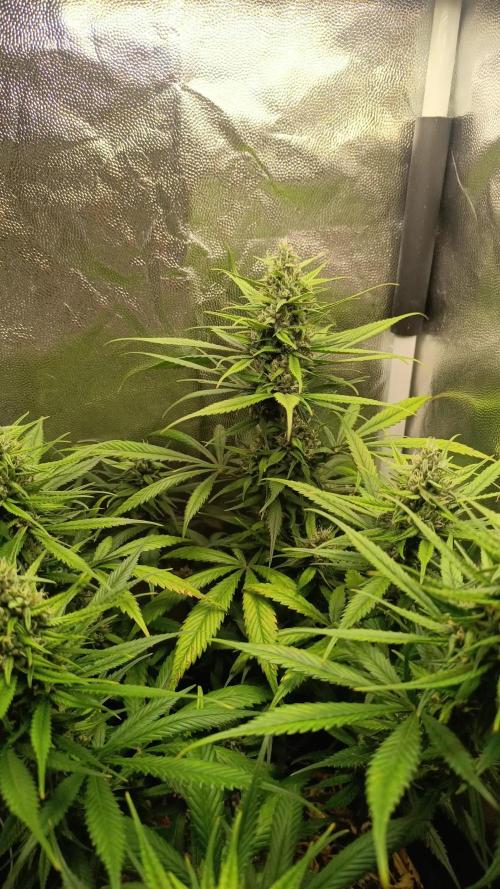
Ainda estão esticando um pouco mas somente os top buds. A da estufa pequena está aparentemente mais gorda e os pistilhos são maiores, já a que tá mais perto do zíper na estufa grande parece ter buds menores só que mais densos e mais bonitos, com muitos botões, já a que tá atrás dela parece ter buds mais alongados, bastantes pistilhos igual a outra só que muito mais alongados.
A da estufa menor tá mostrando sinais de exceso de potasio, Acho que é isso por conta da cor das manchas nas folhas, acredito que seja da última rega que fiz pq eu coloquei bastante astro flower e o regulados de PH também é potasio, a última rega que fiz foi sem ferts e a próxima também, já consegui diminuir bastante a concentração de nitrogênio, acho que o verde já não está tão escuro e as pontas das folhas dobrando para cima de volta, acho que eu poderia ter colocado menos fertilizantes na última rega mas eu queria muito atingir os 1.000 ppm, as da estufa grande parecem estar gostando bastante da concentração e até agora não tem sinais claros de toxidade, somente a que tá sozinha tem manchas meio roxas em algumas folhas, fora algumas queimaduras amarelas por causa do nitrogênio que já resolvi.
Eu acho que a diferença de tamanho nos buds é por causa da altura que o painel tava, então preferi sacrificar a temperatura e descer o painel até um palmo de altura e aumentar a potência, espero que valha a pena, acredito que o PPFD tá batendo 1.000 no ponto mais alto, o painel da estufa pequena sempre esteve baixo e na verdade eu tive que subir uns 8 cm mas o driver fica fora da estufa e por ser de apenas 65w ele não esquenta tanto assim, já o da estufa grande é um painel de 180w (funciona a aproximadamente 80% da potência pq é muito quente e gasta bastante energia 😭) que esquenta bastante e o driver fica dentro da estufa e faz ficar mais quentes ainda. Acho que o painel estar perto foi uma vantagem que a outra sempre teve mas não consigo saber pq ela tem tanto sinal de toxidade e as outras não, mesma água e quantidade de ferts, enfim, continuo aprendendo bastante com essa safra e planejando melhor o que farei nas próximas, ter 3 plantas da mesma genética e todas serem diferentes uma da outra é muito bonito, não somente a diferença aparente como também a diferença de necesidades. 💚🌱
Likes
12
Share


@Greenys
Follow
Ec intake 3.0
Ec run off 2.9
Ph intake 5.8
Ph run off 5.6
Week 4 flower today Iv hit 3.0 now il slowley push back unless the lady’s are asking for more 🤩
VPD 1.3 KPA average
Looking forwards for week 5 transformation
🎸 where jamming
Likes
8
Share


@FirstTime97
Follow
Week 7 seems to be going fine from my house and then I go to the grow 🤣 well fukc me I’ve ran into few problems let um get abit too dey for their liking the week leading up to Christmas / gave um a good feeding with week 7s nutes and peeled back abit of the fan leaves to get more light around , humidifier broke on us didn’t notice for 2 days so tent was 70 percent humid when gone to check , new humidifier replaced and back on track as I said earlier peeled back a few fan leaves think maybe a few too many plants started showing signs of stress soon after again these are autos and I think it could of stunted if not heavily affected the end product also we noticed about 3 weeks into this grow we had way too many plants in the tent starting to see the effects off that now a lot of nonsense on the lower branches and only really the top Lola’s getting the light and the mass , all the same seed bar 4 plants and very differnt plants all in all , definitely not a strain that’s been mastered about half are tall and spaced out and the others are short and very stacked from my own eye I’d say the shorter and more stacked buds will be the ones bearing more fruit the taller ones look very skinny and airy still

Likes
25
Share


@Dingle_Dangle
Follow
14/07/2022 - Day 56 - First day of the 9th week.
Some nut burn. Flushed today.
Wish me good luck and let's hope in sunny mild days 🤞☀️
- DD


Likes
4
Share


@UrbanBoer
Follow
Talk about a mission accomplished, dam you Lamby… you had me excited at one point when I thought you were an auto, but to my shock, you are a regular, you just have a long ass flowering window… at least unlike her sisters within the 4th cycle, she did not reveg she just focused on flower, the buds are bulky and firm, scent is amazing, you would mistake her for a cheese strain. I should not be disappointed by the plant’s size! Because I planted her during winter, and all outdoor or greenhouse(unless you have a GH that is climate controlled), do not grow as big as the would during spring or summer season, and due to this factor, I only got 59g of wet bud. But I have faith the other ladies will produce a higher yields.
Last I smoke this strain was earlier late summer or early Autumn, and from smoking to growing now harvest, I wish I am blown out the water with this strain, it’s time to conduct that questionnaire. Or even better go to an established cannabis club, and get them to samples bud, and ask for a review.
Likes
17
Share


@Lazuli
Follow
She got slowed down a lot because she was grown during winter in temperatures between 16 and 20 celcius