





@HUMO_Cultiva
Follow
Update week 1 day 4 of bloom , this week we put the net to make the technique that calls scrog we see next week what is the resul



@HoneyBlunt42
Follow
День 44
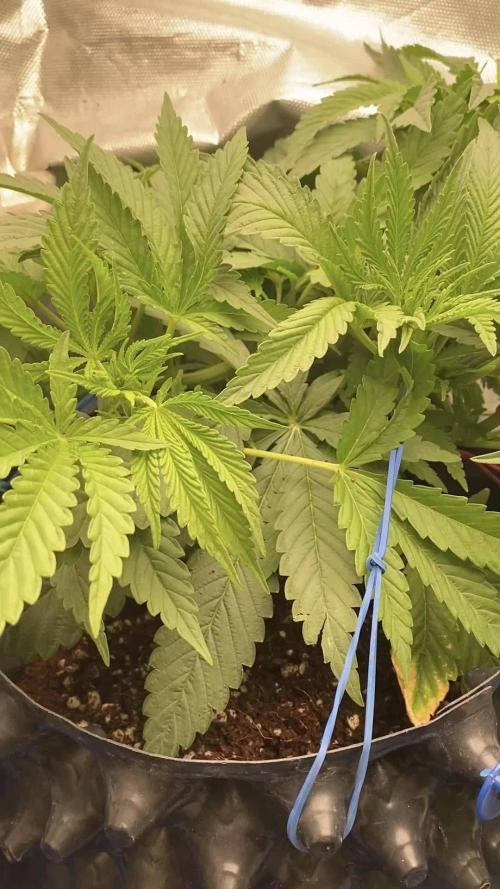
Красивый предцвет, вторая неделя. Лопухи размером с ладонь. Сдерживаю рост канцелярскими резинками. Пригибаю раз-два в неделю.
У меня появился BioBizz RootJuice для корней. На предвеге его еще можно добавлять - раз в неделю пролиаваю 2 ml/l. В остальном ратвор целиком по Simplex Coco.
Навожу раствор в AquaPot (15 л).
Сперва 13 л вода осмос. В нее:
-CalMag - 1 ml/l.
-Затем спустя минуту SillicX - 0,25 ml/l.
-После этого разведенные в литрушках Simplex Coco A и Simplex Coco B - в итоге выходит 2 ml/l раствора (30 ml part A в одну бутыль 1 л и 30 ml part B - во вторую литушку).
-Потом Simplex PK Boost - 1 ml/l.
-Затем Simplex Taste в бак - 1 ml/l.
-Simplex Aroma Punch - 1 ml/l.
-Simplex Fulvic Gold - 1 ml/l.
-Simplex pH down - 1 ml/l.
Даю настояться несколько часов с аэратором перед поливом.
Заметил, что за 4 дня на камне для аэрации наросла слизь.
Возможно, Simplex Taste и Aroma Punch стоит проливать отдельно от основного раствора.
День 47
Растения активно развиваются на второй неделе предцвета. Раз в две недели пригибаю и растягиваю ветки. Это притормаживает рост кол, и они равномернее распределяются по боксу. Визуально состояние - выглядят хорошо, без дефицитов.



@Chubbs
Follow
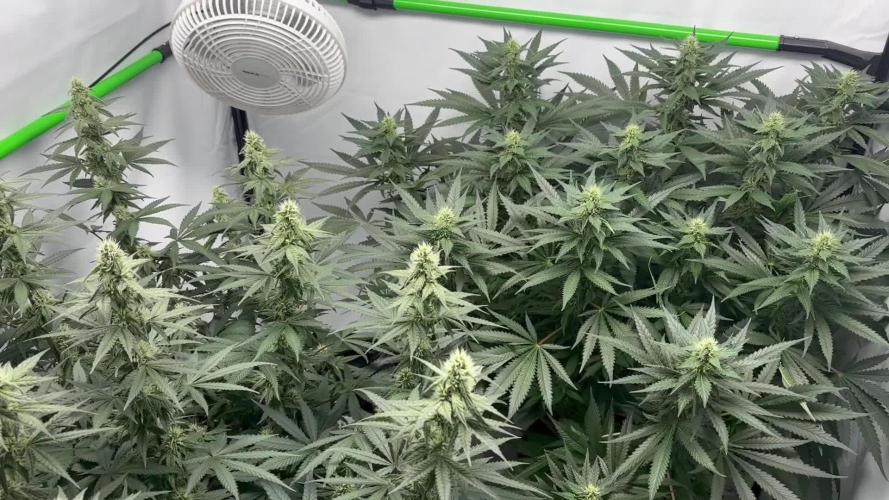
What up Fam, I apologize for the late update. Been away for 2 weeks from the ladies and my son who was watching them did amazing, as I came back to an absolute forest. The plants almost doubled in size which is crazy the growth they had while I was gone. I started adding bloom nutes and did a defoliation and lollipop this week. I'd normally start my training around week 3 but over all they're happy and healthy as can be. Let's Go Happy Growing.



@PharmaZ
Follow
Saturday 25th July (day 28) 9pm
This time I could be home at lights on so they will have a mixed feed with a little PK.
EC still low and will be upping the base nutrients starting tomorrow.
0.5ml/L - Nirvana
0.5ml/L - Calmag
1ml/L - Canna A&B
0.5ml/L - Big Bud
0.5ml/L - Big Fruits
0.5ml/L - Growzyme
PH5.8 EC1.1
Run off BBM PH6.5 EC0.9
Run off Cheese PH6.5 EC0.7
Sunday 26th July (day 29) 9pm
5L of nutrients made.
It is nice to be able to feed when the lights come on makes a massive difference in my management of this grow.
Hopefully fingers crossed and praying to God we can get to harvest.
In a few weeks i have some time off so i can really try to dial it all in.
1ml/L - Nirvana
0.5ml/L - Calmag
1.5ml/L - Canna A&B
0.2ml/L - Big Bud
0.5ml/L - Big Fruits
1ml/L - Humic Acid Plus
PH5.8 EC1.2
Run off BBM PH6.5 EC1.3
Run off Cheese PH6.5 EC0.9
Wednesday 29th July (day 32-39)
1ml/L - Organic Bloom Liquid
2ml/L - Big Bud
1ml/L - Big Fruits
1ml/L - Fast Buds
2ml/L - Humic Acid Plus
PH6.2 EC0.9
Run off BBM PH6.5 EC1.2
Run off Cheese PH6.5 EC1.1
The above feed is to offset the nitrogen in the coco. I have been adding EcoThrive charge too much which has cause lockout due to excess nitrogen in the soil, at first I thought it could have been PK but some research and listening to Brandon Rust I have come to my conclusion that it is a nitrogen toxicity. I was adding far too much organic microbes and supplements.
Basically nitrogen locked out Calmag that caused tip burn, the plants or on the edge of a nitrogen toxicity but because they’re in Coco and have had a mixture of organic and synthetic the organic side has acquired to much nitrates locking out calcium to the tips of the leaves
The BBM has had tip burn the cheese looks too green, both are dark green but the Cheese has more foliage to store the nitrogen hence why little tip burn but more of a vegetative colour, the BBM has hardly any fan leaves left after a strip early in flower. I also think I defoliated too early, but then to second guess I believe if I didn’t feed to much organics the flowers would be much further along.
After the previous 2 feeds I can notice the buds picking back up again. Hopefully I can continue with this mix I’m using now and get some consistent bud growth over the next week. I’ll be glad when this one is over. The summer heatwaves are just tiring when you’re growing especially in coco.
I remember years ago I had issues like this and I said to myself never start a grow in the summer…
https://www.youtube.com/live/qbeT6JAbMe4?is=QqnXHUBAE09fLDUQ
Thursday 30th July (day 33)
1ml/L - Organic Bloom Liquid
1ml/L - Big Bud
2ml/L - Big Fruits
1ml/L - Fast Buds
2ml/L - Humic Acid Plus
PH6.2 EC0.7
Run off BBM PH6.49 EC1.2
Run off Cheese PH6.47 EC1.0
Messed up my measurements a little and only realised after. Big Bud I only put 1ml/L and big fruits I did 2ml/L should have been the other way round…
Otherwise looking ok, returned home the temp was 35c and humidity 78% that is not good…
Tomorrow I will try to get everything In order again, still going to feed this current program for another week, then I will go back to a more balanced feed using more organics for the final push.
Friday 31st July (day 34)
1ml/L - Organic Bloom Liquid
2ml/L - Big Bud
2ml/L - Big Fruits
1ml/L - Fast Buds
2ml/L - Humic Acid Plus
PH6.0 EC0.9)
Run off BBM PH6.49 EC1.3
Run off Cheese PH6.47 EC1.0
Saturday 1st August (day 35) 2am
Scraped the top layer of coco exposing roots, applied some great white after doing another flush and feed.
As you can see I’m imputing a low EC and the run off is gradually spiking up everyday.
Only way to reduce it is to do massive amounts of nutrients.
2ml/L - Organic Bloom Liquid
2ml/L - Big Bud
3ml/L - Big Fruits
1ml/L - Growzyme
PH5.9 EC1.1
Run off BBM PH6.35 EC1.8
Run off Cheese PH6.35 EC1.3
2nd time
Run off BBM PH6.25 EC1.8
Run off Cheese PH6.2 EC1.1


@d0cterstrain
Follow
appreciate the stretch. love hot the stretch filled up the room. mid week 2 lezgoo


@Psicultivo
Follow
Ya paso a la tercera semana de floración, todo va bien hasta el momento, fertilice 2 veces seguida y solo 1 vez con agua esta semana, senti visualmente que le faltaba nutrientes y aun siento que le faltan 😂 saludos!


@valiotoro
Follow
Week 4 has passed✔️
They double in size every week😳
We are now in the preflowering stage they seems to be happy with the LST & Topping✂️
Next week i will cut the nitrogen & start with the bloom nutrient🔥
Take care 💚


@chapadux420r
Follow
Wassuuuup my dudes
21 days into flowering and the results from the lst and defoliation are showing up. Multiple healthy tops and even the small nodes under the canopy are growing bigger, if all goes well I won’t have many popcorn nugs but I’ll have just big buds (let’s hope)
I guess this also means they won’t stretch much more but I think some more height would be good for yield, anyway, can’t complain for the 1st grow and this is a process, there are no perfect grows!
This week was also a week to add some more nutrients (the plagron) and it’s working very well for now!
Let’s wait for the next few weeks, can’t wait to see the fatty buds 😂
Tell me what you think!


@sellem
Follow
Starting week 6 off with a watering of 2,5L, still only grow, bit of rootjuice to fade it out, and activera. No Calmag and a lower dose of microbes - though the Afghan Kush shows signs of a very early calmag def, so ill add some next time again to be on the safe side.
Also, Flowering is underway!!! Will introduce flower ferts for the next watering with both. Also, watering both at different days now - the blueberry drinks way more than the afghan.
Today on 22/12 was the last training and HEAVY defoliation session for the blueberry - she was growing reeeeal bushy and has tight internodial spaces. Getting her ready nice and sexy for her flowering look!
The afghan kush not so much, i sparingly LSTd her but she is growing just "how i like her". Not much training needed in my eyes. The blueberry had overlapping leaves and flower stems.
Also changed the light cycle back to 18/6
on 25/12 watered both with 2,5L, phased out rootjuice for good, added flowering ferts and 0,5ml/L of calmag. i have to ramp up the dose to 0,8 or even 1ml/L next time, since both are showing deficencies of what i would attribute to calmag. Grow rate is good, buds are really starting to form. See you next week!
shorts_status_processing


@ganjaman24
Follow
It’s bern roughly two months these guys have been growing! Lst’d Both but untied the gg because I wasn’t sure she was benefiting from it so I’m going to do it over. These ladies (I hope) will start their flower journey next week when I revive my new flower tent 😎..stay tuned for some epic buds..I hope!!


@Drebor
Follow
One week after the DE cover up and the gnats dropped considerably.
The plants were topped and kept growing without any stress.
Still watering on bare minimum.



@AestheticGenetix
Follow
Chopped and dried 7/8 of the females so far. All sorts of terps and flavors. Stanky rotten to perfumey chemical to intoxicatingly sweet to chemical earth
Check out my YouTube for long form content that I can't post here
https://youtube.com/@aestheticgenetix?si=pSk5e-kvp-nVYccc
I also have a review video up if interested of the super sour double diesel. It got age gated so you might have to look for it. But it's my most recent video(as of the time I typed this)


@Gromie
Follow
Continued w/ the feeding schedule for this week. I used about 1.5-2 solo cups of water for this 1 gal fabric pot. Just enough to have the coco wet.


@Sators
Follow
Add slightly nutrients. Day Nr 16 doing topping. Nutrient tank with capacity 10L turning little bit in alkaline, at the beginning I added 3ml ph down and reach 6.4 pH, than now it’s inccrise to 6.6 on 5 days time. Same I can telling about TDS. At the beginning it was 350 ppm, but now it’s step up on 400ppm without adding nothing. Day 18 start moving out new branches from places around where was topping. Keep watering with 1.5L with slight nutrients dosage… Day 20 we can see how flower keep moving ahead after topping days ago…



@Ultraviolet_
Follow
Turned off IR @ nights
Red wigglers (Eisenia fetida) are highly beneficial. They are considered an ideal choice for "no-till" or container-based organic growing because they live in the upper layers of soil, feeding on organic mulch rather than the plant's root system. Red wigglers accelerate the breakdown of organic amendments and produce high-quality, nutrient-dense worm castings directly in the root zone. Clover is another exceptional component of an organic rhizosphere, offering a sustainable, self-sustaining alternative to synthetic nitrogen fertilizers produced via the energy-intensive Haber-Bosch process. By forming a symbiotic relationship with Rhizobia bacteria, clover converts atmospheric nitrogen N2 into ammonium NH4, providing a steady, slow-release nutrient source that enhances soil health and reduces environmental impacts. Red clover offers superior nitrogen fixation and biomass production compared to white or yellow clover, making it the premier choice for maximum soil vitality, particularly for improving soil structure and providing a high-volume nitrogen credit for subsequent crops.
If it is fully functional and efficient soil, the rhizophagy cycle is far superior long-term than any synthetic delivery when it comes to preventing deficiencies, not because it's "better," per se. The medium will require a very high CEC to make it to harvest without re-fertilization. The rhizosphere acts as a dynamic, interactive exchange where plants and soil microbes trade resources based on immediate needs. When a plant lacks a specific nutrient, it changes its physiology and releases specialized chemical cocktails—root exudates—into the surrounding soil. These exudates, which include sugars, amino acids, and organic acids, serve as a "shopping list" to attract specific microorganisms, which in turn return higher levels of desired nutrients. There is nothing in comparison to synthetic delivery, which causes plants to stop producing exudates, effectively "starving" the beneficial soil life, over time turning the soil barren and void of microbial life. Responsible use, applying the right amount at the right time, can minimize these negative effects. Relying solely on synthetic fertilizers without replenishing organic matter is what typically leads to exhausted soil. The use of synthetic fertilizers can utilize the Cation Exchange Capacity (CEC) of the soil, but without a robust rhizosphere and active microorganisms, the efficiency of this process is significantly reduced. This makes synthetic growing more difficult to prevent deficiencies overall compared to an efficient organic living soil with a robust rhizophagy cycle, as there is no "one size, fits all" when it comes to different nutrient profiles of strains/genetics, making it trickier to "guess" and prevent creeping deficiencies.
CEC does not contribute towards EC. Add more CEC using biochar, problem solved. If you keep pH between 6.3 and 6.7, hydrogen is exudated to cycle the medium's CEC for its needs. Keeping the pH between 6.3 and 6.7 creates an environment where plants release H+ to displace positively charged nutrients (like Ca2+, Mg2+, K+ held on soil particles or within artificial media this cycle through nutrients via the medium's Cation Exchange Capacity (CEC)
Microorganisms generate a stable potential of approximately 0.5 V EC. The rhizosphere creates its own food, similarly to chelation, using 1000's of varying combinations to create its own food.
Start to finish, just add water. Eventually, more materials will need to be added at the beginning of each new grow, but very attainable to go from seed to harvest without ever fertilizing, regenerative cultivation.
ATP is king above all else when it comes to biomass accumulation. Cellular root respiration and cellular respiration are essentially the same biological process, the breakdown of glucose to create usable energy (ATP) in the presence of oxygen, just taking place in different parts of the plant. Synthetic (salt-based) grows have significantly lower levels of total rhizosphere respiration, often referred to as root-zone activity, compared to organic living soil grows. While the plant roots themselves may respire in both systems, the surrounding soil ecosystem in a living soil setup is vastly more active, teeming with bacteria, fungi, and beneficial microorganisms.
2 pools of ATP, it won't double in growth buuuut, but improving root respiration by ensuring high oxygen in the soil is crucial. Good aeration ensures roots can fully utilize glucose to generate the ATP necessary for nutrient uptake, leading to healthier and more productive plants, even if growth isn't exactly doubled. The ATP created using root respiration is dedicated to rootzone growth; the ATP created using regular cellular respiration in a synthetic system would have to dedicate a lot of ATP to the roots when there is little or no root respiration. It's true that there is less of an initial ATP cost in breakdown when nutrients are already in their final form (synthetic), but you lose a solid chunk of ATP when the entire plant is reliant on cellular respiration alone; a large portion of ATP is dedicated to root zones for "forced" (active) nutrient uptake. Making it overall less efficient, even if the initial cost of breakdown is higher. If that makes sense. Oxygen is of critical importance when growing in living soil compared to synthetic methods because it supports the metabolic needs of the microbial, fungal, and insect ecosystem, rather than just the root respiration required by the plant itself. While synthetic grows can survive in lower-oxygen environments with precise mineral feeding, living soil systems rely on aerobic microbes to decompose organic matter (microbial mineralization) to create plant-available nutrients, which is an oxygen-intensive process. While a specific fair percentage is difficult to guess, my experience points to a massive, compound difference between the two methods and the amount of oxygen required. All the ATP spared is used on more biomass, not only that, but the extra root respiration can achieve a much higher CO2 compensation point naturally than you could with synthetic and atmospheric CO2 alone.
As a plant grows faster and increases in size, its demand for nutrients to support that growth increases, requiring a higher rate of nutrient uptake. As plants enter phases of rapid vegetative/floral growth, their metabolic demand for nutrients increases exponentially. Without a robust buffer zone—whether in the soil (cation exchange capacity) or in a hydroponic reservoir—deficiencies will occur rapidly because the instantaneous demand for specific nutrients can quickly exceed the rate of supply.
A growing body of evidence suggests that organic living soil provides superior long-term soil health and environmental benefits compared to synthetic fertilizers, which are often criticized for promoting a cycle of dependency and degradation. While synthetic fertilizers offer short-term convenience and high yields, they often come at the expense of long-term soil health, sustainability, and increased corporate control over growers/ farmers. Organic living soil, while slower and requiring more care to establish, creates a sustainable, resilient, and, ultimately, more fertile environment.
We don't grow; we facilitate energy conversions.
Once all water is removed, approximately 95% to 97% of a plant’s dry matter consists of carbon, oxygen, and hydrogen. These three elements form the structural backbone of all plants. Corporate interest sells you the other 3-5% NPK & all the rest in RATIOS! Why not throw the 3-5% in a pot, and focus your energy on the other 95-97%?
Indigenous Amazonians created, or at least significantly enhanced, the fertile, dark soil known as Terra Preta de Índio (Portuguese for "Indian Black Earth") by incorporating biochar and other organic materials into the soil. This anthropogenic (human-made) soil technique, which dates back roughly 2,500 to 8,000 years, allowed ancient civilizations to flourish in regions with naturally poor, acidic, and nutrient-poor tropical soils.


