


Likes
Comments
Share


@HikeHigh
Follow
Fun grow, treated each plant with a different growing techniques - Fim, Top, Lst, super-cropping, etc. Surprised on yield using basic $130.00 Bestva. Dry weight over 1/3 of a pound. They hung for 5 days. I put time into flushing and Trichome viewing, willing to sacrifice THC content for a more energetic medicine. I nailed the harvest based off of partly/mostly cloudy trichs(pic above). The weed is gas, top-shelve, better than the 21.5% thca GC I purchase through dispensary. Very, Very pleased with results. Biggest mistakes made on this grow: 1) 2 initial pots too small for 10 week veg requiring a tricky late veg transplant. 2) not using cal/mag in mid Veg. 3) allowing humidity to drop too low while drying buds in tent - final product is a little brittle.


Processing
Likes
6
Share


@Mr_nugs_lover_David
Follow
Looks so beautiful and smells even better, so in love with this strain, has surprised me a lot, I would love to grow her again, very nice plant, maybe not the best in yield but quality is assured. 🤤💎🌱

Likes
15
Share


@Satax
Follow
Geeting big!!
Try to defo under the back plants but very difficult to acess there…

Likes
4
Share

@eldruida_lamota
Follow
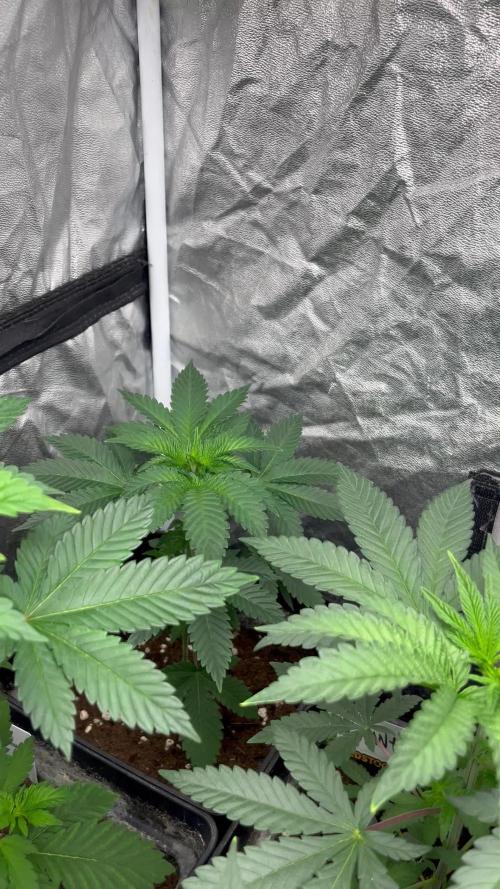
Que pasa familia, vamos con la quinta semana de vida de estas Monster Maker feminizadas de Sweetseeds.
Vamos al lío, las plantas se trasplantaron a macetas de 7 litros.
El ph se controla en 6.5, la temperatura la tenemos entre 24/22 grados y la humedad ronda el 70%.
El ciclo de crecimiento puse 20h de luz, el foco está al 50% de potencia.
Me gustaría estar más encima este cultivo pero la salud me está impidiendo un poco este 100% con el proyecto. Con suerte la semana que viene andaré mejor.
- os dejo por aquí un CÓDIGO: Eldruida
Descuento para la tienda de MARS HYDRO.
https://www.mars-hydro.com
Hasta aquí todo, Buenos humos 💨💨💨


Likes
24
Share


@Wicked_Stix
Follow
Day 35 is here. We are a week into flower and most the plants are just starting to hit that flowering stretch. I have been bending them down a little every couple days, but I need to focus on cleaning up some of the bottom branches so we can keep good air flow through the plants. Will work on that through this next week. I haven't done a water change, just been topping off the reservoir with fresh nutrients as they drink it up. Feeding half and half maxigro and maxibloom. Will cut out the maxigro in a couple weeks when I notice their stretch slowing down. I had a plant overflow this week because the drain line is getting full of roots. I noticed a couple roots have made their way into the reservoir already. I set a pump timer to 1 minute on and 20 minutes off so they can drain properly. I would like to make it through the grow without having to mess with the drains, but we will see what happens. I will make some modifications if needed. Other than that everything is running smooth and I hope we have some little pistils to show by next week. Thanks for stopping by ✌️

Likes
25
Share


@Kikiwindsurf
Follow
I cutted off the main cola of GG accidentally, so we have GG LST, GG LST + topping and LH growing naturally.
Rain days/no sunny days they stay indoors as u can see. (20hours indoors 400HPS and 12 hours outdoors direct sunlight)
Gonna decrease nutrients because of the apparence of the leaves, "plastic leaves effect" let me know what u will do in comments ! DAY 39 AND 40 GORILLAS AND DAY 30 LH
18/04/2020 day 35 of LH and day 44 and 45 of the gorillas. They starting the full bloom and swating crystals. Smell increased considerably. I water more nowadays because she drinks a lot ! enjoy todays vid in the terrace :D

Likes
55
Share


@Roberts
Follow
Fruity Pebbles autoflower #1 is growing great. She love the Medic Grow Mini Sun-2 light, and distance I have her at. She is looking really good, and I have done some training today. Lst, defoliation, and roots pruned. Can see the ball of roots that developed from prior pruning, and roots spreading out wider vs longer. She looks like she is gonna start her pre flowering very soon. Thank you ILGM, and Medic Grow. 🤜🏻🤛🏻🌱🌱🌱 Merry Christmas and Happy Holidays everyone.
Thank you grow diaries community for the 👇likes👇, follows, comments, and subscriptions on my YouTube channel👇. ❄️🌱🍻
Happy Growing 🌱🌱🌱
https://youtube.com/channel/UCAhN7yRzWLpcaRHhMIQ7X4g
Likes
6
Share


@Hommero75
Follow
Seed were put In a cup with water and after 72 hrs it germinated. It was put in soil and after 2 days sprouted.
Likes
21
Share


@Onlypotent420
Follow
This weeks update!
Grow tent- so I had a buddy do my res change I talked him through the whole process couldn’t make it to the grow this week. Number and everything where perfect but!. He didn’t close the valve all the way to the blue dream res tank and left the drain pump on🤦♂️🏾. So when I got there this week leaves where curling and brown thought it might be a nutrient issue. Opened the res to check it. And there was only about a gallon of water in there out of the usual seven. No major harm I was planning on doing my last defoliation to her this week anyway. But that could have been bad.
They are both receiving half strength nutes of the ripening mix GH recommends. Would have been a perfect week if not for that. No harm no foul tho. But def bout to start pushing them on the flower nutes and get back up to my 1000 ppm range buy adding extra bloom formula!
#Staykited


Likes
17
Share


@CanadaGrows
Follow
Very easy strain even though I had issues at first, was a dream to grow and yield wasn’t bad at all!


Likes
3
Share


@PajaritoUY
Follow
El olor de este es una mezcla de diesel con cáscara de naranja, la resina es más pequeña que la #2 pero muy pegajosa también
Likes
167
Share


@DeepWaterGrower
Follow
⭐ TrolMaster tracking ⭐
I started to track my crop during week 15, when I got the Tent-X TCS-1 by TrolMaster. First impression was: this is too professional for me, I can't handle setting it up and using it well. Then I started reading some posts on Instagram, I visited their site and in 5 minutes my cultivation experience took a huge step forward with disarming simplicity, I couldn't believe it.
I have uploaded tracking videos from the TrolMaster app for each week from the 15th to the 19th, as well as the two weeks of drying stage.
⭐ Controller Chronicles ⭐
Day after day I appreciated the clarity and precision for data, access to all settings and instant readings by connecting a WIFI router to the controller's LAN port. I loved the possibility to dim my lamps remotely, or even automatically based on the temperature in the box!
🌱 GERMINATION (2 days)
Seeds in a glass of EC 0.4 tap water for 10 hours, then in root riots and under the lamp. They sprouted after 48 hours from dry seed.
🌿 GROWING STAGE (10 weeks and half)
I decided to give these plants a long vegetative growth and this allowed me to do a lot of training on both.
Starting from the 4th veg week I started with defoliation sessions every two weeks, for a total of four during the entire vegetative phase. The last defoliation was done a couple of days before the switch, in order to allow the lower parts of the plant to get as much light as possible.
Furthermore I did Topping on week 6, cutting the apical branch, then on week 8 I did Topping again on several sites, as well as SuperCropping on the highest branches to make the canopy uniform.
The light cycle I used is 18/6 and the last two veg weeks I lowered the light hours to 16/8 first and 14/10 then.
During the veg stage I made 4 DWC change, PH was always between 5.5 and 6, about EC I started with 0.6 and was 1.4 on the last veg week.
🌸 FLOWERING STAGE (9 weeks)
I started this phase after 36 hours of darkness, I then changed the DWCs solution (adding a flowering stimulator).
Then I mounted the ScrOG-net about 50 cm from the base of the plants and I wove the phenotype #1 through the net occupying at least 60% of the available space; the phenotype #2 stretched shortly after the switch and I used the net only to widen the central branches.
They showed the pre-flowers two weeks after the switch, then I made two defoliations on week 3 and 5 flo.
During the last four weeks of flowering (weeks 6-9) I simply paid attention to the PH-EC levels to provide the roots with optimal conditions. I then kept the TEMP-RH-VPD-PPFD values under control and this also thanks to the Tent-X controller by TrolMaster which allows me to provide optimal conditions also above.
I chopped them when trichomes were about 85% milky and 15% amber.
During the flowering stage PH was always between 5.8 and 6.2, about EC I started with 2 and was 2.3 on the last week before flush.
✅ HARVEST
- From dry seed to harvest: 140 days (2 days germination + 75 days veg + 63 days flo).
- Chopped after 4 days flush and 48 hours in dark;
- Wet trim, removed fan leaves.
✅ DRYING STAGE
- Time: 14 days;
- Average: 20° C - 50% RH.
- After that I made a dry trim, removed branches and sugar leaves.
⚖️ DRY WEIGHT
- Phenotype #1: 230 gr buds + 25 gr larf;
- Phenotype #2: 105 gr buds + 50 gr larf.
So, the overall dry weight is: 335 gr buds + 75 gr larf.
✅ CURING STAGE
- Curing is done after 30 days with Boveda 62%.

Likes
Comments
Share

@SpliffDoc
Follow
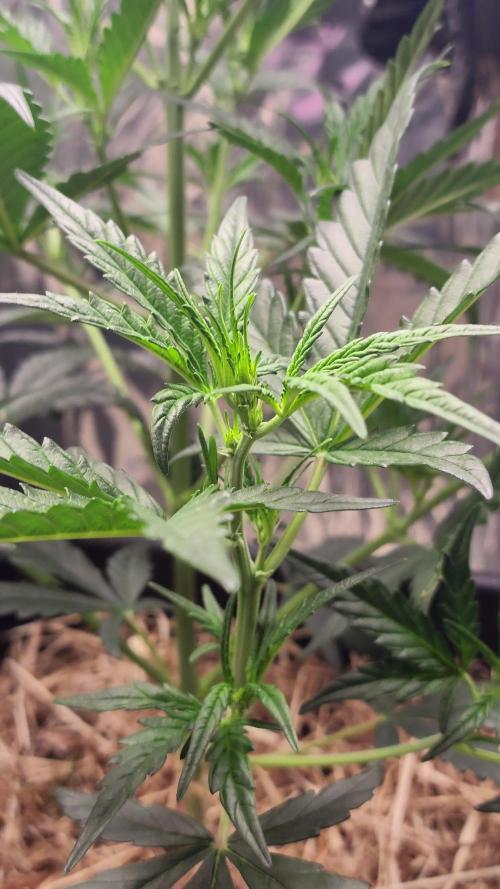
She's growing but never really been happy, droopy and colour is off. Started from day 1, pistils are appearing, stem rub actually smells fantastic 🤣
UPDATE-Day 24 she is looking alot better, watered in with microben terra actus and no shit hours later shes perky for the first time in weeks. I am now happy with both plants 🙏 🤲
Day 24 she received some bloom amendments (2-8-10) applied via top dressing.
Update Day 26, shes a little dumpy one but shes filling out, waiting for the stretch.
Likes
10
Share


@Cocogrow1234
Follow
Week 1 flower
Keeping them on veg nutes till stretch is done so about 3 weeks
Slowly lowering the light every day
I will keeping tucking them under the net to fill the net and keep a even canopy . I will do this for 2 weeks , then lollipop and defoliate
Likes
4
Share


@Ninjabuds
Follow
I finally harvested all of my photo plants. So my 2 auto plants are getting an outage for the rest of their lives I have moved them both into my larger tent with more light and more room. I’m sure 100%h sure why both of these plants are alot light green. I think it’s I got a little behind on the nutrients but the green is slowly comeing back.
It’s been hot lately I have the lights running at night now
Likes
32
Share


@WATP55
Follow
Day 83
Currently drying, will update before Robert Smith turns up....
Day 87 5 days in, all trimmed and back in to dry.
Temp 18c RH 50%
Will raise humidity to 62% for last 5 days and add fan.
Day 92 Girls pruned to similar size buds and in jars to cure.
Will wait a few days until the residual moisture dissipates then weigh for the final time.
Lemony tones coming off her already.
Pleased as was getting worried during drying. Think I'll try a dry trim on the two Lemon Kix I have in atm (see my other diary)
Sampled some this afternoom and eveb before a cure its smooth enough to smoke, citrusy in profile and burns a nice clean white ash.
Looking forward to seeing the flavour/texture evolve over next few weeks before smoke report.
I'm not the most patient person, this part is extremely difficult.
Day 97 Final weight dried and a week cured is 87.8g (3.1oz)
Extremely pleased with the yield.
Smoke report
I've got to be honest, it's not the stinky monster I was expecting but its made up for it in other areas.
Really smooth on the inhale, lemony forest taste, no horrible aftertaste.
No coughing, which is a novelty!
For my first run, I'm v happy.
I feel the excessive heat may have microwaved some of the terps but we live and we learn.
Not long until my Auto Lemon Kix are ready, hopefully got the temp under control in time for them.....

Likes
14
Share


@Rock_n_Roll_Randy
Follow
ALL THE PHOTOPERIODS ARE IN THE 8X8 NOW. DID SOME MAJOR DEFOLIATION BECAUSE THEY ARE TOO BIG NOW. THEY ARE SWITCHED TO FLOWER AND THE STRIVE NUTRIENTS IS INSANE.. BEST FERTILIZER PRODUCTS EVER MADE. I USED IT 4 TIMES IN 13 DAYS AT FULL STRENGTH AND THERE IS NO NUTRIENT BURN AT ALL AND THEY EXPLODED. AND I HAD A FEW THAT WERE TURNING YELLOW, I THOUGHT IT WAS ROOTBOUND OR CALMAG DEFICIENCY BUT THE STRIVE NUTRIENTS BROUGHT THEM BACK AND THEY ARE SUPER HEALTHY AGAIN....
ATTENTION GROWERS:::::: YOU MUST TRY STRIVE NUTRIENTS. BY FAR THE BEST FERTILIZER PRODUCTS EVER.. I PROMISE YOU THAT AND IF YOU USE IT YOU WILL NEVER USE ANYTHING ELSE
FOR EVERYTHING MARS HYDRO VISIT:
www.mars-hydro.com
www.marshydroled.ca
PROMO CODE: rocknroll
VISIT THE ALIEXPRESS STORE:
@marshydro_aliexpress
Instagram: @marshydropenny
https://youtube.com/channel/UChU5ZWwNi-DvnO3oWVU3ceA
(NEW) STRIVE NUTRIENTS 💪
Thanks for taking the time to read and check out my diary🤜🤛
FC-E6500 LED GROW LIGHT:
FC-E6500 grow light with 3978pcs OSRAM BridgeLux Diodes & Moso Driver, market-leading PPF 2.7 µmol/J, Max 2.5g yield/watt with 30% higher Average PPE, more cost-effective when compared to same style type lights. Only consumes 650W, perfectly cover 5x5ft (personal), 4x4ft (commercial) grow space. Innovative Precise Uniform Lighting-Built-in removable bars interval & dimmability enable the exact & dynamic PPFD control over each of the plant growing stages, FC-E6500 detachable bars deliverSuperior Heat Dissipation: Real Aluminum heatsink together with 6 slim profile passive cooled bars (THINNER & LARGER surface) and detachable Meanwell Driver, create less heat. save 50% hydro than other old grow lights! Driver can be mounted remotely on the side of a grow tent/rack or on an adjacent wall to remove heat from grow space. Full Spectrum UV IR LED: With Yield Max spectrum (660nm Osram enhanced Deep Red,2800k-5000k,730-740nm IR,380-410nm UV LEDs), Average PPFD the FC-E6500 LED grow lamp enables cultivators to produce BIG FAT Dense Buds, perfect for full-cycle hydroponic, soil, grow tent/grow room.
Dimmable Commercial Grow Light: Cost-efficient, easy dimming & daisy chain With a max up to 20 lights, IP65 Waterproof, master light easily controls the rest. Perfect for commercial & home horticulture.
FC4800 LED GROW LIGHT:
GET THE MAX FROM MARS👍: Welcome one of the newest members of the Mars Hydro family🤜🤛🤘. The Mars Hydro FC 4800 480W LED Grow Light can accommodate up to a 4' x 4' area for flowering. It has OVER 2000 LED chips consisting of the best selling Samsung LM301B diodes which has a Luminous Efficacy of: 220 lm/W
0.2 W, 3 V mid power,
Osram 660nm Diodes, Infrared light and UV LIGHT👍. It boasts the incredible efficiency of 2.8 µmol/J, maximum 2.5gram yield per watt with 30% higher Average PPFD. This High-intensity spectrum is beneficial for plants at all stages - from veg to bloom, and creates Big dense Buds👍. achieve 50% higher yields & quality compared with the old lights! Only consumes 480W for 4x4ft personal grows, and 3x3ft for commerical grow. It comes with a dimmer and daisy chain function with a maximum of up to 15 lights, the master light controls the rest👍. Wide 6-bar design offers even & wide canopy coverage and can maximizes your grow space. slim 180° FOLDABLE DESIGN... YES I SAID FOLDABLE🤘🤣 , making it compact and easy to install, it's IP65 WATERPROOF and will give you no worries while growing in a humid environment and makes it a flexible high performance commercial grow light for enormous SUPER FROSTY yields.😛😛😛. MARS GETS EM FROSTY BOYS👍
AWESOME HEAT DISSIPATION: The Low energy consumption FC4800 growing light has 6 passive-cooled bars and an aluminum heat-sink a removable driver you can upgrade later or have it outside your tent. with zero noise you can save up to 50% in your electricity bill compared to HID's or HPS lights!
It also has a removable driver so you can upgrade it in the future or have it outside your grow space for better heat control in your growroom👍
UPGRADED FULL SPECTRUM: Yield Max Spectrum with enhanced red (Top-Bin Samsung 3000k-5000knm, Osram 660nm Deep Red), speed up blooming & fruiting, perfectly suited for full-cycle growing. The FC4800 LED grow lamp was born for Big Buds, perfect for commercial, grow tent, grow room, hydroponics, and all soil grows.👍
THE BEST SAMSUNG DIODES: THE FC4800 has Top Bin genuine Samsung Osram Diodes, combined with remarkable 2.8 µmol/J Efficacy, 30% higher Average PPFD, 50% less energy consumption, to maximize your yields. They give you a TRUSTED 3 years warranty 100% Satisfactory guaranteed!!!
TSW2000 LED GROW LIGHT:
INCREASE YIELD AND CROP QUALITY WITH MARS HYDRO LED GROW LIGHTS: NEWEST SMD LED technology provides the highest PAR/LUMEN output (1122umol@18") and can make you get 30% higher yield compared to OLD blurple led lights. Max 2.5g yield per wattage and achieve maximum quality and quantity, much better than traditional HPS grow systems
LOW ENERGY CONSUMPTION LED GROW LIGHT: Consuming only 300W true output with 684 LEDS! It saves up to 50% energy than other led grow lights. Perfect for 3.5x3.5ft bloom stage, 4x4ft veg stage. Over 90% light energy can be absorbed by plants, it will have higher intensity in a MARS HYDRO grow tent with diamond design mylar, or by crossing over using multiple TSW2000
HIGH EFFICIENCY FULL SPECTRUM INDOOR GROW: 3000K 5000K and IR 660nm 760nm RED, makes it close to natural light, highly engineered to provide improved growing performance for plants at all stages of growing, rapid plant response from seed to flower; Uniform and wide-beam light distribution for your plant's optimal growth
8x8 1680D GROW TENT
The MARS HYDRO 8x8 Grow Tent interior is made of a unique diamond design mylar which is highly reflective. (Other companies mylar and reflective rate is as low as 50%, and it won't provide efficient light. They use thick 1680D oxford canvas, and being double stitched, it is tear proof and perfect for locking in the light. Their grow tent keeps 100% of the light inside the tent and helps your plants absorb more light. EXTRA-THICK material means No light leaks or rips at all.👍
Strong Stable metal corner adapters and poles are the trustful supporters of the tent. It's very sturdy, neither rusting or paint flaking off. quick and easy tool-free setup. They use heavy-duty metal zippers, with double layer black lining, by far the best on the market which creates a light-proof seal.
The Easy observation windows are made by double layers of cloth. Observe the growing conditions of your plants without opening the tent and avoid disturbing your plants. The observation windows also serves to dissipate heat and ventilate the air.
The tent includes 2 removable waterproof floor trays to hold soil and water. The removable tray can be taken out to wash easily.
They guarantee the grow tents are easy to install even if you've never done something like this before. Clear Instructions and no tools needed! They also offer 30-day unconditional refunds for quality problems. Just contact their friendly 24 hours customer service 👍