


Likes
Comments
Share


@Regenwurm
Follow
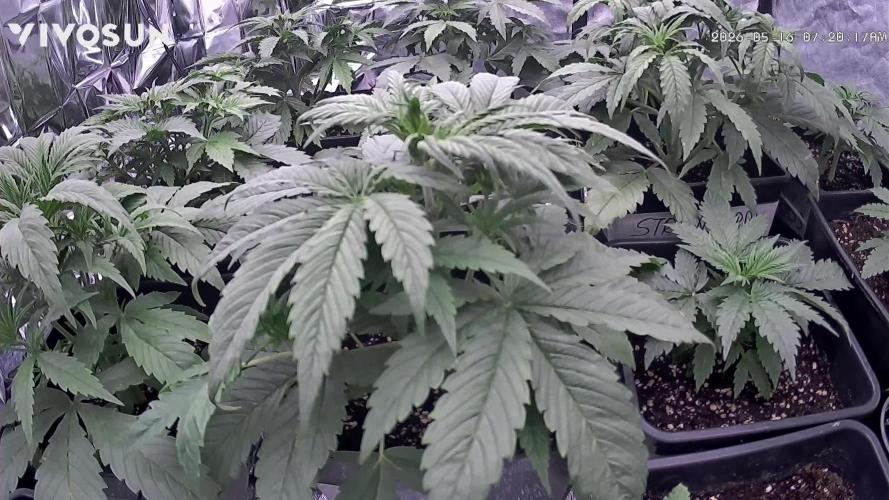
Am 27.01.21 die Ladies nach 5 Wochen vegetativer Phase in die Blüte geschickt. An den höchsten Zweigen superscropping durchgeführt um ein gleichmäßiges Höhenwachstum hinzubekommen. Dieser Strain entwickelt bis jetzt sehr viele große Blätter. In der nächsten Woche wird zum ersten mal großzügig entlaubt um das Licht an alle wichtigen Punkte zu bekommen. Durch den Stretch in den ersten Blühtewochen habe ich mich entschieden in der ersten Blühtewoche noch Wachstumsdünger zu gießen und erst in BW 2 umzustellen. Die Temperaturen sind aktuell bei ca. 18-19 Grad in der Nacht und 23-24 Grad am Tag. Die RLF liegt relativ konstant zwischen 43 und 50 %. Die Ladies sehen gesund aus. Für die aktive Zuluft ist es noch zu kalt. Der CO2 Gehalt ist aber auch so okay! Sorry für die schlechten Bilder unter dem Licht, nächste Woche wirds besser 😁



Likes
16
Share


@GGrows
Follow
With good temperatures this week I have seen massive growth changes. No more burnt leaves. I went up with the nutes, the plants see to like it. Added a time lapse to show changes after feeding.


Likes
13
Share


@420cannabiscouple
Follow
All are cruising along now. Three are vegging in 3.9 pots, one (Euphoria) is flowering ON the autopot system and one (or two?) Divine Indica is still in the 1 gallon for now.

Likes
62
Share


@balansa
Follow
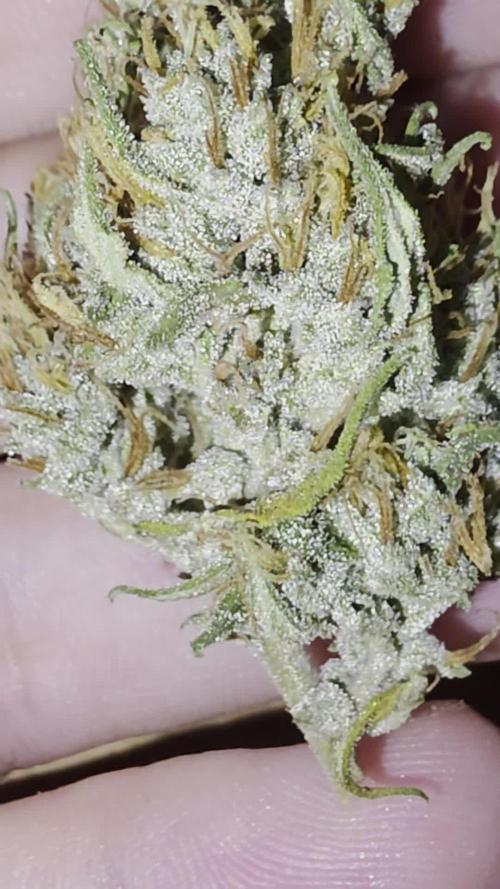
i think mexican airlines is ready for flushing. i will flush her next week smell and aroma is wonderful nore like skunky. moby dick has 2-3 weeks left i think she has more sweet smell. i wanna tell you the smth i know that its unwrighten rule that u should not touch the plant before harvest but i smoked both and they are impressive ))))


Likes
21
Share

@ThatsmyGrow
Follow
🌸 Week 12 – Gorilla Cookies Auto Pheno Hunt
Another week has passed, and we are finally reaching the end of this pheno hunt. It has been an exciting journey with plenty of highs, but unfortunately also a few setbacks during the final weeks.
📈 Current observations:
Unfortunately, Pheno #1 didn't make it to the finish line. Several buds developed bud rot, and rather than risking further contamination, I decided the best option was to remove and dispose of the entire plant.
Pheno #3 never fully recovered after I had to remove multiple main colas earlier in flower because they were growing into the SANlight fixture. That stress significantly reduced its flower production, and in the end it simply wasn't worth keeping until harvest.
Pheno #4 and #5 have now been harvested and are hanging to dry. Unfortunately, Pheno #4 accidentally snapped during handling, so I had no choice but to harvest it immediately. Luckily, it was already mature enough for harvest.
That leaves Pheno #2 and Pheno #6 as the final two plants still standing in the tent. They are continuing to finish their flowering cycle, and I'm expecting Pheno #2 to be ready for harvest sometime next week.
📊 Current environment:
Temperature: 31°C
Relative Humidity: 63%
VPD: ~1.66 kPa
SANlight fixture at maximum height
Light intensity: 90%
🌿 Final thoughts:
Even though not every phenotype made it to the finish line, that's exactly what a pheno hunt is about. Every plant tells a different story, and every run teaches something new. Some phenos exceeded my expectations, while others showed weaknesses under the exact same conditions.
Now the focus shifts to the final harvests, drying, curing, and, of course, the smoke test. I'm especially excited to compare Pheno #4, #5, #2, and #6 once everything is properly cured to see which one truly deserves the top spot.
💬 Which remaining pheno do you think will finish as the winner of this Gorilla Cookies Auto pheno hunt?


Likes
6
Share

@Nazgul420Hafoun
Follow
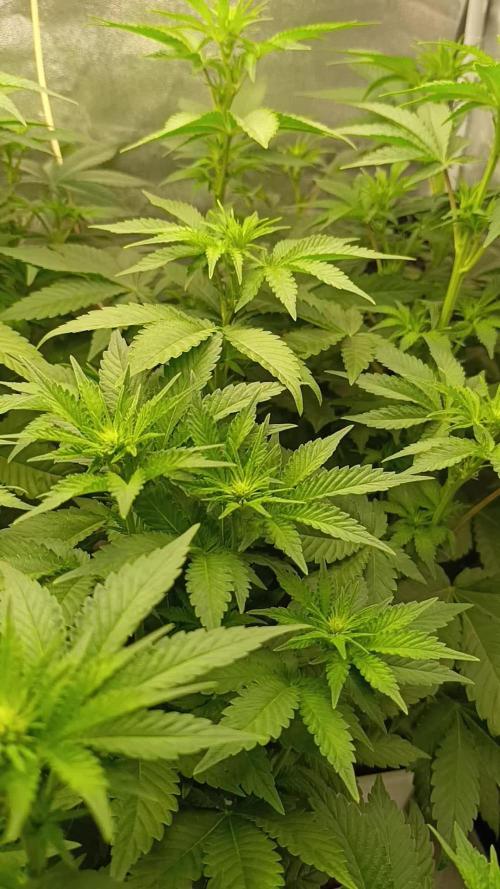
Ahoj všichni 😎
Holky kvetení zvládají ???
Tak za týden+- defoliace
Ať se daří vše 🍀

Likes
11
Share


@CocoLogic
Follow
Sept 6th: (F20)
Fertigation once a day with same recipe (1200 EC 6.1 PH) watered until 10-20% run-off
Sept 7th: (F21)
Fertigation once a day with same recipe (1200 EC 6.1 PH) watered until 10-20% run-off
Sept 8th: (F22)
Fertigation once a day with same recipe (1200 EC 6.1 PH) watered until 10-20% run-off
Sept 9th: (F23)
Fertigation once a day with same recipe (1200 EC 6.1 PH) watered until 10-20% run-off
Sept 10th: (F24)
Fertigation once a day with same recipe (1200 EC 6.1 PH) watered until 10-20% run-off
Had to supercrop 1 branch on the PE#2 since it was almost in the roof of the tent
Sept 11th: (F25)
Fertigation once a day with same recipe (1200 EC 6.1 PH) watered until 10-20% run-off
Sept 12th: (F26)
Fertigation once a day with same recipe (1200 EC 6.1 PH) watered until 10-20% run-off
Note: The PE#2 had a late stretch this week oO hope she is done stretching, dont got more height for it! Had to supercrop one branch on it this week since it was almost in the tent roof.
Its funny that the TUT who is 60-65 Flower days is way in advance in bud forming on the PE#2 who is supposed to be 45-50 flowering days


Likes
8
Share


@Timbo_Growz
Follow
Picture 1 and second video:
20th and 21st November
Plant is looking really healthy so far and can take a decent amount of Water and Nutrients. Also the first Pistols are showing up!
pictures and video (3-5):
25th November
Plant made a good stretch and reached a height of 145cm. Looking like a bonsai tree right now. Gave her 10l with a 2.3EC on the 24th and she is looking very healthy!
I’m looking to thin her up a bit at thursday (day 21) to get some light penetration. I will also do some lollipopping to get this plant to its full potential.
pictures and video (6-9)
28th November
Gave her a really aggressive cut/lollipopping and deployed the scrog net… also did a little lst to get an even canopy.
The plant was quite big before and I was a little scared that she will stretch too much…. But we will see 😜🤟🏻
See ya next week

Processing
Likes
19
Share


@LockDownGrow
Follow
So these ladies are in full swing of flower and the stretch I have tucked any branches I can under my netting too spread out the plants and too fill the tents canapy they are growing about 1 or 2 cm every other day at the moment so tucking under is the order of the week
Really into the massive stretch now I am having too move the climate control probe and thermostat every day now and these girls will soon cover the WiFi camera too , probably growing around 2 or 3 cm per 24 hours at this stage , " day 4 of week 5 "
The tent is filling up nicely but the fbt7 is a clear winner so far , be is my cock up of snapping the main stem and fixing it ? The ftb7 is double the size of all the other 3 plants and is a very nice little bush , the smoothie has been very consistently healthy and vigorous and is around 22cm now and is one I did not lst , the BlackBerry has finally woken up and is now the same height as the others another plant I didn't lst , the c1 started very vigorously and was strong , them week 3 started too show signs of very early flower , she is now is fully fledged flower at week 5 and looking fantastic , and I was lucky enough too get all the side branches out and bend over the main cola too the netting and has made up for in lst what it lacked in size due too the early flowering ,
Likes
62
Share


@KellosaurusGrows
Follow
This girl was definitely one of the best looking plants I’ve ever grown, also outpaced all my other plants and didn’t have any problems like my others did Fast buds has clearly done a good job with the purple lemonade line huge yield this time at 138 grams plant finished around 34 inches from pot
Likes
5
Share


@HIAZ_urbanbudfarmer
Follow
Going to mainline this plant, was topped today at the 3rd node. Interested to see how this pheno turns out as I've done a few runs with this strain recently, both from seed & clone. Two very different phenotypes, 1 grew very bushy with bigger buds & the 2nd was quite different with smaller buds. Both were pretty similar when it came to quality & potency but phenotype 1 yielded more each time around an ounce +. She is in week 3 day 16


Likes
4
Share

@blablamesh
Follow
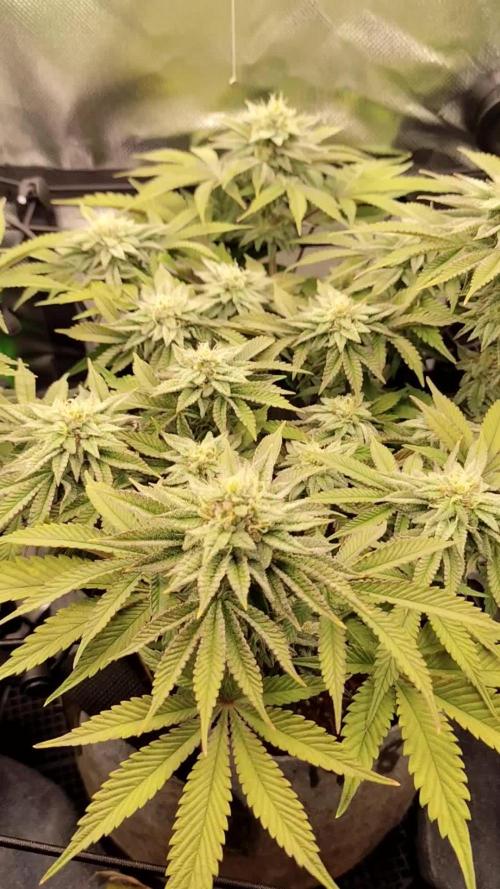
I didn't like the speed at which the flowers were produced. I think 4,5 liters of soil is after all too little to get the result I was hoping for organically. So this week I started giving some canna terra flores. I started with 0,7 EC and gradually increased it to now 1,3. For now it seems the plant is taking it very well. Today I'll be doing some defoliation because it's getting kinda crowded in the middle of the plant.

Likes
6
Share


@jahredi
Follow
It’s-a-growing... Not too stoked on how quick the top layer of soil is drying out with the hot weather. Definitely see a decrease in predator mite activity on the surface... hopefully they’re still busy down below. I added straw to help keep the upper layer from drying out...
This decrease in beneficial bug activity could also be from switching to tap water... I did some rain water from my barrel to begin with, but got scared of pathogens because I know crows take lunch breaks on my roof and their scraps definitely means rodents coming in to clean up 😩 The tap water has no chloramide in it, so that’s a good thing. Hopefully my tiny air pump and stones bubbling a 5 gallon bucket for 24 hours gets rid of enough chlorine to keep the micro biological ecosytem in balance 🙏


Likes
60
Share


@SooSan
Follow
12/12 + 116 jours
Vu qu’il y a 16 plantes mais que sur growdiaries on ne peut mettre que 8 variétés j'ai divisé en 2 diaries pour le bas de la tente
1️⃣
🏠 90x60x90
☀️ FC-E 4800 => puissance a 75%
🍁
Black Bomb / Philosopher Seed
Amnesia Lemon / PEV Seeds
Amnesia Lemon /PEV Seeds
Blueberry / PEV Seeds
Blueberry / 00 Seeds
Wappa / Paradise Seed = 11g
Dark Phoenix / Green House Seed
Quick Sherbet / Exotic Seeds = 14,5
Mango Cream / Exotic Seeds
Banana Frosting / Sensi Seed = 11g
Hindu Kush / Sensi Seed
Mix 1 / Sweet Seed
Mix 2 / Sweet Seed = 15g
Mix 3 / Sweet Seed
Mix 4 / Sweet Seed
📎 https://growdiaries.com/diaries/122084-grow-journal-by-soosan
📎https://growdiaries.com/diaries/124052-grow-journal-by-soosan
2️⃣
🏠 30x60x50
☀️TS1000 => 100w = 54g
🍁
Quick Sherbet - Exotic Seed = 12g
Quick Sherbet - Exotic Seed = 12g
Quick Sherbet - Exotic Seed = 17,5g
Quick Sherbet - Exotic Seed = 12,5g
📎 https://growdiaries.com/diaries/122080-grow-journal-by-soosan


