




Likes
18
Share


@eldruida_lamota
Follow
Que pasa familia, vamos con la cosecha de estas Tropicana Cookies Fast Flowering, de FastBuds.
Por dónde empezar, las flores son bien compactas , y van repletas de resina, tienen tonos rosados por dentro muy bonitos, y tiene un aroma súper dulce aunque engañar engaña porque saber sabe más tropical y cítrica.
Es muy sencilla de cultivar, es de ciclo bastante corto aunque también si le dais una semana más no pasa nada agradecer se agradece al final.
Mars hydro:
Code discount: EL420
https://www.mars-hydro.com/
Agrobeta:
https://www.agrobeta.com/agrobetatiendaonline/36-abonos-canamo
Hasta aquí todo, Buenos humos 💨💨💨

Likes
35
Share


@hornato420
Follow
Week 5 everything was on par with week 4 however, girl #1 seemed to start slowly pulling away from girl number #2. They were almost the same height week 4 but towards the end of week 5 girl #1 had a noticeable height difference with girl #2.
Also it seems I have 2 different Phenos. Girl #1 looks at the end of week 5 as if she is starting to move towards flowering. While girl #2 is just getting bushy and not very much height.
I did do some defoliation of the big fan leaves on each girl and any leafs blocking the light of potential budsites. also I removed the more undeveloped lowers. Hopefully I didn’t stress them out too much removing as much as I did.
I really didn’t feed them to to much This week. They are recovering from very mild nute burn from week 4. Also I think they grew closer to where i had the light so I raised the lights up a few more inches. I barley turned the lights power up that’s why it’s been a littler warmer than usual.
Likes
23
Share


@Herbman420
Follow
This week went well for the two jet fuels I'm really happy with them because I wasn't too sure how they would be. even though they're from the same parents they are too completely different phenotypes that I can see. different structure and shape to the leaves obviously very unstable genetics but gives me something new to see as well . I'm very interested to see how they are going to turn out . Thank you for looking at the diaries and for any more updates on the summer grow please look at the comments in my main profile. Have I have a good day everyone and see you next week
Processing
Likes
22
Share


@horticulturale
Follow
Hi buddies! We are already in second week of flowering stage and the first flowers are starting to appear, the biggest plants are the ones that are showing flowers more quickly, so the others will show them on the next days, I hope 😁😁
Plants are looking strong and healthy so the best is yet to come!! 🤘🤘🤘

Likes
6
Share


@Tezza2
Follow
The purple lemonade is getting some beautiful sticky fat dank buds and the gorilla cookies is flowering nicely the node spacing is super close so i will be looking at some super dence fat sticky buds the smell is amazing i cant wait to have a joint with the two strains combined in it .
Likes
4
Share


@ATX_growguy
Follow
Has a great taste not too strong of a buzz but just right night time. Cdb numbing effect… this was the smelliest plant ive grown so far. I wanted to make fem seeds but seems like it was unsuccessful using. Colloidal silver. I see one weird looking seed but don’t know if it’s viable. Callin this a half win because the bud is good . Will grow again when i have more space because i have a seed left. Thanks seedsman.
Solid auto genetics send me more autos please lol


Likes
12
Share


@gr3g4l
Follow
Finales de la pasada semana y esta lavado de raices. Agua con ácido cítrico y ácido ascórbico.
Corte de los apicales más formados y con mayor riesgo de botritys y el resto seguirá una semana 10 dias más.
Han salido diferentes fenotipos, unos de más skunk y otros de más Critical,
A los 60 dias obté por cortar los apicales y dejar el resto de las plantas para que terminaran de engordar y madurar.
Entonces volví a regar con Bloom Bud y call-Mag -
Likes
16
Share


@Max1973
Follow
7 days exactly... 3 of the seeds made it.... all 3 look good....
just seed raising soil mixed with perlite, inside jiffy pots that break down in 2-6 weeks...
just normal tap water atm, and i'll water them less now, let them dry out abit...
Day 8 - pics/vid.... Had a look under the jiffy's, all 3 had 1-3 cm roots poking out, they went straight thru the jiffy like it was not even there..... (pic - Day 8 - Root straight thru all 3 pots.).... so, went into emergency repotting day... lol.......
i don't want the roots restricted or damaged in any way,
so, got what pots and soil i had, and put em in, (2 x 13.5 lt pot, and 1 x 7.7 lt).
Day 9 - some pics, bought a new tent (wait delivery), just got em under afew 6400k led's atm .... they seem happy..... 👍
😎
Likes
25
Share


@Grower_Of_Persia
Follow
week intel:
we getting close to end of ripening , this week i raised drought , Nitrogen and E.C stress by feeding them 2 times per week and raised e.c to 3 to cause real stress that will help increase terpenes production
stresses :
Nitrogen deficiency Stress by removing the fertilizers that has N in them
Drought stress via removing one meal in week
high E.C stress around 1.7 and the other feeding day 3.0 , 2 times a week
feeding:
no more Nitrogen
i feed them 2 times this week with this order :
day 1 : i feed them high with Bio-Bizz Top-Max + Feeding Booster about 850 ppm - 1.7 e.c to cause a medium e.c stress.
day 3 : no more feeding this day
day 5 : i feed them very high dose of Bio-Bizz Top-Max + Feeding Booster around 1500 ppm - 3 e.c to cause high e.c stress
guide of the week :
be patient in the last weeks, never hurry for harvest because its the time of ripening in last 2 weeks you should let plants to do their work
last weeks of ripening is the time to break the limits we should cause 3 stresses as i said above Nitrogen stress , Drought Stress , E.C Stress

Likes
2
Share


@DigiDom
Follow
Not much do do this week. Training is mostly done. Don't really have anything to trim as was doing it as I went along. Just need to keep an eye on her. She's starting to flower but it looks like dimming the light affected the stretch.
Day 37 - some mild defoliation
Day 39 - looks like she's done with her stretch but hopefully she'll grow a bit more.

Likes
35
Share


@I_and_I
Follow
Start of week 5, think she has finally stopped stretching maybe
Starting to thicken up the bud sites on the long tall colas
Two poly colas, one splits into a fork, the other is a single massive bat of a cola already, this thing has 7 or 8 weeks left to go yet, insanity, cant wait too what this ends up like 😂😂😂🌲🌳🌿


Likes
26
Share


@DesDeGrower
Follow
Welcome in official week 8 of flower 🙏
Girls are in full flush mode what we can see on fan leafs. Rest of Nitrogen is being sucked from all fan leafs what suggest that root zone is now clear.
They are getting 2l per every 24h
From what I can see all trichomes are now cloudy with few amber. I will give them another 4 days before chop.
Next week will be the final one in this garden.
How many Oz we will pull out this time?
Stay tuned!

Likes
50
Share


@DogDoctorOfficial
Follow
🌸 Sundae Driver — Week 9 Flower / Week 12 From Seed
When the plant decides it’s time… you listen!
Another beautiful, crazy, unforgettable week in our Sundae Driver adventure! The tent has been full of aromas, colors, and emotions — and this week brought a little surprise twist. Our Pheno #2, the bold one, the heavy one, decided she couldn’t hold her own weight anymore and literally bowed to gravity. When I arrived, half of her was on the ground, saying: “It’s time, my friend. Harvest me.”
And honestly, she was right. Perfect trichomes, perfect colors — it was exactly her moment. So, we harvested her with love, laughter, and respect. Sometimes, nature tells you what to do, and all you can do is listen.
We didn’t dry her whole as we usually do — since she broke herself in half, we had to go with a different approach this time. A reminder that every grow has its own personality and surprises. We took it as part of the adventure and had a good laugh about it — because in the end, that’s what growing is: learning, adapting, and enjoying every step.
Meanwhile, her sister Pheno #3 is still standing tall and absolutely shining. She’s thriving under the LUMATEK, with her buds swelling beautifully, trichomes sparkling like sugar dust, and her structure holding strong (for now!).
🌱 Nutrients & Environment
This week we’re keeping the mix balanced — still using the Plagron PowerBuds, Sugar Royal, Green Sensation, together with Aptus Regulator and CalMag Boost.
Our pH sits nicely around 6.1, EC around 0.7, and the soil is still rich enough to carry the girls through these final stages. Temperatures hover around 28°C, humidity slightly high at 60+, but both phenos have been adapting beautifully.
🌿 About the Harvest
For Pheno #2 — the early harvest wasn’t planned, but it turned out perfect. The trichomes were milky with just a few ambers, the aroma intense, and the density incredible. This shows that sometimes the plants truly know best. Her colas were so heavy they couldn’t stand anymore — that’s a good problem to have!
💪 Super Crop & Structure
The earlier super crop training clearly paid off — the buds on the bent tops were some of the thickest and frostiest of all. It’s beautiful to see how resilience leads to strength; those stress points turned into power centers for growth.
🧠 What to Expect & What Not to Expect
• Expect Pheno #3 to keep maturing beautifully over the next week or two — trichomes are developing wonderfully, and aromas are getting more complex by the day.
• Don’t expect her to rush. She’s taking her sweet time, and that’s perfectly fine — every flower deserves her full moment.
• Expect me to keep double-checking the branches — after what happened with #2, I’m making sure no more girls decide to “self-harvest” behind my back. 😂
💬 P.S. — About Holding the Weight
For those reading this — always support your branches properly during late flower! When the buds get heavy (and believe me, they will), the stems can only handle so much. It’s always better to tie, stake, or net them before nature makes the decision for you. Trust me, it’s a funny story after the fact… but quite the shock when you find half your plant bowing to the floor.
💬 P.P.S. — About Super Cropping & Experimentation
For anyone afraid to try new techniques — this is living proof that super cropping works beautifully and that plants are incredibly resilient. Don’t be afraid to experiment, to bend, to learn, and to adapt. Each grow is a new journey, and your plants will always reward your courage with lessons and beauty.
💚 Final Words & Gratitude
As always, I want to send a massive thank-you to everyone following this journey — the readers, growers, dreamers, learners, and friends who stop by the diary. Your presence, comments, and good vibes make this all worthwhile.
A special thanks to Zamnesia for the genetics, LUMATEK LED for the incredible light performance, Plagron and Aptus Holland for the outstanding nutrients and additives, and of course TrollMaster for helping keep everything perfectly dialed in.
And to everyone out there — whether you’re just starting or have been growing for years — remember that every plant, every week, every harvest teaches something new. Stay curious, stay passionate, and never stop growing — in the garden and in life.
📲 Don’t forget to Subscribe and follow me on Instagram and YouTube @DogDoctorOfficial for exclusive content, real-time updates, and behind-the-scenes magic. You won’t want to miss it.
• GrowDiaries Journal: https://growdiaries.com/grower/dogdoctorofficial
• Instagram: https://www.instagram.com/dogdoctorofficial/
• YouTube: https://www.youtube.com/@dogdoctorofficial
⸻
Explore the Gear that Powers My Grow
If you’re curious about the tech I’m using, check out these links:
• Genetics, gear, nutrients, and more – Zamnesia: https://www.zamnesia.com/
• Environmental control & automation – TrolMaster: https://www.trolmaster.eu/
• Advanced LED lighting – Future of Grow: https://www.futureofgrow.com/
• Root and growth nutrition – Aptus Holland: https://aptus-holland.com/
• Nutrient systems & boosters – Plagron: https://plagron.com/en/
• Soil & substrate excellence – PRO-MIX BX: https://www.pthorticulture.com/en-us/products/pro-mix-bx-mycorrhizae
• Curing and storage – Grove Bags: https://grovebags.com/
⸻
We’ve got much more coming as we move through the grow cycles. Trust me, you won’t want to miss the next steps, let’s push the boundaries of indoor horticulture together!
As always, this is shared for educational purposes, aiming to spread understanding and appreciation for this plant. Let’s celebrate it responsibly and continue to learn and grow together.
With true love comes happiness. Always believe in yourself, and always do things expecting nothing and with an open heart. Be a giver, and the universe will give back in ways you could never imagine.
💚 Growers love to all 💚


Likes
Comments
Share



Likes
3
Share

@Grow_for_Happiness
Follow
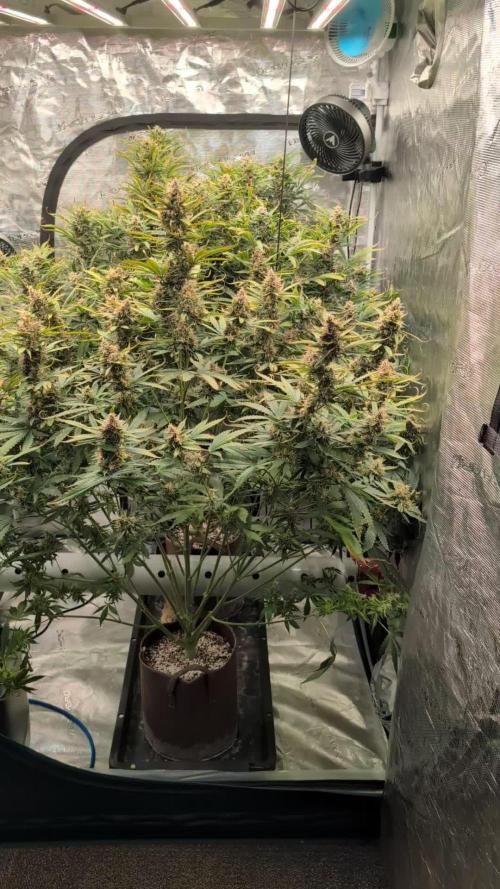
Every time I open the tent I'm amazed at the size of these two. They're easily dominating half the 4x8 and have really spread out as the bud weight has set in. Tent is giving her some support around the edges haha. This week the buds have noticable swollen and are becoming more dense and trichome packed. Still lots of white pistils so would say it's still on track to be a week or so behind the other plants. That's ok, at this rate I'll need the dry space haha. Gave the girls a light defoliation this week, mainly just removing dying leaves from deep inside the canopy. Nothing major, no branches or offshoots, and will most likely be her last one. Otherwise just keeping the environment and nutes dialed in the get these two smoothly to the finish line.
Likes
14
Share


@Kendoda
Follow
This week the plants have started to get hungry. The 3 gal pots feel solid with roots and the growth has slowed down, so I’ve made the decision to repot into 7 gal. It’s a little late for it but i still think they’ll benefit from the fresh soil and more root space.
Currently feeds are
Feed 1 .. grow,bloom,topmax,cal-mag
Feed 2 .. bio heaven, acti-Vera
Feed 3 .. Alg a mic
I also added a watering of fish mix to the master kush and alienz to give them some extra N.


