Likes
Comments
Share
The Strain is a great smoke just price seed but you pay for the quality right, eventhught it could be better as I F*@&^ things up with the soil
Likes
Comments
Share
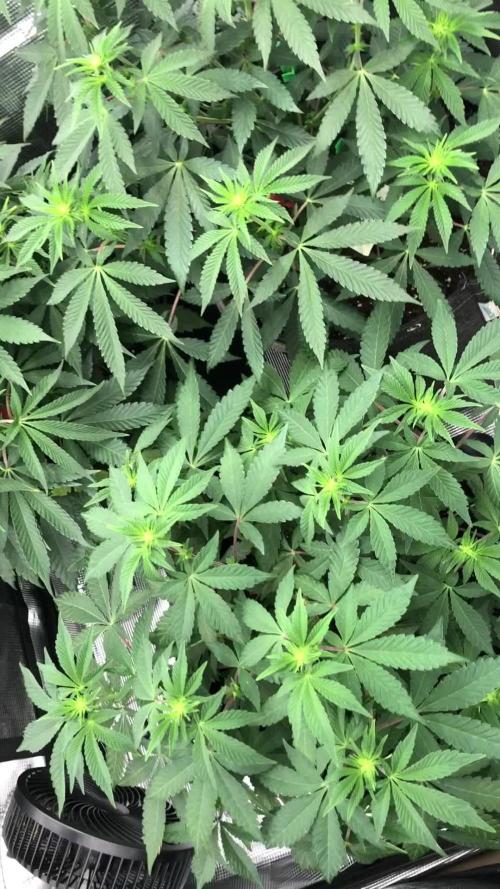
The plants are looking really healthy, I've been defoliating here and there to get the light to penetrate to the lower leaves and branches. They have started to bush out from topping them last week. I started using Mammoth P Microbes halfway through last week. They seem to have grown a little quicker since adding them. The plants are still being fed 4 times a day at 1 minute each feeding. No signs yet of which is female and male, I am planning on pulling all the males once they show signs.
Likes
52
Share
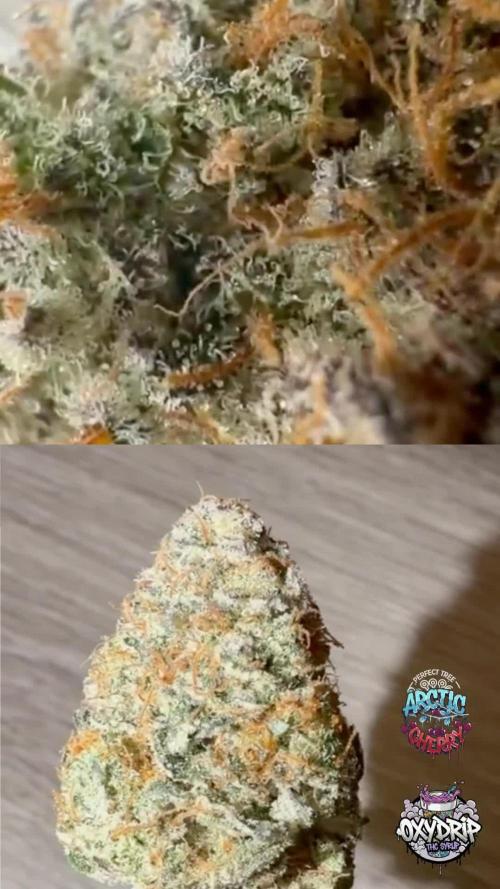
Once again she passes my expectations, late to the show with trichome production. I'm surprised there is purple on the bud, maybe Purpinator does work. I thought I could see hints under the grow lights and thought my eyes were deceiving me, I was just being hopeful. But nah 2 of the 3(under the UV) have developed a beautiful tone of purple. I was never going to bother with a deep freeze but maybe the whole bud will change given conditions, that would be something, fingers crossed. 🤔 was a little skeptical that reducing temps humidity would change density, but it does, buds are solid something I've not been able to achieve before. Rule of thumb is never to surpass 60% RH in the flowering phase and try to progressively reduce it down to 40% in the last 2–3 weeks before harvest. The plant will react as it seeks to protect its flowers, responding by producing denser buds and a higher concentration of resin. Cannabis plants are sensitive to sudden temperature changes, especially in the flowering stage. Extreme heat or cold can impact bud density and overall yields. In nature as a defense mechanism from cold, the plant sensing sudden dips in temperature will attempt to remove the pockets of air within the bud, it achieves this by compacting itself in doing so to better protect itself from cold snaps which are normally indicators in nature that worse weather is on the way. Terpene levels are the highest just before the sun comes out. Ideally, you want as many terpenes present in your plants as possible when you harvest. Cannabis plants soak up the sun during the day and produce resin and other goodies at night. The plant is at its emptiest from "harvest undesirables" so to speak right before the lights on. Boiling cannabis roots during harvesting slows down the drying process. When you boil cannabis roots, it shocks the plant, closing the stomata on the leaves. This prevents massive moisture loss through the leaves, leaving only the floral clusters actively losing moisture at a reduced pace. I've always run a strict 60/60 and it took almost twice as long to dry to a snap than previous grows where I didn't boil for what it's worth. Chlorophyll is good for the plant but not for you. When you harvest the buds, even after you flush them, if you flush them, they’re still filled with chlorophyll. Freshly cut buds are greener than dried buds because they still contain loads of chlorophyll. However, when rushed through the drying process, the buds dry but retain some chlorophyll, and when you smoke it, you will taste it. Chlorophyll-filled buds are smokable, but they aren’t clean. Slow drying gives the buds enough time and favorable conditions to lose the chlorophyll and sugars, giving you a smoother smoke. How the plant disposes of the chlorophyll and sugars by a process of chemically breaking them down and attaching the decomposed matter once small enough to water molecules which then evaporate back into the ether. Time must be given to the process to break down the chlorophyll and sugars. Think of it like optimizing the environment for decay. All the nutrients it could ever need are in abundance, it eats nutrients based on its demand for growth, which is dictated primarily by available light. Plant growth and geographic distribution (where the plant can grow) are greatly affected by the environment. If any environmental factor is less than ideal, it limits a plant's growth and/or distribution. For example, only plants adapted to limited amounts of water can live in deserts. Either directly or indirectly, most plant problems are caused by environmental stress. In some cases, poor environmental conditions (e.g., too little water) damage a plant directly. In other cases, environmental stress weakens a plant and makes it more susceptible to disease or insect attack. Environmental factors that affect plant growth include light, temperature, water, humidity, and nutrition. It's important to understand how these factors affect plant growth and development. With a basic understanding of these factors, you may be able to manipulate plants to meet your needs, whether for increased leaf, flower, or fruit production. By recognizing the roles of these factors, you'll also be better able to diagnose plant problems caused by environmental stress. Water and humidity *Most growing plants contain about 90 percent water. Water plays many roles in plants. It is:* A primary component in photosynthesis and respiration Responsible for turgor pressure in cells (Like the air in an inflated balloon, water is responsible for the fullness and firmness of plant tissue. Turgor is needed to maintain cell shape and ensure cell growth.) A solvent for minerals and carbohydrates moving through the plant Responsible for cooling leaves as it evaporates from leaf tissue during transpiration A regulator of stomatal opening and closing, thus controlling transpiration and, to some degree, photosynthesis The source of pressure to move roots through the soil The medium in which most biochemical reactions take place Relative humidity is the ratio of water vapor in the air to the amount of water the air could hold at the current temperature and pressure. Warm air can hold more water vapor than cold air. Relative humidity (RH) is expressed by the following equation: RH = water in air ÷ water air could hold (at constant temperature and pressure) The relative humidity is given as a percent. For example, if a pound of air at 75°F could hold 4 grams of water vapor, and there are only 3 grams of water in the air, then the relative humidity (RH) is: 3 ÷ 4 = 0.75 = 75% Water vapor moves from an area of high relative humidity to one of low relative humidity. The greater the difference in humidity, the faster water moves. This factor is important because the rate of water movement directly affects a plant's transpiration rate. The relative humidity in the air spaces between leaf cells approaches 100 percent. When a stoma opens, water vapor inside the leaf rushes out into the surrounding air (Figure 2), and a bubble of high humidity forms around the stoma. By saturating this small area of air, the bubble reduces the difference in relative humidity between the air spaces within the leaf and the air adjacent to the leaf. As a result, transpiration slows down. If the wind blows the humidity bubble away, however, transpiration increases. Thus, transpiration usually is at its peak on hot, dry, windy days. On the other hand, transpiration generally is quite slow when temperatures are cool, humidity is high, and there is no wind. Hot, dry conditions generally occur during the summer, which partially explains why plants wilt quickly in the summer. If a constant supply of water is not available to be absorbed by the roots and moved to the leaves, turgor pressure is lost and leaves go limp. Plant Nutrition Plant nutrition often is confused with fertilization. Plant nutrition refers to a plant's need for and use of basic chemical elements. Fertilization is the term used when these materials are added to the environment around a plant. A lot must happen before a chemical element in a fertilizer can be used by a plant. Plants need 17 elements for normal growth. Three of them--carbon, hydrogen, and oxygen--are found in air and water. The rest are found in the soil. Six soil elements are called macronutrients because they are used in relatively large amounts by plants. They are nitrogen, potassium, magnesium, calcium, phosphorus, and sulfur. Eight other soil elements are used in much smaller amounts and are called micronutrients or trace elements. They are iron, zinc, molybdenum, manganese, boron, copper, cobalt, and chlorine. They make up less than 1% of total but are none the less vital. Most of the nutrients a plant needs are dissolved in water and then absorbed by its roots. In fact, 98 percent are absorbed from the soil-water solution, and only about 2 percent are actually extracted from soil particles. Fertilizers Fertilizers are materials containing plant nutrients that are added to the environment around a plant. Generally, they are added to the water or soil, but some can be sprayed on leaves. This method is called foliar fertilization. It should be done carefully with a dilute solution because a high fertilizer concentration can injure leaf cells. The nutrient, however, does need to pass through the thin layer of wax (cutin) on the leaf surface. It is to be noted applying a immobile nutrient via foliar application it will remain immobile within the leaf it was absorbed through. Fertilizers are not plant food! Plants produce their own food from water, carbon dioxide, and solar energy through photosynthesis. This food (sugars and carbohydrates) is combined with plant nutrients to produce proteins, enzymes, vitamins, and other elements essential to growth. Nutrient absorption Anything that reduces or stops sugar production in leaves can lower nutrient absorption. Thus, if a plant is under stress because of low light or extreme temperatures, nutrient deficiency may develop. A plant's developmental stage or rate of growth also may affect the amount of nutrients absorbed. Many plants have a rest (dormant) period during part of the year. During this time, few nutrients are absorbed. Plants also may absorb different nutrients as flower buds begin to develop than they do during periods of rapid vegetative growth. 432 Hz is said to be mathematically consistent with the patterns of the universe. Studies reveal that 432 Hz tuning vibrates with the universe’s golden mean PHI and unifies the properties of light, time, space, matter, gravity and magnetism with biology, the DNA code and consciousness. When our atoms and DNA start to resonate in harmony with the spiraling pattern of nature, our sense of connection to nature is said to be magnified. Another interesting factor to consider is that the A=432 Hz tuning correlates with the color spectrum while the A=440 Hz is off. Audiophiles have also stated that A = 432 Hz music seems to be non-local and can fill an entire room, whereas A=440 Hz can be perceived as directional or linear in sound propagation. Once you adopt the idea that sound (or vibration in general) can have an equalizing and harmonizing effect (as well as a disturbing effect), the science of harmony can be applied to bring greater harmony into ones life or a tune to specific energies. There is a form of absolute and of relative harmony. Absolute harmony can for example be determined by the tuning of an instrument. The ancients tuned their instruments at an A of 432 Hz instead of 440 Hz - and for a good reason. There are plenty of music examples on the internet that you can listen to in order to establish the difference for yourself. Attuning the instrument to 432 Hz results in a more relaxing sound, while 440 Hz slightly tenses up to body. This is because 440 Hz is out of tune with both macro and micro cosmos. On the contrary, 432 Hz is in tune. To give an example of how this is manifested micro cosmically: our breath (0,3 Hz) and our pulse (1,2 Hz) relate to the frequency of the lower octave of an A of 432 Hz (108 Hz) as 1:360 and 1:90. It is interesting to note that 432 Hz was the standard pitch of many old instruments, and that it was only recently (19th and 20th century) the standard pitch was increased. This was done in order to be able to play for bigger audiences. Bigger audiences (more bodies) absorb more of the lower frequencies, so the higher pitch was more likely to “cut through”. One of the oldest instruments of the world is the bell ensemble of Yi Zeng (dated 423 BC), tuned to a standard F4 of 345 Hz which gives an A= 432 Hz. The frequency of 345 Hz is that of the platonic year! Similarly many old organs are tuned in an A=432 as well; for example: St. Peter’s Capella Gregoriana, St. Peter’s Capella Giulia, S. Maria Maggiore in Rome. Maria Renold’s book “Intervals Scales Tones and the Concert Pitch C=128 Hz” claims conclusive evidence that 440 Hz and raising concert pitch above scientific “C” Prime=128 Hz (Concert A=432 Hz) disassociates the connection of consciousness to the body and creates anti-social conditions in humanity. The difference between concert pitch A=440 Hz and Concert A=432 Hz is only 8 cycles per second, but it is a perceptible difference of awareness in the human consciousness experience of the dream we share called existence.
Likes
12
Share
@Siriuz
Follow
Sorry for the delay on the updates guys I am a daddy of a newborn baby boy and it's really time consuming plus the Mary ladies but we keep on the great work nothing wont stop us we go all the way up! Alright here you go Day 87 Starting week 13 Day 88 Gorgeous grapefruit smells like heaven Day 89 Again sorry for the late update but being a first time daddy leaves you without time Day 90 She's gorgeous isn't she? (alright guys so what happened here was that I started flushing too early and took advise from other canngrower and instantly added again all nutes, that's why I left her a lil longer until week 14 when I started to flush again, we are going to show you very well what we did, since it was our first time we were unsure if flushing at week 11 was alright but then we decided at week 12 that she could stay longer and she did) You might say we wasted some nutes but in terms of reality we did not, because we have a full bottle of 3.7gal mix with flora nova grow and flora nova bloom in the other, measuring ppm always to make sure we got the correct amount, otherwise we add more water or more nutes depending on the plant needs but we never waste away all precious nutes are precious resources, in this part of Latin America is really hard to find anything good, so we got to bring everything from Europe or United States that's why we doing the best we can with the money we got. Hey any donations are more than welcome if you guys like what we do, yeah it's risky around here but we don't give a F. You know that patients need their medical cannabis and Id say I'm one of them And by the way very proud Peace and love canna growers We will continue to fill the grow diaries
Likes
6
Share
Was showing signs of nutrient lockout so decided to start flushing process.. amazing smell but this will be the last ever diary of disco biscuits as she has outstayed her welcome. Not as fat as I’d like her to be but still 2 weeks remaining before chop.
Likes
13
Share
Nov.8 - Watered girls 250mL each, 0.25mL of each nutrient for each plant Nov.9 - Moved these girls into Vivosun tent under Phlizon 1200w light from a Marz Hydro tent 5x5 with Marz Hydro ts 1000 light. We needed to move these girls to this tent and have our DWC in the bigger tent so the DWC plants don’t get too hot at the bottom *once girls were transported to new tent the leaves turned to curl and lift upwards, the light is on veg and is 24” high Nov.10 - Watered girls 250mL each, 0.25mL of each nutrient for each plant Nov.10 - Decided we don’t like the blurple light and took one of our Mars Hydro lights from our big tent and switched it Nov.11 - Watered each plant, 500mL, 1mL of each nutrient. Our girls drank soo fast so we are bumping it up a bit Nov.12 - Our girl #1’s leaves are a little droopy and are looking a bit weird in some spots (darker green and almost wrinkled). Our girl #2 though is going great and we started some LST training on her today. Let her growww Nov.14 - Started our girl #1 on LST her leaves are much happier now! Ohhh boy #2 is sprouting so nice she’s starting to fill out so well and she just blossomed once we started LST, she was facing upwards in less than 24h!! Nov.15 - Our girls are thriving so I wanted to FIM #2 and my boyfriend wanted to Top girl #1 Let’s see how these girls groooww Nov.15 - Watered each girl 250mL and 0.25 mL of each nutrient we are going to water them just enough to soak into the ground every day for them to soak up as much nutrients and drink as possible without over watering.
Likes
2
Share
Putting on weight fast now in peak flower. Love the structure of the plant and really regretting not taking a cutting. Oh well, ce la vie. Will stop adding PK in the next few days before cutting back on nutrients next week then flushing for the last 2 weeks. This plant is at the back of the timelapse.
Likes
78
Share
@Wastent91
Follow
Ehi ragazzi come va questa settimana?! Tutto bene?! La mia settimana è stata un alti e bassi di momenti di merda ... Purtroppo la ragazza tropicanna ho dovuto toglierlgla di mezzo xké faceva un odore davvero potente ed era esageratamente grande! Purtroppo stupidamente mi sono fatto prendere dal panico dalla situazione accaduta al mio amico che aveva i miei messaggi e numeri sul telefono.. vabbè è andata così ormai.. mentre devo dire che la Cherry cola della fastbuds sta diventando davvero una ragazza tozza e massiccia , con internodi stretti ma robusti! Sta crescendo molto bene , le God sto un po' di orgatrex e bactrex per continuare a fare vivere i microorganismi presenti nel suolo ! Ho trovato delle foglie con macchie marroni e arricciate che sembrano indicare un deficit di fosforo , ma sinceramente non sono ancora così esperto da capirlo velocemente.. spero continui a crescere e riempire tutta la grow , a giudicare dalle foglie a ventaglio davvero imponenti le cime saranno altrettanto grandi spero! Grazie alla luce di Mars hydro sempre di qualità superiore e agli strain di Fadtabuds posso dire che questa bellissima esperienza è potuta divenire realtà !
Likes
14
Share
Nazdarek🌱😸. Pravje fcil sem sa rozhodua,ze ta otestujem z nasej slovenskej zahoractiny☝️🤣Co uz k temuto dodat?😆 Dneskaj 29.3. je tyden po prepnuci ,v patek sme dosli dom a skoro sem odpadua jaka dzuglabo na mna vyskociua🙈. Najvacej vyskocila za ten tyden Gorilla prime 🦍. Secko sem v sobotu polela a do stredy rana si teraz mozu cilovat🤣. Tipujem este dva tydne a donde mi fantazia,jak ich vynasat ven a focit📸. Uz fcileky maju svoju vahu😮‍💨. Nech sa vam seckym dari a nech vam to rostne🌱. Baj😸
Likes
32
Share
noto que estan comiendo mucho, osea se secan rápido que es que estan comiendo bastante de lo comun. Las ojas tornandose color amarillo para cambiar a color vino. se ven muy bonitas y estan fewlices. No he cambiado mucho entre los nutrientes (Té y Recharge), he sostenido alimentarlas simples y he tenido muy buenos resultados. muy contento con todo, sigas adelante, buenos humos y feliz 2021
Likes
16
Share
@Kush1988
Follow
Dopo aver effettuato una defogliazione intensa, ho fatto il cambio ciclo luce. Ho leggermente diminuito i ppm nella soluzione nutritiva almeno le bimbe non andranno in overfeeding Dopo una settimana dalla potatura posso dire che TUTTE si sono riprese senza troppo stress
Likes
1
Share
Looks like some foxtailing going on but other than that waiting on her to finish up.
Likes
14
Share
Started flowering everything Tuesday 17th going to feed them Gaia green power bloom
Likes
3
Share
Processing
Likes
1
Share
Bonjour à tous, ces derniers jours ce sont bien passé pour mes petit bébés elles grandissent doucement mais sûrement.C’est la première fois que je travail avec cette gamme de produits (je vous est mis des photos des produits 😉) pour l’instant j’en suis satisfait après, il faut voir le résultat final ce qui est moins facile 😂. Mes petit bébés commence leurs 5ème semaine (je me suis trompé d’une semaine 😕 désolé 😉) trop pressé!!! 😂 de mettre de nouvelles photos 😜. Je vous dis à là semaine prochaine vivement 😉 bonne journée à tous. Je vous remercie 😉.
Likes
2
Share
Day 8 flower Plants look like they will end up small. This was a short veg. This is a great time to train plants. _____________ Day 9Flower Plants need to be tied down to have wide arms by day 7 Day 11 flo 18.5inches tall 12inches from light 1300ppm _____________ Day 13 Aggressive defoliation and Lollipop ___________ Day 14 Secret sauce microbe blend .7/gal