


Likes
Comments
Share


@Skunklerman
Follow
Week was great as I saw the end to my fungus gnats and the plants really began to develop their own signature smells.
The monster plant has more myrcene funky smell to it and the smaller bushy plants are hitting hard with fruity earth tones.
This week looked like this:
2/7: nothing
2/8: 1 gal water/pot with 1 tbsp coconut water powder/pot and 1 drop of microbe lite bmc
2/9: nothing
2/10: nothing
2/11: 1 gal water/pot with 1 tbsp aloe flakes/pot. and 1 drop microbe lite bmc. Top dressed with gnarley barley which is sprouted hemp seed, Barley seed and corn seed which i pulverized
2/12: nothing
2/13: .5 gal water/pot and light defoliation

Likes
97
Share


@AsNoriu
Follow
Day 64. they been moved to main tent !
All this week pure water, they should adapt not only to main lights, but i took Mars Hydro SP 150 and made mini side lightning for them. hope it will help. main tent plants are a lot bigger and cast shades ...
still not a right time for defoliation, but with better lightning i hope them to develop quicker and i think i will do it !
Day 69. Transplantation day !!! Girls run out old shoes and it's time for bigger ! Went for 10 gallons pots. Heavily cleared bottoms and lolipoped them. Amount of waist would be enough for few nice plants ;)))
This strain would perform amazingly with scrog , no doubts ! But I have no space .... ;((((((
Happy Growing !!!

Likes
11
Share

@NidoR420
Follow
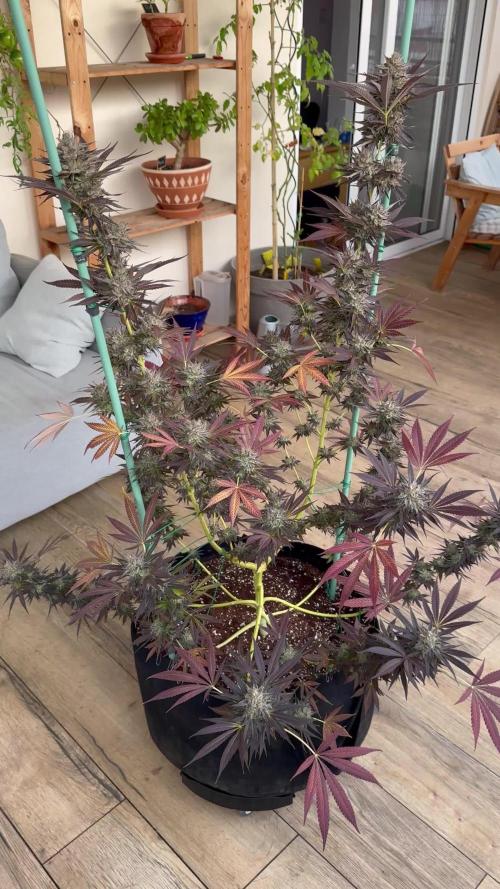
Last week of Ozz! I’m getting some nice trichromes. Surprisingly, she doesn’t smell much, but she’s still beautiful. She also has the best ratio of buds to leaves out of the three plants of the same strain. I’ll start trimming Dorel by Friday and #4 this weekend to free some space. Then it’ll be Ozz’s turn on Sunday or Monday. The relative humidity levels are getting dangerously high, but the temperatures are still fine until next week. Since she’s covered, I have good hopes she’ll hold. No additional bud has rotted since two weeks ago :))
Just finished trimming Dorel and will do #4 tomorrow. Fan leaves were super frosty so I kept them to cook, ended with 17g of trim (only fan leaves and too small buds) as well as 37g of dry buds. Not much but it was the smallest plant of the 3 by far, I wasn’t expecting more. First taste test was really conclusive, looking forward to testing again after some curing!
Edit before I complete the harvest section, all 3 plants cut and just Ozz remaining to dry and trim. Terrible outcome for #4 as I had to throw more than half of the plant away due to bud rots. I’m still really confused about what happened: the day before harvest I noticed and removed 3 bud rots from the plant - so far so good. All remaining buds were fine, but when trimming I realised every single top was maroon-ish at the base and I could clearly see a start of mold when opening some of them. Although I could clearly confirm what it was with a 30x lens, the white spots were extremely scarce and small (less than 1x1mm each time). It doesn’t seem really coherent with how it should have spread. Nonetheless, I didn’t take risk and threw away any bud where I could identify white mold with the lens, and put aside the ones where I had a doubt in pop corns (the “7g maybe”, cf below) to track the evolution.
A quick summary of the harvest so far:
- Dorel: 250g wet, 37g dry / 17g trim (54g total)
- #4: 450g wet, 33g dry / 7g maybe / 29g trim (62-69g total) + a lot thrown away
- Ozz: only weighted the two bigger canopie I cut, 162g+142g≈300g wet. It represents around half of the whole plant (probably less, but stem included), so around 5-600g wet total. Still have a few days before I start trimming, but considering the hassle I might start early to not be overwhelmed.
Likes
34
Share


@Roberts
Follow
FBT2308 has grow great under the Medic Grow Mini Sun-2, in the Agrogardens nutrition. She has a awesome frost, and a fruity aroma. She has a lot of cloudy trichromes and a few clear ones still. A few more days and she will go to ph water for a flush, and fade for 1 to 2 weeks. Everything worked great, and some nice tester buds to boot. Thank you Agrogardens, Medic Grow, and Fast Buds. 🤜🏻🤛🏻💪🏻❄️🌱
Thank you grow diaries community for the 👇likes👇, follows, comments, and subscriptions on my YouTube channel👇. ❄️🌱🍻
Happy Growing 🌱🌱🌱
https://youtube.com/channel/UCAhN7yRzWLpcaRHhMIQ7X4g

Likes
8
Share


@YungSmoke
Follow
Week 8. P Biddy.
She's got the least foliage out of the 4 but the buds have come along nicely. Few of the big fan leaves and upper / newer leaves are showing signs of (I think) N deficiency; yellowing quicker than expected and getting crispy / papery.
Top fed with some all mix and a healthy dose of biogrow and hoping it's the right call.

Likes
73
Share


@Herbz_Unkraut
Follow
i looked awesome all growcycle...i streched alot & i noticed it drank alot more then the other plants while growing...had a good yield, i´m very happy overall


Processing
Likes
27
Share


@lMorphine
Follow
This week i pull the light down to 40 CM away from the colas preparing for flowering stage. this week i in crease an organic food ratio to 3 ML/L and in a couple of weeks i will increase a little more to 3.5 ML/L and still feed in Veg nutes. I think, She is quite ready to get through the flowering stage. Any recommendation for me before i turn to 12/12 cycle for flowering?

Likes
13
Share


@tresplantes
Follow
One week to Go and ladies just Look amazing
Bluezy Structure is Strange but rockhard Headbuds and smell is just out of this Planet
Dantes Inferno is Talking the room over just massive Colas Frosted out down to the bottom
Smell is tropical super Sweet Candy
Tomb raider Structure is Perfect all the buds Hard Even the small ones smell is like a sour Candy Gas


Likes
3
Share

@Dottgreenthumb
Follow
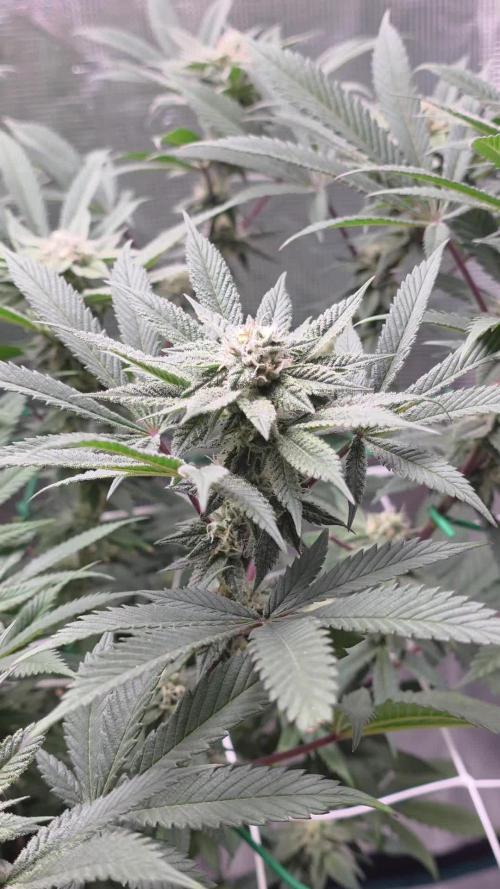
La fioritura avanza si iniziano a intravedere i calci gonfiare sulle cole dello strain e questo mi piace la pianta sta sviluppando tantissima resina molto positivo ho versato ad 1.4 di ec compreso partendo da 0.6 con calcio e magnesio lo scolo è di 1.6 un po basso la prossima annaffiata settimanale aumento

Likes
1
Share


@Herbangardener671
Follow
Trichromes cloudy with a touch of amber.
The smell is amazing similar to tropical fruits very sweet smell.

Likes
17
Share


@w4tch2gr0w
Follow
D1
What a beast! The main bud is already huge af and she still has like 4-6 weeks of flowering up front, love her already.
D5
It’s going alright 👍 In general the buds are getting big and heavy especially the main one.
D7
End of week 12, 6 weeks of flowering behind 5 to go so happy with those big buds already.

Likes
101
Share


@DevilsBud
Follow
Day 56 of flowering of Afghani Gold From Spliff Seeds
Getting to the end of the line of this beautiful 2 plants she frosty she smells and colors absolutely amazing and the only thing that is still going on is flushing.
These ones had more nutrients because they drink more Tru out the grow i had to think about that when say they drink a lot noted for next grow if there drinkers it's fine but give less nutrients 💪🏻 but and i hope i can cut here down Sunday will see i want the ppm to go lower for fine end result i am not going to cut corners on this grow it's looking and going to good for that
23/12/21
Runoff is around 1800 ppm
25/12/21
Runoff is around 900 ppm
I will be now drying the pots out and then it's chop time for these 2
26/12/21
Day 58 flowering runoff 590 ppm 🤘🏻
There looking frosty smell absolutely
🔥🔥🔥🔥
28/12/21
Chop chop 1 Afghani Gold
One left to chop good times
Happy holidays people hope you have some great days stay healthy take care of the one's around yeah and let next year be more weed and Less fucking corona so i can get my ass to Alberta Canada for month vacation to see if we could move there 🤘🏻🇨🇦🤘🏻
visit www.marshydro.eu
for your best gear and use the PROMO CODE: DEVILSBUD
Some info about the Marshydro FC-4800
Superb Quality LED Chips: The whole light is composed of 1206 pcs Samsung lm301b and Osram 660nm chips. More than two times as many LEDs are used to drive the grow lights at low currents and to avoid overdrive. Quality is guaranteed and efficiency is up to 2.8 μmol/j.
Even PAR Distribution and High PPFD Output: The multi-light bar design and the densely distributed light chips enable the LED grow lights to achieve the optimum PPFD required for plant growth over the entire effective coverage area.
Specifically Designed Spectrum: To ensure even plant growth, blue and red light are enhanced on the basis of a full spectrum combination. Not only does this accelerate plant growth, but it also improves the yield and quality of the plants at the same time.
Dimming Daisy Chain Function: The dimming function saves on electricity costs and enables brightness from 10% to 100% for the different stages of plant growth. A single master light can connect up to 30 lights in a daisy-chain system.
Business LED Grow Light: The light's wavy heat sink dissipates heat quickly and the IP65 waterproof allows the light to operate in humid conditions. 180° collapsible feature for easier installation. All these features provide favorable assistance for commercial cultivation.
And some tent info
●【Lock All Light Insid】MARS HYDRO Grow Tent Interior is made of diamond mylar. Non-toxic to the environment, no harm to plants. High-quality 1680D canvas being double stitched, (ALL OTHERS BRAND grow tent is 601D canvas) which is tear-proof for perfect light locking, No light leaks or rips at all.
●【Durability Grow Tent】Stable Metal corner adapters and poles are the trustful supporters of the tent. No rusting nor paint-falling. Quick easy tool-free installation. Carries strong heavy-duty SBS zippers, double layer lining to create a light-proof seal.
●【Easy Observation of your Plants】Special peeks window made by double layers of cloths. Observe the growing conditions of your plants without opening the tent and avoid disturbing plants. The peek window also serves to dissipate heat and ventilate air.
●【Removable Tray Keep Clean】The package includes a removable waterproof floor tray to hold soil and fallen leaves. The tray can be taken out easily to wash. Removable and water-proof makes cleaning easy.
●【Good Ventilation&Fast Assembly】 Circular double-sleeved vent holes with adjustable nylon strap for air circulation by exhaust fan, ducting, carbon filter, or reflector. Better allows proper light, heat, and airflow. Quick tool-free installation. Reinforced by a sturdy metal frame to ensure security and stability, supports up to 140lb. Perfectly safeguard your plants to thrive even in winter

Likes
Comments
Share


@BIYEI
Follow
Vegetativo 29-11-2024 a 05-12-2024
Semana 2
29-11-2024 La planta manifesto un crecimiento considerable, se ve sana y fuerte.
01-12-2024 Se realiza cambio de solucion nutritica y recipiente hidroponico.
03-12-2024 La planta crecio desmesuradamente durante estos dias, pero noto que necesita algo de CALMAG.
05-12-2024 Sorprendente evolucion.
Parametros Utilizados
Temperatura del ambiente 22 C°
Extraccion de aire 4 pulgadas
Humedad 65%
Potencia de la lampara 75%
Ec Original 0.4
Ec Nutriente 1.3
Ph 6.0
Horas de Luz 18/6
Likes
23
Share


@Bossy_Marmalade
Follow
(Update: 4/20/19)
Please stand by while they dry.
(Update
Everything is going great though! The smell is very strong now; no more cut grass smell. From looking at all three today, I believe that some of the smaller branches will be done drying and ready for trimming and weighing in a day or two.
I have one guess for dry weight of Big Lemon, any other guesses?? Remember, the picture of Big Lemon hang drying looks like its two plants, but its all Big Lemon; I had to cut it off to be able to hang it. The amputated branch left of the main plant is bigger than my other two plants alone!
(Update 5/2/19)
Woah...Okay. So after drying the whole for about nine days, and trimming for four days, Big Lemon's dry weight SO FAR is about 430ish grams of super dense and sticky nugs. Its amazing that I got more big bud than I got popcorn nugs from such a big plant.
I have one more 1/2 gal Mason Jar of untrimmed tops to finish, then I'll post pics or a vid of the weigh up and glamour shots etc..
Oh, almost forgot, Little Lemon produced about 40 grams of very nice bud. This surpassed expectations because, although it was planted on the same day as Big Lemon, it was the runt of the bunch because it got pushed out of the main tent that had all the lights and Co2 environment and everything. It spent much of late veg under a very weak light. I remember how limp it was when I gambled on it and chose to switch her over to 12/12. But it was totally worth it in the end!
Alight back to work for me. Check back later today for pics, vids!
(Final Update: 5219 @11:09pm PT)
Its done. Its finally done! I had to trim both plants with my own two hands! So Exhausting, yet so rewarding.
So above are several videos of the weighing. Grand total for Big Lemon is 14oz of prime top shelf nugs, and about 3oz of nice popcorn/LARF (they are separated as shown above in a video. Forgive me for not throwing it all together to weigh it, I spent a long, long, very long time trimming and sorting and canning the buds according to their respective grade/quality. I may add one more update to show their respective weights.
Oh and little lemon produced about an 1 1/2 oz of prime nuggets and quite a bit of popcorn/LARF, which I haven't gotten around to weighing yet.
So, Grand Grand total of Both Lemon OG Candy (amazing job with this beast of a strain, Philosopher seeds) is about 18.5oz, or 1lb 2.5oz for two plants; 15.6oz of which is entirely made up of top-shelf buds 😎
Damn I love SoCal, I didnt even need to run carbon filters because no one be trippin about a lil stink weed.
Thanks to those for following this grow! Tell me what yall think! Cant wait to see some comments from all you growers out there.
(Update: smoke review after a week or two of cure)
This Lemon OG Candy had an extended veg period, about 4 months maybe a little longer, and I harvested her on day 56 of flower (recommended harvest 60-70 days) because of the size/distance to light and her root-bound problems. The results so far, a very uplifting and stimulating quality.


Likes
39
Share


@Proto420
Follow
Pretty good week, no problems. Added a dehumidifier yesterday (Saturday). And also bought a new light. The light should arrive on Tuesday. Looking forward to that because then I’ll be able to spread them out further so they’ll all have as much room to grow as they need.
I believe they’ve started flowering, that happened like day 24 when I first noticed the white hairs coming out of the bud sites.
They really took off growing mid way through the week. Like twice the growth as the prior week.
I haven’t been defoliating per se, I have been tucking & tying leaves down. Many of the secondary flowering nodes have actually surpassed the main cola’s of my plants height wise. Those that did I tied slightly back down.
Really wish I could cut a few branches off them without stressing them out. Oh well. Such is the bane of autoflower growing.
The new light I bought is a Colofrog 2021 CF 2400 LED w/Samsung LM301H Osram Diodes. From what I gathered online, it’s a better light than the Mars hydro tsw 2000 I currently own. I’ve got my ts 1000 in the tent currently just to get through until the new light comes Tuesday.

Processing
Likes
8
Share


@Buck5050
Follow
A very stable environment this week. Everything on cruise control with feedings coming in every other day. All plants do have fading leaves on the bottom that eventually fall off and dry up. Outside temps on the rise which should be challenging with out AC. I do like the fact that the humidity is down due to temp and can keep mildew and mold at bay with minimal effort.
Likes
10
Share


@DogDoctorOfficial
Follow
💙 Project Blue Tent – Week 13 💙
🥒 Pickle Lemon Haze F1 – Pheno B
🌸 OH MY GOD, SHE'S BEAUTIFUL! Frost, White Pistils, and Another Girl Approaching the Finish! ❄️😂
Hello everyone, and welcome back to another chapter of Project Blue Tent! 💙🌱
My friends, seriously...
IS SHE BEAUTIFUL, OR IS SHE BEAUTIFUL?! 😂❄️
Every week, I walk into this room thinking I already know what to expect. Four girls, two cultivars, the same environment, the same equipment, and the same general approach.
And then I look at the flowers again.
And there I go, grabbing the camera and spending another ridiculous amount of time admiring these girls!
😂📸💙
This week, we're giving Pickle Lemon Haze F1 – Pheno B her own spotlight.
And what a beautiful girl she is!
She's dense, compact, seriously frosty, and carrying plenty of those beautiful white pistils. Her colours are developing towards lighter shades, and much like her Pickle Lemon Haze sister, she's showing a different finishing progression from our Blue Waffle F1 girls.
The flowers are looking fantastic, the aroma is amazing, and I'm genuinely curious to see how everything develops from here.
Will the Pickle Lemon Haze girls need more time than the Blue Waffles?
Will we end up harvesting some plants before the others?
Or will the entire room surprise us and finish closer together than we're expecting?
Let's see, my friends!
We're not going to decide the ending before the plants show us what's happening.
For now, we're keeping the ecosystem running, making our latest environmental adjustments, reducing the nutrient concentration, and observing each plant individually.
Same room. Same equipment. Same passion.
But every girl has her own story.
And today, Pickle Lemon Haze F1 Pheno B is the star of the show!
💙🥒🌸
🌿 SAME TENT, SAME ECOSYSTEM – FOUR PLANTS, TWO CULTIVARS
Let's begin with the bigger picture.
Project Blue Tent brings together four plants sharing the same growing environment.
We have two Blue Waffle F1 plants and two Pickle Lemon Haze F1 plants.
They're sharing the tent, the irrigation system, the reservoir, the overhead lighting, the supplemental under-canopy lighting, and the general environmental conditions.
We're maintaining a consistent approach across the room while documenting each plant separately.
And this is where things get interesting.
Even when plants share the same environment, their individual development doesn't have to be identical.
Different cultivars can express different characteristics, and individual plants can show their own variations as flowering progresses.
That's exactly why we're keeping separate diaries.
We want to document what we actually observe rather than treating all four girls as one identical group.
And Pickle Lemon Haze F1 Pheno B has plenty of individual characteristics worth documenting.
She's compact and dense, with beautiful flowers, impressive frost, lighter colours, and plenty of white pistils still showing.
She's looking fantastic, but her progression appears a little different from the Blue Waffle girls.
We're not going to assume that means we know her exact harvest date.
Instead, we'll continue observing her development alongside her sisters and see where the journey takes us.
That's what makes this project so enjoyable.
Four plants. Two cultivars. One ecosystem.
And four individual stories unfolding side by side!
💙🌱
🌸 PICKLE LEMON HAZE F1 PHENO B – DENSE, COMPACT, AND ABSOLUTELY FROSTY!
Let's talk about this beautiful girl!
One of the first things that catches my attention is her flower development.
The flowers are looking dense and compact, with an impressive amount of visible frost across the developing buds and surrounding sugar leaves.
The structure is established, the flowering sites are developing throughout the plant, and we're now concentrating on observing how everything progresses towards the finish.
This is the stage where I love comparing the photographs from different weeks.
Earlier in the project, our attention was focused on building the structure.
We were topping, training, managing the canopy, performing defoliation, and supporting the branches through the flowering stretch.
Now, we can appreciate the results of that earlier work while giving the flowers the attention they deserve.
And Pheno B certainly deserves it!
She's beautiful from a distance, but the close-up photographs reveal another level of detail.
The trichomes, the pistils, the flower structure, and all those little details that make macro photography so rewarding.
Honestly, my friends, I could spend hours looking at these photographs.
And knowing me, I probably will!
😂📸❄️
? WHITE PISTILS – SHE'S STILL WRITING HER STORY
One of the most noticeable things about Pheno B this week is the number of white pistils still visible across her flowers.
They're giving the buds a beautiful appearance, and they're one of the characteristics that stand out when we compare her with the Blue Waffle girls.
The Pickle Lemon Haze plants are showing lighter colours and still have plenty of white pistils, while the Blue Waffles appear to be progressing towards the finish a little faster.
At least, that's what we're observing at the moment.
And I find that fascinating!
We're keeping the same general environment and nutritional approach across the room, yet the plants are showing differences in their development.
Of course, white pistils alone don't determine whether a plant is ready for harvest. Their appearance can vary throughout flowering, and different parts of the same plant can mature at different rates.
So we're looking at the complete picture.
The flowers, the trichomes, the pistils, and the overall development of each individual plant all matter when we're assessing maturity.
For now, Pheno B is still showing plenty of white pistils, and we're going to keep watching her closely.
There's no need to rush.
She'll tell us more as the weeks progress, and we'll document what we see.
💙🌸
🎨 LIGHTER COLOURS – ANOTHER INTERESTING DIFFERENCE
Something else I'm enjoying observing is the colour development.
Pickle Lemon Haze F1 Pheno B is showing lighter colours as she progresses through flowering.
Compared with the Blue Waffle girls, her appearance is taking a different direction.
And that's one of the things that makes growing different cultivars in the same environment so interesting.
The same room doesn't mean every plant will express the same colours or follow precisely the same visual progression.
Genetics, plant development, and environmental conditions can all influence what we see.
We're not going to attribute every difference to one particular cause without enough evidence.
Instead, we're recording the observations and comparing the plants as the project continues.
Right now, Pheno B is looking beautiful with her lighter colours, dense flowers, and impressive frost.
And if she continues developing in the direction we're seeing now, I'm very curious to see how her appearance changes over the coming weeks.
The Blue Waffles are showing their own characteristics, while the Pickle Lemon Haze girls are giving us another expression to appreciate.
Same ecosystem, different expressions.
That's the beauty of documenting the individual plants!
💙🥒🌿
❄️ THE FROST – AN ABSOLUTE PLEASURE TO PHOTOGRAPH
I know, I know.
I keep talking about the frost.
But look at her!
😂❄️
The close-up photographs reveal beautiful details across the flowers and sugar leaves, giving us another opportunity to appreciate the plant beyond what we can see from a normal viewing distance.
This is why I enjoy macro photography so much.
When you're looking at an entire plant, your attention naturally goes towards the overall structure, the canopy, and the distribution of the flowering sites.
But when you get closer, the details become the main attraction.
The trichomes.
The pistils.
The textures of the flowers.
The small features that make every close-up worth examining.
And Pheno B is giving us plenty to work with!
The visible frost is impressive, and I'm genuinely happy with the photographs we've managed to capture.
We're not simply taking pictures to fill the diary.
We're creating a visual record of the plant's development, allowing everyone following Project Blue Tent to see more of what we're observing inside the tent.
And honestly, I think that's one of the best parts of documenting a grow.
We can share the experience with the community, even when everyone can't be standing beside us looking at the flowers.
So, my friends, enjoy the photographs!
Because this girl deserves every bit of attention she's getting.
💙📸❄️
📸 THREE PHOTO STACKS – 664 PHOTOGRAPHS COMBINED!
And now, let's talk about the photography!
For Pickle Lemon Haze F1 Pheno B, we created three separate photo stacks.
Here's the breakdown:
Photo stack 1 – 204 photographs.
Photo stack 2 – 213 photographs.
Photo stack 3 – 247 photographs.
That's a combined total of 664 individual photographs across the three stacks!
😂📸
Now, that's a considerable amount of work for a few final images.
But that's part of the fun.
Focus stacking allows us to combine photographs taken at different focus distances to create a final image with greater depth of field.
When we're photographing small details, the area in focus can be extremely narrow.
One part of a flower might be perfectly sharp, while another section just a little further away falls outside the focus plane.
By combining multiple frames, we can bring more of those details into focus in the finished image.
Of course, the quality of the result depends on the original photographs, the shooting conditions, and how well the stacking process handles the images.
But when everything comes together, the results can be beautiful.
And that's what we're trying to achieve with these stacks.
We created three different views of Pheno B, each giving us another opportunity to appreciate the flower structure and visible frost.
Some of the other girls have more stacks this week, while Pheno B has three.
That's simply how the photography worked out.
Every plant presents different opportunities, and we're working with the time and conditions available to us.
The goal isn't to produce the same number of photographs for every diary.
It's to document every plant as well as we can.
Three stacks. Hundreds of frames. One beautiful Pickle Lemon Haze F1 Pheno B!
And I'm delighted to have them included in her diary.
💙📸🌸
💡 OVERHEAD LEDS – GRADUALLY REDUCING THE OUTPUT
Now, let's move back to the shared room setup.
We're continuing to adjust the overhead lighting as the plants approach the final stage.
The current approach is to run the main LEDs at approximately 90% and gradually reduce the output by around one or two percentage points per day.
We're taking a measured approach rather than making sudden changes.
The objective is to manage the lighting while observing the plants and maintaining a balanced environment.
More light doesn't automatically guarantee a better result, and maximum output isn't necessarily the goal at this stage.
We've already established the canopy and completed the major structural work.
Now we're concentrating on the final stage of development, making deliberate adjustments and observing the plants' responses.
The lighting is one part of the system, but it doesn't work in isolation.
Temperature, humidity, airflow, irrigation, and the condition of the plants all matter too.
So we're continuing to look at the complete environment rather than focusing on one setting alone.
And, as always, we're documenting what happens rather than promising a particular outcome.
💡🌿
💡 TWO LUMIFLORA 150W FIXTURES – UNDER-CANOPY LIGHTING
The two LumiFlora 150W full-spectrum under-canopy fixtures remain part of our setup.
They're arranged in an X-cross configuration beneath the canopy, supplementing the primary lighting from above.
For now, we're keeping their output around 90–95%, with the possibility of reducing it closer to the end.
The purpose of this experiment is to explore supplemental lighting beneath the canopy and observe how the lower flowering sites develop.
With a substantial plant structure, the amount of light reaching different parts of the canopy naturally varies.
That's why we're interested in seeing how the lower portions of the plants develop under this arrangement.
We're not assuming that the additional lighting automatically produces a particular result.
Instead, we're documenting the setup, keeping the other conditions as consistent as possible, and observing the plants as they progress.
This is one of the interesting aspects of Project Blue Tent.
We have the equipment, we have the plants, and we have the opportunity to follow the development over time.
And now we're watching the results unfold.
💙💡🌿
🌡️ TEMPERATURE AND HUMIDITY – PREPARING FOR THE FINISH
The temperature adjustments apply to the entire room, so Pheno B is sharing the same general environmental conditions as her sisters.
Our current approach is to maintain a daytime air temperature around 25°C and bring nighttime temperatures down to approximately 19–20°C.
The solution and substrate temperatures are being kept around 21°C.
We're also maintaining our normal relative humidity target of approximately 55%.
These adjustments form part of our approach as the plants move towards the final stage.
We're looking at the relationship between temperature, humidity, lighting, and plant development rather than treating each parameter separately.
We want to maintain a balanced environment and observe how the different cultivars respond.
One interesting detail is that the Pickle Lemon Haze girls are showing a different visual progression from the Blue Waffles.
However, we're not assuming that the temperature adjustments alone explain those differences.
We're recording what we see and allowing the individual plants to show us how they develop.
If the room conditions remain stable while the plants continue progressing, we'll have a clearer record of what happened throughout this stage.
And that's exactly what we want from this project.
Consistent records, individual observations, and no unnecessary assumptions.
💧 IRRIGATION AND DRAINAGE – THE SAME SYSTEM FOR ALL FOUR GIRLS
The automatic irrigation and drainage system continues supporting the four plants.
All four girls share the reservoir, which allows us to maintain the same general nutritional approach across the tent.
The recorded watering volume is approximately 1.6 litres per plant over 24 hours.
That's the reference value in the diary, although actual demand can still vary between individual plants.
We continue monitoring the system and observing the plants rather than assuming that every plant will behave identically.
The irrigation setup is an important part of the overall ecosystem, but when everything is running as intended, we don't need to make unnecessary changes.
The goal is to maintain consistency while allowing us to concentrate on the plants themselves.
And that's what we're continuing to do this week.
The system remains established, the plants are progressing, and our attention is increasingly focused on the flowers and the approaching finish.
💧🌱
⚗️ NUTRITION UPDATE – LOWER EC, GREEN SENSATION DISCONTINUED
Now, let's document the current nutrient program correctly.
As explained in the previous Project Blue Tent reports, we've stopped using PLAGRON Green Sensation.
We've also reduced both Hydro A and Hydro B, while keeping Power Buds in the recipe for the moment.
This is an important change because it explains why the EC has come down.
We're not simply reducing the A and B components while leaving the entire previous recipe untouched.
Green Sensation has been removed from the current mixture as well.
At this late stage, I've decided that I don't need to continue adding the PK product to the reservoir.
The current recorded recipe is:
PLAGRON Hydro A – 1.8 ml/L
PLAGRON Hydro B – 1.8 ml/L
PLAGRON Power Buds – 1 ml/L
PLAGRON Green Sensation – discontinued
PLAGRON pH Plus and pH Minus – used as required for pH adjustment
The current diary readings show a pH of approximately 6.0 and an EC of 1.86 mS/cm.
We're continuing with the lower nutrient concentration and monitoring the plants as they progress.
The pH target remains close to 6, with small variations being acceptable within our intended range.
We don't need to chase an absolutely fixed number throughout the day if the reading is already where we want it.
We monitor, adjust when necessary, and keep the records accurate.
Because all four plants share the same reservoir, this nutritional adjustment applies to the entire tent.
That consistency is an important part of our approach.
And just as importantly, the written diary needs to reflect what we're actually using.
From this week onward, we're recording Green Sensation as discontinued, Hydro A and B at the reduced rates, and Power Buds as remaining in the recipe for now.
That's the current situation, and that's what we'll continue documenting.
💙🌱
🥒 PICKLE LEMON HAZE VS. BLUE WAFFLE – WHO WILL FINISH FIRST?
This is the question I'm really looking forward to answering!
We have two different cultivars growing side by side in the same tent.
The Blue Waffle girls appear to be progressing towards the finish faster, while the Pickle Lemon Haze girls are still showing plenty of white pistils and lighter colours.
Both Pickle Lemon Haze plants are looking beautiful, dense, compact, and frosty.
But their visual progression appears to be a little slower than that of the Blue Waffles.
And now I'm curious to see what happens next.
Will the Blue Waffles be ready first?
Will the Pickle Lemon Haze girls need additional time?
Will we have a staggered harvest, or will the plants come closer together as flowering progresses?
I genuinely don't know.
And I don't want to pretend that I do!
The appearance of the pistils and the colours of the flowers are useful observations, but they don't tell us everything about maturity.
We'll continue checking the trichomes, observing the flowers, and looking at the overall condition of each individual plant.
The decision will be based on the plants themselves, not simply on the fact that they're sharing the same room.
If some girls are ready before the others, we'll have to decide how to manage that.
If they all finish together, fantastic!
Either way, I'm looking forward to seeing how the four individual stories come together.
This is exactly why keeping separate diaries is worthwhile.
We can follow each plant individually and compare their progress without assuming that they'll all follow the same timeline.
Let's see what the next chapter brings!
😂💙🌸
🔭 WHAT I'M WATCHING NEXT
As we move closer to the finish, my attention is on the details.
I'm watching the flower development and the changing appearance of the pistils.
I'm monitoring the trichomes and the overall maturity of Pheno B.
I'm observing how the lighter colours develop and whether her appearance continues changing over the coming weeks.
I'm also watching the effects of our gradually reduced overhead lighting output, the supplemental under-canopy lighting, and the lower nutrient concentration.
And, of course, I'm comparing her progress with that of her Pickle Lemon Haze sister and the two Blue Waffle girls.
Will the differences in their development become more noticeable?
Will the Pickle Lemon Haze plants continue taking their time?
Will the Blue Waffles be ready first?
We'll keep documenting the journey and let the plants answer those questions.
No rushing.
No assumptions.
Just observation, patience, and plenty of photographs!
💙📸🌿
💙 FINAL THOUGHTS – OH MY GOD, SHE'S BEAUTIFUL!
My friends, what a pleasure it is to document this girl!
Pickle Lemon Haze F1 Pheno B is looking absolutely fantastic.
She's dense, compact, seriously frosty, and carrying plenty of beautiful white pistils.
Her colours are moving towards lighter shades, and her overall progression appears a little slower than that of the Blue Waffle girls.
But that's exactly what makes this stage so interesting.
We have four plants sharing the same room and the same general conditions, yet we're seeing differences in their development.
The lighting setup remains established, the under-canopy fixtures continue supplementing the main LEDs, and the irrigation system keeps supporting the plants.
We've reduced the nutrient concentration, stopped using Green Sensation, and kept Power Buds in the recipe for now.
We're also gradually lowering the overhead LED output and maintaining the cooler environmental conditions we've established for this stage.
And through all of this, Pheno B is continuing to give us plenty to admire.
The photographs are beautiful.
The frost is impressive.
The aroma is amazing.
And I'm genuinely curious to see how she develops from here.
Will she finish after the Blue Waffles?
Will the Pickle Lemon Haze girls need a little more time?
Will we harvest the room in stages?
Let's see!
For now, I'm happy to keep observing, keep documenting, and give every girl the time she needs.
Because that's what this project has always been about.
Learning, experimenting, appreciating the individual plants, and sharing the journey with the community.
Same tent.
Same ecosystem.
Same passion.
Same love.
But every plant deserves her own moment in the spotlight.
And today, that moment belongs to Pickle Lemon Haze F1 Pheno B.
She's beautiful, my friends.
Simply beautiful!
😂💙🥒🌸❄️
💬 COME JOIN THE DOGDOCTOROFFICIAL DISCORD COMMUNITY!
And before we finish, the invitation remains open to everyone!
If you're already part of our Discord family, you know how much fun we have together.
And if you haven't joined yet, come and say hello!
We welcome growers of all experience levels who want to share their gardens, exchange ideas, discuss equipment, share photographs, and learn from one another.
It's a place to meet people who enjoy the same hobby, ask questions, and become part of the community.
We also organize giveaways and photo championships, with prizes for the winners!
So don't be shy.
Come introduce yourself, share what you're working on, and join the conversation.
💙 DogDoctorOfficial Discord:
https://discord.gg/dogdoctorofficial
Everybody is welcome!
🙏 A HUGE THANK YOU
A huge thank you to Zamnesia for making Project Blue Tent possible and giving us the opportunity to document these beautiful Blue Waffle F1 and Pickle Lemon Haze F1 plants individually.
Thank you to PLAGRON for the Hydro nutrient line supporting this project and helping us document the nutritional changes throughout the journey.
A massive thank you to Zamnesia for the Phytonaut LED lighting, curved scissors, and clip fans that have become important parts of this ecosystem.
Thank you to Mars Hydro for the irrigation and drainage equipment helping us maintain consistency throughout the tent.
And a special thank you to LumiFlora for the 150W full-spectrum under-canopy fixtures that we're using to explore supplemental lighting beneath the canopy.
Thank you to GrowDiaries for giving us a platform where we can document the plants, share our photographs, record our observations, and learn from the entire process.
And, of course, thank you to everyone following Project Blue Tent!
Your support makes sharing every individual chapter even more enjoyable.
Four plants. Two cultivars. One beautiful ecosystem.
We're getting closer to the finish, but there's still plenty to observe, photograph, and appreciate.
Until next week, my friends...
Keep growing.
Keep learning.
Keep taking photographs.
And keep enjoying the journey!
Growers Love, happy growing, and take care everyone! 🌱💙🥒🌸❄️

Likes
156
Share


@StarLorr
Follow
Helloing 👋🏻friends and visitors.
Welclone to my Clone diary🙃
Both clones are pumping some serious resins into the buds 😋
Feeding:
Wed 6Dec: 3L each with nuts pH'd 6.3
Sun10Dec: 2L each water only pH'd 6.5
______________________________
All is going smoothly and we should have a happy harvest in 3 weeks😁
Thanks for stopping by, likes and comments are welcome 👊🏻😎
Keep on growin!
Keep on tokin!!!
😙💨💨💨💨💨

Likes
41
Share


@Cannaguy
Follow
Little buds start showing up more and more everyday now, and the smell is incredible! Massachusetts has been experiencing some heat waves a lot with short intense thunderstorms with high winds yet these plants have continued to do what they do best and thrive. Plants have been given another round of Jobes organic granular feed with a 2-5-3 composition on NPK, and have started to restore their dark green color in new bud sites. I have been giving them heavy water due to the intense heat of 90-100 degrees, sometimes twice a day of around 3-5 gallons each watering which could result in slight flushing and more frequent feedings. I will have to wait and see, and watch how the ladies respond
Likes
1
Share


@BruWeed
Follow
21/03 - la semilla estuvo hidratada en un vaso con agua por 24hs.
22/03 - la puse a germinar en papel humedo.
26/03 - Ya brotó y la introduje dentro de una maceta pequeña.
29/03 - Ya brotó.
Por el momento se encuentra perfecta sin ningún problema.
Tiene 15 días de vida desde que la puse a germinar.
En la segunda semana de vida ya le empecé agregar un poco de agua con fertilizante. 0.5ml por 1L de agua. Durante la semana estuve regando un poco con eso.