


@kansasscott725
Follow
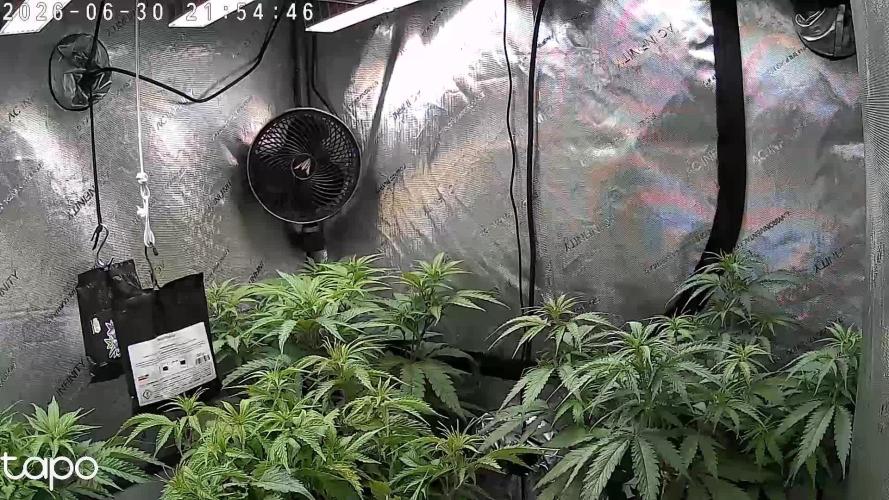
Little bit of a delay. Wanted to get climate perfect before the flip. Upgraded ventilation and have the tent dialed in well at 74 degrees and 60% humidity during day and 70deg/ 55% at night.
Started a second scrog on Day 42. Nervous about the stretch but hopefully I can maintain it (I wish T5 lights could flower...)
Did extensive trimming underneath clearing pretty much anything that will never reach the ceiling of green above it.
Day 45 marks last day of Veg
Day 46 marks first day of flower
AND.
HERE.
WE.
GO.


@PolezGardn
Follow
day 60 flower, ladies look very good, the blueberry has developed nanas... i cut her directly :( but the ChemDog recovered quickly in 12h light!





@Ultraviolet_
Follow
67 days since April 16th, 2026
We become aware at such times of man's wonderful ability to bring seemingly unrelated elements into harmonic balance, and receive a glimpse into a world where everything exists in conscious sympathetic attunement to everything else. When we listen to a piece of music that seems to strike a beautiful chord somewhere inside us, or view a painting that simply glows with harmonic awareness well executed, we probably do not spare much time to contemplate the wonderfully intricate combination of vibrations that our sensors make it possible for us to perceive. We tend to appreciate the relationship between the parts of something by an awareness of the harmony or dissonance of the whole. This ability enables us to say "what a beautiful house!" instead of "analysis has proven that this collection of building materials exhibits certain elements of harmonic proportion." While this ability to instinctively appreciate the beauty of true harmony has an important role to play in evolution, a more analytical understanding of the laws involved can be most useful. This is especially so if we wish to create works of art where each part exists in true harmony, not only with the other part of that particular whole, but with the universe within which the creator and the created exist.
Everything vibrates. From the most dense matter to the most subtle cosmic rays, everything which our senses allow our thoughts to become aware of, can be specified in terms of wavelength or frequency of vibration. These two terms define the same thing, but from different points of view.
The following are the approximate wavelengths of various energy carriers:
Cosmic rays 0.000,000,001 mm
Gamma rays 0.000,000,1 mm
X rays 0.000,500 mm
Ultraviolet rays 0.003 mm
Visible light 0.006 mm
Infrared 0.01 mm
Sound waves 1 meter
Radio waves 300 meters
Violet light 400 nm to 450 nm
Blue light 450 nm to 500 nm
Green light 500 nm to 570 nm
Yellow light 570 nm to 590 nm
Orange light 590 nm to 610 nm
Red light 610 to 700 nm
1 nanometer (nm) = 0.000,000,1 cm = 1/10,000,000 cm
If a guitar string is plucked and we hear a sound, it is not too difficult for the human mind to associate this sound with the vibration of the guitar string. With color it is quite different. It is difficult for us to conceive that the color of a substance is not an inherent property of the substance itself, but an indication picked up by our senses of that substance's ability to absorb or reflect the light which happens to be shining on it at that moment. Neither the matter nor the light is colored. What happens is that the brain learns to differentiate between the frequencies reflected or transmitted by the substance the eyes are focused on. The same thing happens with sound. When we say "Oh! Listen, they're playing my favorite song," what we really mean is: "My brain has stored within it a particular pattern of frequencies. I have compared the new information being received with this stored pattern and have deduced the answer that the two patterns are similar within certain specified tolerances." The 'pleasure' involved could have something to do with our running the pre-recorded pattern at the same time, in 'sympathy' with the new pattern as it is received.
The word sympathy describes very well our ability to appreciate color and sound. It also describes the reason behind certain elements of harmony. For instance, if a substance vibrating at 100 cycles per second (tone 1) is in the proximity of another substance vibrating at 200 cycles per second (tone 2), we could perceive, if we had the right equipment, a certain sympathetic relationship between the two.
We will see from this that there is a uniform doubling of the first tone seen in the second. At various points along the waves, the two are the same in amplitude. At other points, they are at opposite poles to each other. This doubled frequency has more points of similarity to the original than any other frequency except the original itself. If the equipment we had available for measuring these two frequencies was a soundboard amplifier and a pair of ears, then we would hear what would sound to us like one tone. If we had the opportunity to hear one at a time, we would hear that although they sound the same, one is higher in pitch than the other. This characteristic of 'the same but different in pitch', musicians have called the octave. Any two tones produced where one has exactly doubled the frequency of the other is called an octave. Speaking in ratios, an octave would appear then as the ratio 2:1 or 1:2, depending on whether we are talking of an octave up or down.
A single note produced by almost any instrument will contain more than one wavelength or frequency. It will have a dominant frequency, the wavelength of which we would call the note's 'fundamental' or 1st harmonic. It will also have a varying number of upper harmonics, gradually fading in intensity into infinity or silence.
Natural harmonics always have the same pattern of intervals between them. The interval between the 1st and 2nd harmonic is a perfect octave; between the 2nd and 3rd a perfect fifth; between the 3rd and 4th a perfect 4th; and so on, the intervals becoming smaller and smaller until they lose any relationship with the western 12 tone scale as it exists at the moment. Just as an octave has certain elements of sympathy with its fundamental, so some intervals have been noted to be more perfectly in sympathy with the fundamental than others. The ratio of the 'perfect 5th' or interval of 7 semitones, as it occurs in the harmonic series, is 3:2 or 2:3, while that of the 'perfect fourth" is 4:3 or 3:4. All the tones in the western 12 tone scale can be expressed in terms of the ratio between the upper tone and its fundamental. This would seem to be an ideal way of generating a scale from any given fundamental and several attempts have been made to do this, the Pythagorean system being probably the most well known. Although when working with a single tone instrument playing on its own, the Pythagorean formula works wonderfully well, if we had several instruments tuned this way together and asked them to play almost any western music, we would find that at times they sounded quite out of tune to each other.
The lack of flexibility of the various scale systems based on the harmonic series has led to what is known as the 'tempered' scale. This uses as its primary unit of interval the ratio of the octave or 2:1. It then proceeds to divide the interval between any fundamental and its upper octave into 12 smaller intervals by applying the ratio: two to the one-twelfth power, to one (21/12:1). This equals 1.059463094, so by multiplying any frequency by this number, we will obtain the tempered semitone next up from our fundamental. We will also find that any tone twelve semitones up from any other tone, in a scale generated in this way, will have exactly double the frequency.
If we took the note middle C on a piano and halved the wavelength, we would have the note C one octave above. If we halved this, we would have the C above, and so on. However, within about 6 octaves, we would find that although a 'sound' was being produced, no human ear could perceive it. If we kept on going, halving and producing upper octaves of our fundamental C, we would proceed through the infrared band, into the visible light spectrum. If we happened to be outside during the day, we would, for one octave only, see the note C with our eyes. The next octave above would already be in the ultraviolet band, and outside the eye's sensitivity range. If we can think of color as being an indication of a substance's vibratory rate or wavelength, we may begin to see a relationship that could exist between the color and sound spectrums.
The logical extension of what has so far been said is that there exists a scale in the color spectrum that corresponds exactly to the scale in the sound spectrum, each color tone being an octave of the equivalent note in the sound range.
This is not the end of the story but only the beginning. If we can for the moment accept that any wavelength in one band has upper and lower octave stretching out to infinity, then the next question is 'fine, but what shall we use as our fundamental? A particular color? A particular sound frequency?' The musicians among us will probably say 'A 440'. This means that the note A should vibrate at 440 Hertz, or 440 times per second. They would tell us that this is standard pitch has been adopted by most orchestras around the world; pianos are tuned to it, instruments are constructed to formulas based on it, and so to them it would probably seem the most appropriate place to begin. Some of these musicians may know of the battle that is still raging with regards to this being the standard, but few would know why A = 440 Hz was chosen except that it worked when it was set to be a suitable compromise between the many different pitches in use at the time.
432 Hz is said to be mathematically consistent with the patterns of the universe. Studies reveal that 432 Hz tuning vibrates with the universe’s golden mean PHI and unifies the properties of light, time, space, matter, gravity, and magnetism with biology, the DNA code, and consciousness. When our atoms and DNA start to resonate in harmony with the spiraling pattern of nature, our sense of connection to nature is said to be magnified.
Another interesting factor to consider is that the A=432 Hz tuning correlates with the color spectrum, while the A=440 Hz is off. Audiophiles have also stated that A = 432 Hz music seems to be non-local and can fill an entire room, whereas A=440 Hz can be perceived as directional or linear in sound propagation.
Once you adopt the idea that sound (or vibration in general) can have an equalizing and harmonizing effect (as well as a disturbing effect), the science of harmony can be applied to bring greater harmony into one's life or tune to specific energies. There is a form of absolute and relative harmony. Absolute harmony can, for example, be determined by the tuning of an instrument. The ancients tuned their instruments at an A of 432 Hz instead of 440 Hz - and for a good reason. There are plenty of music examples on the internet that you can listen to in order to establish the difference for yourself.
Attuning the instrument to 432 Hz results in a more relaxing sound, while 440 Hz slightly tenses up the body. This is because 440 Hz is out of tune with both macro and micro cosmos. On the contrary, 432 Hz is in tune. To give an example of how this is manifested microcosmically: our breath (0,3 Hz) and our pulse (1,2 Hz) relate to the frequency of the lower octave of an A of 432 Hz (108 Hz) as 1:360 and 1:90.
It is interesting to note that 432 Hz was the standard pitch of many old instruments and that it was only recently (19th and 20th century) the standard pitch was increased. This was done in order to be able to play for bigger audiences. Bigger audiences (more bodies) absorb more of the lower frequencies, so the higher pitch was more likely to “cut through”. One of the oldest instruments of the world is the bell ensemble of Yi Zeng (dated 423 BC), tuned to a standard F4 of 345 Hz, which gives an A= 432 Hz. The frequency of 345 Hz is that of the platonic year! Similarly, many old organs are tuned in A=432 as well; for example, St. Peter’s Capella Gregoriana, St. Peter’s Capella Giulia, S. Maria Maggiore in Rome.
Maria Renold’s book “Intervals Scales Tones and the Concert Pitch C=128 Hz” claims conclusive evidence that 440 Hz and raising concert pitch above scientific “C” Prime=128 Hz (Concert A=432 Hz) disassociates the connection of consciousness to the body and creates anti-social conditions in humanity.
The difference between concert pitch A=440 Hz and Concert A=432 Hz is only 8 cycles per second, but it is a perceptible difference of awareness in the human consciousness experience of the dream we share called existence.


@4hundert20
Follow
Alles gedeiht, aber es bahnen sich CalMag Probleme an..
normalerweise habe ich bisher erst in der Blüte auf CalMag zurückgreifen müssen, wahrscheinlich ist die Wachstumsphase mittlerweile aber auch sehr lang und sämtliche Speicher werden aufgebraucht sein. Ich werde vorsichtig damit anfangen, CalMag aufzudüngen. Bin aber relativ zurückhaltend, da ich in der Vergangenheit so oft Salzstress ausgelöst habe



@Hexahydrat666
Follow
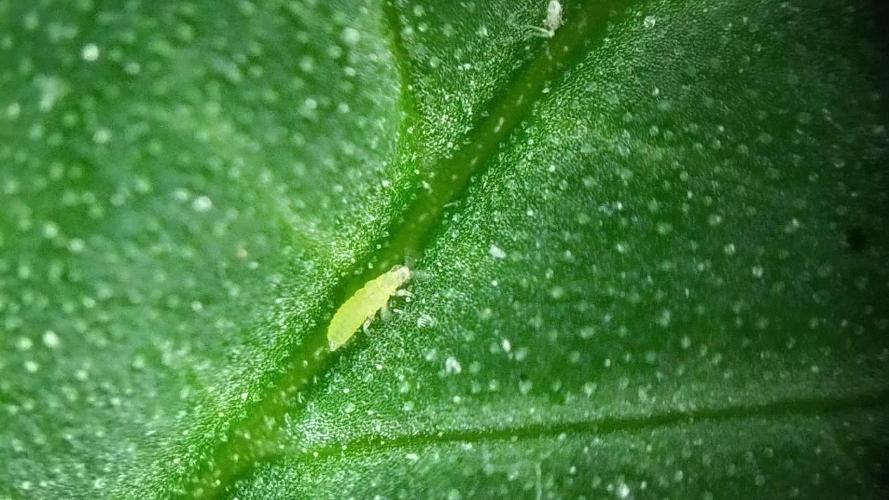
Die Thripse treiben wieder ihr Unwesen. Trotz der Raubmilben tummeln sich die Biester fröhlich auf den Pflanzen. Die nächste Lieferung,ein Mix Paket aus Raubmilben, Nemathoden und Raubwanzen ist Unterwegs aber ich überlege ob es sich so kurz vor der Ernte noch lohnt die Tierchen auszubringen oder ob ich sie für den nächsten Grow aufbewahre.Ansonsten ist die Pflanze in ihrem Herbst angekommen und verliert langsam ihre Farbe,die ersten Trichome sind bernsteinfarben und ich denke das ich in den nächsten zwei Wochen ernten werde.




@MiyaguiOkPolilla
Follow
Hola amigos 😁
Vaya vaya, estas fotografías fueron tomadas apenas 5 días de 12/12 y se ven fenomenal, si estructura se comienza a ensanchar un poco y el ápice asoma ya brotes abarrotados 😎


@Tainopr
Follow
Week 4th flowering
Start smelling strong!!
Like if you open a fresh bag of skittles!! Really fruity candy sweet!!
Looking healthy and happy
Co2 treatment
Low stress training on them!!
Nuts normally and easily
Lil blueberry terpenes on the water..
Trying new strains from new seed banks..
So far they great!!
Let's see how they keep doing!!
Love the smell!!


@The_Lonely_Farmer
Follow
Hey growers I hope your all well ✌️
SHOULD I FLIP???
These girls are nearly 50cm and the one girl is around 35cm, I'm going too continue veg for 1-2 weeks longer and scrog in the meantime too gold back the 2 taller girl.
These girls are plodding into week 7 now so they are ready too flip but will see how my grow question goes before switching too 12/12 👌
They are happy and healthy and doing well under the shogun nutrients!
I have defoliate the odd top fan leaf too allow better air circulation.
We have very high heat atm but hopefully they uptake more 😉😅
Happy growing 🌱💚


@Ganja_Guenthaah
Follow
Woche 2 der Blüte hat begonnen.
Die Pflanzen haben in der letzten Woche noch einmal ordentlich an Grünmasse hervorgebracht. Außerdem wurde wieder jede der der Pflanzen mit dem BioEnhancer von GreenHouseFeeding gedüngt.
Die Automatische Bewässerung ist auf 5x 5min, über den Tageszyklus verteilt, eingeschaltet.
Auch ist immer mehr ein Geruch beim öffenen des Zeltes wahrzunehmen.
Im Laufe der Woche wird wieder entlaubt.
Sobald der größte Teil des streches abgeschlossen ist, kommt ein Netz ins Zelt.


@Greenwolvesfarmer
Follow
Le hice un scrog sin pensarlo . Veremos si aumenta la producción...yo creo que sí !! La malla scrog de los Master : #kanovikultivo #greenwolvesfarmer




@Darkozone
Follow
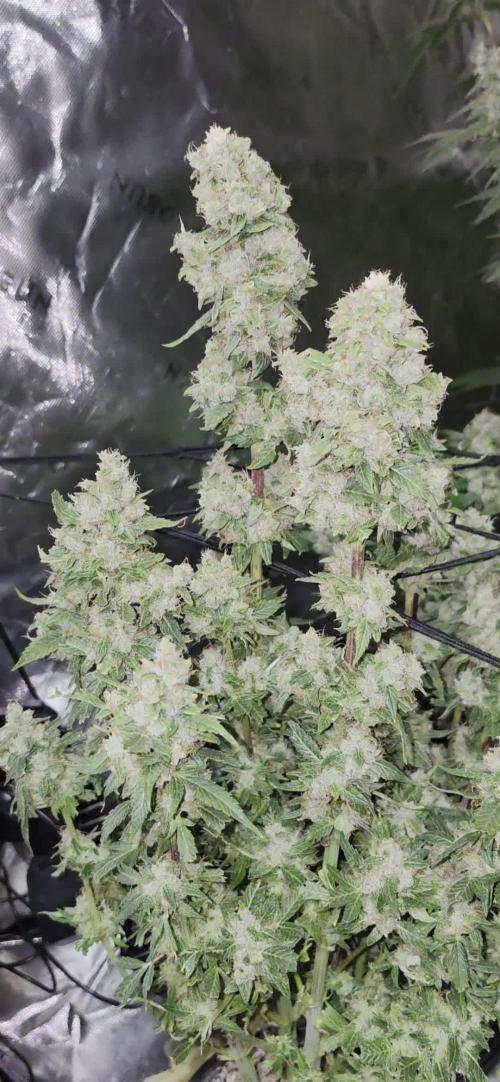
Had issues with my phone hence lack of updates. first batch of seeds did not germinate except for one Blueberry headband, 2 strains which are in here and not mentioned are part of a growoff happening under the Growconsultant PTA (black domina xxl auto and Mantanuska thunder)


@TheCannaProphet
Follow
~ DUTCH PASSION / SUPER SATIVA SEED CLUB FAST FLOWER 'TESTER' A and 'TESTER' B ~
Well cannafam, here we go again on another growing adventure together! This diary will be special to me for two reasons, one because I have the opportunity to cultivate some new and exciting strains from two of the TOP breeders in the industry! The second reason this will be special to me is that I will be growing these two strains in a brand new greenhouse that I put up! I'm super stoked to see how these two ladies turn out in this new setup.
On to the strains:
'Tester' Strain A info: Hybrid (I/S) | 6-7 weeks flowering | Fruity, Sweet, Candy
'Tester' Strain B info: Indica-Dominant (90%) | 7 weeks flowering | Fruity, Peppery, Sweet
I hope that you enjoy this run as much as I will... It's going to be fun and interesting for sure!
~GROW WHAT YOU LOVE, LOVE WHAT YOU GROW!~
____________________________________________________________________________________________________________________________________________________________________________________________________________________________________________________________________________________________________________________________
The Setup:
These beauties will be growing in a brand spanking new 10x14' greenhouse that I have equipped with automatic window openers, a complement of Hurricane fans and a de-humidifier/heater to help keep the environment as dialed in as possible.
I started both tester in glasses of tap water, where they soaked for 24hrs. After soaking, they were placed directly into whole eggshells with just their tops removed to make a natural seed starting pot that I filled with a 70/30 blend of Coco/Perlite which was pre-moistened with well water ph'd to 6.2, then placed under a 50w full spectrum LED on a 24hr light schedule.
Once, they both have their second set of leaves emerged, I plan on starting to put them in the greenhouse for 2-3 hour a day for a few days to help them acclimate and 'harden off' in the greenhouse. I'll be starting both off in 1qt pots, then transplanting them into to gradually larger pots until they're around 6 weeks old, then they will go into their final pots which are 25g fabric pots.
I mix my initial medium using 3 tbsp/g of Gaia Green Organics 4-4-4 along with 1 tbsp/g of Gaia Green Organics Glacial Rock Dust for the trace minerals it provides, 1 tbsp/g of Down To Earth Kelp Meal, 1 tbsp/g of Trichoderma/Mycorrhizae, and 1 cup/g of Wiggle Worm Castings. I hand mix my amendments to ensure an even distribution throughout the medium. I'll be watering with well water ph'd to 6.2-6.8 and providing bi-weekly compost tea's throughout the run.
____________________________________________________________________________________________________________________________________________________________________________________________________________________________________________________________________________________________________________________________
Weekly Updates:
6/9- Here we go into the eighth week of vegetation for the two 'Testers' from Dutch Passion/SSSC and they are both growing fast and the 'Tester B' is getting tall!
6/11- Daytime temperatures outside are now hitting 90℉, and the greenhouse temps are pushing 100℉. I have plenty of air circulating using 4 fans and I'm probably going to put a shade tarp over the greenhouse if the weather continues to get any warmer.
6/13- Daily waterings continue with 2g of well water that is ph'd to between 6.2-6.7 @ 72℉ along with weekly Compost Teas. Despite the excessive heat, both 'Testers' have shown absolutely ZERO signs of any stress whatsoever which is a testament to the superior genetics in both!
6/15- Eight weeks of veg are in the rear view mirror and I'm looking forward to the coming weeks to see how these gorgeous ladies begin to slowly transition into their 'pre-flower' stage. I can't say how impressed I am with both strains vigor and resilience to stress that they have exhibited!
Thank you for visiting my diary, I hope you will follow along and hope you enjoy what I do! Stay Blessed!😎💚


@Weedman268
Follow
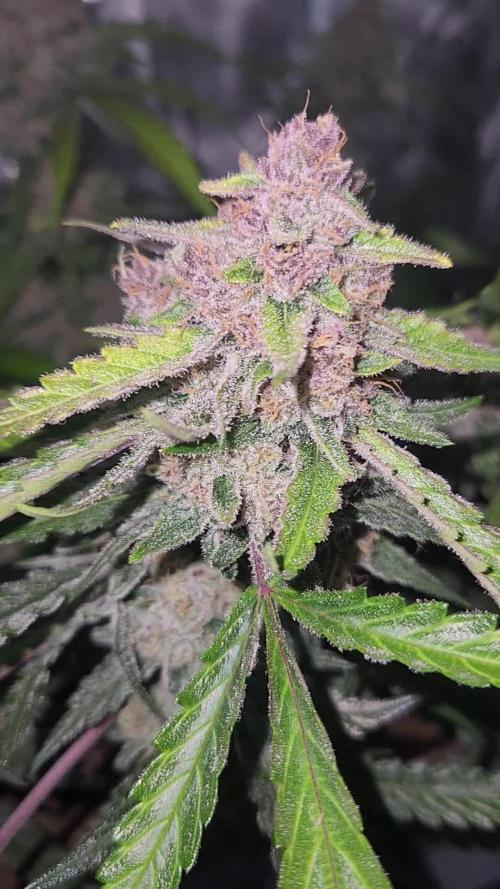
She smells really nice this is her last week will be picking her in the next day or two


@DaisyNabis
Follow
preventivo de la semana al dia, desintale humificador para preparar a mis bellas para su trasplante a maceta definitiva, esta oportunidad no hare podas bajas solo algunas defoliacion