


Likes
Comments
Share


@Silverback_Guerilla
Follow
2/26:
I harvested her on the night of the 26th. She was live trimmed, chopped and washed, and hung to dry.
3/2:
Still drying in the closet...smells very strongly of elderberries and gasoline.


Likes
9
Share


@Rizik86
Follow
Day 58 - Checked PPM 1,300.
Day 59 - Checked PPM 1,300. Got lucky <<<
Day 60 - Checked PPM 830. buds are swelling.
Day 61 - Added 10 mL of 10 mL of CalMag Micro Grow and Bloom. Added 5 mL of Bud Candy Sensizym Big Bud Nirvana Rhino Skin and B-52. PPM is 1,560.
Day 63 - Checked PPM 667.

Processing
Likes
18
Share


@wheedtobeus420
Follow
Day 84. She’s huge and growing bulkier each day it seems. I try to rotate her because she has grown over the light. She’s a slow finisher. But I’m hopeful of what she will become and how she will smoke.


Processing
Likes
13
Share


@Cheesefarmer420
Follow
Growing this popsicle cake definitely had its ups and downs. What started out looking like a dud of a seed turned out to be something pretty spectacular. Stacks the buds nicely to fill up the whole colas, super frosty, with an un godly stench of sweaty dirty socks. Still in the curing process but definitely has a heavy indica punch!
Likes
78
Share


@deFharo
Follow
Bienvenidos cultivadores de marihuana clandestinos, y también, a los que tienen la fortuna de no serlo! 🖐️👨🌾... todo por la causa!
Décima semana de floración, la gitana floreada se va! 💃😿 El paso del tiempo se lleva a mi gitana aunque yo no quiera, fantástica a sido su compañía estos meses, ella, discreta como siempre y conforme con su destino, presume hasta el último momento de sus bellas flores... pero la vida manda.
Llega el momento de la cosecha, de la despedida, del saqueo, de la tristeza infinita, mi gitana y yo hablamos...
Dad -¿Cómo estas mi gitanilla?
G - Bien Papi, en paz, satisfecha.
Dad -¿Qué necesitas, mi niña?
G -Riégame por última vez, con agua pura
Dad -Claro, te purificaré mi amor!
G -Sácame al calor del sol, como hacíamos cuando era joven...
Dad -Sí niña, al sol de verano!
G -Quiero estar despierta hasta el final
Dad -Te acompañaré...
G - ¿Me contarás historias Papi?
Dad -😿 Claro como cada noche, pero hoy, te cantaré una canción...
G - Te quiero ❤️
Feliz verano cultivadores!!
Hasta la cosecha...
SALUDOS A TODOS!!
=================================
Info de la cepa GYPSY KUSH: https://en.seedfinder.eu/strain-info/Gypsy_Kush/Kannabia_Seeds/
"una variedad única con un duende flamenco que no se puede aguantar y que solo puede venir del sur..." Kannabia Seeds
- Genética: Black Domina x Afghan x Ginger Ale
- Hibrido: Sativa 50% Indica 50%
- Tiempo de Floración: 58-62 días
- Rendimiento: 500 gr/m
- THC - Hasta 16%
==============

Likes
38
Share


@TrueNorth
Follow
September 23 2019 6AM- Here we are! Week 10! Feels like just yesterday they were seedlings! Great bud growth, frostier than frosty the snowmans ass! 🤣. Going to get a microscope to look in there and see if they are milky yet or not! More and more hairs are going orange, i have been lollipoping these bad girls like crazy.
September 23 2019 10AM- Got a microscope! So damn cool!😱
September 24 2019 6PM- The Smell is so sweet it is amazing, almost like candy! i took some popcorn buds and they are currently drying! that is where i got those sugar leaves from, i continue to defoliate the bigger leaves covering the buds from all that beautiful light.😘
September 25 2019 7AM - Today i started the flawless finish by advanced nutrients!!😎
September 25 2019 6PM -The buds have honestly thickened up over night it seems to happen as i blink lol i love growing, amazing strain! definitely recommend this strain for beginners as you can see i made many mistakes!
September 26 2019 6PM - i took the videos and photos when i took the ladies outside for the first clean water flush through the whole thing. i will continue flawless finish both are looking amazing. the smell is so good, Those popcorn buds i took off are so amazing i can not wait to have the full finished product!😍

Processing
Likes
12
Share


@GrowGuy97
Follow
Day 48 - Ladies are doing great, buds are getting much bigger and extremely purple & frosty! Will be updating on my days off! Thanks for following & happy growing friends!🙏🏼✌️🏼
Likes
168
Share


@Still_Smoq
Follow
📆 Week 15, 12-18 August 2024
12-18 Aug - Observed and let the plant grow.
13 Aug - Turned lights down to 50% power.
📑 It’s been another week and no signs of slowing down. Pablo continues to grow! Her sativa genetics are really showing. I’ve turned the light power down to 50% hoping this will help to mature the plant. It is looking like another good week of flower will be appropriate here. Lets see just how big she can get.
🍶 14 Aug nutrient solution changed
🍽️ 14 Aug feeding schedule updated
💧 Using reverse osmosis water with EC/TDS at 0
🐉 Nutrient Solution EC 1.0 at 74 degree F
🔆 Light power at 50%, DLI 35 canopy coverage at 12hrs
😤 Using PYPABL, Air Pump, 400GPH
That is it for this week. Thanks for the look, read and stopping by.

Likes
2
Share

@CWolcott1991
Follow
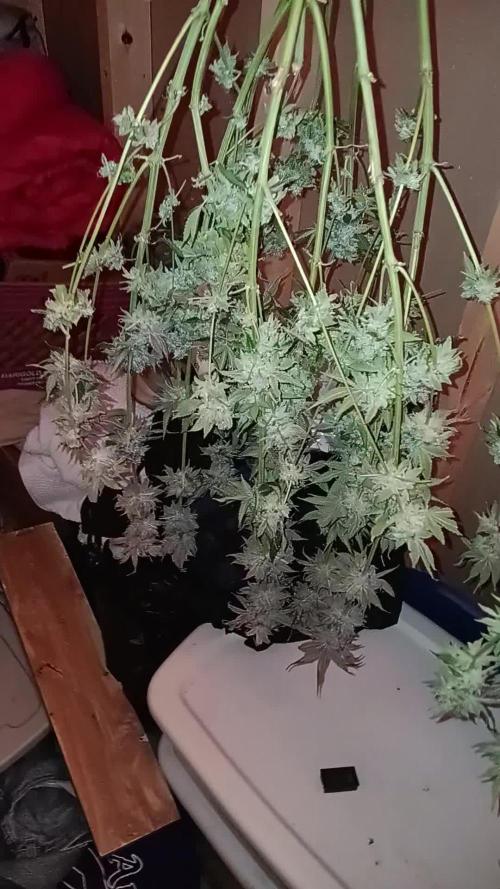
Day 63 Chopped em down trimmed off all fan leaves and hung em whole plant in closet thay stays around 58% RH and 69°F


Likes
2
Share


Likes
15
Share


@Kurow
Follow
This week is dedicated to finalizing the pot and nutrients for the rest of the lifecycle, looks like it took to the nutrients very well not much new upwards growth but new leaf sites appeared!

Likes
20
Share


@Ultraviolet
Follow
The most important contribution that any man can make to a garden -- even more important than water or compost-- is the radiation he himself puts into the soil while cultivating it.
Epinoia
(ἐπίνοια) is a Greek term meaning thought, intention, purpose, or conception, stemming from "mind" (nous) and "upon" (epi), representing the mind's reflective or creative process, used in philosophy (Aristotle, Gnosticism) and theology to discuss understanding and divine names, appearing once in the New Testament for the "intent of your heart" (Acts 8:22). It signifies the mind's operation to form ideas or designs, contrasting with raw data or innate perception, and in Gnosticism, it's an emanation of divine wisdom (Sophia).
Exclusion Zone and Coherent Domains in water, broken down into layman’s terms. Imagine you have a glass of water with tiny particles (like dust or dye) mixed in. Now, put a special surface—like a gel or a hydrophilic (water-loving) material—into that water. Next to that surface, a layer of water forms that is totally clear. All the particles and dye are pushed away from it. This water is not just liquid; it has changed into a structured, gel-like state. It "excludes" solutes (particles), hence the name "Exclusion Zone" or EZ water. To understand why the water behaves this way, scientists look at "Coherent Domains" (CDs). Molecules move randomly, like a chaotic crowd. A group of water molecules gets energized and starts acting as one single unit, moving together in perfect rhythm. This state is created by electromagnetic energy and quantum effects, forming organized, crystalline-like structures. Think of a flock of birds or a school of fish. They aren't tied together, but they move in perfect unison, reacting as one. In a Coherent Domain, water molecules act like this synchronized flock rather than independent, random molecules.
Coherent Domains are the "rhythm" or the "structure" inside the water.
The Exclusion Zone is the physical space where this structured, coherent water builds up next to surfaces.
The interaction of light—specifically UVB light—with liquid water generates quantum Coherent Domains (CDs).
This type of water is believed to be vital for biology, acting as an energy storage system inside our cells, as EZ water forms naturally around membranes and proteins.
Light has a duality fundamentally. It can act as a particle or a wave photoelectrically. You do not have to understand or like this, just accept it because nature is absurd at times in what she gives us. When the EZ forms, the EZ then begins to absorb light in the 270 nm range to increase the EZ power and potency. This is in the ultraviolet range. Water absorbs ideally in the red frequency range 1500 nm -3000 nm. Red light builds the battery, and once the EZ is formed, UV light adds massive power to the EZ to drive all biochemical reactions via enzyme flux using proton tunneling. Releasing millions of almost free electrons.
Great book
Library of Congress Control Number: 2020930536
ISBN 978-1-64502-009-7.

Likes
16
Share


@CheeRz
Follow
Day 51 of flowerin' and the ladies almost fin' 💚. Trichomes lookin' damn frosty ❄️❄️❄️ and buds gettin' really big.

Likes
8
Share


@MTUZZIO
Follow
Fully into flower. Filling in well, smell coming along nicely (some are like lemon candy, some are a little more skunky).
I had a Mars Hydro TSW2000 sitting around so I added that in between the two lights/beds which really helped to even out the PAR. Dead nuts in the middle of the beds is about 1000, the edges are about 700. Super cropped a few that were just reaching too much.
Put up some trellis, I think I'm going to need the supports, and helped to spread out some of the stacks that were going to be a little too close. Did a little more defoliation. It's really just maintenance at this point (and standing there admiring and smelling over and over)
Been mixing up a little organic nutrient cocktail to supplement with, using BuildASoil BuildABloom (soy protein hydrolysate, rock phosphate, gypsum, magnesium sulfate, potassium sulfate), Fermented Plant Extracts: Liquid Pumpkin Extract (Probiotically Grown Pumpkins, Clean Mountain Water, EM-1, Home Made LABS (Lactobacillus Serum), Super Cera Powder, and Molasses), BuildASoil Aloe and the Quillaja extract. I'll do a foliar spray first thing in the morning and replace the first fertigation of the day with this same mix (at the normal EC and PH level). They seem to love it and respond really well.
I really want to switch over completely to organic living soil, I'm probably going to after this run, so it's fun to experiment with some of the ingredients.
Likes
99
Share

@SundancerS
Follow
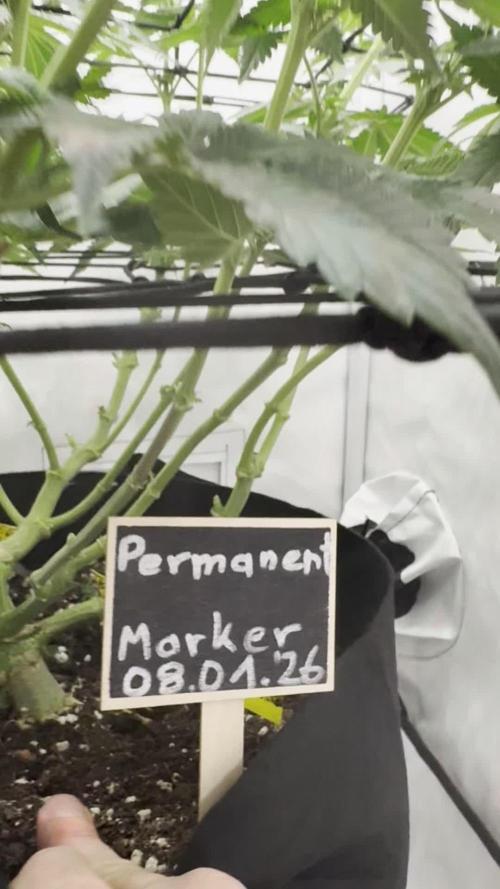
Die Permanent Marker ist sauber in die Blüte gestartet und zeigt kräftiges, kontrolliertes Wachstum. Der Stretch hat vorsichtig eingesetzt, noch moderat, aber spürbar. Das Experiment mit dem zweiten SCROG-Netz wirkt bislang vielversprechend, die Triebe nivellieren sich fast von selbst auf eine Höhe. Ein paar wenige Seitentriebe wurden noch entfernt, alles im grünen Bereich.
Dank Hy-Pro Spraymix stehen die Blätter sattgrün und vital bis in die Spitzen. Ab dieser Blütewoche, wird er jedoch abgesetzt. Mit einem EC von 2,2 und pH von 5,8 scheint die Nährlösung auch gut abgestimmt zu sein. Ihr Durst ist beachtlich: etwa 1,3 Liter pro Tag gehen problemlos durch. Insgesamt ein guter, vielversprechender Start in die Blüte.


Likes
1
Share


@Donrodman3
Follow
Transplanted to their final homes, 5 gallon fabric pots. Plant's height is 8cm - 13cm.
Temp: 22°c - 29°c
Hum: 30% - 45%
Water ~ 1L each
PH: 6.7
On day 16, I transplanted to 5 gallon fabric pots.
I amended the Biobizz light mix soil with:
*Per 5 Gallon Pot*
EcoThrive Grow - 27g
EcoThrive Bloom - 3g
Ratio = 90/10
Now they're all drinking 1L a day.
L.S.T:
I topped the two American Beauties once each on Day 20 at the 5th node to allow the Cherry pies to catch up.
😁
Very pleased!
Likes
32
Share


@Bossman
Follow
I have nothing to complain about I'm more than satisfied with the results this far l. Roots organic is my new bestfriend