


Likes
Comments
Share


@4F1M6
Follow
Pollen was dropping like crazy as the male flowers got ripe and ready. The females got good and coated and fully pollinated. I harvested the males to collect and preserve the pollen. Some dried and I veiled it up. But the bulk majority is still drying up.
I left just the bottom portion of the male kicking for some extra pollen well the females throw off. The diary will now begin to focus on the pollinated females. The journey to beans is well under way! Until next update. Happy growing and stay lit fam.


Likes
16
Share


@HowtoBubatz
Follow
As the plant enters the fifth week of flowering, the first trichomes have begun to form.
The buds have started to thicken considerably during this week. They are becoming denser and more robust, which indicates that the plant is channeling its energy into producing larger, more resinous flowers.
Throughout the growth process, the cannabis plant has shown no signs of health issues.
It has remained vigorous and resilient, with no observable deficiencies or diseases.
To ensure optimal light penetration and airflow, the plant was lightly defoliated this week.
The cannabis plant is progressing well in its fifth week of flowering.
The formation of trichomes, the thickening of buds, and the plant's overall health are all promising indicators of a successful flowering phase.


Likes
9
Share


@NordicCropz
Follow
Chopped on day 67, could have gone longer. But DAMN this blew past all my expectations, mostly because of the lighting challenges. I got 126 grams with 5 weeks of veg with a less than optimal positioned 400 hps, HELL YES. Not to mention it is probably the best THC strain I have ever had, certainly the best smelling, at least.

Likes
27
Share


@Oetelando
Follow
We Have Week 9 Day 1.
Everything looks good and the Trichomes get Brown.
Some of the Strains get Harvested in 5-6 days and the rest in 8-10 days.


Likes
10
Share


@SgtDoofy
Follow
3/6:
Yesterday I fed half strength nutrients ph'd to both. Amnesia's runoff ph was 5.5. So I made another half gallon of half strength and ph'd it to 7.5 to get Amnesia's runoff to be 6.5. If only I had done this sooner and didn't mess up with the PH testing drops as opposed to using a ph meter, Amnesia's leaves could have still been green. I've been removing all of the dried, crispy ends as I find them, leaving the rest of the leaf intact to suck up as much light as possible. Timelapses are showing that the buds are fattening up well though. Trichome production has kicked in and is covering the leaves. Beautiful colors all around.
3/8:
I don't think I can wait any longer to feed Amnesia. Vacation starts midday tomorrow, Thursday, and I'll be away until Monday evening. I'm mixing up a half strength nutrient mix with molasses and epsom salt. I'm also going to try to set up a timer/pump system to water sunday night.

Likes
4
Share

@Dr_4NdY
Follow
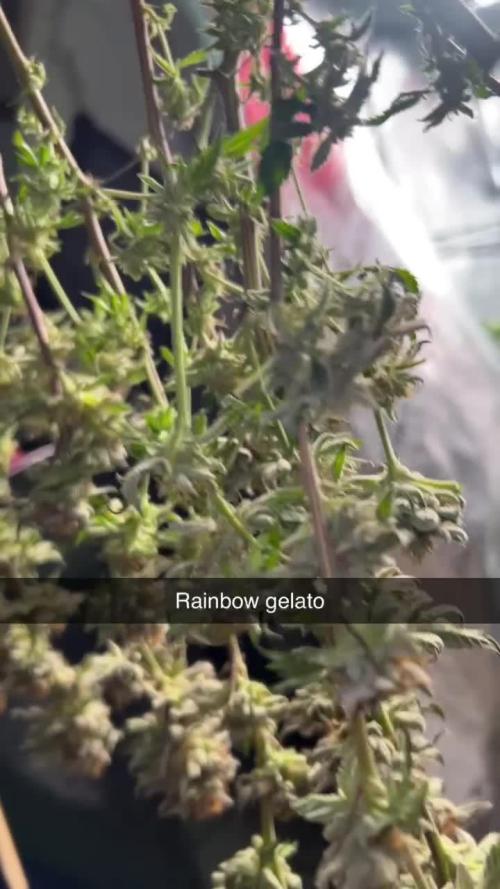
First Vid is after drying, rest was at harvest timeHad fun growing the plant, nice beginning & good long veg time
Buds don’t look that nice but are tasty (heavy citrus / little vanilla flavor) + a nice clean high
Got 245g dry out of 1 plant
60% heads 40% popcorn
Heavy lollipopping required!
As seen some top leafs were getting crisp at the end, i think it was because of little mineral deposits (salts from hard tap water) at the bottom of the pot
This strain should be growed with osmose water


Likes
11
Share


@ElGrowLab
Follow
Yesterday I wanted to hang the lamp a little lower and unfortunately it fell into a plant. The damage could be greater but it makes me a little sad.
One BigBud looks really beautiful and is slowly turning purple. no one else does that. I also ordered canna terra flores because a few defects are slowly becoming noticeable, especially in the 6 l pots. I am otherwise very satisfied.
I currently water about 2 liters in the 6 liter pots and about 3 liters in the 9 liter pots. I will probably use fabric pots or AirPots less in the future because watering them annoys me so much and they dry out very quickly.


Likes
9
Share


@russrahl
Follow
Flipped to flowering on these girls as the screens are now almost full across the 4x8 tent and we will still need to train them along the screens for the next 2-3 weeks. So working for a packed tent this time hopefully. Plants have been exploding in growth daily. Water was changed out and new water added with 3/4 Remo Flowering lineup and UC Roots at full strength. Smell is starting to get noticeable when you open the tent and is very pleasant.


Likes
19
Share


@Deepgrow
Follow
Primera semana de floracion, 7 dias, ciclo de luz 1212 y ya veo los primeros pelitos.
Empiezo a agregar pastillas easy to bloom, de Royal Queen a 2/3 de la dosis indicada por el fabricante, al bajar el PH con las pastillas agregro PH + y Ata Clean para mantener limpio el autopot, aunque se lo hecho en el riego a todas las plantas y les va bien.
Las he ido doblando las colas mas largas para equilibrarlas en altura, aunque no hizo mucha falta, quite un par de hojas muy grandes y le aplique el ultimo tratamiento de prevencion con jabon fosforico e insecticida natural de aceite de Neem, por cierto, ha venido muy bien, 0 bichos.
Quiza le aplique en un par de semanas cola de caballo para prevenir hongos.
Likes
12
Share

@Grow4ever
Follow
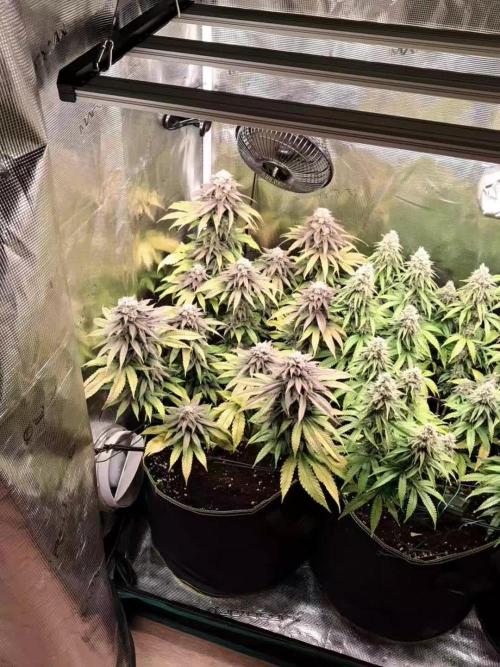
Wir befinden uns Ende Blütewoche 8.
Sobald das Zelt aufgeht kommt mir eine süße Welle entgegen. Die Buds der Lemon Orange sind im Vergleich zu den anderen Strains etwas kleiner. Auf die Ernte, in ich schätze 2 Wochen, freue ich mich wirklich sehr :)

Likes
103
Share


@Hou_Stone
Follow
️ Genetics of Tarte Tatin = Caramel Apple Gelato x King’s Tart ️
🌱Here I am with 4 small seedlings of Tarte Tatin 🥧
With her genetics, I have a feeling she's going to be delicious, I can't wait to taste it! 😋
After a short week of growth I place my seedlings in their final 7Liters pot with a mixture that I made. I use unfertilized soil as a base.🌱
And I add organic nutrients from GreenHouseFeeding that I mix at the top of the pot (35Grams BioGrow 14Grams Biobloom).
Then I water each pot with 1L of water.💧
I use tap water. I lower the pH and sometimes add a little BioEnhancer😘
My Instagram 🌱❤️️ :
https://www.instagram.com/hou_stone420/
------------------------------------------
Equipment used :
Light FC3000 Mars hydro. power 25% at 30cm
Extractor 6 inch Mars Hydro. power 1/10. ON 24/24h
No other fan this week
Heating mat Romberg 95x95cm. ON half an hour every hour
☄️🌠🌠🌠🌟
Thanks for your visite mate 💪
🙌Have a nice day !
Likes
37
Share


@BnV405
Follow
Great week popped in a day! Germination took 1 day also! Growing fast! Fastbuds!
Likes
19
Share


@pifflestikkz
Follow
Day 64
02/09/24 Monday
Feed today using de-chlorinated tap water pH 6 with calmag.
Day 66
04/09/24 Wednesday
De-chlorinated tap water pH 6 today only. Smell is really coming on strong now!!
Day 69
07/09/24 Saturday
De-chlorinated tap water pH 6 only today.
Depression has hit, so has mould 🤦♂️😔
Had to chop her main colar, and two sides, so the overall production will be more than halfed... But I will finish diary off till she completes. I hope I saved her

Likes
11
Share


@CanarianGrow92
Follow
Already, this is going to be the last week, next week im switching to 12/12 lets see what this marshydro TS1000 can do, i want to see if i get the same results as my LEC, if thats the case its a real winner as its half of electricity costs, and electricity starts to get expensive as every indoor grower knows 😁😝
The blue sunset goes good, she's looking quite recovered from last weeks topping

Likes
4
Share


@Growin_Ish
Follow
NY Diesel Auto Feminised is an auto-flowering version of the celebrated New York City Diesel. It is mostly indica while also displaying some sativa-like cerebral effects to accompany the deep relaxation that it provides.
NY Diesel Auto grows to a height of 60 – 100 cm. tall and develops plenty of side-branches that produce nice, dense buds. Growers can harvest yields of yields of around 600 gr/m2 in just 60 - 70 days from germination. This strain can also be grown successfully outdoors due to the hardy ruderalis genetics.
The scent is very dank with notes of diesel fuel. THC production is in the region of 14 – 16% while CBD levels are around 2%. The overall effect has an initial cerebral quality leading into bodily relaxation and a sense of wellbeing while not being physically incapacitating
10/5
Dropped two NY Diesel Auto seeds into a shotglass of room temp spring water. Placed the shotglass in a dark warm cupboard.
I will be preparing the medium today as well. The plan is 24 hours in the shotglass, 24 hours in a wet paper towel, then straight into 3gal fabric pots that have already been cooking for 2 days. They'll go under 18/6 with RH at 60% to 70%.
10/6
One seed has a tiny tap root and is still floating in the glass. The other seed fell to the bottom but has no taproot. Letting them stay in the shotglass another 12 hours.
10/7
Diesel #2
Half inch tap root and she sank to the bottom of the shotglass finally. I wet the coco-perl with PH 6.35 room temp water with Fish Sh!t in it. Let's grow Diesel #3 without Fish Sh!t for comparison.
Diesel #3
She has a miniscule taproot and it's black. Could just be film from the seed case where it cracked. I put her in a damp paper towel and stuck her in the dish washer. We'll check back in 12 hours.
12 hours later, no change. Then I realized I forgot to put it in a zip lock. The paper towel was still wet tho. Put it in a zip lock, will check in the morning.
10/8
We have a taproot on NY Diesel #3. Put some Azos in the drop site and sowed the seed. Half a shot glass of water to seal it in. 18/6, 67% RH, 80°f
Likes
2
Share

@Canivent11
Follow
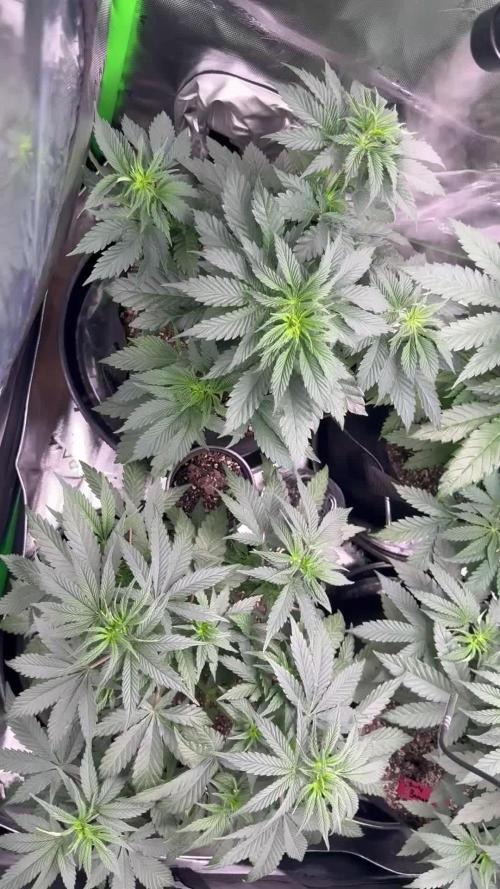
1st feed of green rush leafy green grow, Gaia green all purpose and power bloom as I get ready to flip this girl to flower in a week or so.

