


Likes
Comments
Share


@Grey_Wolf
Follow
Looking For A Keeper
cream of the crop seeds purple paralysis
2nd April 2021
First of all ... Phew!!!! That was a long grow!!
I've done all of the Main trimming and have a heap of Jars full of Stinky Buds ready to begin the curing process. 😍😍
It was a challenge growing in new conditions during Summer with Temps often getting above 45 degrees celcius
Thunderstorms and High winds became an issue once or twice and finally the worst part was the Bloody Caterpillars 😣
Those buggers gave me the absolute shits for the last 5 weeks of the plants life .
These plants actually started from clones taken from a Purple paralysis plant that I was hoping to flower last year.
However due to an unavoidable trip away I lost that plant but the clones survived.
So then my plan became to plant them both into a garden bed filled with my soil mix which basically consisted of
locally sourced Red dirt and washed river sand mixed with Cattle manure , worm castings , garden lime and Lucerne mulch.
The Plants thrived thru the summer months and into Autumn and ended up yielding 19 ounces plus Lots of good quality trim.
I love this strain and have definately found myself a Keeper in this one .
I'd really like to get the oppurtunity to try other strains from Cream of the crop seeds and maybe I will before too long.
I wont go into too much more detail about the grow and how it played out , instead I put up some pics
from various stages of the plants progress as they say pictures are worth a thousand words. 😀
Thanks must be said to you all for checking in from week to week and for the likes left I truly appreciate it. 🙏
Well thats the end of my 6 month long diary I hope you liked it and thanks for stopping by 👍👍





Likes
8
Share


@GrownwithLED
Follow
The plants react well to the switch to 12/12 and continue to stretch and fill out their grow space. They love the Advanced Nutrients feeding schedule and have a healthy green color all over. The first signs of flowering (=white hairs) start to appear and both plants are female (as expected from feminized seeds). Barbarian (=AK-47 x Barbara Bud) plant #2 is appr. 12 cm taller than plant #1 at this time.
Likes
1
Share


@Mr_Motalovah
Follow
Hello Growers & Tokers!
Rooooots. Don't forget about them!
At the beginning of the week they all got transplanted into their final pots, 11L fabric pots.
Medium is Light Mix from BioBizz.
Synergy from Grotek nutrients was blended in the medium to help out the roots.
Let hat mycorrhizae do it's thing.
I'll let them settle in their new home then I'll be topping them to widen that canopy out.
Take care out there and happy growing!
Likes
16
Share


@MadeInGermany
Follow
Flowering day 15
since time change
to 12 / 12 h
Hey guys :-)
This week the ladies developed beautifully 👍.
The stretch has started very strongly :-) .
Watering was done twice this week with 1.2 l (see table above for nutrients).
The heating mat does exactly what it is supposed to do, you can see that the ladies are doing perfectly again 😃.
Fresh osmosis water was mixed with tap water in a 100 liter tank so that I would have enough stale water for the coming week 👍.
Otherwise everything was cleaned and checked.
During the check, I noticed that after spraying neem oil 3 times, there were still a few damn trips to see.
I have ordered nematodes for leaf and substrate against tripse.
Then they should finally be gone again 🙏🏻
have fun and stay healthy 💚
👇🏼👇🏼👇🏼👇🏼👇🏼👇🏼👇🏼👇🏼👇🏼👇🏼👇🏼👇🏼
You can buy this Nutrients at :
https://greenbuzzliquids.com/en/shop/
With the discount code: Made_in_Germany you get a discount of 15% on all products from an order value of 100 euros.
👇🏼👇🏼👇🏼👇🏼👇🏼👇🏼👇🏼👇🏼👇🏼👇🏼👇🏼👇🏼
You can buy this strain at :
https://www.ripperseeds.com/en/feminized/kmintz-feminized-cannabis-seeds
Water 💧 💧💧
Osmosis water mixed with normal water (24 hours stale that the chlorine evaporates) to 0.2 EC. Add Cal / Mag to 0.4 Ec Ph with Organic Ph - to 5.8 - 6.5
MadeInGermany

Likes
210
Share


@Rock_n_Roll_Randy
Follow
https://greenbuzzliquids.com/en/shop/
PROMO CODE: rocknroll
CHECK OUT MY MUNCHIES DIARY AND ALL MY OUTDOOR DIARIES FOR RESULTS FROM GREEN BUZZ LIQUIDS👍🤘
This is what's in the box👍👍 guaranteed the best fertilizers on the market by far. I'm going to start using it on all my outdoor diaries because they are still younger but I will wait until my next indoor grow to use it so I can start from the beginning 👍. Such a detailed and easy to follow feeding chart and directions from them it's foolproof. Everything is 100% organic. I mentioned to them as a joke that I might drink it all to get bigger and stronger and they ACTUALLY gave me a recipe for a drink made with these products. Now that's what I call organic👍. I didn't expect that. So if you're nervous about what you feed your plants then these products are for you. If we can drink it then you know how safe it is👍 PERFECT FOR LIVING SOIL AND ORGANIC GAREDENS. It will work amazing on fruits and vegetables too, so I will use it on my MUNCHIES DIARY for all my vegetables too👍
They are located in Europe, so if you live anywhere in Europe you need to TRY THESE PRODUCTS👍
I hope we can spread the word on green buzz liquids so we can get it in stores in North America. SO PLEASE SPREAD THE WORD my friends👍🤜🤛. This is the best fertilizer products you can get I will guarantee it🤘. They have pre made kits for beginners, professionals and vegan👍 with detailed instructions and information for everything 👍 from beginner, professional and vegan. They are priced very well in comparison with other big brands👍 SO CMON AND HELP SPREAD THE WORD and lets help them get it to Canadians and Americans and all over the world👍🤜🤛
Check them out and all their awesome products at:
https://greenbuzzliquids.com/
@greenbuzzliquids
#greenbuzzliquids
Here is a bunch of information about these products:
Description:
PH POWDER
Lowers the pH-level fast and effectively
Out of respect for mother nature: organic pH correction in powder form
With pH- Powder:
• pH-level is corrected quickly
• nutrient lockout is prevented
• plants are provided with extra nutrients such as nitrogen, phosphorus, magnesia, sulfur, and high-quality silicates
More advantages of pH- Powder:
• applied regularly, it prevents signs of nutrient deficiency before they occur
• easy to use – can be fed at the same dosage during the entire life cycle
• it is 100 % organically obtained and makes the use of hazardous acids unnecessary
• not harmful, because it is in powder form
Application:
This information serves as a benchmark only, as starting pH-levels vary a lot depending on your region
• mix all nutrients and supplements, then measure the pH-level
• about a teaspoon (1-2 grams) should be enough for 5-10 liters of nutrient solution; stir well and measure pH-level anew; this is optimal between 5.8-6.5 pH
• if the pH level is still too high, add more powder; if it gets too low, add more water to dilute the concentration.
Description:
FAST PLANT SPRAY
Vitalizing plant aid for young plants
Ideal to use on:
• Seedlings
• Young plants
• Cuttings
• Mother plants
With Fast Plants:
• nutrients are unlocked more easily, increasing receptivity right from the start.
• plants produce higher amounts of CO2 and other beneficial matter, which lets them grow faster.
• nutrient deficiencies are removed reliably.
Fast Plants offers many advantages:
• clearly better and quicker root development
• no more nutrient deficiencies or stunted growth
• shocks are dealt with more easily, shortening the growing phase
• foliage is visibly vitalized and highly branched
• stress tolerance and heat resistance are increased
Application as foliar spray:
We suggest spraying the leaves dripping wet after the lights have gone out.
Seedlings
• spray every two days
Cuttings
• spray every third day
Young plants
• spray every fifth day
Mother plants
• spray three days before and three days after taking cuttings
Description:
FAST START GEL
Fast and reliable rooting gel
With Fast Start Gel:
• cuttings develop roots faster and better
• survival rate of 100% under the right conditions
• helps grow vigorous, well-rooted young plants in the shortest time possible
Fast Start Gel offers many advantages:
• cuttings will be well-rooted in no time
• cuttings are clearly stronger and more vigorous than untreated ones
• faster transition to the growing phase
• healthy cuttings are the foundation of a successful crop
2-3 additional applications with Fast Plants Spray brings even more advantages:
• no more limp, hanging leaves from cuttings
• the usual signs of nitrogen deficiency are prevented
• vital nutrients are provided directly to the foliage, relieving roots in this most critical stage
Application:
DO NOT shake before use!
For taking cuttings:
• Take desired amount from bottle. Then squeeze remaining air from bottle and close tightly. Keep refrigerated after opening.
• Soak the cuttings where the cut was taken immediately for 2-3 minutes in Fast Start Gel.
• Next, stick cutting into the rooting media of choice.
• Remaining gel can be used to seal the holes in which the cuttings were placed.
Description:
LIVING ORGANICS
Ideal to improve and activate soil life
Living Organics consists of trichoderma and bacterial fungal strains which upgrade your soil life. As a result, plants can process more nutrients and have a higher resistance towards environmental stress. These microorganisms occur everywhere in nature in different concentrations and should not be neglected when growing organically.
With Living Organics, soil life is clearly improved from the very first application. When adding Living Organics to your growing media (especially soilless substrates), it is treated with various beneficial microorganisms. Millions of trichoderma and bacterial fungal strains help improve the condition of the growing media with every further application. The result is a symbiotic relationship between the plants and the beneficial fungus, which interacts with the plants’ root system.
Living Organics offers many advantages:
• it improves soil life and root development by continuously populating mycorrhizal strains;
• promotes compact plant growth;
• raises nutrient uptake and protects plants from disease;
• plants’ resistance toward environmental stress is higher;
• ties down excess nitrogen and phosphorus while making organic material available to the plants;
• stabilizes ph-levels and helps to achieve higher yields.
Application:
When preparing your growing media:
• 2 g (1 tablespoon) per 10 liters of water
The growing media can be upgraded further with products such as Humic Acid Plus and More Roots before planting to achieve better germination or to reduce stress on cuttings. The products accelerate root development and reduce the risk of losing plants. The plants will be able to begin their vegetative growth faster.
When treating your growing media before transplanting:
• Sprinkle a thin layer of Living Organics on top of your media. For starting seedlings, sprinkle a small amount into the hole where the seed will be placed.
• When transplanting to a new container, sprinkle Living Organics into the hole where the roots will be placed. You can also spray the root zone with water and sprinkle Living Organics directly onto the roots.
To refresh the existing microorganisms within the growing media:
• 1 g (1 tablespoon) per 10 liters of water
Refreshing the media every 14-21 days with Living Organics to keep the microbes healthy is advisable. We do not recommend applying Living Organics continuously for cost reasons.
Description:
GROWZYME
The plant aid for more efficient plant growth
With Growzyme:
GROWZYME is a liquid brown-algae extract from the seaweed Ascophyllum nodosum, which is harvested in the Atlantic Ocean along the north coast using an innovative, high-quality and gentle cold-pressing process.
We place great importance on seaweed of the best quality, because it is particularly rich in amino acids, minerals, trace elements, vitamins and other nutrients that are not present in this variety in terrestrial plants. Our seaweed is sourced only from the unpolluted northern part of the Atlantic and is harvested at the most nutrient-rich stage of the plant-growth cycle.
Growzyme offers many advantages:
• applied directly to the leaves, the plants already look much more vital on the next day, regularly applied more bushy
• increases and stabilizes chlorophyll in plants, resulting in dark-green leaves and increased sugar content
• promotes the growth of microorganisms in the soil that can bind nitrogen from the air
• increases the absorption of nutrients and minerals from the soil into the plant
• increases flowering and the size of blooms and fruits
Further advantages of Growzyme:
• improves seed germination and promotes root development
• produces powerful plants with greater resistance to diseases
• increases the shelf life of fruit by slowing protein loss
Application:
Growzyme should be applied with each watering throughout the growing cycle as follows:
From seed germination / with fresh cuttings:
• 5 ml per 1 liter of water
The seedlings should be watered once, together with our products HUMIC ACID PLUS, LIVING ORGANICS and MORE ROOTS; cuttings should also be sprayed using the same dosage.
As a spray solution during the entire vegetative phase, up to the fruit set:
• 3 ml per 1 liter of water
Growzyme is ideally additionally sprayed daily together with 5 ml/1 L HUMIC ACID PLUS, 2 ml/1 L MORE ROOTS and, as needed, with 1 ml ORGANIC MORE PK. Spray the plants dripping wet half an hour before sunrise/beginning of illumination, and again in the evening hours. Plants sprayed with Growzyme for the first time can absorb the valuable vitamins, ingredients and nutrients directly through the leaves and thus already look much more vigorous the next day.
All other life stages:
• 2-5 ml per 1 liter of water
Water the plants regularly with Growzyme as well as with all other products of the respective week according to the feeding charts.
As a flavour enhancer after the rinsing process with Clean Fruits:
• 5 ml per 1 liter of water
continue to use regularly until harvest.
Description:
ORGANIC CALMAG
Calcium-Magnesium booster for highly debilitating plants
When the rate of photosynthesis in plants increasingly declines and their leaves begin to turn yellow prematurely, it is time to act quickly.
Organic CalMag has been designed to meet the ever-increasing demands of highly consumptive plants in plant breeding. This means that Organic CalMag specifically prevents calcium and magnesium deficiencies especially in the increasingly frequent indoor cultivation of plants under LED lights; with many automatically flowering varieties; when the growing medium coco or airpot is used; or with prolonged acidic pH-values of below 6.0. In addition, if deficiency symptoms are already developing, they can be quickly and effectively counteracted with 1-2 applications.
Organic CalMag is also ideal for preventive application in all other cultivation media or cultivation systems for the purpose of generally increasing yield. In this case, however, the reactions of the plants must be taken into consideration after each application and the application reduced or completely discontinued if necessary. In these situations, Organic CalMag should always be used with the appropriate caution and attention.
We only use naturally occurring raw materials for our CalMag fertilizer. Organic CalMag contains not only the nutrients calcium and magnesium, as the name suggests, but also a wide range of other raw materials and their beneficial secondary components.
Application:
Recommendations of official advisory centers have precedence.
Shake well before every use!
Organic CalMag can be used either regularly with all other necessary plant aids and fertilizers with every second watering procedure or, in the case of imminent or acute deficiency symptoms, in increased short-term dosages.
For regular watering in the nutrient solution:
• 2 ml per 1 liter of water
Water the plants additionally with Organic CalMag with every second watering procedure, if necessary.
In the case of emerging deficiency symptoms:
• 5 ml per 1 liter of water
The plants should only be watered once or twice with Organic CalMag, after which the deficiency symptoms should go away again.
Note:
An optimally adjusted pH-value of the nutrient solution of 5.8-6.5 guarantees a constant absorption capability for all nutrients necessary for the plants in the flowering phase. For optimal results, we recommend you follow our feeding charts and our nutrient-availability table.
Description:
MORE ROOTS
Plant aid for a faster and better root development
Ideal as a regular application for young plants until the beginning of flowering
With More Roots:
• auxin production in the root hair is increased by 150-300 %, enhancing root development considerably
• nutrient uptake and vitality of plants is higher due to the improved root development
• plants are less vulnerable to pests like spider mites and aphids thanks to the naturally obtained essential oils
• the contained essential oils have an immunizing effect and protect your plants against diseases like powdery mildew, mold, or damping off
More Roots offers many advantages:
• leads to clearly faster and superior rooting
• reduces the risk of stunted growth due to low temperatures
Application:
More Roots is applied together with your nutrients and supplements regularly during the entire growing phase until bud sites start to show.
For watering use:
• 2-5 ml per 1 liter of water
Feed the plants regularly with every watering. When bud sites appear, we recommend substituting Big Fruits for More Roots for maximum bud production. More Roots can be blended with any other nutrients or supplement and benefits any growing media.
Description:
HUMIC ACID
Soil additive for an active soil life in any growing media.
With Humic Acid Plus:
• fertilizers are more effective and less nutrients are drained to waste
• plants show clearly higher nutritional needs due to increased cell stability and size
• contained microbes accelerate the production of biomass, which results in higher yields of enhanced quality and taste.
Humic Acid Plus offers many advantages:
• improves soil structure and plants’ water-holding capacity
• natural catalyst for microelements
• higher permeability of the roots’ cell membranes, resulting in better nutrient uptake
• encourages plants to produce enzymes
• delays the reduction of UV-unstable active ingredients like vitamins and iron
Application:
Humic Acid Plus can be applied during the entire life cycle and in any growing media.
Seedlings and Cuttings:
• 5ml per 1 liter of water
Soak the growing media well before planting. Remove excess water. Rockwool should be squeezed out. Causes no problems with other rooting agents or nutrients.
All other life stages:
• 2-5 ml per 1 liter of water
As Humic Acid Plus is a natural plant aid, it can be applied with each watering without causing nutrient burns of any kind.
As a flavor enhancer:
• 5 ml per 1 liter of water
Continue to use regularly after rinsing until harvest.
Description:
ORGANIC MORE PK
Phosphorus-Potassium fertilizer for compact flowering
Organic More PK is an N-P-K flowering fertilizer meant to support the effectiveness of the main fertilizer to achieve even better results.
High amounts of phosphorus and potassium are what the plants need during the last weeks of flowering to form strong and compact buds. Organic More PK provides these key nutrients in abundance and sets a new standard in organic cultivation thanks to its 100 % organic formula.
Finally, organic fertilizing is possible without using chemical PK boosters.
Other advantages of Organic More PK
• high amounts of P and K make for better flowering; you will see the difference – even in the lower branches
• 100 % vegan – contains no animal excrements
Note:
Organic More PK should be used in the last weeks of flowering together with Organic Bloom Liquid as flower booster. It can also be used without the use of our basic fertilizers for a 100 % vegan fertilization, but in the first two weeks of flowering should be stopped completely with the application in this phase, because otherwise the plants can stretch up to much. A too previous repotting makes an early fertilization in the first days unnecessary anyway.
Application:
Recommendations of official advisory centers have precedence.
Shake well before every use!
For watering as a nutrient solution:
• 2-5 ml per 1 liter of water
(in soil, apply with every second watering)
Please always observe the following after each fertilization:
When leaves turn a dark green color, reduce amount of fertilizer by 30%.
If leaves turn a lighter green, increase fertilizer until leaves regain their normal color, and continue with that amount of fertilizer.
Description:
ORGANIC GROW LIQUID
N-P-K fertilizer for a healthy and thriving growing phase
With Organic Grow Liquid your plants are provided with everything they need for a strong and vigorous growing phase. Thanks to the pre-soluted formula, 50 % of the nutrients are available instantly while the other 50 % show an effect after 7-10 days, depending on the microbial activity in the growing media.
The high quality of ingredients contained in Organic Grow Liquid will help optimize cell structure and general resistance of your plants to pests and disease. Your plants will be ready to flower in no time.
Note:
An optimum pH-level of the nutrient solution (5.8-6.5) guarantees the availability of all nutrients at any time required.
Application:
Shake well before every use! (when not in use, shake every 2 weeks)
A thin layer can be visible at the bottom and is easily dissolved by shaking. This is no loss of quality, but comes from using the highest concentration possible.
For watering as a nutrient solution:
• For soil and coco:
2-5 ml per 1 liter of water (in soil, apply with every second watering)
• Any other growing media:
3-5 ml per 1 liter of water
Please always observe the following after each fertilization:
When leaves turn a dark green color, reduce amount of fertilizer by 30%.
If leaves turn a lighter green, increase fertilizer until leaves regain their normal color, and continue with that amount of fertilizer.
Description:
ORGANIC BLOOM LIQUID
N-P-K fertilizer for a successful flowering phase
With Organic Bloom Liquid, fructification sites grow to become powerful buds thanks to the pre-soluted formula. 50% of the nutrients are available to the plants immediately while the other 50% feed the microflora and become available to the plants after 7-10 days, depending on the growing media and the microorganisms within.
The well-selected, high-quality ingredients will give you a true connoisseur taste experience that you have not known before.
Note:
An optimum pH-level of the nutrient solution (5.8-6.5) guarantees constant availability of all nutrients required in the flowering phase.
Application:
Shake well before every use! (When not in use, shake every 2 weeks.)
A thin layer can be visible at the bottom and is easily dissolved by shaking. This is no loss of quality. It comes from the high concentration of organic nutrients.
For watering as a nutrient solution:
• For soil and coco:
2-5 ml per 1 liter of water (in soil, apply with every second watering)
• Any other growing media:
3-5 ml per 1 liter of water
Please always observe the following after each fertilization:
When leaves turn a dark green color, reduce amount of fertilizer by 30%.
If leaves turn a lighter green, increase fertilizer until leaves regain their normal color, and continue with that amount of fertilizer.
Description:
FAST BUDS
Plant aid for a faster and better bud production
Ideal for the transition stage when light cycle is changed
With Fast Buds
• the transition phase from growing to flowering is clearly shorter
• fructification is faster and lusher compared to plants not treated with Fast Buds
• plants produce higher yields and offer better taste in fruits
• plants reach the actual flowering phase earlier (5-10 days instead of 14-21 days), giving the plants more time to effectively produce buds.
Fast Buds offers many advantages:
• causes plants to flower better and more quickly
• makes plants less vulnerable to heat, especially during summer time
• activates the soil life in any growing media
• binds unpleasant odors
• accelerates composting process when recycling soil
Application:
Fast Buds can be applied as a foliar spray or as part of your nutrient solution.
For a stimulating foliar spray:
• 50 ml per 1 liter of water
For best results spray plants dripping wet at dusk, daily, until flowers start to show.Stop spraying at the beginning of flowering. Once mixed, spray lasts max. 10 days.
For watering during transition phase:
• 5 ml per 1 liter of water
Feed regularly, starting 10 days before switching lights to flowering. Stop application shortly after flowers start to show. The plants’ own hormones have been stimulated successfully.
Description:
BIG FRUITS
The plant aid for a stronger and more compact bud development
Ideally suited for regular application, starting at the base of the fruit and continuing until the end of the flowering phase. Big Fruits contains, many other things, various high-quality amino acids, fruit extracts, kelp (ascophyllum nodosum) and other vitamins that are useful for the plants.
With Big Fruits:
• fructification can be raised by 25 % thanks to the higher auxin production in the bud tips when applied regularly
• higher yields and a clearly better aroma are guaranteed
• the plants are less vulnerable to pests due to the naturally obtained essential oils
Big Fruits offers many advantages:
• supplies plants with small amounts of root stimulant until the end of the flowering phase – since roots continue to grow during flowering, they should not be neglected during this phase
• strengthens cell stability, which leads to more compact buds
• raises the plants’ heat resistance
Application:
Big Fruits can be blended with other nutrients and supplements as part of a nutrient solution. Apply with every watering as soon as bud sites appear.
For watering as a nutrient solution:
• 2-5ml per 1 liter of waterFeed the plants regularly. Stop using Big Fruits about a week before harvest and continue with ph-corrected water only. Big Fruits can be used in any growing media and with any nutrients.
Description:
CLEAN FRUITS
Clearing solution for rinsing out nutrients fast and thoroughly
Ideal application for the last week(s) of flowering!
With Clean Fruits:
• all unwanted nutrients are rinsed from the growing media fast and thoroughly from the first application on
• your fruits are able to develop a far better taste thanks to a well-flushed growing media
• desalination of the media and the plants guarantees a mild taste with no trace of fertilizer, as is often witnessed with commercially grown fruits.
Clean Fruits offers many advantages:
• having to use enzymes or chemical desalination products to flush your growing media has finally become a thing of the past
• can be used as a replacement for enzymes during the entire life cycle
• signs of nutrient burns are treated fast and effectively
• the substrate can be reused directly after preparation
Application:
Clean Fruits can be applied for:
Flushing during the last week(s) of flowering:
• 5 ml per 1 liter of water
Increase the volume of your growing medium threefold and flush the plants with this amount of Clean Fruits solution. When the plants have lost their color to about 50%, a further application is not necessary.
Curing toxic nutrient conditions:
• 5 ml per 1 liter of water
Keep on flushing the plants with Clean Fruits until their natural color comes back.
Likes
9
Share


@Growin_it
Follow
Low maintenance. Just watered this week with cal-mag'd water.
Trichomes still nice and cloudy.
Harvest is close.


Likes
12
Share


@PacoMendoza420
Follow
Secondo week of flower, Mimosas stretched pleasantly less than I expected and they already started to stack buds. Peyote critical seems to be stretching quite well and evenly and despite its indica dominant genetic it seems to be a little slower than the mimosas (sativa dominant)


Likes
67
Share


@GanjaReaper
Follow
Photos taken at Day 25:
They start to recover and grow again.
Sprayed them with Canna Cure to get more healthy leafs.
Removed the humidifier.
Lets hope they will grow for another week before they go into preflowering.
Thats it for now, new pictures and updates will follow within this week.
Stay tuned!
Update:
Day 28:
Canna cure did his thing. The leafs start to get greener again.
Also my feedings made them grow and recover again.
Removed some lower branches and leafs.
They are back in the race!
Likes
7
Share


@DrewbieDoobieNoobie
Follow
the ladies can drink at least the 4 big girls can. the 2 smaller ones are coming along and of the 2 there is 1 runt of the litter. but it should be oj as well maybe make hash of the smaller 2 we will see.
it is getting a little hot and humid in the tent. time to add some CO2 and turn on the dehumidifier to bring it back to 45 % RH during flower. enjoy the time lapse.
see ya next week.

Likes
7
Share


@ChitownCannaChica
Follow
So after consideration of the density of the buds and my night humidity levels— decided to chop a week early.
Buds are super dense. Concern for mold.
Very leafy lady- with massive fans
She’s 10% amber but still some white pistols on the lowers.
Very easy to grow. Stayed on the shorter side with minimal stretch—which is appreciated.
I love how the Plagron Green Sensation is nitrogen free! I used it from weeks 3-6. Super helpful as the leaves were getting a little curl— even with minimal nutes.
Will have harvest report soon. As terps can change after dry/cure.
Happy with the results of the Runtz and Plagron! 🏻💚

Likes
8
Share

@ChitownCannaChica
Follow
Topped the plant—- I have a seed popping out of the soil! Not sure what that could be…
Just water so far, but I have to water so much more frequent!

Likes
6
Share

@PrinceOfHerbs
Follow
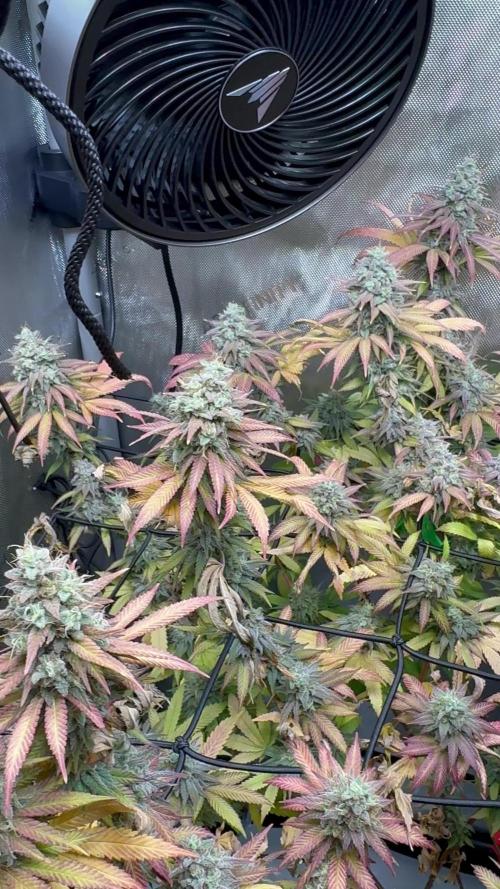
The plant is extremely resinous and has a great fragrance. The leaves turn a very autumnal color. However, the flowers are not extremely large. From now on, the plant will be rinsed with water.
Flowering Day: 55

Likes
11
Share


@pegonter
Follow
lot of heat during week 2, plants start to visibly stretch and show white pistils besides green and vigorous branches bulking up.
applied ipm twice this week (nutes nutes mentioned)
watering time reduced from 3'50" to 3'20" and then 2'50" due to leaking much water at every watering (at each 12h).
ps.: numbers reported are always measured from pot #3.

Likes
7
Share


@100Trillion
Follow
Week 7 plants are going great. The Contest Pheno on the top right corner is out growing all the other phenos. The development seems to be faster than previous generations of the limon Blanco. The other are more consistent in their growth patterns so far. Scrog has been placed as of day 48 and going to let plants grow into it over next couple weeks before flower and second trellis.

Likes
62
Share


@KellosaurusGrows
Follow
Well everything went smoothly this week still feeding same schedule I have notice the leaves are fading a good amount but it’s pretty late flower so nothing to worry about, I did check trichomes at day 70 and they seem to be about half cloudy half clear, no Amber in sight yet but hopefully next week they start ambering up I’m thinking maybe 85 days or longer for this one
Likes
60
Share


@SooSan
Follow
12/12 + 123 jours
Vu qu’il y a 16 plantes mais que sur growdiaries on ne peut mettre que 8 variétés j'ai divisé en 2 diaries pour le bas de la tente
1️⃣
🏠 90x60x90
☀️ FC-E 4800 => puissance a 60%
🍁
Black Bomb / Philosopher Seed
Amnesia Lemon / PEV Seeds
Amnesia Lemon /PEV Seeds
Blueberry / PEV Seeds
Blueberry / 00 Seeds = 17g
Wappa / Paradise Seed = 11g
Dark Phoenix / Green House Seed
Quick Sherbet / Exotic Seeds = 14,5
Mango Cream / Exotic Seeds
Banana Frosting / Sensi Seed = 11g
Hindu Kush / Sensi Seed
Mix 1 / Sweet Seed = 26,5g
Mix 2 / Sweet Seed = 15g
Mix 3 / Sweet Seed = 22,5g
Mix 4 / Sweet Seed =
📎 https://growdiaries.com/diaries/122084-grow-journal-by-soosan
📎https://growdiaries.com/diaries/124052-grow-journal-by-soosan
2️⃣
🏠 30x60x50
☀️TS1000 => 100w = 54g
🍁
Quick Sherbet - Exotic Seed = 12g
Quick Sherbet - Exotic Seed = 12g
Quick Sherbet - Exotic Seed = 17,5g
Quick Sherbet - Exotic Seed = 12,5g
📎 https://growdiaries.com/diaries/122080-grow-journal-by-soosan


Likes
2
Share


@Dralph
Follow
Una black berry y la crystal meth se me han estirado bastante... Ya estoy usando base de flora y algun boost de hesi y delta 9 junto a super vit y micorrizas con el agua nivelada sobre el 6.3

