


Likes
Comments
Share


@Ganjagrandaddy
Follow
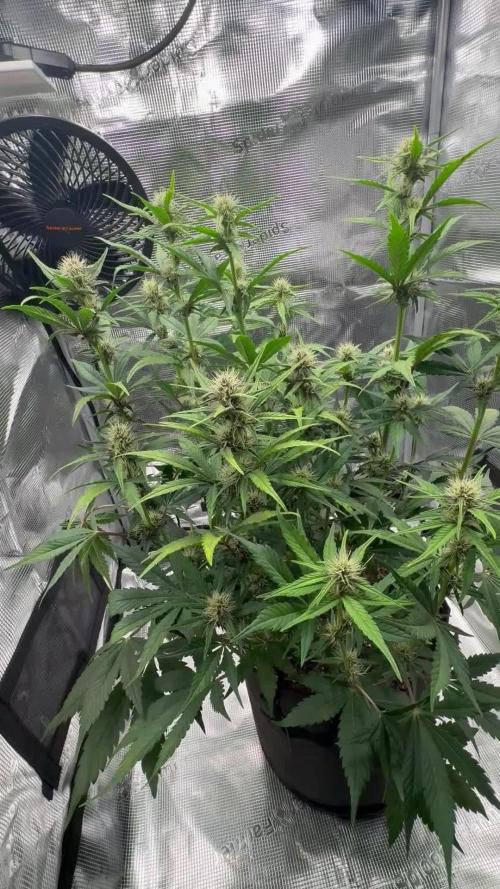
Day 14 flowering: The little ladies have had a good weeknof stretching this week with the Herz O.g showing the way to the other 2.
Herz.og has now been in flower for 14 days and is well into her stretch period. She has quite wide node lengths so no donkey dicks for her I think. seeing other grows , they donproduce very nice buds somlets see how she progresses with her bud building. looks healthy and happy enough and feeding with no issues so far.
Strawberry Cola is now in flower proper and can say 7 days flowering for her now. she is stretching nicely with some good looking nodes around her frame. I will make sure I don't let her get too bushy to keep all her tips and budlets getting light. i took a good amount of small and pointless lower growth out to open her up more now. She looks the better for it now.
Monster Mash has also had a good stretch the last few days but not as much as her rivals. she has enough nice budlets to work with on her limbs and should start stacking them up soon. All three are looking very healthy and a good size now. soon they can go into a better position under the light as I harvest the other strains in the run.
Until next week growmies , be safe and well.

Likes
44
Share


@ILoVeThiSpLaNt
Follow
Giorno 74 (14 fioritura)
Le piante stanno abbastanza bene.
Per il prossimo giro autunno/inverno dovrò stare attento con le temperature perché tra vegetativa e ora inzio fioritura hanno sofferto un po' di basse temperature (nulla di preoccupante ma preferisco avere 23/24° piuttosto che 17/18°).
Come detto la settimina scorsa ho dovuto flushare una Pink Gasoline perché tutte le foglie avevano macchie chiare distribuite in modo non uniforme.Ora, dopo dieci litri di acqua con gli ultimi due con una leggera dose di fertilizzanti finalmente i nuovi getti sembrano stare meglio.
Tutte le altre piante stanno bene, sta solo a me non dare troppo cibo e monitorare il colore delle foglie per correggere eventuali eccessi/carenze.
Non posso fare danni con questi incroci 😃 🙏
A settimana prossima sperando di vedere un po' di resina 😋


Likes
31
Share


@KitaKush
Follow
78 grams roughly 2.8 oz! Pretty happy with that as I’m looking for quality and potency and no longer quantity and quickness.
She has a good amount of frost and super pungent stank radiating off her.
Unfortunately for me I had issues with drying and at one point a few hours of 70% humidity which led to a few areas of mold…I threw away those buds and the rest are top notch..probably my most resinous plant harvested so far and strongest smelling. I also grew a runt which will give me less than an ounce now I know it’s just best to call quits on those stumpy odd growing plants and start fresh.
Lastly my humidity stayed at 52-56% and I should’ve harvested 1-2 days earlier so the buds are much drier/crispier than I’d like. I’m still trying to find a good drying location..one room had that low humidity and my grow room had way too high at 70..will figure it out eventually.
Also 200watt for lighting I can’t go back and change it.


Likes
23
Share


@Firepharmer
Follow
Everything’s looking beautiful !! 2 weeks in .. not a lot of different between the two nutrients canna and remo , I cut of the canna rhizotonicxp and cannazym just using canna coco A&B and canna boost I’ll use canna pk1314 half way through week 4 and half too the end of week 5 .. remo nutrients I use all 6 nutrients...


Likes
4
Share


@ObloTheGrower
Follow
Here we go, next week I will feed my girls hard next week, I did not feed them in grow phase, the custom media had whatever they need, but now I want to push them high, :) I have no grow led but my main girls are autos, according to their leafs, ruderalis highly dominant espacially 2 of them I should check their phenotypes. So the sun is enough for the light side and on the other side I will choose Advanced Nutrients Connoisseur Bloom from my poke ball :D
Likes
1
Share


@Skubi420
Follow
here is the time of my mistake, I thought it was an auto seeds, its fast version with more photopheroid genes, I started watering with fertilizers to bloom. Light still 20h
Likes
12
Share


@thonhash
Follow
Subimos algo más los ml de terranabis,buena asimilación y engorde,gracias a enzynabis que busca el equilibrio de todo.




Processing
Likes
100
Share


@TheFairyBudMother
Follow
Getting my supports into place and then will flip this coming week. Mites seem under control, still using soap spray and systemic spinosad in watering. The two middle most plants are Ice Bomb. I have not been feeling well so I have not pulled them all out for photos this week.

Likes
8
Share


@skaterblasted
Follow
Days 99 - 105 (from sprout)
8/30/24 - 9/5/24
Raised light above canopy of The Good Shit - PAR on main tops is 800-700+ while remaining lowers are seeing closer to 450-500
Loompa's Headband x TK fading to a close this week - trichome check starting to show amber on the bracts
Sweet 16 S1 now starting senescence and a little fading on some fan leaves
The Good Shit showed signs of some overwatering, so a newly made FPE was added to feed schedule to assist the microbiology
Light schedule lowered to 10 hrs this week
IPM: Applied enzymes (tweetmint) at a rate of 0.5 fl oz to 1/2 gallon and sprayed on cover crops + mulch throughout the week. Significant decrease in pest population, now needs a high quality compost top dressing for long term correction

Likes
10
Share


@ScottShelby
Follow
Lst training for a while now . I just got new led grow light for very cheap , I know it wont do the best but lets see
Likes
3
Share


@Growfather1
Follow
Hello everyone.
Here is the update for my Mac 1 F1 hybrid clones.
The two plants are entering week 8 of the vegetative state.
As I mentioned a couple of weeks before, I have no flowering tent available right now.
Because of this, they have to keep waiting in line until a tent opens up so they can finally switch to flowering.
Humidity is well in check, sitting comfortably between 61% and 67%.
The temperature is swinging between 21°C and 26°C at the peak moments, though it mostly stays under 24°C.
There really isn't much else to tell for this week.
I just picked a couple of leaves off to tidy them up, but I didn't do any topping.
So let's see how she looks next week.
Thanks for stopping by and have a nice day.
Best regards,
Growfather

Likes
71
Share


@TimTheTerpMan
Follow
July 19th : Didn't get out before dark to get pics.
July 20th : Wowza! We got Flowering people!! 2 of the 3 are now Budding! This is when the fun begins!
July 21st - July 24th : Didn't get around to pics had a few things I've been dealing with.
July 25th : Just gave them some Happy frog Fruit and Flower last night. Lets see them blow up now!


Likes
4
Share

@OnkelBonsai76
Follow
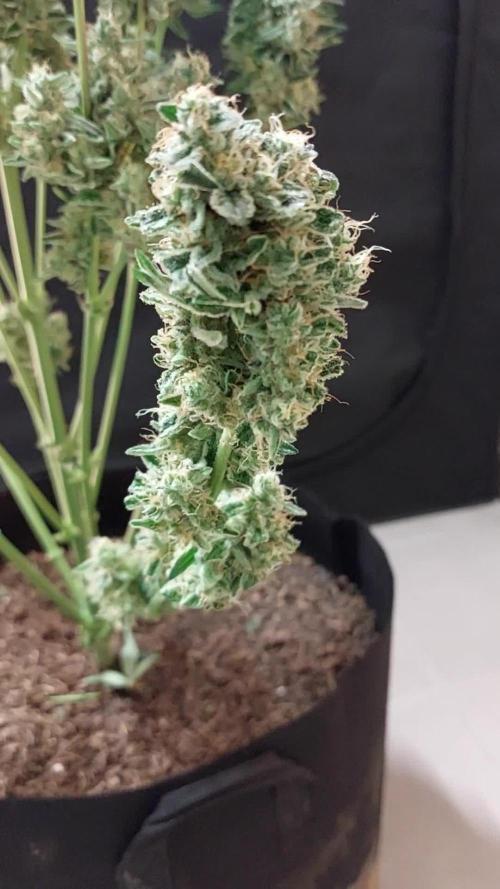
Die Dame wurde erst komplett entlaupt und dann zerlegt.
Jetzt liegen sie im Kräuternetz, verpackt in Dryferm Beutel und ich muss geduldig warten.
Likes
262
Share


@Ju_Bps
Follow
Hello happy growers!
All was fine this week, stretch still in progress and impressive,
I've down 2 pots because plant start to be too big.
My lamp is now to 100%,
Outside weather start to be better, so temperature inside box a bit too much.
I've given this week,
start week,
2l water + easy grow tab rqs + sugar royal
Today (end week)
2.25 water + easy bloom tabs rqs + canna boost.
I hope grow continue like that,
Have a good week my friends,
See you next week 👊👊😍😍

Likes
25
Share


@EBxAH
Follow
Seeds went into water on 1/20/22 and now an inch tall on 1/27/22. I'm super excited for this one because of the Black Widow!!! All the girls have names: Basha, Stefa, and Wandzia ❤️ I definitely like this new 5x5x6 tent that is not barn style, I won't worry about room come stretch time like I did last run! That's about it for now and as always, HAPPY GROWING EVERYONE
✌️🍀✌️

Likes
4
Share


@Wackytabacky_420
Follow
This is a purple haze clone I received on 3/23. She has been topped and trained in prep 4 scrog!! She received her first @gaiagreenorganics all purpose 4-4-4 feeding on 4/23. Also installed scrog on 4/23. She received her second dose of 4-4-4 on 5/23. Installed Marshydro tsw2000 on 5/31. She received a 15 tablespoon dose of Gaia green worm castings on 6/2. 6/30 gave her a mix of Gaia green all purpose and power bloom. 6/30 switched light to 12/12 cycle. 7/30 gave a full dose of power bloom. This is what she looks like today!
💡 Grow Sponsor💡
@marshydroled__amazon
@marshydronnier
#marshydro
#TSW2000
#rvagrown ,#rvagrower , #cannabisgrower , #homegrown , #hightimes , #weed4ptsd , #weed4veterans , #veterangrown , #tricomes , #ledgrown , #weedstrains , #indoorgrow , #indoorgrown , #tentgrown , #supportlocal , #growlocal , #letsgrowrva , #weedismedicine , #420 , #veterangrower , #purplehaze , #sativa , #sativastrain
Likes
32
Share


@MadeInGermany
Follow
Info:
Unfortunately, I had to find out that my account is used for fake pages in social media.
I am only active here on growdiaries.
I am not on facebook instagram twitter etc All accounts except this one are fake.
Flowering day 57
since time change
to 12/12 h.
Hey guys :-)
The mini grow experiment is slowly coming to an end :-)
The next 10-12 days will be harvested :-)
This week I added another 1 g GHSC Enhancer Pro l cocos.
Otherwise everything was cleaned.
Stay healthy 🙏🏻
You can buy this Strain at :
https://www.zamnesia.com/de/5165-zamnesia-seeds-kalini-asia-feminisiert.html
Type:
Kalini Asia
☝️🏼
Genetics:
Black Domina x Purple Kush
👍
Vega lamp:
2 x Todogrow Led
Quantum Board 100 W
💡
Bloom Lamp :
2 x Todogrow Led
Cxb 3590 COB 3500 K 205W
💡💡☝️🏼
Soil :
Canna Coco Professional +
☝️🏼
Fertilizer:
Green House Powder Feeding
☝️🏼🌱
Water:
Osmosis water mixed with normal water (24 hours stale that the chlorine evaporates) to 0.2 EC. Add Cal / Mag to 0.4 Ec Ph with Organic Ph - to 5.5 - 5.8 .
