




Likes
5
Share


@Englandshigh
Follow
Coming along beautiful have tied there stalk to support and topped one of them

Processing
Likes
2
Share


@lupitalolita
Follow
This week was interesting! Most if not all of the internodes have begun forming small preflowers. There is no white hair yet but I’m still hopeful that the plant is indeed female. The inner and new growths look healthy and strong. I’ve started using volcanic dust/dirt in my water to give the plant some more nutrients and it seems to really like the new mix. Still using egg shells and coffee grinds (having to use a whole lot as the pot is huge)) so far so good!

Likes
9
Share


@Changman
Follow
28/05/2024 - seeds were placed in a shot glass of water to for 18 hours
29/05/2024 - all seedlings except the Auto Power Plant were showing signs of a tap root and were transfered onto paper towels and placed inside a dark cool space.
30/05/2024 - of the 3 Power plant seedlings only one showed signs of a tap root so they were transfered to a paper towel on a plate and placed with the others.
02/06/2024 - one day behind but thankfully we got our seedlings into their grodan blocks and into their dome with a mars hydro heat mat set to 85F to speed up the process, we also have our 500w led set 24 inches away from the dome lid and will be updating 18 hours from now at 7am.
03/06/2024 - Seedlings are looking healthy and have been given some "Plagron Power roots" liquid nutrients. We shall keep our eyes closely on them.


Likes
20
Share

@Prof_Weed
Follow
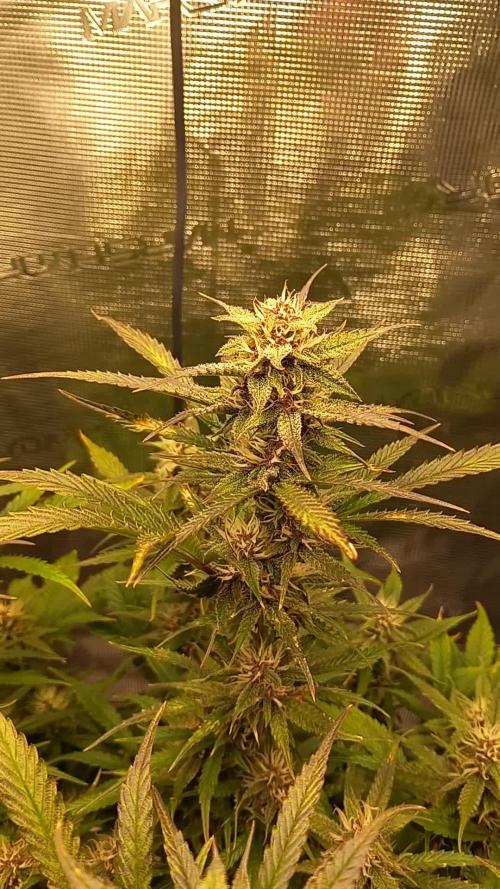
Reduced the light a little bit, she is prayin and stackin now.
Overall healty, no bugs no deficencies.
The buds are swelling and smelling, i like it!
Some cool purple colors, and she is sticky and fruity.
I love fruity strains.
Thanks to Sebastian Good from Good Genetix for the Tester.
And thanks to Bionova for the vegan line.
Likes
7
Share


@Genussmittel420
Follow
i am pretty sure we are produceing many seeds here..... anyway, lets see how the babys will be.
flower day 39 - found spidermites on the triple g and had to take many leafs off. also ordered some predatory mites and did some other changes to hope to prevent the outbreak.

Likes
9
Share


@bigolebuds
Follow
Week 4: We are officially one month into our grow! things have been going pretty smooth so far and that’s exciting!! Yesterday we picked up our Gaia Green 4-4-4, repotted one watermelon zkittles into 5gal, and we we watered both Sunday and yesterday (oops). With that and the topping done, we plan to give them the week to recover and then start LST and feeding. You’ll notice a large number of plants were moved outside… those were all auto seeds that we got for free from Seedsman and Perry’s Magic Beans (Northern Lights, Critical + 2.0, M+M, and High C) shout out to them!! In a week or so the clones will be moved out and we will have our final 4 in the tent.

Likes
6
Share


@Mr_nugs_lover_David
Follow
I have topped one of the 5 phenos because this plants looks like they had a few more days of growth before flowering and wanted to get more colas, they are developing awesome one pheno ended up too small but it will definitely give something, let's see how this beautiful ladies keep developing


Likes
3
Share


@TheBudWhisperer
Follow
Second week on the veg. And the drainage table repairs were done just in time. Moved all these plants into the recirc. System and within 24hours of transplant they were notably happy. I’ll add two more seedlings to the group for a total of 10 plants. Hopefully at least 50% are female🤞.
This grows pretty much on autopilot now. All that will be left is regular plant maintenance and top offs to the finish👍.
Processing
Likes
4
Share


@fezzollas
Follow
The time is coming. It's very healthy, I ended up exaggerating a little bit with the fert, but don't panic, it's organic, it caused just a little burnt on the edge of the leaves. The weather is stabilizing, it stopped raining here and the humidity is normal now. The pistils are starting to fester and are resining too much. She is very fat, the smell is strong every day and I am totally in love with her.
Likes
13
Share


@DeepRootsGrowTrees
Follow
JOANNE'S CBD / ROYAL QUEEN SEEDS
WEEK #15 OVERALL
WEEK #3 FLOWER
This week all 👍 good no issues to report she's looking good nice and green she's doing her thing 👌 buds are starting to form nicely!! Stay Growing!!
Thank you for stopping by and taking a look it's much appreciated!!
THANK YOU ROYAL QUEEN SEEDS!!
BUDTRAINER.COM BUD CLIPS
Likes
4
Share


@Elpatron152
Follow
Hello everyone, Everything is smooth just i put the scrog to late the delivery was late, but everything good will see how is going

Processing
Likes
20
Share


@Silverback_Guerilla
Follow
2/17:
I spent a little time rearranging today. I bought some 32" x 14" plastic ventilated storage shelves and cut the legs down on two of them so I have some different-height platforms for the shorties in the garden. I should also be able to easily flush 6 plants in 5 gallon pots, or 9 plants in 3 gallon pots at a time now, that's a win!👈
2/18:
I debated whether to feed or not, and settled on watering them with about 1/2 gallon each. including bembe, cal-mag, signal, humic acid, and a little beastie bloomz.
The new dehumidifier is pulling about a gallon and a half per day from the air, so I should be able to feed them in a couple of days.
2/19:
Rainy day outside, so I'm pulling in 99% humidity, plus the pots are still petty saturated, but the new dehumidifier is keeping up. RH is holding at about 45% today.👍
2/20:
Day 31 of flower...they don't seem to be stretching any more, so they aren't a problem, but other plants have been. A semi-solution occurred to me that allowed me to raise the lights another 3-4 inches. Now I'm truly maxxed out...
So far, this has been the most consistent of the FFT strains I'm growing. They actually "look" like sisters..
I took photos and videos of all the plants today since I had to empty the closet and it wasn't a feeding day.
2/21:
I fed them today with about 3/4 gallon each including beastie bloomz, tiger bloom, big bloom, signal, bembe, and cal-mag...no grow big this time.
2/22:
They're both looking great..no complaints at all.
2/23:
I ordered some Terpinator because I'm not so sure about Signal's efficacy at this point....I'm usually dealing with odors more by now..😕
I've reached the ceiling again with my lights, but these two plants wont be a problem. They're both budding up nicely now.

Likes
Comments
Share


@Pyrogrows
Follow
Just a little night shoot of my babies. They're still going like hell. The white gorilla haze has been cut and is drying now. Sadly had to cut that one early due to rot. The critical whites have about a week or 2 left and i'm super exited how they'll look by then.

Likes
35
Share


@SmokingTiki
Follow
- I didn't weight wet buds.
- The trichomes photos have been taken just before the harvest on buds all over the plants.
- The hash balls were : a little less than 1cm diameter for the Mandarin Punch#1 and around 3mm diameter for the Mandarin Punch#2
- Drying was made at 20°C and around 50% of humidity.
- Humidity in jar around 50% on the first day, temperature around 20°C.
MANDARIN PUNCH #1
Veg time : 44 days.
Flowering time : 70 days.
Total time from seed to harvest : 114 days.
Height : 142cm
Pot size : 26l
Harvest : 61g
MANDARIN PUNCH #2
Veg time : 45 days.
Flowering time : 67 days.
Total time from seed to harvest : 112 days.
Height : 123cm
Pot size : 10l
Harvest : 41g

Likes
17
Share


@Foggedaboudit
Follow
My oh my the bouquet on these cherries! Absolutely pumped for these!

Likes
10
Share


@HideAndFly420
Follow
Flowering period started, i added adv nutrients to biobizz line and i just have to understand the reaction of blue dream, i just think there is something too much.
I m not sure cause i'm experiencing problems with temperature and humidity too, so i can't exactly recgnize wich is the problem now.
i'll update next week hoping the problem will be solved.
Let's go!
Likes
28
Share


@JackFrost17
Follow
Identified a bit of browning in some pistil, I didn’t think it was supposed to occur this early, could somebody please help me identify.
Processing
Likes
25
Share


@FriendlyNeighbor
Follow
Week 6 Flower
Day 45
Fruit Spirits are getting more mature as you can see in the closeups...
the trichomes are getting cloudy but I dont see any amber so far.
She is definetly the first one who will be cut down,
but I will wait a week longer i guess maybe starting flush in 5 days or so.
Green Gelato what can i say super frosty big buds awsome smell!!!!
I could cut her right now but it would be such a waste.
Skittelz is showing more flower and trichomes slowly...
lets hope for the best with her 😇