Likes
63
Share
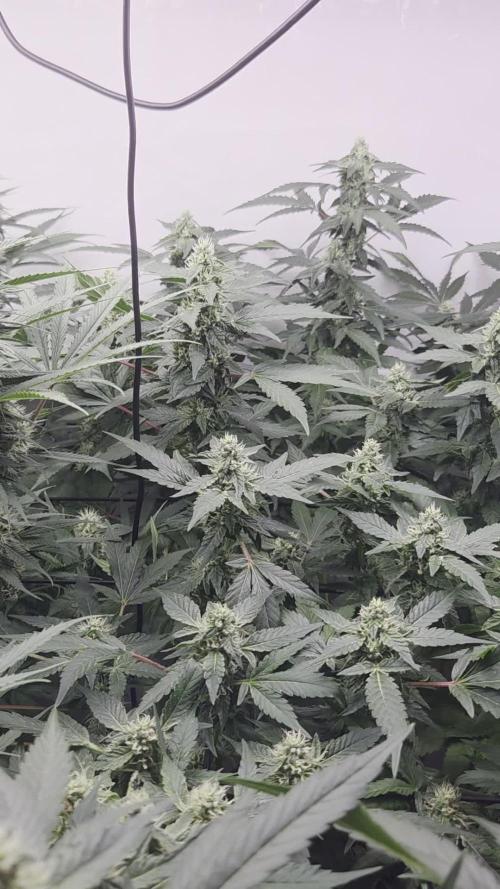
Day 28 and we are in flower !!!. The Purple monkey have really accelerated their growth this last week and have been building flowers for the past 3 days. They are all really healthy looking with nice strong limbs to support the upcoming fruits. There are 2 different phenotypes by the look of them with #3 being slightly different to the other 2 . I have been gently shaping them towards the pots edges without stunting their growth too much vertically. They are very long limbed from their stretching and the nodes lengths are a fairly medium distance from each other so won't be forming donkey di#$s buds but should have some very nice cluster buds with their overall indica leaning sides. At around 18 inches tall and still stretching, these girls could be great yielders. No signs of any issues at all with the addition of the sumo boost which will support the flowering cycle but won't stop the stretch as other boosters can do. this means I can use it from the start of flowering. Banana mash have spent the week stretching past rhe tries and opening up for light. They are a little behind the Monkey girls but are showing starts of flowers now. Their limbs are a lot less solid than the other strain too with a loose limbed appearance more like a bush. 2 of them have been set in a more splayed out mainline approach to keep them low and get the lowers into the canopy too .i have included some pics of the lst to show howbi did itThey have a lot of potential mains now that the apical dominance has been broken. hopefully a ring of buds should form on them both now. the #1 is more natural with a topping only to stop her getting too tall. She has some nice mains forming now too. The Mutant Banana is a really odd lady. she has so many growth tips close together in her bunched up appearance. She is starting to stretch now so will finish quite good I think. I have been growing out 2 seeds that came from previous grows of exotic strains. sadly the pollen "donated " came from another breeders strain but hit most of the crop on a couple of buds so gave me seeds. i am testing a couple out with this run so include them for their exotic connections. The mango cream X is doing brilliant and had to be supercropped over into an s shape to hold her down a little. def female so far and growing very quickly. The Exotic ? is just starting her real growth now but will be a squat lady by the look of her so far. no idea which she is but will be an interesting grow out for fun. The fact that one went into flowering already is a good sign of an auto genetic at least. So there we have it growmies another week done and exciting times ahead in flower. be a safe and well.
Likes
5
Share
@Xabii
Follow
49 Days! Lost a day of timelapse footage, found a temporary fix tho, should not happen again. The plant stretched a little and is full on on flower. This will most likely end up as a single big bloop of bud again, sadly did not stretch as much as I liked it to be. Overall a good week. Spoiler: added lights to the bottom to get more light inside the plant at the first day of week 8, more on that next week. Values are average of the day. DATE - EC(us/cm) 20250705 1373 20250706 1362 20250707 1346 20250708 1378 20250709 1333 20250710 1331 20250711 1353 DATE - PH 20250705 5.67 20250706 5.67 20250707 5.90 20250708 5.95 20250709 6.17 20250710 6.15 20250711 6.13 DATE - ORP (mV) 20250705 -8 20250706 62 20250707 19 20250708 43 20250709 21 20250710 -1 20250711 -4 DATE - °C - RH% (Tent Temp/RH) 20250705 24.8 46 20250706 25.1 55 20250707 24.7 59 20250708 23.8 52 20250709 24.2 56 20250710 24.8 52 20250711 24.1 60 DATE - °C (Reservoir) 20250705 22.1 20250706 22.7 20250707 22.5 20250708 21.4 20250709 21.8 20250710 22.3 20250711 22.4 DATE - CF 20250705 13.73 20250706 13.62 20250707 13.46 20250708 13.78 20250709 13.33 20250710 13.31 20250711 13.53
Likes
1
Share
Very happy with the results so far. Diligently doing nothing lol
Likes
9
Share
@Arcadios
Follow
Things are moving right along! We're definitely into flower now. All three plants are flowering strong and the Amnesia is starting to spread out. The other two are going to be very dense plants. I think perhaps I should have started LST a bit sooner on the Quarter Pounder. It's so dense I can't really separate it. They are taking a lot of water. I feel like I could be doing 1.5 gallons each and it barely goes to run off. Is that a good thing? * Watering a bit over 1 gallon each every 2 days * Top fed 1.5 tbs each 3 gal pot with Dr Earth Life. This is under the recommended amount but last time I got nute burn. * Top dressed with additional FFOF
Likes
11
Share
23. Mai Pflanze wächst. 4l Wasser. 2l von oben, 2l von unten 26. Mai 5l Wasser. 2 von unten, drei von oben
Likes
1
Share
Smell is so nice now, skunky with almost a sweet spice in the mix. I started bagging them at 7pm on July 19th. After 8-10days flower was showing. Idk, I'm actually happy with my slow going process. I mean these girls were started around the very end of March indoors. Now, almost mid August I'm just a little over a week into flower. Slow process people. Gunna be worth the wait though 😏 All in all, I'd say if you live in Zone 3b, growing pure Sativa outdoors is not the most optimal choice. It can be done successfully though with a little extra care and attention paid.
Likes
24
Share
Hey everyone 🤗. There isn't much to report this week. It was topped again, otherwise everything is like last week. She is developing well 👍. I wish you lots of fun with the update, stay healthy and let it grow 🌱🍀 You can buy this Strain at https://www.amsterdamgenetics.com/product/kosher-tangie-kush/ You can buy this Nutrients at https://greenbuzzliquids.com/ Type: Kosher Tangie Kush ☝️🏼 Genetics: Kosher Kush X Tangie 👍 Vega lamp: 2 x Todogrow Led Quantum Board 100 W 💡 Bloom Lamp : 2 x Todogrow Led Cxb 3590 COB 3500 K 205W 💡💡☝️🏼 Soil : Canna Coco Professional + ☝️🏼 Fertilizer: Green Buzz Liquids : Organic Grow Liquid Organic Bloom Liquid Organic more PK More Roots Fast Buds Humic Acid Plus Growzyme Big Fruits Clean Fruits Cal / Mag Organic Ph - Pulver ☝️🏼🌱 Water: Osmosis water mixed with normal water (24 hours stale that the chlorine evaporates) to 0.2 - 0.4 EC. Add Cal / Mag 2 ml per l water every 2 waterings . Ph with Organic Ph - Pulver to 5.8 .
Likes
12
Share
Plantas compactas y de verdes grisaseos. Cosechas abundantes pero especialmente resinosas. Cristales everywhere! Humo bien espeso
Processing
Likes
41
Share
Hey guys ;-) This week she really got a growth spurt 😍👍. It grows beautifully, does not cause any problems and is a genetic perfection from Sweet Seeds 🙏🏻 many thanks to @ SweetSeeds for that 👍. In the next few days Bio Vega will be sold and exchanged for Bio Flores. Nothing is trimmed and removed. From this week on, she will also receive Bio Boost, so that the flowers can develop nicely. I wish you all a nice weekend, stay healthy 🙏🏻 and let it grow 😎👍 Sweet Seeds Cup 🏆 Type: San Fernando Lemon Kush ☝️🏼 Genetics: OG Kush x Kosher Kush 👍 Vega lamp: 2 x Todogrow Led Quantum Board 100 W 💡 Bloom Lamp : 2 x Todogrow Led Cxb 3590 COB 3500 K 205W 💡💡☝️🏼 Earth: Canna Bio ☝️🏼 Fertilizer: Canna Bio ☝️🏼🌱 Water: Osmosis water mixed with normal water (24 hours stale that the chlorine evaporates) to 0.2 EC. Add Cal / Mag to 0.4 Ec Ph with Organic Ph - to 6.0 - 6.3 💦💧
Likes
14
Share
It’s been 7 days and one of my amnesia hazes is getting yellowish spots on it not 100% sure what’s the issue im going assume it’s too much water? Confused cause the other have same soil and every same amount of water and don’t have those issues I have the light right now about 1.5 ft away from the plants moved the light down I felt like they was stretching and becoming real skinny been keeping the temp about 75 and humidity somewhere around the 60% also I used fishshit today in the watering hopefully that’s helps The sour diesel I’m pretty sure I dropped the seed to deep my mistake so I removed a little soil until I seen top of it and now it’s looking like it might make it it just a little behind the amnesia haze The two in red solo cups (black Truffles) are growing pretty fast looking bit better then the amnesia haze and I found them seeds lol anyway if you looking and see anything that could help (Please do!!!) also if your using ac Infinity controller 69 I need help!!! Today the first time I messed with it to make make the 18/6 schedule and not 100% sure if I did it right yet I wanted to make it on 5am-11pm off the other 6 I had it on 24/7 all last week and not sure is that caused the yellowing or not I doubt it but I’m NEW and I’m not sure I’m a YouTube university grad 😂😂 But yea thanks for looking and I’ll try to post more day D14
Likes
44
Share
With no doubt these plants have not produced much more quantity and density of buds due to the 2 serious mistakes I've made (those who have read the weeks will know what I mean). However, I can say that I am happy with the production obtained given the mistakes made. Between the 2 plants, the one that has produced more and generated the most dense buds has been the Gorilla with the Man-lining technique applied, it has also loosed a bit less weight drying than the non man-lining one. In comparison with the Money Makers with which they have grown the result is the same. Both Gorillas have each produced more than any of the Moneys comparing them 1 to 1. Also buds are a bit dense than the moneys, but none of them is really desde at all. *****ESPAÑOL***** Sin duda estas plantas no han producido mucha mas cantidad y densidad de cogollos debido a los 2 graves errores que he cometido (quien se haya leído las semanas sabrá a que me refiero). No obstante, puedo decir que estoy contento con la producción obtenida dados los errores cometidos. Entre las 2 plantas, la que más a producido y ha generado cogollos más densos ha sido la Gorilla con la técnica de Man-lining aplicada, y también ha perdido un poquito menos de peso en el secado que la otra. En comparación con las Money Maker junto a las que han crecido el resultado es el mismo. Las Gorillas han producido cada una más que cualquiera de las Moneys comparándolas 1 a 1. Así mismo, los cogollos de las Gorillas presentan un pelín más densidad que el de las Moneys, aunque realmente ninguna de las 4 plantas ha generado cogollos densos del todo.
Likes
8
Share
Eccoci qui... Finalmente dopo uno stop per il lavoro torno ad aggiornare il diario con il capitolo finale... Tutto è stato molto semplice con lei in quanto molto vigorosa e molto stabile non ha dato alcun problema, le cime sono piene di resina e molto compatte seguirà una recensione post concia Grazie a @Zammi_official e a @Xpertnutrients per la collab e a tutti per il supporto🔥🌲❤️ NE VERRANNO DELLE BELLE
Likes
4
Share
Muy buenas familia bueno empezamos la 7° semana y ya empiezo a estar nervioso espero que no se me tursa la cosa ahora que estamos ya casi en la recta final ya tengo muchas ganas de probarlas y de empezar el próximo para corregir los fallos que he tenido en este y bueno en estas semanas que quedan seguro que alguno más habrá espero me echen la mano y cualquier cosa que vean que este mal decirme para intentar corregir o en la próxima tenerlo en cuenta y ponerlo en práctica que tengan buena semana familia un abrazo y buenos humos paz
Likes
25
Share
ANTHOCYANIN production is primarily controlled by the Cryptochrome (CR1) Photoreceptor ( !! UV and Blue Spectrums are primary drivers in the production of the pigment that replaces chlorophyll, isn't that awesome! 1. Diverse photoreceptors in plants Many civilizations, including the sun god of ancient Egypt, thought that the blessings of sunlight were the source of life. In fact, the survival of all life, including humans, is supported by the photosynthesis of plants that capture solar energy. Plants that perform photosynthesis have no means of transportation except for some algae. Therefore, it is necessary to monitor various changes in the external environment and respond appropriately to the place to survive. Among various environmental information, light is especially important information for plants that perform photosynthesis. In the process of evolution, plants acquired phytochrome, which mainly receives light in the red light region, and multiple blue light receptors, including his hytropin and phototropin, in order to sense the light environment. .. In addition to these, an ultraviolet light receptor named UVR8 was recently discovered. The latest image of the molecular structure and function of these various plant photoreceptors (Fig. 1), focusing on phytochrome and phototropin. Figure 1 Ultraviolet-visible absorption spectra of phytochrome, cryptochrome, phototropin, and UVR8. The dashed line represents each bioactive absorption spectrum. 2. Phytochrome; red-far red photoreversible molecular switch What is phytochrome? Phytochrome is a photochromic photoreceptor, and has two absorption types, a red light absorption type Pr (absorption maximum wavelength of about 665 nm) and a far-red light absorption type Pfr (730 nm). Reversible light conversion between the two by red light and far-red light, respectively(Fig. 1A, solid line and broken line). In general, Pfr is the active form that causes a physiological response. With some exceptions, phytochrome can be said to function as a photoreversible molecular switch. The background of the discovery is as follows. There are some types of plants that require light for germination (light seed germination). From that study, it was found that germination was induced by red light, the effect was inhibited by subsequent far-red light irradiation, and this could be repeated, and the existence of photoreceptors that reversibly photoconvert was predicted. In 1959, its existence was confirmed by the absorption spectrum measurement of the yellow sprout tissue, and it was named phytochrome. Why does the plant have a sensor to distinguish between such red light and far-red light? There is no big difference between the red and far-red light regions in the open-field spectrum of sunlight, but the proportion of red light is greatly reduced due to the absorption of chloroplasts in the shade of plants. Similar changes in light quality occur in the evening sunlight. Plants perceive this difference in light quality as the ratio of Pr and Pfr, recognize the light environment, and respond to it. Subsequent studies have revealed that it is responsible for various photomorphogenic reactions such as photoperiodic flowering induction, shade repellent, and deyellowing (greening). Furthermore, with the introduction of the model plant Arabidopsis thaliana (At) and the development of molecular biological analysis methods, research has progressed dramatically, and his five types of phytochromes (phyA-E) are present in Arabidopsis thaliana. all right. With the progress of the genome project, Fi’s tochrome-like photoreceptors were found in cyanobacteria, a photosynthetic prokaryotes other than plants. Furthermore, in non-photosynthetic bacteria, a homologue molecule called bacteriophytochrome photoreceptor (BphP) was found in Pseudomonas aeruginosa (Pa) and radiation-resistant bacteria (Deinococcus radiodurans, Dr). Domain structure of phytochrome molecule Phytochrome molecule can be roughly divided into N-terminal side and C-terminal side region. PAS (Per / Arndt / Sim: blue), GAF (cGMP phosphodiesterase / adenylyl cyclase / FhlA: green), PHY (phyto-chrome: purple) 3 in the N-terminal region of plant phytochrome (Fig. 2A) There are two domains and an N-terminal extension region (NTE: dark blue), and phytochromobilin (PΦB), which is one of the ring-opening tetrapyrroles, is thioether-bonded to the system stored in GAF as a chromophore. ing. PAS is a domain involved in the interaction between signal transduction-related proteins, and PHY is a phytochrome-specific domain. There are two PASs and her histidine kinase-related (HKR) domain (red) in the C-terminal region, but the histidine essential for kinase activity is not conserved. 3. Phototropin; photosynthetic efficiency optimized blue light receptor What is phototropin? Charles Darwin, who is famous for his theory of evolution, wrote in his book “The power of move-ment in plants” published in 1882 that plants bend toward blue light. Approximately 100 years later, the protein nph1 (nonphoto-tropic hypocotyl 1) encoded by one of the causative genes of Arabidopsis mutants causing phototropic abnormalities was identified as a blue photoreceptor. Later, another isotype npl1 was found and renamed phototropin 1 (phot1) and 2 (phot2), respectively. In addition to phototropism, phototropin is damaged by chloroplast photolocalization (chloroplasts move through the epidermal cells of the leaves and gather on the cell surface under appropriate light intensity for photosynthesis. As a photoreceptor for reactions such as escaping to the side of cells under dangerous strong light) and stomata (reactions that open stomata to optimize the uptake of carbon dioxide, which is the rate-determining process of photosynthetic reactions). It became clear that it worked. In this way, phototropin can be said to be a blue light receptor responsible for optimizing photosynthetic efficiency. Domain structure and LOV photoreaction of phototropin molecule Phototropin molecule has two photoreceptive domains (LOV1 and LOV2) called LOV (Light-Oxygen-Voltage sensing) on the N-terminal side, and serine / on the C-terminal side. It is a protein kinase that forms threonine kinase (STK) (Fig. 4Aa) and whose activity is regulated by light. LOV is one molecule as a chromophore, he binds FMN (flavin mononucleotide) non-covalently. The LOV forms an α/βfold, and the FMN is located on a β-sheet consisting of five antiparallel β-strands (Fig. 4B). The FMN in the ground state LOV shows the absorption spectrum of a typical oxidized flavin protein with a triplet oscillation structure and an absorption maximum wavelength of 450 nm, and is called D450 (Fig. 1C and Fig. 4E). After being excited to the singlet excited state by blue light, the FMN shifts to the triplet excited state (L660t *) due to intersystem crossing, and then the C4 (Fig. 4C) of the isoaroxazine ring of the FMN is conserved in the vicinity. It forms a transient accretionary prism with the tain (red part in Fig. 4B Eα) (S390I). When this cysteine is replaced with alanine (C / A substitution), the addition reaction does not occur. The effect of adduct formation propagates to the protein moiety, causing kinase activation (S390II). After that, the formed cysteine-flavin adduct spontaneously dissociates and returns to the original D450 (Fig. 4E, dark regression reaction). Phototropin kinase activity control mechanism by LOV2 Why does phototropin have two LOVs? Atphot1 was found as a protein that is rapidly autophosphorylated when irradiated with blue light. The effect of the above C / A substitution on this self-phosphorylation reaction and phototropism was investigated, and LOV2 is the main photomolecular switch in both self-phosphorylation and phototropism. It turns out that it functions as. After that, from experiments using artificial substrates, STK has a constitutive activity, LOV2 functions as an inhibitory domain of this activity, and the inhibition is eliminated by photoreaction, while LOV1 is kinase light. It was shown to modify the photosensitivity of the activation reaction. In addition to this, LOV1 was found to act as a dimerization site from the crystal structure and his SAXS. What kind of molecular mechanism does LOV2 use to photoregulate kinase activity? The following two modules play important roles in this intramolecular signal transduction. Figure 4 (A) Domain structure of LOV photoreceptors. a: Phototropin b: Neochrome c: FKF1 family protein d: Aureochrome (B) Crystal structure of auto barley phot1 LOV2. (C) Structure of FMN isoaroxazine ring. (D) Schematic diagram of the functional domain and module of Arabidopsis thaliana phot1. L, A’α, and Jα represent linker, A’α helix, and Jα helix, respectively. (E) LOV photoreaction. (F) Molecular structure model (mesh) of the LOV2-STK sample (black line) containing A’α of phot2 obtained based on SAXS under dark (top) and under bright (bottom). The yellow, red, and green space-filled models represent the crystal structures of LOV2-Jα, protein kinase A N-lobe, and C-robe, respectively, and black represents FMN. See the text for details. 1) Jα. LOV2 C of oat phot1-to α immediately after the terminus Rix (Jα) is present (Fig. 4D), which interacts with the β-sheet (Fig. 4B) that forms the FMN-bound scaffold of LOV2 in the dark, but unfolds and dissociates from the β-sheet with photoreaction. It was shown by NMR that it does. According to the crystal structure of LOV2-Jα, this Jα is located on the back surface of the β sheet and mainly has a hydrophobic interaction. The formation of S390II causes twisting of the isoaroxazine ring and protonation of N5 (Fig. 4C). As a result, the glutamine side chain present on his Iβ strand (Fig. 4B) in the β-sheet rotates to form a hydrogen bond with this protonated N5. Jα interacts with this his Iβ strand, and these changes are thought to cause the unfold-ing of Jα and dissociation from the β-sheet described above. Experiments such as amino acid substitution of Iβ strands revealed that kinases exhibit constitutive activity when this interaction is eliminated, and that Jα plays an important role in photoactivation of kinases. 2) A’α / Aβ gap. Recently, several results have been reported showing the involvement of amino acids near the A’α helix (Fig. 4D) located upstream of the N-terminal of LOV2 in kinase photoactivation. Therefore, he investigated the role of this A’α and its neighboring amino acids in kinase photoactivation, photoreaction, and Jα structural change for Atphot1. The LOV2-STK polypeptide (Fig. 4D, underlined in black) was used as a photocontrollable kinase for kinase activity analysis. As a result, it was found that the photoactivation of the kinase was abolished when amino acid substitution was introduced into the A’α / Aβ gap between A’α and Aβ of the LOV2 core. Interestingly, he had no effect on the structural changes in Jα examined on the peptide map due to the photoreaction of LOV2 or trypsin degradation. Therefore, the A’α / Aβ gap is considered to play an important role in intramolecular signal transduction after Jα. Structural changes detected by SAXS Structural changes of Jα have been detected by various biophysical methods other than NMR, but structural information on samples including up to STK is reported only by his results to his SAXS. Not. The SAXS measurement of the Atphot2 LOV2-STK polypeptide showed that the radius of inertia increased from 32.4 Å to 34.8 Å, and the molecular model (Fig. 4F) obtained by the ab initio modeling software GASBOR is that of LOV2 and STK. It was shown that the N lobes and C lobes lined up in tandem, and the relative position of LOV2 with respect to STK shifted by about 13 Å under light irradiation. The difference in the molecular model between the two is considered to reflect the structural changes that occur in the Jα and A’α / Aβ gaps mentioned above. Two phototropins with different photosensitivity In the phototropic reaction of Arabidopsis Arabidopsis, Arabidopsis responds to a very wide range of light intensities from 10–4 to 102 μmol photon / sec / m2. At that time, phot1 functions as an optical sensor in a wide range from low light to strong light, while phot2 reacts with light stronger than 1 μmol photon / sec / m2. What is the origin of these differences? As is well known, animal photoreceptors have a high photosensitivity due to the abundance of rhodopsin and the presence of biochemical amplification mechanisms. The exact abundance of phot1 and phot2 in vivo is unknown, but interesting results have been obtained in terms of amplification. The light intensity dependence of the photoactivation of the LOV2-STK polypeptide used in the above kinase analysis was investigated. It was found that phot1 was about 10 times more photosensitive than phot2. On the other hand, when the photochemical reactions of both were examined, it was found that the rate of the dark return reaction of phot1 was about 10 times slower than that of phot2. This result indicates that the longer the lifetime of S390II, which is in the kinase-activated state, the higher the photosensitivity of kinase activation. This correlation was further confirmed by extending the lifespan of her S390II with amino acid substitutions. This alone cannot explain the widespread differences in photosensitivity between phot1 and phot2, but it may explain some of them. Furthermore, it is necessary to investigate in detail protein modifications such as phosphorylation and the effects of phot interacting factors on photosensitivity. Other LOV photoreceptors Among fern plants and green algae, phytochrome ɾphotosensory module (PSM) on the N-terminal side and chimera photoreceptor with full-length phototropin on the C-terminal side, neochrome (Fig. There are types with 4Ab). It has been reported that some neochromes play a role in chloroplast photolocalization as a red light receiver. It is considered that fern plants have such a chimera photoreceptor in order to survive in a habitat such as undergrowth in a jungle where only red light reaches. In addition to this, plants have only one LOV domain, and three proteins involved in the degradation of photomorphogenesis-related proteins, FKF1 (Flavin-binding, Kelch repeat, F-box 1, ZTL (ZEITLUPE)), LKP2 ( There are LOV Kelch Protein2) (Fig. 4Ac) and aureochrome (Fig. 4Ad), which has a bZip domain on the N-terminal side of LOV and functions as a gene transcription factor. 4. Cryptochrome and UVR8 Cryptochrome is one of the blue photoreceptors and forms a superfamily with the DNA photoreceptor photolyase. It has FAD (flavin adenine dinucle-otide) as a chromophore and tetrahydrofolic acid, which is a condensing pigment. The ground state of FAD is considered to be the oxidized type, and the radical type (broken line in Fig. 1B) generated by blue light irradiation is considered to be the signaling state. The radical type also absorbs in the green to orange light region, and may widen the wavelength region of the plant morphogenesis reaction spectrum. Cryptochrome uses blue light to control physiological functions similar to phytochrome. It was identified as a photoreceptor from one of the causative genes of UVR8 Arabidopsis thaliana, and the chromophore is absorbed in the UVB region by a Trp triad consisting of three tryptophans (Fig. 1D). It is involved in the biosynthesis of flavonoids and anthocyanins that function as UV scavengers in plants. Conclusion It is thought that plants have acquired various photoreceptors necessary for their survival during a long evolutionary process. The photoreceptors that cover the existing far-red light to UVB mentioned here are considered to be some of them. More and more diverse photoreceptor genes are conserved in cyanobacteria and marine plankton. By examining these, it is thought that the understanding of plant photoreceptors will be further deepened.
Likes
27
Share
Let’s Go day 85 from Seed!! These ladies have all got the chop !! We will be hanging to dry over the next 2 weeks or 12-14 days an we will be ready for trim an jar up for cure! What a very satisfied grow this was @fastbuds_genetics very happy with the strains an would definitely run em again! Hope you all enjoy stay tuned for next week! Start trim up an get some weights!
Likes
14
Share
@artems
Follow
15.10.23 - Just 2 feeding this week. I was out of the town and thats why some leafs looks poor. And after feeding that changed. 22.10.23 - But with big defoliation and a lot of new photos and even video! Check it out!