


Likes
Comments
Share


@Adam420
Follow
Week 1 going good.
After only for now til next week.
Still trying to beat last years grow season
Ly grow at this time:
Have not started yet

Processing
Likes
20
Share


@mikemobes
Follow
9/2
-Cream Cookies Trichomes at 90% Clear, 10% Cloudy, 0% Amber. Im a lover of a good heavy indica and usually allow the plant to mature until it reaches 0% Clear, 90% Cloudy, 10% Amber.
-Cheese is towering some main cola sites with thick flower development. Going to develop into massive colas. (Cheese has historically taken 2 weeks longer than other plants to mature and is around 2 weeks behind cream cookies. There is still a possibility she explodes with flowering growth in the coming week.)
-Lowering dose of nutrients to 12 mL/gal until harvest.
9/3
-Cream Cookies is beginning to change color and dump its fan leaves. Going to allow the plant to do its thing. Don't want to cut the leaves early as the plant is most likely using those fan leaves as a source for mobile nutrients for the rest of the plant. Going to let nature keep its "nutrient batteries" if you will. The plant built up its healthy leaves only to use them later when it doesn't need them anymore. I love nature and the cycle of plant life. Just mesmerizing.
9/4
-Rotated the plants so I could get a better vantage point for cheese and holy shit. Cheese has grown so thick that a major major defoliation was needed just to expose slightly under the canopy to some light. The plant is also growing absolutely huge colas. HUGE. like 8-10 inch colas with flowering buds thickly covering the stem. On these colas you can't even see stem. Im so excited what a pleasant surprise
-Cream cookies is beginning to change colors indicating its entering the final stages of flower and is on par to be harvested right at the beginning of week 13.
9/6
-Rigorous defoliation done on both Cheese and Cream Cookies.
-Beatiful aromas are dominating my dwelling. Gotta love the natural dankness smell. Ahh home sweet home. Anyway both plants are developing extremely well.
-Cheese is towering and developing later kind of, weird growth pattern but if it produces dank thick colas ill be very happy. Cheese is definitely going to stay flowering longer than her sister cream cookies who I'm going to flush next week and harvest in 7 days! Very excited.
-Cream Cookies buds are developing very nicely. Accidentaly forgot to raise the lamp 2 inches and as a result the plant got a little stressed and one of the buds got a little light burn on its baby fan leaves but no actual bud damage. Going to leave the leaves on until they begin to become an issue.

Likes
59
Share


@Ganjagrandaddy
Follow
Day 63: This week has seen the bud stacks building up nicely. They look a far way off a finish still in general but that's ok by me for their overall yield potential. All 3 have been doing good and I dont doubt without any training, would have been impossible to fit in the room without a drop in plant count. They are putting out a beautiful aroma now and it seems I have another very fruity smelling beauty strain to harvest.
#1 Has kept her growth consistent throughout and been the best producer until now She has a lot of bud sotes to get busy stacking on so hopefully a few weeks will see her balloon.
#2 Has become the behemoth of the grow now with her pushing her way through foliage like a British Missionary. She needs some space now and will be very happy to get it following the 1st harvest of blackberry.
#3 Has done well to keep her development active among the thicket she was in. Trimming out the undersides of these ladies has given great airflow so I dont have to worry too much about mould and too much Rh. She will also get more space soon.
Feeds are going well and they Love the MC/shogun combo it seems. Let's hope we have a great harvest to show how amazing these Fast Buds strains are.
Likes
74
Share


@Rasta_Faraev
Follow
11.10.21. Банана перешагнула черту в 6 недель. 2 й день как включён режим 12/12. Из трех растений, банана меньше всего хочет расти вверх, но кустится на уровне. Мне очень нравятся темпы развития в этом цикле. Полет продолжается.
Всем спасибо за ваше внимание!! Не стесняйтесь комментировать, как хвалить, так и критиковать. До скорой встречи!
15.10.21. 5 дней 12/12. Полет нормальный 🚀


Likes
21
Share


@NG420
Follow
I wasn't sure how to properly flush with flawless finish my girls so I followed different ways. For the TOP I just watered with flawless finish until I had 20% run off. For the FIM I watered with flawless finish double amount than usual and after 12 hours ph'd water until having clear running offs.I think I'm going to cut them off in the middle of next week.Can't wait!


Likes
50
Share


@BB_UK
Follow
Been an amazing week! My ultimate favourite strain is lacking on her diamonds 💎 frosted for the world to see the star she is ☺️💚 honestly not has a flavour compete with this one! But they are all thriving! I will defoliate again in a week as I start overdrive and prepare for flush 2 weeks after! I’m literally proving all these nutrients we are told to buy are not necessary. I’m using Dutch pro as my base nutrients and used formulex and moonshine during veg and during bloom using rezin and will use overdrive and flawless finish to aid flush! I’ve been through all advance nutrients except the connoisseur base range! But all other products I’ve used and see no point!! But I’ll define that one day and do a back to back comparison! It’s always been my thing as I was searching for best methods and nutrients and how I’ve come so far with that nearly 4 years later and I’m where I wanted to be! Stay tuned there’s more to come!!
Likes
1
Share


@Budking420
Follow
Well in a very unfortunate turn of events I’ve discovered the pound cake was a hermaphrodite & somehow I think I got very lucky and the lsd-25 as well as the papaya cookies did not get pollinated. As you can see she’s speeding a long I plan to push this plant to its true potential. I’m hopping for 3-4 more weeks. Check back next week to see just how fast she buds & remember it’s 4:20 somewhere!!!
Likes
3
Share


@Ryno1990
Follow
My big girl here Grapes an Cream from Atlas seeds is gunna finish the biggest girl of them all an the frostiest too she has been an amazing grow this hole time an one of my favorite strains now atlas did an amazing job making this fast flowering strain
Likes
3
Share


@NyBushDr
Follow
Good morning, today is day 36 of veg and the start of week 6. As you can see the ladies got transplanted into their final 10am fabric pot homes! These ladies like it a bit cooler and more humid so I’m still keeping vpd at .9 with the temps maxing out at about 77! I also needed to bump up watering - they ran through a half gallon super quick so I went to a gallon and they needed it every 3 days ! Still sticking to my every other watering of fish shit and silica! Still a few weeks of veg to go, mainlining slows down the process and I need to fill the canopy horizontally before I start to let them grow taller and after that flip!
Likes
15
Share


@AdamCajda
Follow
Once again girl are stretching like crazy and had to be bent to avoid heat issues. Couple of branches snapped but luckily survived with some tape aid,
I keep defoliating quite heavily other everyday but it's still jungle, one bigger defoliation coming on program today.
I feel like the buds are forming pretty slow but that's probably because I look at them evey 2 hours haha
Apart from the height issues and little bit of heat stress on the top no known issues :)
Will update with some pictures tonight.
thanks for checking <3
Likes
31
Share


@THCpapa
Follow
What an incredible journey this has been! From start to finish, these plants dazzled at every stage. The drying process was a bit of a marathon – 21 days of suspense. But now, they are absolutely perfect. They snapped off the stems with a satisfying crunch – straight into my rolling paper for, ahem, "quality control" purposes.
I'm beyond excited to have 2 more seeds ready for the future. Though I won't be growing them in my next round, I can't wait to see what they'll do next time. These gorgeous ladies have rewarded me with a whopping 248 grams dry! I'm in absolute weed heaven.
Now comes the hard part – keeping my hands off while they cure and reach their full potential. My trusty humidor will help make sure they become everything they're meant to be. Here's to a fantastic harvest and many more green adventures ahead! 🌿🎉


Likes
16
Share


@Sethstover
Follow
This is week 9.2 I’ll chop them all down this week til then 2 days if darkness they go now I’ll let them start drying in the stem then chop in 2 days then off to the drying process for a few weeks
Purple lemonade coming down last week didn’t have a smell really too much into this grow but finally after a few weeks a grape like smel is there better than nothing lol bjt superrrr frost plant love how it grow and the buds look great but wish it had more of a smell and isn’t very sticky either surprisingly super dark purple colors with really bright green spots with orange and red fading out too leafs all happy and man I really like this plant wish it had that punch to it
This plant is exactly what you would expect from it gets orange and yellow all around when fading smells just crazy of 🍊 got some good sized buds all around it this plant just reeeeks it’s so gassy but straight orange super strong can smell the orange before even getting close very sticky but not to frosty on sugar leafs at all had some nice calyx development was always a happy plant even when under fed fully organic 444 and 284 Gaia green
Gg4 Sherbert This plant had a very light color most of its grow this plant has a very very orangy lemony chemical smell like almost like simple green cleaner which is weird but it’s a good smell when coming from weed 🤣 very strong smelling it might want more light cuz then leave never point up everywhere only some places I really do like this plant now it went from one of my least favorite because of it’s growing just wasn’t what I like but it’s quickly became my most unique plant I’ve grown so far maybe I’ll try a reveg one week later and the color changed to yellow and purple such a awdome looking plant


Likes
8
Share

@bkickstand
Follow
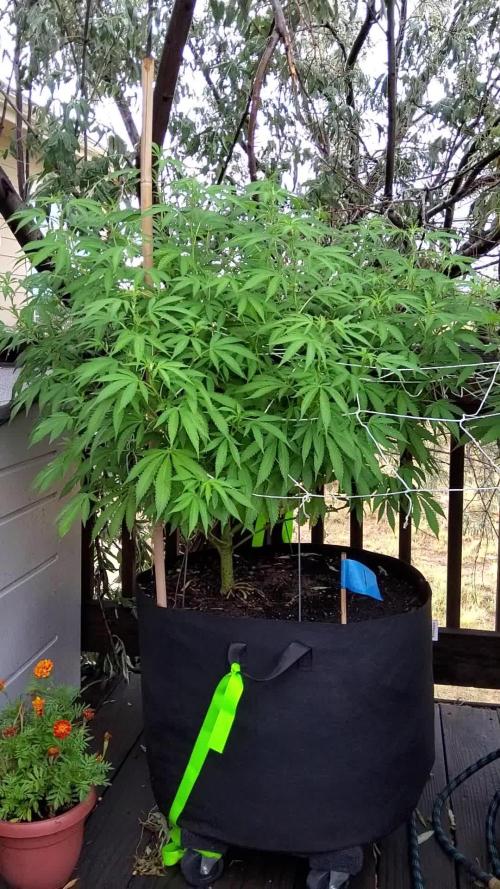
Week 20 Journal Update: Durban Poison Crew
* Current Stage & Vigor: The four photoperiod Durban Poison plants continue to thrive in their vegetative stage on the deck, displaying lush canopy growth supported by the custom bamboo trellis and lattice net system.
* Setup & Mobility: Housed in 25-gallon fabric bags positioned on wheeled moving dollies, the crew maintains optimal mobility on the deck layout.
* Hydration & Maintenance: The automated irrigation manifold continues to supply well water smoothly via hand-drilled halo rings, keeping the soil consistently hydrated alongside the mobile perimeter of African marigolds.
* Outlook: The plants are showing robust health and structure as they prepare for upcoming soil top-dressing with organic worm castings and high-phosphorus guano heading into August.

Processing
Likes
5
Share


Likes
4
Share


@SamDo
Follow
Vegetative Week 5 – Pineapple Upside Down (Round 2)
This week brings a clear and positive shift compared to the previous ones.
The plant has visibly regained vigor, with a noticeable difference in overall growth and structure.
New shoots and branches are actively developing, and foliage density is increasing.
Leaf shape and color look much more natural and healthy than before.
Although the plant still shows some irregular structure due to early-stage stress, the general appearance is now clearly positive.
Growth momentum is back, and the plant is rebushing nicely.
The main objective this week is stabilization.
No pruning or training has been performed yet, as the priority is to allow the plant to fully recover, build strength, and establish a solid base.
Structural work and shaping will only begin once growth is fully consistent.
Nutrition remained unchanged from last week.
Maintaining stable inputs seems to be working well, as the plant is responding positively without any additional adjustments.
While some time was lost earlier in the cycle, the delay is significantly less severe than in the previous run.
This recovery phase is encouraging and provides valuable insight for improving future starts.
Overall, this week ends on a positive note.
The focus moving forward will be on consistency, care, and supporting this renewed growth.
See you next week, take care.

Likes
55
Share


@Ultraviolet
Follow
What's in the soil? What's not in the soil would be an easier question to answer. 16-18 DLI @ the minute. +++ as she grows.
Probably not recommended, but to get to where it needs to be, I need to start now.
Vegetative @1400ppm 0.8–1.2 kPa 80–86°F (26.7–30°C) 65–75%, LST Day 10, Fim'd Day 11
CEC (Cation Exchange Capacity):
This is a measure of a soil's ability to hold and exchange positively charged nutrients, like calcium, magnesium, and potassium. Soils with high CEC (more clay and organic matter) have more negative charges that attract and hold these essential nutrients, preventing them from leaching away.
Biochar is highly efficient at increasing cation exchange capacity (CEC) compared to many other amendments. Biochar's high CEC potential stems from its negatively charged functional groups, and studies show it can increase CEC by over 90%. Amendments like compost also increase CEC but are often more prone to rapid biodegradation, which can make biochar's effect more long-lasting. biochar acts as a long-lasting Cation Exchange Capacity (CEC) enhancer because its porous, carbon-rich structure provides sites for nutrients to bind to, effectively improving nutrient retention in soil without relying on the short-term benefits of fresh organic matter like compost or manure. Biochar's stability means these benefits last much longer than those from traditional organic amendments, making it a sustainable way to improve soil fertility, water retention, and structure over time. Needs to be charged first, similar to Coco, or it will immobilize cations, but at a much higher ratio.
a high cation exchange capacity (CEC) results in a high buffer protection, meaning the soil can better resist changes in pH and nutrient availability. This is because a high CEC soil has more negatively charged sites to hold onto essential positively charged nutrients, like calcium and magnesium, and to buffer against acid ions, such as hydrogen.
EC (Electrical Conductivity):
This measures the amount of soluble salts in the soil. High EC levels indicate a high concentration of dissolved salts and can be a sign of potential salinity issues that can harm plants.
The stored cations associated with a medium's cation exchange capacity (CEC) do not directly contribute to a real-time electrical conductivity (EC) reading. A real-time EC measurement reflects only the concentration of free, dissolved salt ions in the water solution within the medium.
98% of a plants nutrients comes directly from the water solution.
2% come directly from soil particles.
CEC is a mediums storage capacity for cations. These stored cations do not contribute to a mediums EC directly.
Electrical Conductivity (EC) does not measure salt ions adsorbed (stored) onto a Cation Exchange Capacity (CEC) site, as EC measures the conductivity of ions in solution within a soil or water sample, not those held on soil particles.
A medium releases stored cations to water by ion exchange, where a new, more desirable ion from the water solution temporarily displaces the stored cation from the medium's surface, a process also seen in plants absorbing nutrients via mass flow. For example, in water softeners, sodium ions are released from resin beads to bond with the medium's surface, displacing calcium and magnesium ions which then enter the water. This same principle applies when plants take up nutrients from the soil solution: the cations are released from the soil particles into the water in response to a concentration equilibrium, and then moved to the root surface via mass flow.
An example of ion exchange within the context of Cation Exchange Capacity (CEC) is a soil particle with a negative charge attracting and holding positively charged nutrient ions, like potassium (K+) or calcium (Ca2+), and then exchanging them for other positive ions present in the soil solution. For instance, a negatively charged clay particle in soil can hold a K+ ion and later release it to a plant's roots when a different cation, such as calcium (Ca2+), is abundant and replaces the potassium. This process of holding and swapping positively charged ions is fundamental to soil fertility, as it provides plants with essential nutrients.
Negative charges on soil particles: Soil particles, particularly clay and organic matter, have negatively charged surfaces due to their chemical structure.
Attraction of cations: These negative charges attract and hold positively charged ions, or cations, such as:
Potassium (K+)
Calcium (Ca2+)
Magnesium (Mg2+)
Sodium (Na+)
Ammonium (NH4+)
Plant roots excrete hydrogen ions (H+) through the action of proton pumps embedded in the root cell membranes, which use ATP (energy) to actively transport H+ ions from inside the root cell into the surrounding soil. This process lowers the pH of the soil, which helps to make certain mineral nutrients, such as iron, more available for uptake by the plant.
Mechanism of H+ Excretion
Proton Pumps: Root cells contain specialized proteins called proton pumps (H+-ATPases) in their cell membranes.
Active Transport: These proton pumps use energy from ATP to actively move H+ ions from the cytoplasm of the root cell into the soil, against their concentration gradient.
Role in pH Regulation: This active excretion of H+ is a major way plants regulate their internal cytoplasmic pH.
Nutrient Availability: The resulting decrease in soil pH makes certain essential mineral nutrients, like iron, more soluble and available for the root cells to absorb.
Ion Exchange: The H+ ions also displace positively charged mineral cations from the soil particles, making them available for uptake.
Iron Uptake: In response to iron deficiency stress, plants enhance H+ excretion and reductant release to lower the pH and convert Fe3+ to the more available form Fe2+. The altered pH can influence the activity and composition of beneficial microbes in the soil. The H+ gradient created by the proton pumps can also be used for other vital cell functions, such as ATP synthesis and the transport of other solutes. The hydrogen ions (H+) excreted during photosynthesis come from the splitting of water molecules. This splitting, called photolysis, occurs in Photosystem II to replace the electrons used in the light-dependent reactions. The released hydrogen ions are then pumped into the thylakoid lumen, creating a proton gradient that drives ATP synthesis.
Plants release hydrogen ions (H+) from their roots into the soil, a process that occurs in conjunction with nutrient uptake and photosynthesis. These H+ ions compete with mineral cations for the negatively charged sites on soil particles, a phenomenon known as cation exchange. By displacing beneficial mineral cations, the excreted H+ ions make these nutrients available for the plant to absorb, which can also lower the soil pH and indirectly affect its Cation Exchange Capacity (CEC) by altering the pool of exchangeable cations in the soil solution.
Plants use proton (H+) exudation, driven by the H+-ATPase enzyme, to release H+ ions into the soil, creating a more acidic rhizosphere, which enhances nutrient availability and influences nutrient cycling processes. This acidification mobilizes insoluble nutrients like iron (Fe) by breaking them down, while also facilitating the activity of beneficial microbes involved in the nutrient cycle. Therefore, H+ exudation is a critical plant strategy for nutrient acquisition and management, allowing plants to improve their access to essential elements from the soil.
A lack of water splitting during photosynthesis can affect iron uptake because the resulting energy imbalance disrupts the plant's ability to produce ATP and NADPH, which are crucial for overall photosynthetic energy conversion and can trigger a deficiency in iron homeostasis pathways. While photosynthesis uses hydrogen ions produced from water splitting for the Calvin cycle, not to create a hydrogen gas deficiency, the overall process is sensitive to nutrient availability, and iron is essential for chloroplast function.
In photosynthesis, water is split to provide electrons to replace those lost in Photosystem II, which is triggered by light absorption. These electrons then travel along a transport chain to generate ATP (energy currency) and NADPH (reducing power). Carbon Fixation: The generated ATP and NADPH are then used to convert carbon dioxide into carbohydrates in the Calvin cycle. Impaired water splitting (via water in or out) breaks the chain reaction of photosynthesis. This leads to an imbalance in ATP and NADPH levels, which disrupts the Calvin cycle and overall energy production in the plant. Plants require a sufficient supply of essential mineral elements like iron for photosynthesis. Iron is vital for chlorophyll formation and plays a crucial role in electron transport within the chloroplasts. The complex relationship between nutrient status and photosynthesis is evident when iron deficiency can be reverted by depleting other micronutrients like manganese. This highlights how nutrient homeostasis influences photosynthetic function. A lack of adequate energy and reducing power from photosynthesis, which is directly linked to water splitting, can trigger complex adaptive responses in the plant's iron uptake and distribution systems.
Plants possess receptors called transceptors that can directly detect specific nutrient concentrations in the soil or within the plant's tissues. These receptors trigger signaling pathways, sometimes involving calcium influx or changes in protein complex activity, that then influence nutrient uptake by the roots. Plants use this information to make long-term adjustments, such as Increasing root biomass to explore more soil for nutrients. Modifying metabolic pathways to make better use of available resources. Adjusting the rate of nutrient transport into the roots. That's why I keep a high EC. Abundance resonates Abundance.
Likes
78
Share


@Hou_Stone
Follow
👨🚀Salut les copains,👋
🌞 Nous sommes au 38ème jours de floraison,
Lors de ma visite j'ai été surpris par le changement de couleur de quelques feuilles sur les plantes. 🤔
Je n'ai pas beaucoup le temps de m'en occuper en ce moment, je passe juste les arroser et prendre quelques photos.
Intensité de la FC3000: 90%
Ventilation : Extracteur mars hydro 6 pouces avec filtre à charbon puissance : 4/10 (24h/24h) + 3 ventilateurs à l'intérieur ( ON 8/24h). ils s'activent à un horaire différent.
J'arrose environ tout les 4-6 jours avec 1.5L d'eau. (+ 1gr de bioenhancer/L eau un arrosage sur 2)
Venez me voir sur Instagram ✌️
https://www.instagram.com/hou_stone420/
🌺💃❤️️❤️️🌺❤️🌺❤️️❤️️💃🌺