The Grow Awards 2026 🏆
Likes
Comments
Share
@Smokey89
Follow
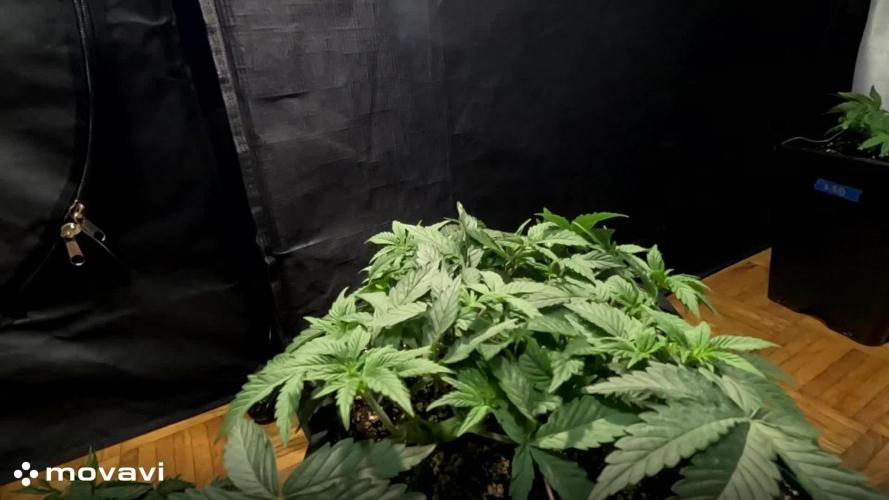
Week 4 and these girls are looking great the cheese is looking as though it's a week behind the bubblegum but still looking nice and healthy and I was expecting it to be slower as it has a longer flower time. My 2 bubblegum are growing really well pheno number 2 is by far the biggest even after I snapped a branch completely off. I've noticed an uptake in water I'm now giving them 2 litre of 6.5 ph plain water every other day. Theres a slight hint of candy as you enter the grow tent makes my mouth water every time I walk in. The LST has gone well (baring the one snapped branch) all bud sites are exposed/tied out towards the exterior of the pot, looking forward to watching them develop and I will be keeping an eye on them for signs of pre flower as the bubblegum is supposed to be 8 weeks or less. Day 31 I think pheno 2 is in early pre flower stage, she is consuming 1.5 litres of water every day and is growing at a great rate. Pheno one is a little smaller and has no signs of flower as of yet, she has had the same feeding and watering as pheno 2 Cheese critical I think is looking good but I'm not seeing much growth I'm wondering if she may be stunted I'm going to check the ppm run off and see if theres any indication as to what's going on That's all for now guys and gals happy growing
Likes
52
Share
Its time to prepare for war. *Blows bagpipe* FISH SH!T THE ORGANIC SOIL CONDITIONER (used twice before and always noticed instantly) Fish Shit is a living product! It provides a complex Microbial profile that includes thousands of different species of bacteria, fungi, and protozoa. This profile is closer to a natural ecosystem than anything you will find on the market. Fish Shit helps release essential oils and terpenes which contribute to the building of a myriad of flavonoids. Flavanoids play a key role in the development of the most potent aromas and tasteful flavors of a plant and its fruit. Fish Shit contains beneficial microorganisms that help plants maximize nutrient uptake. It does this by transforming nutrients into more usable forms and keeping these nutrients in the soil longer. During photosynthesis plants naturally produce exudates (chemicals that are secreted through their roots). Through these exudates, plants can attract the types of good bacteria that are beneficial to them at different points in their growing cycle. These good bacteria cover the roots and act as a barrier to the invasion of disease-causing organisms that may harm the plant. What Are Enzymes? Before we dive headfirst into how, exactly, enzymes can benefit cannabis plants, it helps to understand a little about what these microscopic proteins do. Essentially, enzymes facilitate chemical reactions. They do so by binding with a substrate and forming or breaking molecular bonds. In this context, the substrate is the molecule upon which an enzyme acts to boost the efficiency of a reaction. •substrate /sŭb′strāt″/ •noun •The material or substance on which an enzyme acts. A surface on which an organism grows or is attached. An underlying layer; a substratum. Enzymes are proteins with complex 3D shapes that feature regions called active sites. When the substrate binds to these active sites, it forms an enzyme-substrate complex that causes a chemical reaction to take place, temporarily changing the structure of the enzyme and ultimately causing molecules to either come together or break apart. As a result, molecular products are released, and the enzyme returns to its original shape. Specific enzymes are capable of binding with certain substrates, as the substrate fits into the active site more or less via a lock-and-key principle. Although, new research suggests a more accurate theory of "induced fit", in which enzymes and substrates undergo structural changes to facilitate the reaction. If you take the human body as an example, we have an abundance of enzymes in our saliva and digestive system. These molecules bind with substrates in these regions (food particles), working to break down the food we eat into usable parts before converting them to energy. Enzymes in cannabis work in a similar way to the example highlighted above. Typically, enzymes occur in soil naturally, but if your soil mix is lacking organic material, or you're growing hydroponically, then adding enzymes directly to the substrate is crucial. By using them in cannabis growing, enzymes not only help break down essential nutrients into smaller, more readily available pieces, but they also support the digestion of dead root cells, clearing a direct path for nutrients. Overall, enzymes make it easier for your cannabis plants to absorb all the elements they need to reach their full potential. For growers, a plant that reaches its full potential means a bucketload of juicy buds come harvest. This is essential if you want to reuse a pot with old systems left over like mine. Common plant enzymes include: •Cellulase •Xylanase •Beta-glucosidase •Hemicellulase •Amidase Amino acids are a crucial, yet basic unit of protein, and they contain an amino group and a carboxylic group. They play an extensive role in the gene expression process, which includes an adjustment of protein functions that facilitate messenger RNA Nitrogen, phosphorus, and potassium are the three main pillars of nutrient solutions and fertilizers, but there are countless other nutrients that your cannabis plants need to produce the best possible harvest. Amino acids are one of them. You may have noticed that amino acids get a lot of attention from bodybuilders and other athletes. That’s because they play a key role in the synthesis of protein, which, as you probably know, is super important for sports recovery and muscle growth. Amino acids are the building blocks of protein and the foundation of both plant and animal life. But what do amino acids do for cannabis? WHY IS PROTEIN IMPORTANT FOR CANNABIS? Just like proteins are important for the human body, they are equally important for the growth and development of plants. For example, proteins help plants: •Facilitate the growth of intracellular plant structures •Promote energy generation •Stimulate metabolic processes •Facilitate the absorption and transportation of nutrients So, where do plants get these vital proteins from? Well, unlike humans, plants can’t source proteins or amino acids from other organisms. Instead, they need to create their own amino acids, and then use these to build protein. That's why gardeners, much like athletes, go wild for amino acid supplements. Amino acids help plants by… • Increasing their production of chlorophyll, which ultimately improves their ability to photosynthesize • Serving as an easily absorbable form of nitrogen • Stimulating the synthesis of key vitamins • Improving their resistance to pests and diseases • Boosting the strength of their cells Amino acids also serve as the precursors to auxins, a group of plant hormones produced in the meristems—the apex of the stems where new leaves and stems are born. Auxins play a key role in the plant, activating genes for plant growth and development by triggering a multitude of vital plant functions. In other words, they determine what its size and architecture will look like. Auxins influence the development of branches, flowers, and roots, and even help to regulate the photoperiod response of the plant. Some amino acids, like cysteine, also work together with antioxidants like glutathione to help cannabis plants deal with oxidative stress, which can be caused by high-intensity lighting, some nutrient solutions, and high levels of CO₂. Unlike humans, plants can synthesize all the amino acids they need to survive and develop properly. Unfortunately, however, amino acid synthesis is a really high-energy process, and plants may struggle to produce enough amino acids when exposed to stress. WHAT FACTORS AFFECT A PLANT’S ABILITY TO SYNTHESISE AMINO ACIDS? Any kind of stress can affect a plant’s ability to produce enough amino acids. This includes: • Drought • Temperature extremes • Poor soil health • Pests • Diseases • Poor lighting • Lack of space • Poor root health WHAT DOES ALL OF THIS MEAN FOR WEED PLANTS? If you want to push your plants to their extreme in terms of floral growth and resin production, you should look into amino acid fertilizers. By making amino acids readily available to your plants, they’ll be able to use crucial energy to grow and bloom, rather than focusing on synthesizing amino acids themselves. Game of Inches, this is another Plants can absorb amino acids via their roots and leaves. They can also benefit from amino acids during both their vegetative and flowering phases. The fastest way for plants to absorb amino acids is via their leaves. The foliar application of amino acids is believed to improve the transportation of nutrients, increase transpiration, and boost photosynthesis. Hence, I recommend feeding your plants with foliar amino acid fertilizers. When doing so, however, carefully measure the amount of fertilizer you use, as—like with any nutrient—overfeeding can damage your plants. FOLIAR FEED AND SOIL SOAK • 1 crushed queen anne carrot • Add 2 tbsp of NPK Raw powdered water-soluble cane molasses • 20ml h2o2 • 1 crushed radish • 0.25 tsp NPK Enzymes • 0.25 tsp NPK Amino Acids • 50ml coconut water ( nature's own amniotic fluid packed with amino, enzymes ) + The sound of songbirds. Onto the predators 1250 -Green Lacewings Lacewings are extremely voracious predatory insects that feed on several pests. In adulthood, it feeds on pollen and nectar. In the larval stage, it feeds on aphids, thrips, and mealybugs at all stages of growth. It can also attack spider mites in moderate quantities. It is initially an aphid predator, but very effectively controls thrips and mealybugs infestations. It is so voracious that in the absence of prey, it will feed on its congeners. Lacewings are cannibalistic if there is no food available for them. It is therefore important to introduce them into an infestation situation, and not just preventively. •congener /kŏn′jə-nər/ •noun •A member of the same kind, class, or group. •An organism belonging to the same taxonomic genus as another organism. •A thing of the same kind as. or nearly allied to, another; specifically, in botany and zoology, a plant or an animal belonging to the same genus as another or to one nearly allied. Ideal temperature 20°C – 26°C Ideal humidity 60% – 70% Predatory stage life cycle 21 days Introduction rate 4 weeks Storage Refrigerator Use Immediately Are there any specific instructions on how to use this predator? Lacewings are available on small paper cards that you can hang to plant stems. On the cards are dozens of eggs ready to hatch. There are also sterile eggs they can feed on once they have hatched before they are ready to disperse in the foliage. It is important to use them quickly upon receipt to avoid cannibalism. If you don't use them right away, you can store the cards in the refrigerator for 24 to 48 hours to prevent the eggs from hatching too quickly. Avoid storing them for longer than this or you risk losing eggs. 1250 eggs are divided into 7.5 cards, 2500 eggs on 15 cards, and 5000 on 30 cards. The application rate is one card per square meter of growing surface. Is this predator best used for preventive or curative treatments? Lacewings are used as a curative solution. Anything else I should know? Lacewing eggs hatch approximately 24-72 hours after the cards are exposed to room temperature. When they emerge, the lacewings are just 1.5-2 mm long. They are very small so they are difficult to see. Once hatched, they will stay on the cards for a few hours and then disperse in the foliage. You quickly lose sight of them if you have not witnessed the hatching. They then live in the foliage for about 3 weeks. Often, you will see them towards the end of their larval cycle. After feeding for 3 weeks, they will triple and even quadruple in size. At that point, they are easier to see. But they remain very discreet insects, it is not abnormal not to see them. Egg carcasses left behind on the cards do not disappear after the hatching has happened. It's normal to see eggs still on the cards. Visually it is very similar before and after hatching. Also, on the boxes, there are sterile ephestia eggs which are used to feed the lacewings once hatched. Not all lacewing eggs are viable either. Only a certain percentage of lacewing eggs will hatch. Once hatched, the eggs are white. You can observe this using a magnifying glass. With, 5000 Stratiolaelaps Scimitus It is used to prevent or control thrips pupae, fungus gnats larvae, and root mealybugs in the soil. It can also be used for red mites in bird farms or hen houses. The adult is about 1 mm long and is medium brown with a beige triangle on its back. Another fun fact about them is they can survive without prey. They can eat algae and plant debris. This is why they can reproduce and stay in plants for long periods. Ideal temperature 15°C – 23°C Predatory stage life cycle 18 days Introduction rate 2 weeks Storage Room temperature Use Within one week Are there any specific instructions on how to use this predator? Sprinkle directly on the growing media. They can live in all types of substrates like potting soil, coconut fiber, rock wool, cedar mulch, etc. Stratiolaelaps establish easily so they are permanently fighting pests. One introduction is generally enough unless you have an infestation. In this case, introduce them at least twice at a 2-week interval for best results. If you grow your plants in a 100% mineral substrate, it will have to be released more often since there is less organic matter than in traditional soil. Do I need to take any specific precautions? Stratiolaelaps breed in the top layer of the soil. So it is important not to disturb them in the first days following their introduction. They don't like temperatures below 8 ° C. So be sure not to introduce them in a water-saturated or cold environment. Release them 24-48 hours after your last watering. They are very sensitive to chemical acaricides and diatomaceous earth. These methods are incompatible with their use.
Likes
27
Share
Nice and steady growth. No extra feedings yet, just water for now.
Likes
8
Share
Giving Ph balanced tap water to start flushing. Will add a flushing agent halfway through the week & will do 2 days of darkness prior to harvest. 😎👍🏼🌿
Likes
67
Share
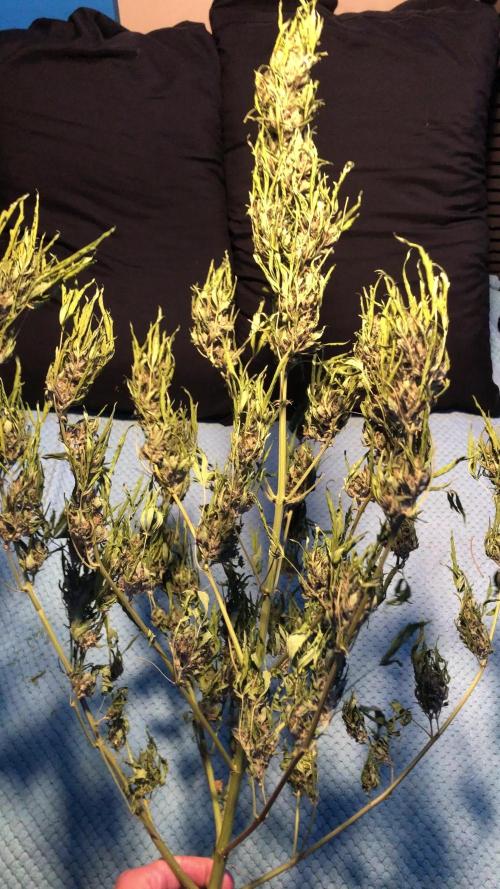
Day 83: After being in the dark for like 4-7 days, they where ready to harvest. All plants getting cut by the machine, big buds are cut by hand. I never weight wet buds because that doesnt make any sence. I will update soon on how much it is dry weight. My friend helped me with the harvest since it takes many hours of work. I have many buds that are as big or bigger as my hand. Quallity so far looks promising even thought there are shitty buds as well, but thats normal and oke. They have been cut freshly so I won't lose much weight when cutting. This will happen when cutting dry buds. The remaining small leafs on the wet buds will dry in with the buds and will be barely visible. More info soon.
Likes
10
Share
This week was good, the girls are bulking up and looking good. The twisted sister looks like she is coming back around. Going to veg these girls out for a while see how thicc we can get ‘em. Until next time growmeis, best of luck ✌️ 06/26/23
Likes
64
Share
@Prof_Weed
Follow
Der Sour Jealousy von FastBuds geht es ganz gut 👍. In Hydroponic dauert es am Anfang immer ein wenig länger bis die Pflanze richtig durchstartet.. Ich denke mal in 2 Wochen fängt es dann richtig an. DLI liegt bei 16.92 ( 20 h Licht bei 235 PPFD). Heute wechsle ich das 1. Mal Wasser und gebe additiv Silicate von Terra Aquatica hinzu. Die ersten Tage hatte ich Schwankungen im PH Wert,ich denke weil der EC Wert so niedrig ist und weil die Blähton Kugeln auch erstmal den angestrebten Ph Wert annehmen müssen. Die Pflanze bekommt hier und da gelegentlich Streicheleinheiten von dem Mini Ventilator damit sie kräftiger wird
Processing
Likes
3
Share
Likes
26
Share
Gracias al equipo de Seedsman y XpertNutrients sin ellos esto no sería posible. 💐🍁 Bubba Cheescake: Bubba Cheesecake es un cruce de Bubba Kush anterior al 98 con Cheese Cake (Wedding Cake x Exodus Cheese). Se trata de un híbrido 70% índica con muy buenos rendimientos, alto en THC y bajo en CBD. Bubba Cheesecake prospera en interiores y exteriores. En interior se aconseja un corto periodo de crecimiento vegetativo debido a la cantidad de estiramiento que presentan las plantas. Las plantas pueden crecer hasta una altura de 250 a 350 cm. cuando se deja crecer naturalmente al aire libre. En interior, la floración dura entre 60 y 65 días, con rendimientos entre buenos y altos, de 400 a 550 gr/m2. Las plantas de exterior son capaces de producir entre 700 - 800 gr. peso seco. En las latitudes norteñas, en exterior, los productores pueden esperar cosechar a principios de octubre. Los cogollos son grandes y duros como piedras. Las plantas maduras muestran atractivos colores púrpuras y azules y brillan con una resina pegajosa que cubrirá las manos del cultivador si no tiene cuidado. El componente Wedding Cake agrega dulzura al sabor del regaliz y el aroma es terroso y musgoso. La producción de THC es muy alta con un nivel bajo de CBD. El efecto es intensamente narcótico, fuerte y duradero. 🌻🚀 Consigue aqui tus semillas: 🍣🍦🌴 Xpert Nutrients es una empresa especializada en la producción y comercialización de fertilizantes líquidos y tierras, que garantizan excelentes cosechas y un crecimiento activo para sus plantas durante todas las fases de cultivo. Consigue aqui tus Nutrientes: https://xpertnutrients.com/es/shop/ 📆 Semana 3: Ha sido una buena semana, ella ha dado un gran cambio en su lugar definitivo 😎, una mala noticia es que algun tipo de saltamontes se ha comido una parte de una hoja, el tratamiento fungicida e insecticida no le ha gustado mucho porque finalmente la ha dejado en paz ✌️. A partir de ahora se aplica riego manual, 1/3 de la dosis recomendada por el fabricante ya que al estar en exterior y en buena tierra tiene bastante comida.
Likes
25
Share
@Dunk_Junk
Follow
Day 70 - She grew 4cm this week. Her flowers are not as developed as any of her tent mates, looks like she's going to take her time flowering. That's ok. I'm happy to wait 😀
Likes
37
Share
@Ferenc
Follow
Last couple of days... No watering from today, (Day 129) and the light will be switched off as well from tomorrow (Day 130) so I will harvest them approx on Day 132 or 133 on the 18th week :)
Processing
Likes
6
Share
Added brand new Mars Hydro ts3000. Raised the water quantity given to the plants. Sour diesels would probably be ready for harvest before than the other strain.
Likes
76
Share
@Canna96
Follow
This week went pretty good, the flowers are getting super sticky and smell amazing, but they're packing on quite as much weight as I hoped. I had a friend over who told me it looked like I was growing a tree in a solo cup, so I think I might run these same genetics back next and pot her up from a solo cup to a 3 gallon pot, get the manifold built, then pot up to a 12.5 gallon air pot. I am going to take the wife on a couple vacations or "holidays" as most of you would say. But yeah I plan to run the same genetics, same training, same lights, everything and see what kind of difference a larger pot alone can make. Anyways not much left for me to do until harvest, I am watching the trichomes closely, I will probably start the flush within a week or so. Thanks for stopping by, be safe and blaze on.
Processing
Likes
21
Share
@rhodes68
Follow
9/14 Week 9 and she is doing fine Little vid she is front left Nuets not changing for now 9/16 Doing well but some white tips are saying we gotta reduce the salts so will be dropping CT nuets 10% and upping PK to 2.5 Extra space is really doing them well Defoliation again tonight the war on stemmed leaves has begun 9/17 Held a meeting of the minds and decided the best course of action is to flip the light schedule so I can feed them more appropriately, twice a day. Leaving nuets as they are as this will drop pot EC. Setting the alarm for the AM before lights out at 7:30 and changing the sched to 6AM-6PM summer is done no need for current schedule. Lights be out from 7:30AM to 6AM long I know but should not bother them. 9/19 Lights on girls feed buds look fine Video enjoy
Likes
24
Share
@MrJones
Follow
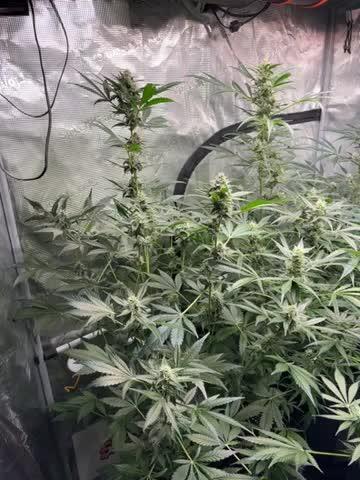
So work has been very busy - but plants look like they are doing well, last week we added the SCROG and top dressed, then just watering (De-chlorinated / PH 6.8) and 1 watering with Recharge. The tent is alive with flowers, tomorrow I am going to add a second SCROG net to help with the weight when these flowers become massive, also will clean out the plants a bit - and may try to create a compost tea. Remember last week I moved the little girl over to my grow cabinet she is doing well but weird phenomes produce such a short plant when her sisters are like triple her size. 02.06.20 - Today I defoliated the little girl - look at all the flowers I found, I topped dressed with Organically Done Bloom Boost with Recharge. 02.06.20 - This afternoon I defoliated and cleaned out all 4 of the girls, topped dressed with Organically Done Bloom Boost (De-chlorinated / PH 6.8) - along with a few doses of optics overgrow planned in the morning - I like to use optics overgrow for insect an inoculant and as a WPM prevention, the other amazing things this dose it just a bonus. 02.07.20 - Uploaded a few pics of the day after defoliation - all looks great! 02.07.20 - Just a few more pics from this evening - the plants are responding well to the cleanup - also pushed the light to 100% now just have to keep things watered and let the buds get fat and juicy!
Processing
Likes
21
Share
Put a selection of my own seeds s1's apart from red/purps red Russina Cross straight into soil and mist sprayed them with ph 6.5 water it took them 3-4 days to pop up but all popped up with 12 hrs of each other 🍾.
Likes
4
Share
@DRO420
Follow
2nd trellis net up , scog is spread nicely. Switching to Bloom formula . Defoliated everything below the first net. Started 12 / 12 light cycle
Likes
9
Share
Diese Woche musste der Kopf ab! Es ist einiges an Masse dran weg gekommen und die Triebe wurden runter gebunden. Ab jetzt geht es in die Breite. Nach 3 Tagen hatte sich die Lady aber schon wieder gut erholt. Näheres dazu in meinen Vegi Woche 2 Video auf Youtube: https://www.youtube.com/watch?v=m4LJzeAcxp0 Link zur Lampe (Mars Hydro FC3000-Evo: https://marshydro.eu/products/mars-hydro-smart-fc-3000-evo/?ref=docgreenthumb Gutscheincode für Mars Hydro (3% Rabatt): docgreenthumb
Likes
12
Share
@ELPIRATA
Follow
DIA 50; Comienza una nueva semana, durante estos dias habia tenido problemas con la humedad; dia 25 se instala Deshumidificador El día 25/06/2020 se han regado 3 plantas en macetas de 11 litros: X2 Semillas Auto Lemon Kix= 1,5L [1MlBLOMBASTIC+1mlKnactive+3ml/L ATAGrowth-C+5mL ATAFlower-C+] PH 6.4/ EC=1.84Tº=23 X1 Semilla Auto Tutankhamon= 1L [1MlBLOMBASTIC+1.5mlKnactive+5ml/L ATAGrowth-C+5mL ATAFlower-C+1mLAutoTop] PH 6.2(?) / EC= 1.84Tº=23 *El día de hoy se han regado 1 planta en macetas de 7 litros: X1 Semillas Auto Lemon Kix#3 = 800 ml [1MlBLOMBASTIC+1mlKnactive+3ml/L ATAGrowth-C+5mL ATAFlower-C+] PH 6.4/ EC=1.84Tº=23 *Se comienza a usar Bloombastic en semana 6, dia 42 (0.5 ml/Lt) Me gustaria realizar foliacion en esta etapa, sera recomendable ?