


Likes
Comments
Share


@FeirmeoirGlas
Follow
Great for a novice, especially when it grows over 4 feet tall! Incredibly sweet, even still tasting it in my grinder days later.

Likes
49
Share


@Roberts
Follow
RSV11 has grown very well. She is still bulking and looks like it will be 3 weeks till finish. She has frosty colas on her that are getting very good size. Looks like a heavy yield will come from her. She is just riding out the rest of her time as of now. She has Naturally been defoliating her lower leaves as she has been flowering. Which is fine that she is using up stored energy. Will make for a good fade upon the flush time. Everything is looking super promising. Thank you Terpyz Mutant Genetics, and Spider Farmer. 🤜🏻🤛🏻🌱❄️❄️
Thank you grow diaries community for the 👇likes👇, follows, comments, and subscriptions on my YouTube channel👇.
Thank you Happy Growing 🌱🌱🌱
https://youtube.com/channel/UCAhN7yRzWLpcaRHhMIQ7X4g

Likes
293
Share


@Ju_Bps
Follow
Hello growmies 👩🌾👨🌾🌲🌲,
👋 Plants growing good, look happy and healthy.
I've a good surprise with how growing good with the Tropicana, same structure, same size, will be good for the scrog.
I've reorganized the tent after harvest of other plants,
Down the supply of lamp and Filter Fan Kit.
💪 Have been topped and did a defoliation 🍃
💧 Give water each 2/3 day
And vaporise plant with water + Plagron Roots (1ml/l)
0.5 l Water + Roots + Grow + Zym (1 + 4 + 1 ml/l)
0.5 l Water + Roots + Grow + Zym (1 + 4 + 1 ml/l)
PH @6
💡Mars Hydro - FC 3000
23% 50 cm
Mars Hydro Fan kit
Setting 4
Have a good week and see you next week 👋
Thanks community for follow, likes, comments, always a pleasure 👩🌾👨🌾❤️🌲
Mars Hydro - Smart FC3000 300W Samsung LM301B LED Grow Light💡💡
https://www.mars-hydro.com/fc-3000-samsung-lm301b-led-grow-light
Mars Hydro - 6 Inch Inline Fan And Carbon Filter Combo With Thermostat Controller 💨💨
https://www.mars-hydro.com/6-inch-inline-duct-fan-and-carbon-filter-combo-with-thermostat-controller
Fast Buds - Gorilla Cookies FF🌲🌲
https://2fast4buds.com/us/seeds/gorilla-cookies-fast-flowering

Likes
30
Share


@buddin_onna_budget
Follow
These beautiful lil ladies are coming along nicely eating very well! Not bad for my first photos


Processing
Likes
28
Share


@Datiko
Follow
She is doing soo good. i think she will give me a lot of buds. I think that 2th LST experience was succesfull too... she will have 4 main cola now.


Processing
Likes
27
Share


@Silverback_Guerilla
Follow
1/14:
This morning, I did a foliar application of big bloom and fulvic acid, then about 5 hours later I watered them with about a half-gallon of rainwater each and added armor si, humic acid, endoboost myco/tricho, liquid molasses, and a bunch of cal-mag. Today, I also I wired up and mounted my new samsung sun board strips (660nm/730nm) and my Solacure FlowerPower UVB fixture.
I'm running the deep red/far red bud boosters a few hours per day right now, but will run them for the entire photoperiod once I start flowering them. I'll run the UVB for 4 * 15-minute sessions a day for the full flowering cycle, and if they don't protest too much I'll increase each session by 5 minutes and evaluate again. Some strains are more forgiving than others and I've got 5 different strains in this space...so really not sure much time I'll get away with exposing them to the deadly rays without damaging them too much...😈
1/15:
I received one of the rapid led/growmau far red initiator pucks today. With the placement of my UVB light, I'm realizing I'll need another far red puck to have even and intense far red coverage, so I'm ordering another with Prime delivery and waiting to start flowering until I receive it.
I sprayed them down really well with ph adjusted rainwater tonight to rinse off nutrient build-up from foliar applications.
1/16:
I'm really excited to try flowering under 14/10. I grew photos indoors on an off for 15 years before I semi-retired. If I added up all the additional flowering time I could have done through the years if LED technology existed, I'd have had an extra truckload of bud to smoke.
I did another application of Axiom Harpin a|b Proteins this evening, right before dark. I'm expecting a big growth burst this week, leading up to the flower stretch. I really need them to trigger under 14/10 within 4 or 5 days🙏
...if not, I'll switch to 13/11 and wait a few more days🙏😟..if still no pistils are poppin, I'll go to 12/12 and chalk it up as bad luck or varietal indifference to Pr and Pfr manipulation.
1/17:
I fed each of them about 3/4 gallon of full strength veg nutes. This will be the last. I'll go with half-strength veg and half-strength bloom for a week, then go with full strength bloom nutrients until I start flushing them in 6-8 weeks.
1/18:
I installed the second far-red flowering initiator today and got all my timers configured for flowering:
=========================================
timer#1 - power strip with qb's and red boosters
10:00am -12:00am
timer#2 - (dual/independent setting)
sideA- 3-way cube with uva bars
10am - 3pm
7pm - 11pm
sideB- flowerpower uvb
1pm - 1:15pm
4pm - 4:15pm
7pm - 7:15pm
11pm - 11:15pm
timer#3 - far red pucks
11:00pm - 12:15am
timer#4 - sub-canopy tube
10am - 1pm
3pm - 6pm
8pm - 11pm
========================================
I also did some testing on the timers and sealed myself into the closet to check for any light leaks. All good.👌
1/19:
Looks like the FIM job didn't take on one of them..but she's got perfect symmetry. WIll probably have to just top her again next week...gonna be a tall one I think. Tonight is their first long night. It's ON!👍
1/20:
I watered them today with about a half gallon each. I'm seeing calcium and magnesium deficiences here and there, so added some boomerang and heavy cal-mag-Fe along with liquid molasses, humic acid, and endoboost myco. I also foliar fed with big bloom and fulvic acid.
That's it for week 4-

Likes
6
Share


@Kountryboi90
Follow
Day 48 of flower and day 77 total. Started giving her some Kool Bloom nutes and she's taking it well. Buds have some good looking structure and is packing on weight. I'm going to tie them up for the last few weeks. Looking forward to the finish line!

Likes
Comments
Share


@UrbanBoer
Follow
Why does she(Unknown Strain SA Plug Edition) not learn from her sisters al she needed was one time in September on my return, and she has worried herself with bud development, there is new growth but it is minute, you pickup on bud development more than actual plant growth. She worries though she excites the imagination, the problem I now face with having big buds if she does produce such, I need to find a way to support the extra load, which have the potential in breaking a whole brunch of a tree, this is the part where strong air flow is necessary. She must continue with her budding focus, her aroma is getting more defined, I am no expert when it comes to deducing notes in scent, so I will leave that to the smoke to explain it, I am going to have a questionnaire for 10smokers to get feedback, if you think you can grow dope weed, give stoners free weed to smoke and rate.
Likes
10
Share


@MG2009
Follow
08/27/2021
Been 7 days since last pictures.
Pheno #4 was eliminated do to the fact she reversed (hermied)
I believe that an outside light was at fault. ( lemon Thai) genetics maybe coming through.
Others have not really been affected but pheno #2,3 may have been delayed a bit but no sign of hermies just not as developed as pheno #1(Hulk).
Going to mix up a flowering tea (AACT) fungal dominant.
Also topdress with Gypsum, and Diatomatious Earth before tea is applied.
Gypsum
Gypsum is calcium sulfate (CaSO4). Refined gypsum in the anhydrite form (no water) is 29.4 percent calcium (Ca) and 23.5 percent sulfur (S). Usually, gypsum has water associated in the molecular structure (CaSO4·2H2O) and is approximately 23.3 percent Ca and 18.5 percent S (plaster of paris).
Diatomatious Earth
Diatomaceous earth is a mineral-based pesticide and its composition is approximately 3 percent magnesium, 5 percent sodium, 2 percent iron, 19 percent calcium and 33 percent silicon, along with several other trace minerals
08/29/2021
Posted close ups of Hulk.
Processing
Likes
26
Share


@eldruida_lamota
Follow
Esa familiaa, estoy impresionado porque estas skunk están muy compactas, es una cepa increíble, y no la fume todavía, solo hay que verlas no solo lo prietas que van, si no lo tricomas as que están .
Hay que felicitar a Zambezaseeds ya que esta variedad es muy estable y sencilla de llevar.
Ph controlado, quitamos productos y lavamos raíces, pronto solo agua.
Ph controlado, temperatura por debajo de 29 y humedad por debajo del 40%, deseando que estén listas para ver la producción, esss flores pesarán, hasta la semana que viene fumetillas.

Likes
422
Share


@Crashoverite
Follow
Hi everyone 😁
Welcome back in another week update!
Thank you all for this amazing support on this bananas journey💚💚💚
Uploading and updating each week content on daily bassis so please revisit this diary if week not over yet.
So far all going great. Girls looking very healthy and happy. Due to my short trip had to leave my 🍌💜👊 girls unsupervised for 3 days. Was stunned when opened my cabinet on the Dec 5th. Athena stretched like crazy. Good 3 inches. She better slow down as not much roof space left for her. May tie some taller branches to netting if necessary. Introducing blooming nutes for the first time this week on December 6th at smaller dosage and on the second watering as listed.
Week 8
Dec 4 - Dec 10
Dec 5
Leaves tucking
Dec 6
Heavier selective defoliation on both girls. Athena fully lolipopped and Xena at 75%. Watered with 8 ltr beetwen both with perfect runoofs PH 6.4. Girls were very thirsty 🤤
Dec 7-8
Just enjoying how my girls developing. Frost has landed and they are start showing colours. All is looking great.
Dec 9
Second watering for this week 7 ltr beetwen both. Runoffs PH 6.4
Even with so much difrence in size of my 🍌💜👊 girls it seems that they are drinking my juice almost equally.
Dec 10
Applied selective defoliation and tied 3 tallest branches of Athena to netting to avoid any potential burns on these beautiful baby colas.
It's the end of the week!
Thank you all again for such a great support, all the likes, dm's, comments and follows 💚💜💚💜
Stay tuned for coming week update 😁✌️💚
Likes
15
Share


@MrGrowMan
Follow
Week 12-13
1 nutrient water
1 non nutrient water
LsT and Scrog
Diesel and Mimosa (front 2) auto
day 62 start 12/12 light period
2 break up cake day 67 start flowering


Likes
11
Share

@BabaHase
Follow
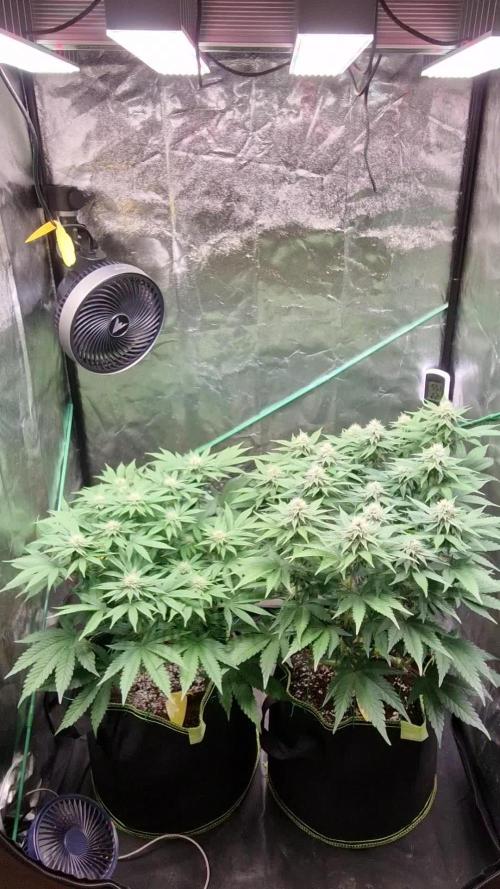
BT 28. Es wächst und gedeiht. Der große strecht dürfte durch sein. Die Blüten entwickeln sich langsam - schauen wir mal was wird.
Likes
4
Share


@Kronen
Follow
Mohawk Meds: Banana Flambe (BF): Realized 2nd Week of germination the lighting was 12/12. Explains the slow start. Now its corrected and started to grow like they should. BF #4 was having some problems breaking soil. I had to dig it completely out and it was curly Qued, growing deeper into the soil the wrong way. I probably planted tap root up. I dug it out and corrected its growth direction. Its cotyledons were present just underground. Unfortunately, between miss planting, 12/12, and digging it up BF #4 did not make it. 😞 They have had spritz of 6.0ph waterx2 each day. Will start to bottom water to get those roots to stretch. Environment is consistent 79F, 60%RH, 320-390ppfd, & 650ppm CO2.
Likes
3
Share
@Chrisandweed
Follow
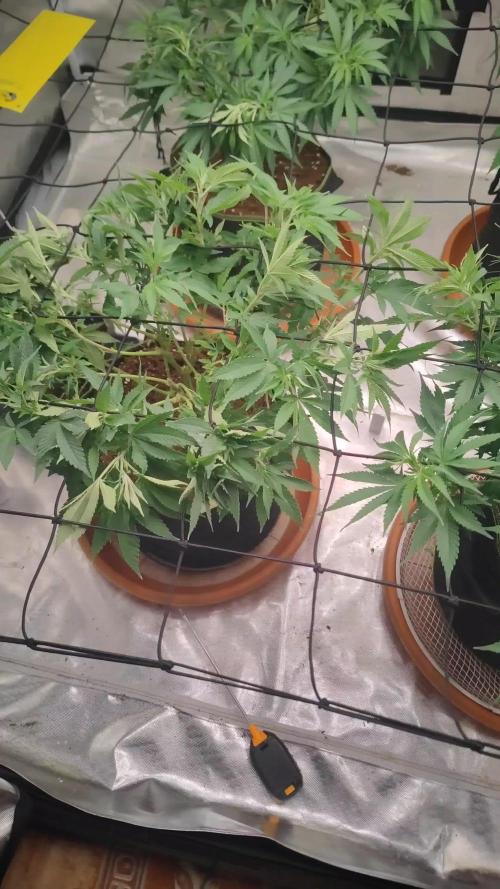
Cada vez mas cerca del objetivo, van flying que te cagas! Jajajajajaja están creciendo muuy bien, se expanden muuuy bien y los abonos se controlan. Hubo una ligera sobrefertilización al hacer el trasplante pero ya lo solucione, la planta mas afectada de las 4 fue la "Critical" normal, pero a esa le meti 10L de riego con flush para arrastrar todas las sales y demás. A las otras 3 les hice lo mismo pero con 5L. Ahora que ya están casi secas, han tardado 3 dias en secarse mas hoy el dia entero 4, están maravillosas, todas con sus hojas fuuuertes y mirando al techo, la critical es un poco la que aun le queda un poquito, pero con el proximo riego yo creo que ya se recupera. Luego, voy a ver si en breve planto alguna auto y la meto al indoor unas 2 o 3 semanas y me la saco al exterior... Ya veré sinceramente que en mi exterior tengo ciertos problemas dificiles de controlar, entre otros, vecinos que no saben lo que significa la palabra intimidad 😅.
Aaahh lo olvidaba!! Se ven hojas manchadas, eso es porque les metí ayer una limpieza guapa guapa foliar por delante y por detras a todas las plantas con un producto de estos tipicos de jabón potasico + aceite de neem, ya junto, en plan los 2 en 1. De entre las cosas que he ido aprendiendo con los cultivos, es que es muy importante hacer estas aplicaciones y ya no estas a modo preventivas, sino agua sola ayuda mucho, especialmente pulverizarla lo mas fuerte posible A LOS TALLOS, a la totalidad de los tallos/ramas de las plantas. Es verdad que los bichos suelen irse a las hojas a comer peeeeeeeeeero en mi experiencia, su base las hacen en los tallos y ramas, si, en la parte mas cercana a las hojas, peeero en las ramas! Por lo que minimo una vez a la semana procuro pegarle una buena pasada como si de una Karcher se tratara y si que el armario es nuevo y procuro tener cuidado, pero de momento todo bien respecto a plagas.

Likes
19
Share


@GanjaGecko
Follow
WEEK 9/6F // D57/36F - D63/42F
Diese Woche war nicht viel zu tun. Die Guava entwickelt sich prächtig und hat wunderschöne frosty Buds. Am Donnerstag Abend wurde die Lady für das Wochenende reingeholt und vor das Südfenster gestellt. (Was bei drei Tage Regen und Wolken eh komplett witzlos war). Allerdings wollte ich kurz vor der Ernte der Dame nicht 3 Tage Dauerregen aussetzen😄
Die Guava wurde heute das letzte Mal gegossen wird ab morgen bis kommenden Freitag nicht mehr gegossen und wird dann Samstag früh zusammen mit den beiden Helgas in das Zelt zum trocknen aufgehangen.
Bei Regen wird die Guava reingestellt damit die Blüten nicht mehr unnötig nass werden vor dem trocknen.
Gegossen wurde an Tag 57/36F, Tag59/38F, Tag61/40F und an Tag63/42F.
An den Tagen gab es jeweils ca 1L-1.2L.
Bei jedem zweiten Gießen wurde gedüngt.
Der Topf wird vor dem gießen leicht angehoben um zu abzuschätzen wie viel die Dame benötigt.
Temperatur
Tag: 22-26°C
Nacht: 13-19°C
Höhe 84cm


Likes
3
Share


Likes
29
Share


@Ganja_Victoria_Aus
Follow
Keeping my lady happy is a full-time job full of surprises, sometimes heavily exhausting long hours. I'm giving all my love to them. So thankfully, Respect and Love for my family for keeping me able to spend hours daily. 🌅🙏🤙
Unfortunately, grow diaries crash every time I update nutrients and photo 🤷

Processing
Likes
6
Share


@ganjaman24
Follow
Everything is looking pretty good gonna flower soon just letting the structure develop a bit more..probably going to let Somango veg longest

