


Likes
Comments
Share


@Mrg7667
Follow
Day 74 and there getting chopped today! I thought the harvest was going to be broken into two separate weeks considering the times on the Choco was listed about 7-10 days sooner then the DD (wich was listed at 70 days for flowering)
However looking at the tricombs on the Chocolate Marshmallow most pheno didnt start getting amber untill the DDs did as well! A couple DD pheno could have maybe gone a couple more days but we will see!
Going for reveg on all the pheno, since i didnt get to take any clones. We will see how it goes!

Likes
13
Share


@CBDezz
Follow
The plants are ready to be chopped and hung for 3-5 days. I removed all the fans leaves and left them all branches on the main stem. The ladies smell so strong I can wait to see how they turn out when they are dried and cured.
1) I plan to hang them for 3-5 days @ 71 f and 50-55 RH,
2) Do a final tight trim
3) Than I will move them to jars and cure for 2-3 weeks
I will update the diary with harvest pictures & weight before I move them to the jars for curing.
I think the seeds might have got mixed up when packing because these three plants were all supposed to be the same and you can clearly tell from the pictures that they are not.

Processing
Likes
8
Share


Likes
41
Share


@Stinkygorilla
Follow
Currently waiting for the soil to dry out after the flush last week so only foliar feeding . It seems to be helping, I need to put aside a few hours to give both my remo chemo and purple CBD some love. Both got lockout from salt buildup and I need to sit down and trim any dead growth, some light LST and TDS and pH the runoff. The old growth is yellowing fast on this one so it better be soon! Otherwise she will lollipop herself!
Day 70 - fed nutrients and pH water 6.2.
Looks like I will have to do a bit more topping, she's stretching for the sky!
Day 66- no water no food, just letting her dry out a bit as I suspect root issues, she's stretching to the sky though so aside from the nitrogen deficiency we're looking good!
Day 68- she had dried out nicely, gave her some fish mix and liquid seaweed, 3ml/l and 4ml/l respectively, 2l feed. Have trimmed dead and dying growth. Just going to leave her to it for a week or two

Likes
12
Share


@brosef_b_baggin
Follow
Week 4: Started adding Humboldt Secret Golden Tree at 600 ppm. The plant started bushing out from the LST so I defoliated whatever green wasn't getting any light and to expose light to smaller nodes. I was planning on topping this week but to my surprise the plant had created a third axil/node and axillary branch.
Likes
3
Share


@Xabii
Follow
42 days!
Sadly did loose footage of 1,5 days.
Did a reservoir swap and am now using Yara Kristalon Orange instead of Blue.
Orange NPK: 6:12:36.
Lowered EC after some research on rockwool, guess I was feeding way to high all the time, as it seems salts accumulate in rockwool even when you do long irrigations to basically flush it every time.
Will aim for 1.2-1.3EC from now on, a lot lower than in my previous NFT setup.
The plant is doing good, some slight tip burn, took the heatwave like a champ.
Some branches are stretching, some not, bit it will get bigger for sure (writing this 2 days in to the next week).
Did quite some defoliation.
Smell is coming in for sure, attached the Charcoal filter this week, previously without because not needed :)
Overall not a monster of a plant but not bad either, good average?
Values are average of the day.
DATE - EC(us/cm)
20250628 1405
20250629 1391
20250630 1454
20250701 1531
20250702 1519
20250703 1427
20250704 1336
DATE - PH
20250628 5.87
20250629 5.74
20250630 5.84
20250701 6.20
20250702 6.03
20250703 6.12
20250704 5.82
DATE - ORP (mV)
20250628 121
20250629 18
20250630 51
20250701 -41
20250702 -41
20250703 -30
20250704 -12
DATE - °C - RH% (Tent Temp/RH)
20250628 25.7 59
20250629 26.4 61
20250630 26.9 57
20250701 27.5 50
20250702 29.0 50
20250703 25.4 51
20250704 25.3 44
DATE - °C (Reservoir)
20250628 22.3
20250629 23.3
20250630 22.7
20250701 22.8
20250702 24.2
20250703 23.1
20250704 22.3
DATE - CF
20250628 14.05
20250629 13.91
20250630 14.54
20250701 15.31
20250702 15.19
20250703 14.27
20250704 13.36

Likes
1
Share


@Blucha
Follow
These ones going crazy right there!
Week 6 of flowering just a couple day ago they started to bulk up.
I did some defoliation but nothing big
Strong and extraordinary smell of both strains. Two different worlds in tha tent.


Likes
11
Share


@ElGrowLab
Follow
Unfortunately, I had to correct the first week of flowering as the last week of the growth phase because I didn't reset my timer and the lamp therefore ran at 18/6 for another 5 days
Some plants are a little lighter, some are a little darker, they all received about the same water I'm assuming it's phenos Otherwise they look really good and grow into the net. Each flower gets a field of the net
Celebrate well with your loved ones, I hope you had a nice Christmas and I wish everyone a good start into the new year

Likes
20
Share


@Canna_Enthusiast
Follow
This week the wedding cake recovered nicely from the topping and looks full and bushy.
No issues occured.
See timelapse for the growing progress

Processing
Likes
11
Share


@Flashback25
Follow
This week has been interesting.
As i prommised last week i have upgraded the lights to just about 200w.tue to it being homemade i used what i had, the lights ended up being a colder tone. But more light is better i supose.
Towards the end of the week there was a noticeable stretch, so there is finaly signs of flowering starting.
Plants are looking really good.
Started adding more potasium and phosphorus in preperation, before cuting off the nitrogen towards the end of the stretch.
Any feedback is welcome, best way to improve is to learn from mistakes, but i feel like i am mising some of my mistakes.
Likes
23
Share


@DeepRootsGrowTrees
Follow
MATARO BLUE by KANNABIA
Week #18 overall
Week #4 Flower
She's doing great this week looking good and her buds are starting to dense up she's getting nice trichome coverage as well. Stay Growing!!
Kannabia.com
MATARO BLUE


Likes
88
Share


@Roberts
Follow
Gorilla Jealousy F1 has been going great. She is still bulking. The colas are super frosty and have that earthy smell I have seen in over Gorilla strains I have grown. Looks like she has about 2 weeks left roughly without closer examination. Everything has been. Going really well. Thank you Seedsman, and Spider Farmer. 🤜🏻🤛🏻🌱❄️
Thank you grow diaries community for the 👇likes👇, follows, comments, and subscriptions on my YouTube channel👇.
❄️🌱🍻 https://www.seedsman.com/?a_aid=Mrsour420. This is my affiliate link to seedsman.
Thank you Happy Growing 🌱🌱🌱
https://youtube.com/channel/UCAhN7yRzWLpcaRHhMIQ7X4g


Likes
10
Share


@Elguacho420
Follow
Buenas buenas!, cómo ven en esta 3ra semana de etapa de gestación de estás lemon cookies kush están bastante bien ( a mi parecer) , las veo crecer sanas y sin problemas, D.P.M.
El transplante les ah sentado muy bien, las dejaré una semana más y luego el cambio... El alimento de la mano de la gente de advanced nutrients, eh comprado este kit q para mí está bien, ya les contaré y veremos los resultados juntos. De momento mis niñas están muy bien y promenten ser las verdaderas! 😎🔥 Buen fin de semana para tod@s, Buenos humos para tod@s.. 👍🏻
Likes
15
Share


@the_big_pink_place
Follow
01/10/22 Everything is Going good, which means something bad is going to happen. Plants were 9 inches at the end of week 4 on day one of week 5 they were topped and defoliated which brought the height to 4.5 inches, So after the shock of having there tops removed they grew 4 inches in one week. Extremely happy I'm keeping track.01/13/22 Defoliated and LST'D the plants.01/14/22 Adjusted LST , removed all branches growing on the underside to allow for proper Growth of other branches. Fingers crossed this should be a decent harvest flipping on week 9.


Likes
15
Share

@Mr_R_IL
Follow
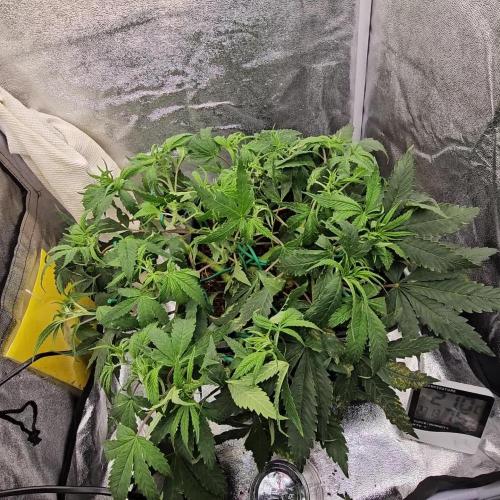
Getring ready for flowering, on Thursday removed a lot of suckers and started washing the coco to avoid fertilizer salts buildup, keep spreading her and winning as much surface as I can, by the looks of it i belive next week will be the last veg week.
I'm very pleased :)
By the end of the qeek u started the pre flowering fertilizer set up. From this point there is no more stressing on the plant and just growing and growing. I think I made a monster 😅

Likes
57
Share


@MadeInGermany
Follow
It's finally here 😀.
Both phenotypes are in the fermentation phase 😍.
The grow was a lot of fun, so I thought I'd make an Iolator hash out of leaves and a little bud and a little oil out of both phenotype buds.
Cannabis:
The grow:
Both grew beautifully.
Your stretch was normal and it didn't cause any problems.
Feeding :
You received GHSC bio Grow once in the vegi phase and GHSC Bio bloom twice in the flowering phase.
GHSC enhancers were added every 2 weeks. That was just the right amount for both : 1:.
Optic:
The appearance of Phenotype 1 is almost completely purple 😍.
Pheno 2 is coated a bit purple with a mixture of silver from the resin :-).
Smell / taste
Pheno 1 tastes very fruity.
You can really say that it tastes like a tangerine in the finish : 1:.
Pheno 2 also tastes a little fruity but with its distinctly stronger note in the Kush direction. Both very tasty : 1:.
Storage:
The cannabis is stored in glasses in a dark place where the temperature is between 19-22 degrees.
The first 2 months of fermentation are boveda packs 62% in the jars. Then the 58% come in.
Since I was in the mood for a few specialties again, as mentioned above, I also made Hash Oil and Ice Oilator hash.
Let's start with Video 1 (BHO) Hash Oil production:
Hash Oil:
Process:
Small grated cannabis goes into the Dexso tube.
Below is a container in the PTFE film that serves as a base so that the oil can be easily removed at the end.
At the top we give the Dexso gas through the Dexso tube filled with cannabis.
The result is a mixture of the gas and the cannabis oil.
We put the bowl with the mixture in a hot shot of water but make sure that no water comes in at the top.
We let the whole thing simmer for 20 minutes so that the first gases can evaporate.
Then everything goes into the vacuum chamber so that all remaining vapors can really escape and we have a pure product 😁.
The whole thing is carried out for 2-3 days until the oil is ready 😀.
I can only recommend everyone to vaporize oil in a dabbing rig 😍.
Taste:
The taste is extremely delicious.
In the finish, it tastes much more like mandarin than the buds 😀.
Optic:
The oil is very shiny to matt.
If you pull it apart, it becomes light as honey :-).
If you roll it up, it's very conceit.
Consistency:
The oil will become a little harder in the silicone storage after a short time.
However, if you take it in your hand, it can be pulled and kneaded very easily after a few seconds.
That was it with the oil production.
So let's continue with the Ice o Lator 😀.
Making the Ice o Lator:
I took all the remains of the leaves and placed them in the small net.
Then the IO maker is first made about 1/3 full of cold water with water.
I add 3-4 kg of ice cubes and wait about 15 minutes until the water is below 0 degrees.
As soon as the temperature is reached, I put in the net with the leftovers and set the timer to 15 / on and 10 / off.
I run the whole thing 3 times.
Then the complete broth is passed through the sieves (160, 120, 73 and 25) in a bucket. After sifting everything is spread out on a ceramic plate and poked very small with a knife.
The whole thing comes in a dark place and is then allowed to dry for about 3-4 days.
As soon as the hash has dried, it comes into the press for a few hours at a little temperature.
The result is a kneading oily Ice o Lator 😍😍😍.
Optic:
The optic is partly reminiscent of that of oil :-).
Consistency:
The ice o lator has a very soft consistency :-).
You can roll up small sausages while smoking 😁.
Taste:
The taste is very medicinal. But very earthy and smoky finish : 1:.
All the screenings are very good but the 25 and 73 are the best 😃.
That was it with the production to see everything again in Video 2.
So we come to the end of a beautiful passage ☺️.
Finally, I would like to say that I would like to thank Sweet Seeds for the sponsorship and for providing two such great genetics 🙏🏻.
If anyone has any questions about this type, oil or ice, I will answer as soon as I can.
I wish you all a lot of fun with this big update :-).
Have a nice start to you and your families into the new year and everyone stays healthy 🙏🏻.
Let it grow 🍀
MadeInGermany
You can buy this Strain at :
https://sweetseeds.es/de/red-mandarine-f1-fast-version/
Type:
Red Mandarine F1 Fast Version
☝️🏼
Genetics:
Red Poison Auto®️ (SWS39)
X
Tangie (California Orange x Hybrid Skunk)
: 1:
Vega lamp:
2 x Todogrow Led
Quantum Board 100 W
💡
Bloom Lamp :
2 x Todogrow Led
Cxb 3590 COB 3500 K 205W
💡💡☝️🏼
Soil :
Canna Coco Professional
☝️🏼
Fertilizer:
Green House Powder Feeding
☝️🏼🌱
Water:
Osmosis water mixed with normal water (24 hours stale that the chlorine evaporates) to 0.2 EC. Add Cal / Mag to 0.4 Ec Ph with Organic Ph - to 5.5 - 5.8 .
