


Likes
Comments
Share


@Blosmk57
Follow
Buds are really swelling and smell has come on strong ! Really shaping up to be nice plants and good looking buds. The trichomes are starting to stack on and hopefully will get better as the buds begin to bulk up here in last few weeks ! But really a beautiful plant and has great structure! Many main colas instead of just a Christmas tree shaped plant with 1 , so far that’s a bonus !
Beginning week 8 and things have come along great. After a slow start I’m really impressed with how these are looking. 1 of the 2 has quite a bit more color starting to appear on some leaves and in the new buds but both are turning into beautiful plants. Not a lot of smell coming from them yet but just starting to notice a few trichomes on some sugar leaves near the highest forming buds. Excited to see how things progress!
@blimburm thanks for the genetics! Starting to really get excited about this Grizzly Purple Auto !

Likes
17
Share


@Tazard
Follow
I let her go another week. The trichome photo was on Wednesday and I was just starting to amber. I’ll harvest her today 22/2/2020 and then do a harvest report in a couple weeks after she’s cured up some.

Likes
14
Share


@Fat_Olsh_Farms
Follow
Day 14. Supercropped the top, holding it down with a paperclip.
Day 18. Continuing with lst and hst. Happy with the progress.
Day 19. Minor defoliation in the morning.

Likes
16
Share


@Lol_You_Looked
Follow
For nutrients, as directed by the GHE Medium Flora Feed schedule for the week corresponding with how old the plant is. All three seeds are on slightly different weeks as follows (Which means all the weeks may be off on the diary, I think I did it as accurate as I could) -
Strawberry Banana Auto (SN) sprouted on 10/15/22
1 Cold Creek Kush (CCK1) sprouted on 10/27/22
The other Cold Creek Kush (CCK2) sprouted on 11/05/22
For these plants, I'm not doing any crazy training or anything, simply defoliating when I think it's necessary, but otherwise letting the plants grow.
Sort of hard to update or have this diary be 100% accurate as the plants are not at my residence but at a buddy's.
RIP the 2 Cold Creek Kush plants, both turned out to be male and are later culled. I will keep the photos in this diary for preservation and to look back on when I eventually grow CCK again.


Likes
15
Share


@AloeLover
Follow
Defoliation definitely happened. She was getting very bushy. However, it's hard for me to NOT defoliate LOL. I want to see her true colors. I'm hoping my swollen nodes isn't telling me it's the opposite sex from seed..

Likes
16
Share


@Ultraviolet
Follow
Seedling managing 93F 30%RH, around 20 DLI. Vpd is in the 3's. No I don't recommend.
Signum Magnum.
"A great sign appeared in the sky
a woman clothed with the sun
with the moon under her feet
and on her head a crown of twelve stars.
Sing ye to the Lord a new canticle:
because He has done wonderful things.
Glory to the Father, and to the Son, and to the Holy Spirit
As it was in the beginning, and now, and ever shall be, world without end."
The plant nutrient nitrogen exists in forms with both positive and negative charges. Ammonium (NH4+)(immobile in soil)(Cation) has a positive charge, while nitrate (NO3-) (highly mobile in soil)(Anion)has a negative charge. Nitrogen is unique among plant nutrients in that it can exist in both positively charged (ammonium, NH₄⁺) and negatively charged (nitrate, NO₃⁻) forms in the soil. This makes it a special nutrient. In that it is responsible for providing balance for reactionary trade offs when it comes to ph. Because ph itself in the medium will always slowly drift towards acidicity, such is nature. 80% of nitrogen should be nitrate and no more than 20% ammoniacal nitrogen.
Ca, mg, and K are the big 3 cations related to soil composition, pH & base saturation.
When nitrogen is in the form of ammonium, it can compete with calcium, magnesium, and potassium for absorption sites in the plant root. This competition can lead to a reduction in the uptake of these other essential nutrients. Nitrogen, particularly in its nitrate form (NO3-), can increase soil acidity, which can also affect the availability of calcium, magnesium, and potassium. The form of nitrogen applied (ammonium vs. nitrate) can influence its interactions with other nutrients. Ammonium nitrogen can have a more pronounced negative effect on the uptake of calcium, magnesium, and potassium compared to nitrate nitrogen.
Common forms of ammonium nitrogen include ammonium ion (NH4+), urea, and ammonium compounds like ammonium nitrate, ammonium sulfate, and ammonium phosphate.
Common forms of nitrate nitrogen include potassium nitrate (KNO3), sodium nitrate (NaNO3), calcium nitrate (Ca(NO3)2), and ammonium nitrate (NH4NO3).
Phosphorus is an essential plant nutrient, and its availability in the soil is strongly linked to the presence of oxygen. Plants primarily absorb phosphorus as phosphate (PO4), and oxygen is a key component of this molecule. Furthermore, the availability of phosphorus in the soil can be impacted by factors like soil aeration and temperature, which in turn affect the oxygen supply to the roots.
Phosphorus uptake in plants is most critical during the early stages of growth, particularly within the first few weeks of plant development.
Young plants actively growing tissues have a high demand for phosphorus. They may absorb up to 75% of their total phosphorus requirements within the first few weeks of vegetative growth, with up to 51% of uptake happening overnight, primarily in the first few hours or early nightfall.
⑨Anaerobic root respiration, or respiration without oxygen, is detrimental to plants because it's less efficient and produces toxic byproducts, leading to reduced energy production, nutrient uptake issues, and ultimately, root damage and plant stress.
⑨Anaerobic respiration, unlike aerobic respiration, doesn't utilize oxygen as the final electron acceptor in the electron transport chain. This results in a significant drop in the amount of energy (ATP) produced, which is necessary for various plant functions, including growth, nutrient uptake, and maintenance of cellular processes.
⑨In the absence of oxygen, plants produce byproducts like ethanol and lactic acid during anaerobic fermentation. These byproducts can be toxic to the roots and inhibit their function,
⑨When oxygen is depleted in a medium, the pH tends to decrease (become more acidic) due to the production of metabolic byproducts. This is particularly relevant in biological systems where aerobic respiration relies on oxygen as the final electron acceptor.
⑨When oxygen is scarce, plants may switch to anaerobic respiration. This process produces carbon dioxide (CO2) as a byproduct.
⑨CO2 dissolves in water to form carbonic acid (H2CO3). This acid lowers the pH of the medium, making it more acidic.
⑨Anaerobic conditions can impair a plant's ability to regulate its internal pH, leading to a drop in cytoplasmic pH and potentially cellular acidosis.
⑨The change in pH can also affect the availability of certain nutrients to the plant, as pH influences the solubility of micronutrients like iron, manganese, zinc, copper, and boron.
⑨The lack of oxygen in the plant medium leads to a decrease in pH due to the production of carbon dioxide during anaerobic respiration and impaired pH regulation within the plant.
In plant cells, cellular acidosis, a drop in the internal pH of the cytosol, is a significant stress response, particularly during conditions like flooding or hypoxia. This acidification can be triggered by a decrease in oxygen levels, leading to the production of metabolic byproducts like lactic acid and CO2. The plant's ability to tolerate and recover from these conditions depends on its cellular mechanisms to regulate pH and mitigate the effects of acidosis. When plants are subjected to low oxygen environments, such as those experienced during flooding, anaerobic metabolism, which produces lactic acid and ethanol, becomes the primary source of energy. This can lead to a build-up of these acidic metabolites in the cytosol, causing a drop in pH.
OXYGEN
Atomic oxygen (single oxygen atom, O) is the lightest form of oxygen, as it has the lowest mass of the oxygen molecules. Oxygen also exists as a diatomic molecule (O2) and an allotrope called ozone (O3), which have higher masses due to the number of oxygen atoms combined.
Atomic Oxygen (O):
This refers to a single oxygen atom, which is the most fundamental form of oxygen.
Molecular Oxygen (O2):
This is the common form of oxygen we breathe, consisting of two oxygen atoms bonded together.
Ozone (O3):
This is an allotrope of oxygen, meaning it's a different form of the same element, consisting of three oxygen atoms bonded together.
Since atomic oxygen has the fewest oxygen atoms, it naturally has the lowest mass compared to O2 or O3.
Ozone (O3) Lifespan:
Ozone has a relatively long lifespan in the stratosphere, particularly at lower altitudes. For example, at 32 km in the middle latitudes during spring, ozone has a lifetime of about 2 months.
Oxygen (O) Lifespan:
Atomic oxygen, on the other hand, has a much shorter lifespan. At the same altitude, its lifetime is about 4/100ths of a second.
Ozone-Oxygen Cycle:
The ozone-oxygen cycle involves the rapid exchange between atomic oxygen (O) and ozone (O3). UV radiation can split molecular oxygen (O2) into atomic oxygen (O), which then reacts with O2 to form ozone (O3). Ozone can also be photolyzed by UV radiation, creating atomic oxygen again, which can then react with O3 to reform O2.
Dominant Form:
The partitioning of odd oxygen (Ox) between ozone and atomic oxygen favors ozone in the lower stratosphere. This means that a much larger proportion of odd oxygen exists as ozone than as atomic oxygen, especially in the lower stratosphere.
Recombination:
Atomic oxygen has a high energy and reactivity. When it encounters another oxygen atom, they can combine to form O2. This process releases energy, contributing to the heating of the atmosphere.
Ozone Formation:
Atomic oxygen can also react with molecular oxygen (O2) to form ozone (O3). Ozone plays a significant role in absorbing harmful UV radiation.
Other Reactions:
Atomic oxygen can react with various other molecules in the atmosphere, like nitrogen (N2), water (H2O), and carbon dioxide (CO2), forming different compounds.
UV light below 240nm (peak 185nm) creates ozone (O₃) through a process called photolysis, where UV light breaks down dioxygen molecules (O₂) into single atomic oxygen atoms (O). These single oxygen atoms then react with other oxygen molecules to form ozone (O₃). Specifically, UV-C light with wavelengths shorter than 240 nm can cause this photolysis.
UV light with wavelengths between 240-280 nm, (peak 254 nm) breaks down ozone (O₃) into dioxygen molecules (O₂) and atomic oxygen atoms (O). 280nm does not have the energy potential to break apart the stable bond of (O₂) into enough (O) to make (O₃)
At ground level, atomic oxygen (single oxygen atoms) has a very short lifespan. This is because it's highly reactive and quickly combines with other molecules to form stable diatomic oxygen (O2) or other compounds. While the exact timeframe varies depending on the specific circumstances, its lifespan is typically measured in nanoseconds or picoseconds.
Likes
8
Share


@DWCpaqy
Follow
Week has been good. I'm not sure about the ppm and salt around roots, they are a little brown. Wounder if I should flush them and start again with nutrient?
And see some of the last picture, it's pretty thigth between the leaf and buds, should I but some of the leaf?
Ppm 1400-1600
Temp 22 to 31
Temp in water 20-26
Humidity 50-60%

Likes
21
Share


@IslandTerps
Follow
Overall Grow Experience
This run was smooth and rewarding. The plant responded well to training, Gaia Green nutrients held up beautifully, and the structure stayed strong all the way to harvest.
Nutrient Line – Gaia Green Organics
Organic, easy to use, and very forgiving. This line really impressed me and delivered healthy growth and solid flower development. Will definitely continue using it.
Training Technique
Mainlining worked great on this strain. Created a clean structure with even canopy and solid colas. Timing could be improved, but overall worth the effort.
Final Thoughts
I’m satisfied with how this grow turned out. Learned a lot and already planning how to improve the next run. This strain is definitely one I’d grow again.
Thank you all for following!

Likes
4
Share


@lotero
Follow
riego progresivo de 150-175ml/planta/día
ha estado bastante nublado, no han crecido mucho, pero parecen bastante sanas


Likes
12
Share


@Skunkiest_bender39
Follow
Der Harvest war erfolgreich, alle bis zum maximalen Ende stehen lassen. Alles gleichzeitig zu ernten war ein bisschen unentspannt, da der Indoorgrow gleichzeitig zum trocknen hängt! Dennoch mega glücklich!!! Jetzt beginnt das Aushärten, die meisten Behälter sind zwischen 67-73% bleiben aber noch 1-2Tage offen.☮️
Likes
10
Share


@Sickone
Follow
Auch für die Pfadfinder eröffnet sich die nächste Woche.
Beide Ladys machen einen Hervorragenden Fortschritt sowohl die Abstände der "Nioden?" als auch das Wachstum und die Farbe der Ladys gefällt mir sehr gut.
Bei einer Lady habe ich etwas nach geholfen die zukünftigen Triebe durch die Fächerblätter zu fummeln damit diese schon frühzeitig licht bekommen und ggf. auch auf einer höhe weiter wachsen so wie sie es bisher tun.
Bei der anderen Lady experimentieren ich etwas herum wie es sich auf die Ernte auslegt wenn ich einige Triebe nach unten "Binde" um einen Größeren Lichteinfluss zu generieren was aber bei der Lady nicht so einfach ist da sie ein verdammt wildes Wachstum hat was für mich als Newbie nicht klar erkennbar ist dank ihrer Mutation.
Weitere Infos / Bilder folgen im laufe der Woche da sich seit Gestern ( Sonntag ) auf Heute nicht viel getan hat.🌱
Update Montag Abend:
Erste Anzeichen der blütephase entdeckt Let's do it!🍃💚
Likes
2
Share


@Herbangardener671
Follow
Vaped some lower buds and the taste is as advertised like tropical fruit or fruity pebbles

Likes
64
Share


@Wastent91
Follow
Eccoci ragazzi siamo a più della metà di fioritura.. Purtroppo poca resina, ma le cime sono belle compatte e dure, non c'è molto aroma nella aria, speriamo che migliori nelle prossime settimane, purtroppo ho fatto qualche errore forse con questa ragazza, ho dato troppi nutrienti e troppo poco calcio e magnesio.. Staremo a vedere come procede e cosa ne esce fuori, come struttura è davvero una pianta imponente, praticamente l ho solo stoppata due volte e per il resto l ho lasciata crescere nel modo più naturale possibile, senza defogliare o togliere rami, infatti è diventata un mostro come grandezza, ma purtroppo per ora c'è poca sostanza di quello che mi interessa veramente è avere tanta resina.. Speriamo continui ad ingrossarsi, provvederò a mettere dei sostegni, anche se penso che non ne abbia bisogno dato che la struttura ad albero di Natale, sembra bella solida.. Grazie ad anesia seeds che ha reso possibile tutto ciò, hanno delle genetiche grandiose! Il prossimo ciclo di sicuro metterò di nuovo loro perché esce Dell erba meravigliosamente potente! 💪😸🌱🌿🥦🧑🌾🤞🍀😽💨🔥

Likes
31
Share


@Dunk_Junk
Follow
She grew 13cm this week. Not bad. She's looking good. Tent is a little bit too overcrowded for her at the moment but in a few days the situation will be better.

Likes
10
Share


@Yolka
Follow
This week is just water, no stimulants.
For the rest of the week, just water. It looks already ripe, although the passport says another 1-2 weeks.
The smell is very strong - my old filter can not cope.
What do you say, when Harvest?.
Likes
2
Share

@GrowerfromSrilanka
Follow
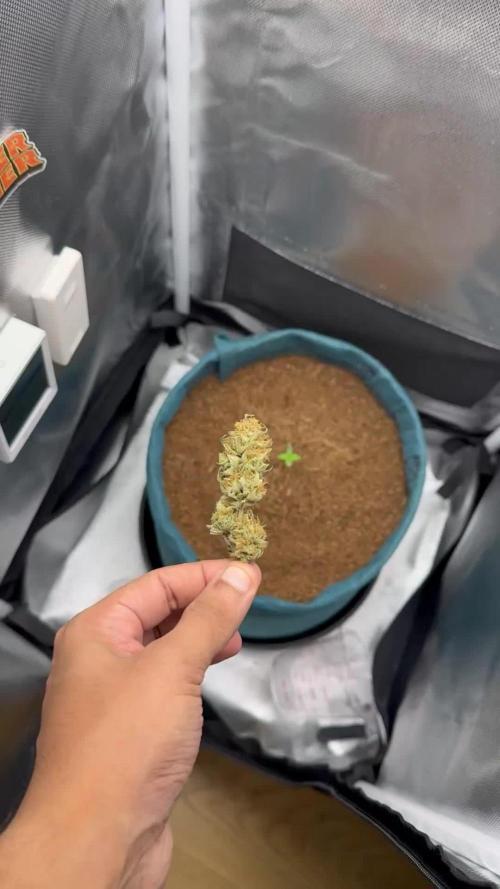
Good start to the grow. The seedling has emerged and is developing its first leaves. I’ll continue documenting its progress.


Likes
2
Share


@DogDoctorOfficial
Follow
💙 8×8 Adventure – Week 14 🌿
Blueberry Muffin – Pheno A
❤️ Seeing Red Before Bed — Beautiful Flowers, Slow Motion, and a Little Light Science
Welcome back to another chapter of the 8×8 Adventure! 🌱💚
And our little Blueberry Muffin is still doing her thing.
Beautifully.
Slowly.
And, apparently, in absolutely no hurry whatsoever.
😂💙
Seriously, girl...
Could we perhaps pick up the pace a little?
Just a little?
No?
Okay. Fair enough. 😂
The funny thing is that while she may be slow as fuck compared with some of the other girls in this room, I really cannot complain about what I'm seeing.
The colours are beautiful.
The flower structures are beautiful.
The overall development is beautiful.
And she's still evolving.
That's the important part.
We're not seeing a plant that has simply stopped doing anything. We're seeing a plant that continues to develop, but follows a much slower timeline than many of her neighbours.
And it's not just Pheno A.
Both Blueberry Muffin sisters are taking their sweet time compared with much of the 8×8 Adventure.
Same room.
Same general environment.
Same lighting ecosystem.
Same overall nutritional approach.
Yet these girls are clearly following their own clock.
😂💙🌸
So, this week, we're not making dramatic changes.
Actually, we're not changing anything at all in the general setup.
We're continuing to observe, document, and let the plants do their thing.
But we do have something interesting to talk about today:
❤️ Red light at the end of the lighting period.
And, because I love understanding what happens behind the scenes, we'll also have a quick look at the science behind the Emerson effect.
Let's get into it!
────────────────────────
💙 STILL SMALL, STILL BEAUTIFUL, STILL MOVING
Blueberry Muffin Pheno A continues to look beautiful.
And that's what I want to focus on this week.
Not her height.
Not how quickly she's progressing compared with the others.
Not whether she should already be somewhere else in her flowering journey.
Let's look at the actual plant.
The colours.
The flowers.
The structure.
The details.
Because there's plenty to appreciate.
Her flowers continue developing, and the overall structure is looking lovely. There's a visual character to this girl that I really enjoy, and the photographs help show it much better than simply looking at her from across the room.
She's compact.
She's taking her time.
But she's still giving us something beautiful to follow.
💙🌸✨
And honestly, that's what these diaries are about.
We're documenting the plant we have in front of us, not the plant we imagined we'd have when we started.
────────────────────────
🐢 THE BLUEBERRY MUFFIN SISTERS ARE IN SLOW MOTION
Let's be honest for a moment.
😂
These two girls are slow.
Not just a little slower.
Compared with much of the room, they're moving in their own time zone.
While some of the other plants seem to be racing through their flowering development, the Blueberry Muffins are taking the scenic route.
And yet, both are still evolving.
That's an important distinction.
Slow development doesn't automatically mean something is wrong. Different genetics and phenotypes can follow different timelines, and the environment being shared doesn't make every plant develop at the same speed.
That's one of the things this project keeps reminding me.
We can create a shared environment, provide consistent care, and observe the differences.
But we cannot expect every plant to read the same calendar.
😂💙
The Blueberry Muffin sisters clearly didn't get that memo.
And that's fine.
We're watching their actual development rather than trying to force them to match the faster plants.
────────────────────────
🌸 THE COLOURS AND FLOWER STRUCTURE ARE BEAUTIFUL
This is where I really want to give her the spotlight.
Because when I look at this girl, the first things that catch my attention are the colours and the flower formation.
There's something very satisfying about seeing a plant continue to develop while maintaining such a beautiful overall appearance.
The flowers have their own character.
The structure is interesting.
And the photographs capture little details that can easily be overlooked when you're checking the room quickly.
📸💙
This is also why I like keeping individual phenotype diaries.
If we only looked at the room as a whole, it would be easy to focus on the biggest plants or the fastest-moving ones.
But that would mean missing some of the interesting details happening elsewhere.
Blueberry Muffin might not be winning any speed competitions.
😂
But she's still worth looking at.
She's still worth photographing.
And she's absolutely worth documenting.
────────────────────────
🌱 SAME ROOM, SAME CARE, DIFFERENT CLOCK
The 8×8 Adventure continues to demonstrate one of its central ideas.
Different plants can respond differently even when they're sharing the same general growing environment.
We're not creating a separate room or an entirely different program for every phenotype.
We're observing individual plants within a shared setup.
The Blueberry Muffin sisters are a good example of why that matters.
They are moving more slowly than many of their neighbours, but they're still developing.
That difference is part of the story.
And rather than treating it as something that must be corrected, I'm interested in documenting it.
The plants don't have to be identical to make the experiment interesting.
In fact, the differences are precisely what make it interesting.
💙🌿
────────────────────────
💡 THE LIGHTING SETUP — NOTHING NEW THIS WEEK
We're keeping the lighting setup unchanged.
The Future of Grow Black Series LEDs remain the main lighting system in the room, with the two additional Black Series 600W fixtures still contributing to the upgraded setup.
After adding those fixtures, we reduced the output to approximately 59% from the plug rather than simply running everything at maximum.
Our working reference remains around:
☀️ Approximately 1,500 PPFD across the upper canopy.
Actual intensity varies with plant height and position, of course.
And Blueberry Muffin Pheno A continues to share this lighting environment with the rest of the room.
No special lighting arrangement just for her.
No dramatic changes because she's slower.
The setup remains the same, and we're continuing to observe how each plant develops within it.
A huge thank you to Future of Grow for supplying the additional fixtures and giving us the opportunity to explore the capabilities of this lighting setup. 💡🙏
────────────────────────
❤️ RED LIGHT BEFORE BED — A NEW LITTLE DETAIL
Now let's talk about the red lights.
One of the things we're doing at the end of the lighting period is giving the room an additional 15 minutes of red light after the main lighting period.
The idea is to explore how this end-of-day lighting treatment fits into the lighting routine.
And because this is a topic that often gets discussed in growing communities, I want to separate what we know about plant light responses from what we might hope to achieve with a particular setup.
🌱 Plants don't simply experience light as bright or dark.
They respond to different wavelengths, and those wavelengths can influence different physiological processes.
Red and far-red light are particularly relevant to the way plants perceive their light environment and regulate responses associated with the day-night cycle.
But there's an important distinction here:
**Red light and far-red light are not the same thing.**
A red LED treatment isn't automatically equivalent to a far-red treatment, and the exact response depends on the wavelengths involved, the intensity, the duration, and the plant's condition.
So, for our 15-minute red-light finish, I'm treating it as an additional part of the lighting routine that we're exploring, rather than claiming it will automatically produce a specific result.
❤️💡🌱
────────────────────────
🔬 QUICK SCIENCE BREAK — WHAT IS THE EMERSON EFFECT?
Time for a little science!
😂🔬
The Emerson effect comes from research into photosynthesis.
In simplified terms, researchers found that when plants were illuminated with certain combinations of red light and far-red light, photosynthetic activity could be greater than expected from the effects of the two wavelengths used separately.
This helped scientists understand that photosynthesis involves two cooperating photosystems:
🌿 Photosystem II (PSII)
🌿 Photosystem I (PSI)
These systems work together in the photosynthetic electron transport chain.
The classic Emerson enhancement effect is associated with the complementary contribution of different wavelengths to the two photosystems, particularly when red and far-red light are combined under the appropriate conditions.
In other words, the wavelengths can complement each other.
That's the interesting part.
But here's where I want to be careful.
The Emerson effect is **not simply another name for giving plants 15 minutes of red light after the main lights switch off**.
And it doesn't automatically mean that a short red-light treatment at the end of the day will increase growth, improve flower development, or make a plant finish faster.
Those outcomes depend on the actual light spectrum, intensity, timing, and plant response.
The classic effect concerns photosynthetic activity under particular illumination conditions. An end-of-day treatment is a different lighting scenario, and we shouldn't assume the same result without evidence.
So, yes, the science is fascinating.
But we shouldn't stretch the explanation further than the evidence allows.
🔬💡🌱
────────────────────────
❤️ SO, WHAT ARE WE TRYING TO ACHIEVE WITH THOSE 15 MINUTES?
For this run, we're adding a short red-light period after the main lighting period.
The important thing is to be precise about what we're saying.
Red light can influence plant photoreceptors, including phytochromes, which participate in sensing the light environment.
However, the effect of a red-light treatment depends on its spectrum and timing, and red light alone does not guarantee that the plants will interpret the treatment as a signal to enter darkness or "go to sleep."
The transition into the dark period involves a broader set of plant responses.
So I like the idea of exploring an additional end-of-day lighting treatment, but I'm not going to claim that those 15 minutes automatically improve the plants' sleep, boost yields, or trigger the Emerson effect.
That's not how good experimentation works.
We try something.
We understand what it is intended to do.
We keep track of the setup.
And we avoid turning a plausible explanation into a guaranteed result.
💚🔬
That's how I prefer to approach new ideas in the grow room.
Curiosity first.
Evidence always.
And no magic claims.
😂🌱
────────────────────────
🌙 THE LIGHTS GO OUT — AND THE PLANTS CONTINUE THEIR RHYTHM
The plants' dark period remains an important part of the overall lighting cycle.
For our 12/12 setup, the main light schedule continues unchanged.
The additional 15 minutes of red light is a separate finishing period after the main lighting period, not a reason to assume that the plant's normal night-time responses can be reduced to one simple switch.
Plants have internal rhythms and respond to changes in their light environment.
The spectrum matters.
The timing matters.
And the conditions surrounding the treatment matter.
That's why I want to document what we're doing accurately rather than simply repeating something we've heard.
We're experimenting with the lighting routine.
We're observing the plants.
And we're keeping the rest of the setup stable.
That gives us a much clearer picture of the overall run than changing multiple variables at once.
────────────────────────
🌿 SAME NUTRITIONAL PROGRAM — NO CHANGES
And on the nutritional side?
Nothing new this week.
We're keeping the current program unchanged rather than making adjustments simply because the Blueberry Muffin sisters are progressing more slowly than the others.
The current recipe remains:
🌱 Plagron Pure Zym — 1 ml/L
⚗️ Plagron pH Plus — 0.03 ml/L
🍋 Plagron Lemon Kick — 0.03 ml/L
🌸 Plagron Terra Bloom — 2 ml/L
🌱 Plagron Power Buds — 1 ml/L
🍯 Plagron Sugar Royal — 1 ml/L
🌿 Plagron Green Sensation — 1 ml/L
We're keeping the nutritional approach consistent with the current room program.
No sudden changes.
No attempts to force a faster timeline.
And no assuming that a slower phenotype necessarily needs a different recipe.
The plants are still developing, and we're continuing to observe their individual responses.
────────────────────────
🌡️ WEEK 14 — ROOM OVERVIEW
🌸 Flowering: Week 14
💡 Main lighting schedule: 12/12
❤️ Additional end-of-day red-light period: 15 minutes
💡 Lighting system: Future of Grow Black Series LEDs
⚡ Fixture output: approximately 59% from the plug following adjustment
☀️ Upper-canopy PPFD reference: approximately 1,500
🌱 Pot size: 15 L
The overall room setup remains unchanged this week.
We're keeping the environment and general care consistent while observing the differences between the plants.
────────────────────────
😂 THE GROWER IS NOT TRYING TO MAKE HER WIN A RACE
I think this deserves its own section.
Because sometimes it's tempting to look at a slower plant and start wondering what we should change.
Should we do something different?
Should we push harder?
Should we change the environment?
Should we try to make her catch up?
And sometimes, those questions are absolutely worth investigating.
But not every difference means that something needs fixing.
Blueberry Muffin Pheno A is still developing.
Her flowers are beautiful.
Her colours are beautiful.
And she continues to show us her own rhythm.
So I'm not going to change the whole approach just because she's slower than some of the other girls.
She's not competing against them.
She's not trying to win the 8×8 Olympics.
😂💙
She's simply growing.
And we're letting her do that while continuing to observe what happens.
────────────────────────
📸 THE CAMERA STILL HAS A JOB TO DO
One of my favourite parts of this project is looking back through the photographs.
Because individual images capture moments that can be difficult to appreciate when you're standing in the room.
A particular flower.
A change in structure.
A different colour.
A new detail.
And with the Blueberry Muffin sisters, those comparisons are especially interesting because their progress is slower than much of the room.
That gives us a chance to document their development over time rather than rushing toward a conclusion.
I want to see how their flowers continue to change.
I want to see what their individual structures look like as they progress.
And I want to keep those records so that we can compare the actual journey later.
That's what these diaries are for.
Not just the final result.
The whole story.
💙📸🌱
────────────────────────
💙 FINAL THOUGHTS — SLOW AS FUCK, BEAUTIFUL AS EVER
Week 14.
Blueberry Muffin Pheno A.
And she's still doing her thing.
😂💙
We're not changing the setup this week.
We're not changing the general nutritional approach.
We're not trying to force her to catch up.
The Blueberry Muffin sisters are both moving more slowly than much of the room, but they're still evolving.
And the colours?
Beautiful.
The flower structures?
Beautiful.
The development?
Still happening.
So we're going to keep observing.
We're going to keep documenting.
And we're going to let these girls follow their own timeline.
We've also added that 15-minute end-of-day red-light period to the lighting routine, and we've taken a moment to discuss the science behind red light, far-red light, and the Emerson effect.
Because I enjoy exploring these things.
But I also want to be honest about what they mean.
The Emerson effect is a real photosynthesis phenomenon involving complementary contributions from different wavelengths under suitable conditions.
It isn't proof that a short red-light treatment after the main lighting period will automatically improve the plants' performance.
And that's okay.
We don't need to make extraordinary claims to find the science interesting.
We can experiment.
We can observe.
We can learn.
And we can let the results speak for themselves.
💡🔬🌱
As for our little Blueberry Muffin?
She's still slow as fuck.
😂💙
But she's beautiful.
She's developing.
She's giving us something worth documenting.
And she absolutely deserves her spotlight.
So let's keep watching.
Let's keep learning.
Let's keep appreciating the differences.
And let's give this girl the time she needs to finish writing her story.
💙🌸✨
────────────────────────
🙏 THANK YOU
A huge thank you to Zamnesia for the Blueberry Muffin genetics and for giving us the opportunity to follow these individual phenotypes throughout the 8×8 Adventure. 💙🌸
Thank you to Plagron for supporting the nutritional side of the project. 🌱
A big thank you to Future of Grow for the Black Series lighting and for supplying the additional fixtures that have expanded the lighting capability of the room. 💡🙏
Thank you to LumiFlora for helping illuminate the deeper parts of the canopy.
Thank you to TrolMaster for helping keep the environment stable behind the scenes.
And, of course, thank you to everyone following the journey on GrowDiaries.
Every comment, every question, every observation, and every person taking the time to follow these girls means a lot.
And to Blueberry Muffin Pheno A?
Keep doing your thing, little lady.
Keep evolving.
Keep showing us those beautiful colours and flowers.
Take your time.
We're watching. 💙🌸
Growers Love, my friends, and happy growing! 🌱💚💙
See you next week in the 8×8 jungle...
where the faster girls keep moving,
the Blueberry Muffin sisters continue taking the scenic route,
the red lights get their 15 minutes of fame...
😂❤️
and we keep learning something new along the way.
Let's grow, observe, and let every plant tell her own story. 🌱💚💙
Likes
15
Share


@MrJones
Follow
MrJones Ztrawberriez Auto
🍓╰⊰🍓´🍓⊱╮🍓╰⊰🍓´🍓⊱╮🍓╰⊰🍓´🍓⊱╮🍓╰⊰🍓´🍓⊱╮🍓
💧 Feeding - Using Gaia Green Grow / Bloom and Compost Teas
🍃Training / LST-Defoliation-Topping TBA
🕷️ IPM - Will be using Green Cleaner" 1 OZ per Gallon, and CannControl from Mammoth alternating between products each month for Integrated Pest
🍓╰⊰🍓´🍓⊱╮🍓╰⊰🍓´🍓⊱╮🍓╰⊰🍓´🍓⊱╮🍓╰⊰🍓´🍓⊱╮🍓
▶️Saturday 11.18.23 - These girls are just blowing up, always like the flower stretch of FastBuds strains, the smells are nice and they are starting to drink more, the closet is filling up, did another PPM treatment with CanControl.
🍓´🍓⊱╮🍓╰⊰🍓´🍓⊱╮🍓╰⊰🍓´🍓⊱╮🍓╰⊰🍓´🍓⊱╮🍓
▶️Bud Description Ztrawberriez Auto produces long and fat buds with a beautiful light green shade with oftentimes purplish hues and a thick layer of resin that starts at the top of the flowers and continues all the way to the tip of the sugar leaves. It’s the typical bud structure you would expect from hybrid varieties topped with an explosion of fruity terps that’ll hit you in the face with a blend of creamy, fruity, and sweet aromas as soon as you break the buds open. Definitely a must for terp heads and extractors looking for exaggerated flavors and aromas
🍓╰⊰🍓´🍓⊱╮🍓╰⊰🍓´🍓⊱╮🍓╰⊰🍓´🍓⊱╮🍓╰⊰🍓´🍓⊱╮🍓
▶️SOIL MIX
40% ProMix HP
40% Coco Coir 70/30
15% Worm Castings
05% Malibu Compost
🍓╰⊰🍓´🍓⊱╮🍓╰⊰🍓´🍓⊱╮🍓╰⊰🍓´🍓⊱╮🍓╰⊰🍓´🍓⊱╮🍓