


Likes
Comments
Share


@Maven26
Follow
I pinch and twisting the stems. Bending them gently and use 90 degree plastic bending guides found on amazon. They seem to train them well so far. I have added Great White Premium Mycorrihizae into my Autopots water supply (water pump inside to circulate the water)..

Likes
23
Share


@adam_pawloski87
Follow
This week has been great ,today is day 78 and the girls are just doin their thang , 1 looks ready for flush already and the rest look about another longer then flush for them aswell,, can’t wait to see how these girls finish out over the next couple of weeks 😍!! Y’all keep them eyes peeled an stay tuned for next week! Peace love an positive vibes to y’all Cheers.💨💨💨


Processing
Likes
7
Share


@x_grower
Follow
Last week plants were looking super healthy and responded very well to the second topping so I decided to flip the light schedule few days later. They already started stretching and the smell is noticeably enhanced.
Likes
Comments
Share

@Hazelmaus
Follow
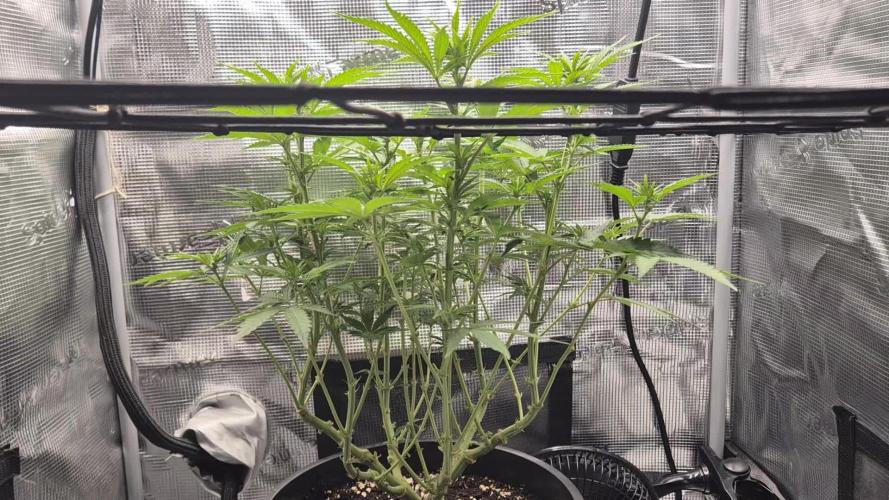
Unfortunately, I messed up a little bit with the side branches, I wanted to have them all at the same height when beginning the flowering phase.
Nevertheless, I will let them grow and try to fill as many squares as possible.
All in all she lools quite pretty imho

Likes
35
Share

@gr3g4l
Follow
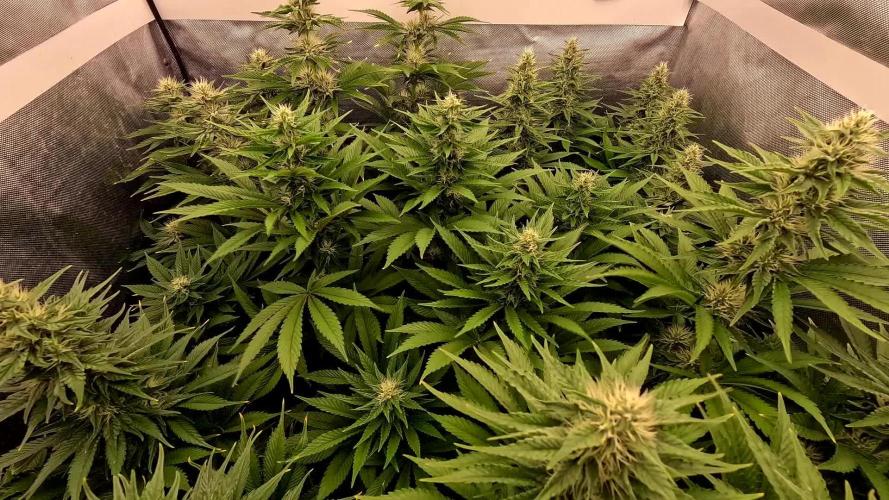
A week of noticeable bud fattening, lower leaves starting to dry out, loss of color, and very slow growth.
The smell also intensified considerably.
A week in which they began to show signs of nutrient overload, and I had to reduce the bloom dosage.
Una semana de un notable engorde de los cogollos, hojas bajeras que empiezan a secarse , perdida de color y un crecimiento ya muy lento.
El olor también aumentó considerablemente.
Una semana en la que empezaron a mostrar un exceso de nutrientes y me tocó rebajar la dosis de bloom.

Likes
37
Share


@PapaNugs
Follow
A great second week here as the girls stabilize. They got watered two times this week. All good growth. 📈
This girl is also doing real well. Not much to note cause all is on track currently!!
Dimmed to 40%
Here are the lights details:
Medic Grow Mini Sun-2 150W LED
Model: MN150-022
Spectrum mode: V1
Efficacy: 2.8 umol/J
Thanks for stopping by!
You can find the light on Grow Diaries:
https://growdiaries.com/grow-lights/medic-grow/mini-sun-2-150-watts
You can find the light on Medic Grow's website:
https://medicgrow.com/


Likes
22
Share


@donovanliam
Follow
Love the amount of growth. Pruned a bit just to let light in but i cut as little as possible. If anyone has any suggestions of what to do or if you think im doing something wrong please tell me. This is only my 3rd plant ever so i have alot too learn and dont mind criticism

Likes
11
Share


@Spectrabox360
Follow
This week gonna ad plagron bloom. 2.5ml
With plagron grow 5ml and plagron roots 1ml.


Likes
246
Share


@DogDoctorOfficial
Follow
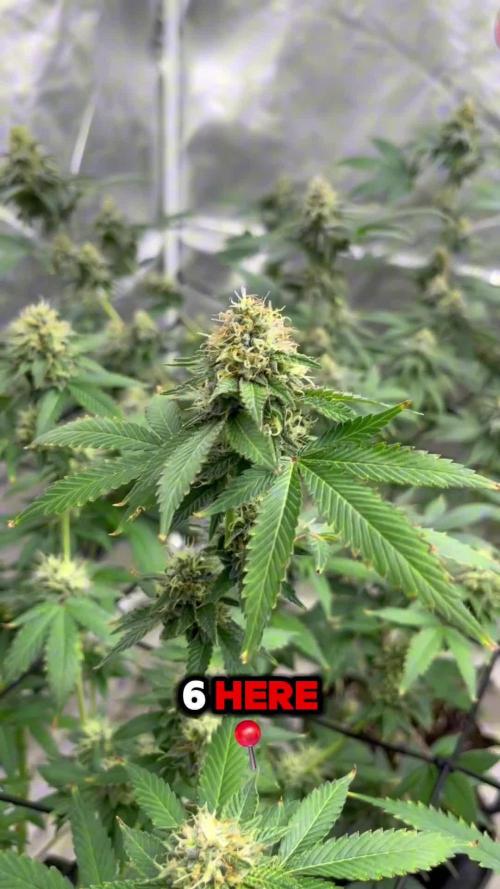
And the time for Le Madame Freak Le Chick to come down as arrived!!! This was a wild ride , super emotional and repleted with amazing views, i totally advise everyone to try and grow this wild card , she is a treat and a blessing in our lives
As always thank you all for stopping by , for the love and for it all, i fell blessed to have you all with me for one more love journey, and a different one form the rest i did so far <3 <3 <3 Thank you Thank you Thank you , you guys are great and have been amazing , thank you for everything <3<3<3
#aptus #aptusplanttech #aptusgang #aptusfamily #aptustrueplantscience #inbalancewithnature #trueplantscience #dogdoctorofficial #growerslove
With true love comes happiness , Always believe in your self and always do things expecting nothing and with an open heart , be a giver and the universe will give back to you in ways you could not even imagine so <3 <3 <3
<3 <3 <3 Growers love to you all <3 <3 <3
Here are the words from this peace of art from nature creator Shapeshifter's @ HI-ELEVATION GENETICS <3 <3 <3
"FREQUENTLY ASKED QUESTIONS
Q. How did you create/breed Freakshow?
A. Methodical selection, line breeding, and culling is the short answer. Read our About page for more details.
Q. Is it an indoor or outdoor type?
A. Everything I've ever worked has been outdoors, including of course Freakshow. It has been our experience that outdoor (or sun grown, as it's recently being referred to) cultivars seem to perform extremely well under artificial conditions. This is true of seed starts or clones made from seed starts. The opposite is not always true; indoor clones often give an outdoor grower headaches because they don't always make the transition smoothly. This is due to light spectrum, temperature, and/or photoperiod changes. Yes, Freakshow will do exceedingly well indoors, and will thrive and mature just fine in a wide variety of natural environments as well, so it's definitely both and I think might even prove to be more resilient to those sorts of transitions.
Q. What are the potency and terpenoid levels?
A. Average 18-20% THCa, THC; negligible CBD, CBN with terps variable, averaging 2.5-3.5, primarily limonene and pinene, but this is variable, there was a lot of diversity in terp combinations and compositions in all the prior generations, it's just something that was left "as is" for now. The different parallel lines that we are developing can be directed in a few different pathways flavorwise.
Q. Why are the seeds white?
A. Why is the sky blue? No, the mature seeds are shrouded by a rice paper thin membrane which has coloring and mottling on it, but it's so fragile that it disintegrates in the process of shucking. Stripped of the outer layer the seeds are very pale, nearly white. It came as no surprise that this plant would have abnormal seeds.
Q. Is it a GMO?
A. Wow...? Well, it's seriously "modified" and the modifications are definitely genetic, and it is an organism. (Genuinely Modified Organically!) Uh, no. No radiation, no recombinant DNA, no gene splicing or editing, no TALEN or CRISPR! These biotechnologies don't belong in the food and medicine plant industries. Sadly, in the near future it will become commonplace and widespread in cannabis and other medicinal plants as it is already is with food crops and ornamentals. I'll avoid discussion on this topic for now, but we hope some people enjoy consuming Frankenbud!
Q. What's the floral period length?
A. 8-9 wks, finishes early Oct. at most latitudes and elevations.
Q. Is it a big producer?
A. Freakshow will produce nice, fat, dense colas (see gallery) with remarkable trichome coverage, and you can expect yields according to your veg. time, root space, and general knowledge and expertise as a gardener. The same set of variables apply to expected outcomes regarding cannabinoid levels and terpene profiles.
Q.What is the lineage?
A. (Bigbud x Skunk#1) x (Big Sur Holy Weed x Banana Kush). NLD("Sativa") dominant, but the afghanica influence is apparent. I'm pretty sure that Freakshow contains some Trainwreck and some Maui Wowie based on some research I did on the origins of the Pineapple Express. Interestingly Big Sur Holyweed, OG Kush, Banana, Trainwreck, and Maui Wowie are all of unclear origins. We have to remember that these are all just names and that they don't really mean much. The exact heritage of any cultivar today is impossible to determine accurately. Also, considering the amount of continuous shameless hybridization that has occurred in the last 40 yrs., any modern kind could easily contain over 40 kinds. In the case of Freakshow, it's much more limited because the ancestry is largely older "Sativas" that didn't go through as much outcrossing. In the 70s in Santa Cruz, Haze was a favorite among surfers for the pure energy and I still have (greatly improved) stock of it around, simply because even when I made hybrids with it I always kept the original in pure form for obvious reasons.
Q. What is the psychoactive effect like?
A. Like the flavors, many people have commented that the "buzz" is somewhat different than other mainstream types out there. It's not entirely out of the scope of imagination that given that this strain has new alleles in so many other respects, that it could also contain new, unique cannabinoids, as well as new and unique terpenoids, some of which may not even be among the standard 16 or so that the average lab is testing for. Aside from the up, cerebral, energetic boost, some report a mild time/space warp effect. Creativity and idea induction should be mentioned, for sure. Freakshow has the pure energy effect and greatly alters perception to the positive side, so definitely destroys depression. Appetite suppression is a side effect, but the enjoyment of food is enhanced. I personally will attest to all of the above. We all have different receptor profiles, so these are just generalizations. Couch unlock.
Q. Is it pest and mildew resistant?
A. Indeed it is. On many occasions in the last few years, it has been observed that when pest and mildew issues were affecting other plants adjacent to in the vicinity of Freakshow plants, for unknown reasons the freaks remained entirely unaffected. This includes 0botritis, PM, various mites and insects, soil fungus, etc. We haven't heard any complaints along those lines so far, so if anyone has any problems, especially with a rigorous IPM regimen in place, we would like to hear about it. And if anyone can attest to the extreme level of resistance it seems to have we'd love to hear about that as well.
Q. Does it contain web-leaf genetics?
A. I thought I better clarify this because there are a few people thinking that because of an article "Growing Marijuana that Doesn't look like Marijuana" that mentions that I had worked web-leaf types years ago and had eventually turned that into Freakshow. This is incorrect and I'm needing to get ahold of the writer to have him change it. When I read the piece and saw the mistake I figured it didn't matter that much, that the actual method of breeding could just remain a "trade secret". Recently, I noticed online that a posting, "Freakshow only exists because of duckfoot" by Curious Cannabis Connoisseur, where he explains how I developed Freakshow using Duckfoot. Let me explain, about 20 yrs. ago a friend gave me a jar of seeds labeled "BC Bigbud" and I sprouted flats of hundreds to look for oddities and had found one web-leaf pheno which we named Webster. It was a female so I bred it to a normal leaf male and began selecting and stabilizing a line of Webster. About 5 or 6 generations later I had nailed it to 100% webs and had also stabilized it for a deep purple color and a nice "gingerbread" terp profile. I was busy working other lines at that point so I put Webster in the library. Also, I was having a hell of a time getting a pheno of it that flowered to my satisfaction. (it seemed to finish with a limited number of calyxes). I knew I would have to outcross it to something with a big tasty bud and restabilize it for web-leaf, and I no longer had the original BC Bigbud. I still have the Webster seeds, and trust me the thought has crossed my mind to make the cross with Freakshow, but why? Why mess around crossing things just to create something even weirder? I have heard that the "Duckfoot" also doesn't bud up well so maybe there's a correlation there. Anyway, people can do what they want to and I will too, but crossing Freakshow with some low-THC crap like ABC is in my opinion idiotic. I worked extremely hard stabilizing and perfecting a beautiful new subspecies and I believe it should be kept pure. I won't go on a rant here about the rampant crossing and the lack of line-breeding in the cannabis world in the last several decades, or where this will eventually lead us, but I will say that it's not in a good direction. Bottom line....Freakshow has no web-leaf genes, it was made using top-grade tropical narrow-leaf drug (NLD) cultivars.
Q.Why is Freakshow patented?
A. Although I and most others (including all the folks at HSC) believe in and subscribe to the concept of "open sourcing" because sharing in cannabis genetics was always the cultural norm, it was decided that Freakshow should be protected (1) because it is a novel and unique, not a preexisting strain (or even subspecies), (2) To keep the greedy corporate big boys from exploiting it, (3) To maintain control of the genetic refinement of it in all future generations. We really can't wait to share it with the entire collective world of cannabis enthusiasts and invite experimental breeding for personal use and curiosity."
source https://freakshowcannabis.com


Likes
Comments
Share

@BlackBear833
Follow
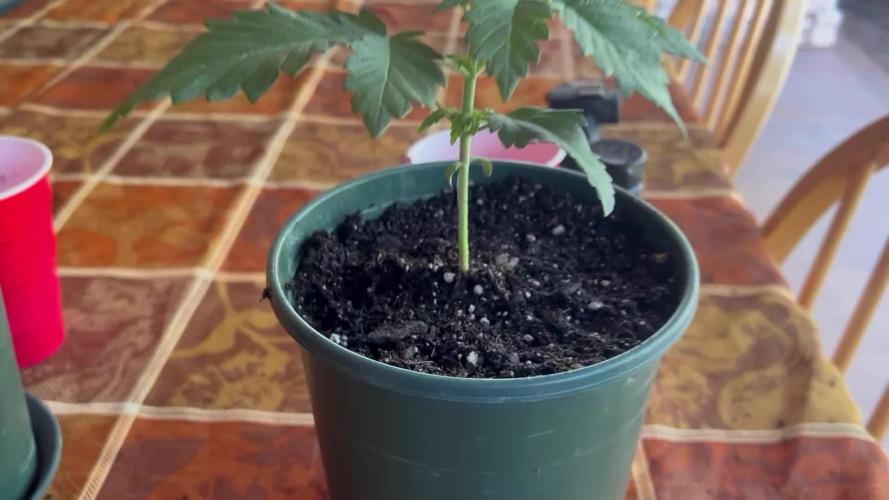
After three weeks in the solo cups I transplanted to 1 gallon pots and three days later I noticed yellowing on one of the plants so in 16oz of water I mixed in 1/4 tsp of Epsom salt and gave it to both plants in fear of magnesium deficiency but the other plant is thriving and growing strong. YouTube video:
Likes
59
Share


@JeyGanesha
Follow
Grower, ancora non l'ho provata.ma sono sicuro che è più che valida...vi farò sapere quando sarà pronta
Likes
13
Share


@Grownewgenetics
Follow
These week we see a big bud evolution, they're strong and healthy, i can not wait to tryout more strains from SweetseedS.
The p.p.m is also a little more higher than the last week because we add 2 ml. Of biobizz biobloom on our weekly feeding and all ready for the 3 week of flowers
Likes
7
Share


@Naujas
Follow
it's a pity, but the weather is not spoiling us, this week the girl has seen very little sun :( despite everything, she is growing a little bit, from next week she promises better weather :) well, this is just a test, so I don't expect a harvest of more than 10 gr :D so everything is fine :).

Likes
10
Share


@CANNASIM
Follow
We are at week 3 now. A lot of development, i have not used liquid nutes this week, it is raining a lot so no water needed, thus no liquid nutrients.
I have top feed of dry nutrients mix, basically a mixture of a super soil recipe that usually is used within to make a hot soil:
I mix all tue ingredients together and use it gradually about 40g as a powder, in the top of the soil.
- Azomite 500g
- Natural fosfate 500g
- Biochar 1kg
- Bokashi 1kg
-Kelp meal 500g
-Mamona meal 1kg
-chicken meal 1kg
-Potassium silicate 500g
-Gypsum farm 500g
-Diatomaceous earth 500g
Mix all keep it in a soil bag, this pure mix and use it once every month.
The companion plants have emerged and will protect the soil humidity mainly.


Likes
3
Share


@Barcelona_Farmers710
Follow
Esta semana los pelos de los cogollos empiezan a formarse,la resina ya es visible. siempre publico a final de semana para que se note mas la diferencia entre semanas, espero que os guste Farmers! Buenos humos y buen finde semanas para todos!💚
Likes
3
Share


@Kern420
Follow
Woche über haben sich die Blüten weiter entwickelt. Die Trichome wurden mehr und man fängt an erste Terpene zu riechen.
Wir haben Donnerstag (BT 2) stark entlaubt und schauen jetzt wie die Pflanzen wachsen.
Papaya entwickelt die dicksten Buds bisher und allgemein ist sie der OG G.O.A.T