


Likes
Comments
Share


@HighZenBerg
Follow
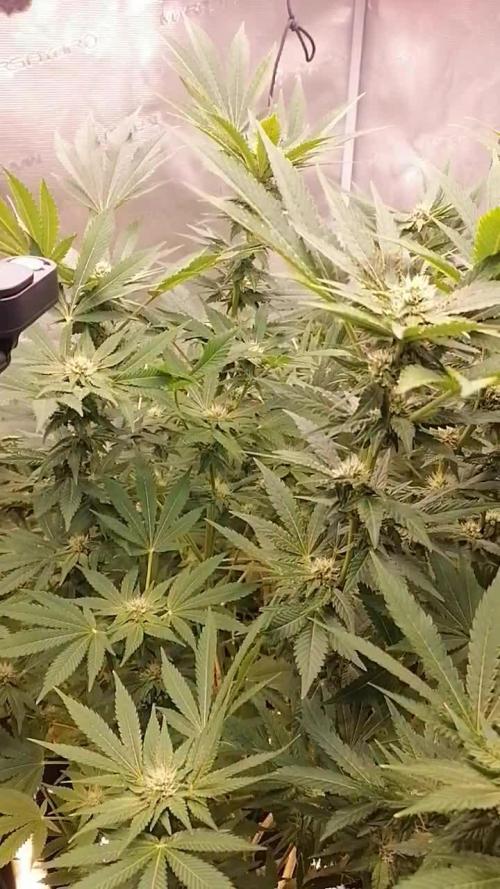
Start of week 8 and the lady developed nicely. Buds are getting more compact. Leaves are already frosty.
First leaves getting light green, yellow. I will feed the lady with BioBizz nutrients to see, how she will develop.
Harvest getting closer and the first pistils get brown. I think 3-4 weeks left.
Keep in touch !
Cheers,
HighZenBerg

Likes
40
Share


@Dingle
Follow
The girls look to be finishing the vegetative growth phase this week and are starting to switch full steam ahead into flower production ☺️☺️
Trichomes are also starting to form now and the smell is getting slightly stronger each day.
Not much to be done this week just some defoliation and training to help open up the canopy’s.
Peace ✌️

Likes
7
Share


@StickyFingah420
Follow
Se acerca el fin para esta hermosa LCC, los tricomas están casi en el punto justo y la cenecencia se logró con éxito, ahora solo esperar un poco más y estaremos cosechando con casi 76 días desde que salió a la superficie 🤓

Likes
7
Share
@Cannarotic
Follow
The scent is becoming noticeable throughout the whole room.
It’s kind of like very ripe banana and… fresh sweat. But not in a disgusting way. It actually reminds me of a gym after someone had a banana protein shake 🍌💪
That’s just my personal perception — I can’t describe it any better 😜
A calcium deficite has been spottet 😢
Likes
51
Share


@felixthegrower
Follow
Well, it was my first diary here, and I'm really happy to had found this amazing community that is so eager to help!
It gave me the opportunity to win the first giveaway in my life 😂 And it was from RQS! These seeds are in my new grow diary, and I really thankful for all the gift received! A special thank to Pol from the RQS staff!
A special thanks to everyone who watched me grow here, and I hope to contribute with the community more and more!
Likes
6
Share

@Pblc_10
Follow
03.12.25
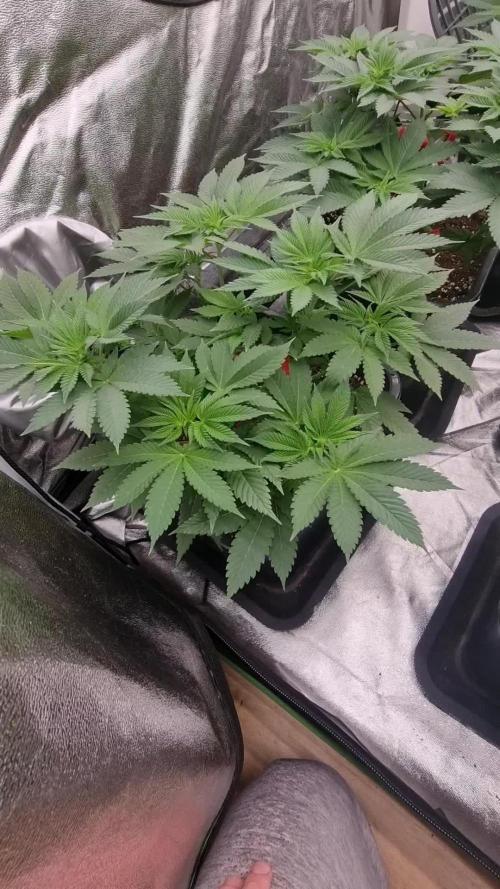
Die Mädels stehen richtig gut da. Alles wirkt gesund, gleichmäßig und schön kompakt. Im Schnitt sind sie jetzt bei etwa 25 cm angekommen. Das Topping und das LST haben sie ohne Probleme mitgemacht. Die CO₂-Bags hängen seit ein paar Tagen drin.
Vor zwei Tagen gab’s nach dem Umtopfen das erste Mal Dünger, was sie gut wegsteckten. Beim nächsten Gießen gehe ich auf ungefähr 80 % vom Schema. Mein Leitungswasser ist zurzeit etwas hoch im pH (zwischen 7.2 und 7.9), deswegen muss ich inzwischen regelmäßig mit pH-Down korrigieren.
Ich lasse sie noch ungefähr eine Woche in der Vegi und schicke sie dann in die Blüte darauf freue ich mich schon am meisten.
06.12.25
In 2 Tagen gibt's nochmal Dünger ansonsten passiert nix weiter und wenn alles passt gehen sie am 13.12 in die Blüte
Hat zwar doch ne Woche länger gedauert als geplant aber ich bin optimistisch das es sich lohnen wird nochmal 7 Tage zu warten👍
Verbesserungsvorschläge sind erwünscht ✌️🍀


Likes
29
Share


@theo_b65
Follow
Start of week 4, she’s not stretching like I thought she would but she’s healthy no nutrient burns or adversity of any significance. Topped her in week 3 with success. I took a risk and transplanted her into a bigger pot on day 30. Seemed shocked at first but is now thriving ... onto week 5.


Likes
7
Share


@OwlGang_Uk
Follow
Gorilla Glue #1 - Harvest Comment - I Am Very Satisfied With What I Got, I got 3 ounce 7 grams - I Uses Advance Nutrients PH perfect In veg then I switch to the iguana juice organic juice for the flowering stage. I notice a much more slower growth when I switch to organic nutrients.00
Likes
1
Share

@smoking_hills9
Follow
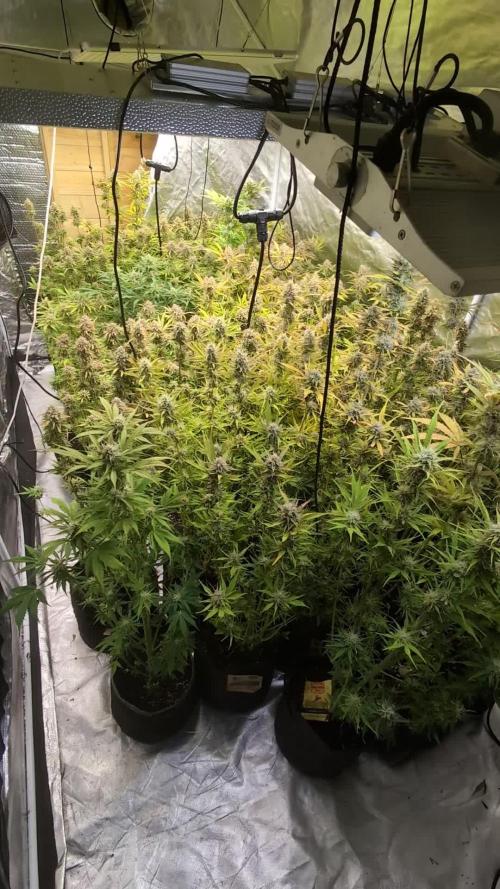
These cali genetics are blowing my mind 🤯 super sticky, very frosty rock dence buds with extra strong smells. All 3 strains are 10 out of 10, very impressed. Done last defoliation few days ago, preparing for the harvest so it's much easier. Stalks are super fat, same as buds.
Got big surprise from Atami, plant food, and many extras. Crazy. Thanks a lot guys. 💚 Start adding you Bloombastic food already. They love it. Smell is mad. I think most of plants ready in week or so.


Likes
13
Share


@Krautbauern
Follow
As you can see at the beginning of the video, the Gorilla Punch was infested with spider mites at the end. I sepereted her directly outside the greenhouse.
High time to harvest them before something worse happens…
After 67 days in total from seed to harvest she got cut off👨🌾
it is dried in a cardboard box in the cellar at about 20 degrees
Because of the spider mites there were some rotten buds, maybe 2-3g i have to cut off. It was definetly the smallest plant of them all. The bud rot is caused by the plant herself... nearly every bud was produced directly at the stam buds directly at the stam.
Likes
45
Share


@tresplantes
Follow
All at all really nice plant with beautydull colors at the end the smell during flower is unbeleavable Sweet im sure this is the right seed for a Pheno Hunt there are bangers hidden 100%


Likes
56
Share


@Grey_Wolf
Follow
For Whom the Bell Tolls
Greenhouse Seeds The Church CBD
1 week since Germination
11th April 2020
Well she's up and away this CBD version of the Church is looking nice and Healthy .😀👌
Whilst all of my flowering girls hate this humidity we are having , the little seedlings Love it 😎
Will give her a 1/4 strength feed today of some Organic Grow nutes.
That is all for this week thanks For stopping by 👍
Likes
5
Share


@diversiv0
Follow
The plant grows at fast speed with no issues. I keep defoliating once/twice a week and the foliage is always fast in growing back and branches too. I adapt LST daily to make sure light reaches all of the buds that are now clearly visible and more and less evenly distributed. I could not have the main one at the same height because it is too close to the border of the vase. I am not sure why the ph of the soil is around 7/7.5 while before watering i always regulate the ph to be 6.4/6.5 and the soil itself is 6.5 by default. What are the factors that increase the ph?
Likes
16
Share


@DonKrika
Follow
No problems this week, plants growing extremely well.
I got a new TDS meter, but unfortunately, I was not able to set up a drip system yet.
The only training I did was to defoliate the first true leaves and everything below that.
DAY 17 - Nutes
PH - 6.1
Solution Temp - 19.5
PPM-1340
Watering Volume per plant - 2L
DAY 20 - Water
PH - 6.04
Solution Temp - 19.2
PPM-570
Watering Volume per plant - 2.5L
Plant B is about 14cm Height and Plant A is about 17 cm Height.
One interesting thing that I'm seeing is the fact that Plant B continues to show signs of deformity. On the video, you can see that the right side is missing a node, this missing node corresponds to the deform leaf. Maybe they are related,
Plant A was slightly bigger from the beginning, but the node development is bigger in Plant B.
Likes
29
Share


@Prilyfe13
Follow
May 10, 2024
A new week and more flushing. Both ladies look really good. Tropicana C is way too heavy for her branches. It's good and bad. It's bad because they are flopping all over. And it shows how weak these tops are. It had to be my nutrient regimen. It's good because it shows the buds are dense and heavy.
Tropicana Cookies has significantly stronger branches and can hold a lot of weight for the size of the buds. I could just be a tight fit with all the buds up and down each top. Who knows. They are starting to lean a little bit, but not too bad.
Her buds are almost all purple top to bottom and the leaves are getting lighter and lighter throughout the plant. She's covered in trichomes. From what I can see, there's not nearly enough amber trichomes on the buds. Very soon though.
I reactivated her wick system today. Her container was about half the weight as it was yesterday. Maybe now that it's not saturated anymore, the wick system will provide what it needs. We shall see later today I think.
The lighting for some of this week will stay the same. I'm just waiting for the other 2 plants in the tent to start their flush. Then I'll drop the power down some. Most likely to a DLI of 36 mol/m²/d. We shall see. I'm also curious if it will actually do anything. They are autoflowers and light doesn't really mean much. Just as long as it's on and the right DLI, it should be fine, right? Anyway, I'll drop it when the flush starts anyway. I want to see what happens.
The environment is looking a little better. The humidity is lower at 54%, but still way too high. At least it's below 60% finally. But 54% isn't much better. The temperature is pretty good at 76° during the day and 67° at night. I still can't get it down to 66° at night, so 67° will have to suffice. However, there is about a 10° difference between lights out and lights on.
Grow System Environment:
Temp: 74.1°
RH: 54.2%
VPD: 1.29 kPa
May 11, 2024
Watering day! Last watering of the grow. I'll let them dry out from now on. It should be like 4 days before they are dried out.
Tropicana Cookies looks so close to being done. Her fade is spreading and I'm guessing another 3 days? Maybe less. There is so much more purple now. Ite absolutely beautiful. She definitely will need a trichome check daily.
Tropicana C has started showing purple finally. I'd give her another 5 days, maybe a week. I honestly cannot tell. I'll check trichomes tomorrow and every day afterward. Her buds are definitely getting heavier and some even look fatter. She's definitely not quite ready, but super close.
The light power will be dropped in a couple days down to a DLI of 36 mol/m²/d. Not much else for that.
The environment is still kind of a mess. The temp is fine at 75°, but the humidity is still high at 55%. I even got the temp down to 66°. So that's good. I'd like to keep it there for the rest of the grow. I'll also try to drop the temp during the day to help bring out more color. It will also help with keeping the temp low during the drying period.
Grow System Environment:
Temp: 73.0°
RH: 53.6%
VPD: 1.27 kPa
Update: I ended up checking the trichomes anyway, and i think I know when they will be done. Just an estimate, but I think a good one. Anyway, Tropicana Cookies should be done in about 3 days while Tropicana C should take about 5 days. I may wait and harvest both at the same time. Or in between and harvest them in 4 days.
Tropicana Cookies just needs more amber trichomes. They are almost all cloudy. Very few clear, but only about 5% amber.
Tropicana C on the other hand, has a bit too many clear trichomes and no where near enough amber. 5 days should do it. 4 might be a little early, but that might be the only option. We shall see in 4 days.
May 12, 2024
Not much going on today.
Tropicana Cookies had a soaked bottom again, so I removed 1 of the wicks. So there should be about half the water going in now. She's definitely not thirsty. So very close. Anyway, she is fading quite nicely and I think she will have a whole bunch of beautiful colors. Lots of purple and some nicely fading fan leaves. Light greens, yellows a tiny bit of red. But not there yet.
Tropicana C did not have a soaked bottom today. She never does. It just tells me she is still thirsty. Which also tells me she still has some time left. Maybe 4 to 5 days, but I may harvest her in 3 to 4 days. It all depends on how she looks.
I got some trichome pics today. Just one for each plant, but they were the best I could get so there you have it.
Anyway, Tropicana Cookies looks very close. More amber trichomes, more cloudy and much less clear.
Tropicana C still has a bit too many clear, but definitely has more cloudy. Not too many amber, but more than yesterday.
I still plan to drop the DLI down to 36 mol/m²/d in a day or two. It won't really matter, but it's still important to note. It's for the other plants in the tent.
The environment is a lost cause. I can still control the temp, but the humidity is still at 57%. I have the temp at 77°, but I think I'm going to drop it down to 74°. I don't think the humidity will go up with the temp change. And if it does, back up to 77°. I'll probably get the 74° mark, so all good.
Grow System Environment:
Temp: 73.9°
RH: 55.6%
VPD: 1.25 kPa
May 13, 2024
Not much going on today. I checked trichomes and I think I'm going to harvest when Tropicana C is done. She should be done in a couple of days. Maybe 3 to 4? Maybe less? I'm supposed to be harvesting tomorrow, but I'm not sure I will. I'll check the trichomes again tomorrow, but both are there. Just a little bit more. Not too much longer though. I have 4 more plants ready to come in like ASAP.
Anyway, the trichomes on Tropicana C are mostly cloudy now, with a few clear and more amber. Maybe 8% to 10%. Just a bit more. Tropicana Cookies is a bit further with next to no clear trichomes and the same amber as her sister. Roughly 8% to 10%. She will definitely be done either tomorrow or the next day.
So I think it makes more sense to focus mostly on Tropicana C for harvest time. I really don't want to harvest an indica too early. Not to mention, the purple is coming through really quickly for Tropicana C.
Tropicana Cookies has almost all purple buds. The very bottom of the plant still has mostly green with purple coming through just a bit. It's more like pink than purple. But the majority of the bud is green. These are the underdeveloped buds. Not even worth of popcorn I think. That stuff will become concentrate.
The light intensity will be dropped tonight down to a DLI of 36 mol/m²/d. Kind of pointless for the last couple days, but it needs to be done.
The environment is driving me crazy. I can keep the temp at 74°, but then the humidity goes up to 58%. Much too high. Even opening the tent door only drops the humidity down to 52%. I'm going to need to drop the humidity in my room down to 35% somehow and maybe I'll get below 50%. This is ridiculous.
Grow System Environment:
Temp: 74.4°
RH: 56.2%
VPD: 1.24 kPa
Update: I ordered a new dehumidifier for grow tents today. It should be here tomorrow. I'm guessing a lot of my problem with the humidity is my current dehumidifier. It barely pushes air. Cheap and well used. The new one is from Vivosun. A much more reputable company.
May 14, 2024
Trichome day! Took a couple videos. The videos are kind of crappy. I hurt my back so I'm shaky.
I removed the wick system completely from both plants. Tropicana Cookies was yet again soaked. Not as bad with just the one wick, but still soaked. Anyway, I pulled the wicks and emptied the reservoirs. Maybe that will help with the humidity. They should both be dried out in a few days. Just in time for harvest.
Tropicana Cookies looks wonderful! Her buds are nearly black, with nearly black leaves. It's the darkest strain I've ever grown. Insane. She still has a day or 2 left to go. There's trichomes, but not enough. Hopefully 2 days will do it.
Trichomes are mostly cloudy, a little bit of clear and not enough amber.
Tropicana C is right behind her sister plant in the dark purple color. Her flowers and sugar leaves are getting super dark. Fan leaves are lights ing up, but not fading. I have a feeling she is going to need longer than I have been estimating. I also have a major issue with the side branches all around the plant. They are just laying down. Buds completely facing down. The branches are also super weak. I don't understand what happened. Back to trichomes. There's like 20% clear still and nowhere near enough amber.
The lower light intensity doesn't seem to being doing anything, but I'm sure it's preserving the trichomes. Maybe even helping along the plants to finish up.
The environment is still a nightmare. The temp is still fine, but the humidity is stuck at 60% again. The humidity in my room is higher than outside. I have the door open to help drop it, but it's not helping with the tent humidity. I have no idea how environmental science works. Lol.
I wonder if I defoliate both plants a couple days early, what will happen. Wouldn't it put all of its energy into the buds and increase trichome production, like a last push? I'll research this and decided what to do by tonight.
Grow System Environment:
Temp: 74.3°
RH: 59.2%
VPD: 1.15 kPa
May 15, 2024
Nothing going on today. Both ladies are about halfway there before completely drying out. I'd say another 2 days.
I was going to harvest tomorrow, but I checked the trichomes and they still aren't there yet. Plus, I think the other 4 waiting to get in the tent still have time to veg before they overwhelm their containers. One of them is very close, but I don't think she will be a problem in the next 2 days. Plus I can always train her down.
Tropicana Cookies is starting to lean more. Her branches aren't quite falling over, but they are definitely getting weighed down. She seems to have basically stopped fading. Still a lot of green leaves, but each top is essentially all dark purple. So this may be it for fading. Now I can only wait for her to ripen up. Hopefully 2 more days. I really can't push it that much further.
Tropicana C is still behind her sister by a bit. Not much, but enough for me to be concerned about harvesting them together in 2 days. I guess I'll see how the 4 other plants are doing in 2 days. Maybe I'll wait 3. Who knows at this point. It's been 7 weeks, so it should be any day.
I think the light intensity is making the smell stronger. Less intense light is keeping the trichomes nice and plump and filling with cannabinoids. So maybe it was a great idea to drop he intensity.
The environment is still kicking my ass. I can't get the humidity to drop below 60% and now I don't have much control over the temp
It's stuck at 73°. Not bad for this stage, but it's killing the VPD. It needs to be at like 1.5 kPa, but it's at 1.00 kPa. Super bad. No good. The night temp is still too high. The average last night was 69.1°. Much too warm for night temps. Maybe that's what is taking Tropicana C to turn purple. She's getting there definitely and should be the same color as her sister. They are the same phenotype after all.
Grow System Environment:
Temp: 72.9°
RH: 63.0%
VPD: 1.00 kPa
May 16, 2024
The final day of the week and I think I need to harvest these 2 tomorrow. The 4 Sour Diesels I have in my 2x2 tent are starting to get bigger and will need more space very soon. Not to mention, they are in my 2x2 tent I use for drying.
Tropicana Cookies is basically done. I didn't check her trichomes today, but all the buds top to bottom are purple. Lighter purple in the lowers, but those are popcorn and larf, so I'm not so worried. She also seems to have stopped fading. She's nearly dried out now. Probably tomorrow right when I need to harvest.
Tropicana C on the other hand has her trichomes looked at today. Made a video and took a pic from it. Anyway, the trichomes are much more cloudy now and maybe 7% amber. She should go a few more days, but I still have the dilemma of the other plants. I guess it all depends on how they look tomorrow I guess.
She hasn't started fading yet, but more purple is showing up everyday. That's another reason I think she could go a few more days. She still hasn't even begun to fade. She's about half dry, but if I have to, I'll add a half gallon of plain water tomorrow to see if she fades at all.
I may have to harvest Tropicana Cookies tomorrow and then Tropicana C a few days later. I should be able to fit 4 more 3 gallon containers in the 3x3 with just the one plant gone. It'll be tight and I'll need to Tetris the shit out of it, but I think I can manage.
One thing I haven't thought about until now is drying itself. If I have to harvest separately, the 2 to 3 day difference will mess up the dry for the first one harvested. I think? Maybe not. I have a plan. Instead of hanging them next to each other, I'm going to hang them on top of each other.
So the first will be Tropicana Cookies on top and later in Tropicana C on the bottom. Theoretically, with this setup, I could control the humidity a bit better. When Tropicana Cookies is nearly done and needs the extra humidity for that even dry, Tropicana C will have brought it back in and I should be able to hold it around 60% for the rest of the drying time for both plants.
Lighting doesn't matter anymore. It's served it's purpose and I could technically take one out now for a 2 day dark period before harvest. But if anything, I'll wait for tomorrow. I honestly didn't think about the dark period until now. Haha. Whoops. That may just solve problem entirely. I don't have to wait for harvest time.
My other plants won't get too big and I can put them in the 3x3 more comfortably. I can also harvest both plants at the same time. Or, if I have room, I can place Tropicana C in the dry tent on the bottom while Tropicana Cookies gets hung up. I don't think there's enough space though.
Anyway, I think the best course of action is to put Tropicana Cookies in the dry tent for a 2 day dark period and harvest both when Tropicana C is ready. Then I can see if there's a difference between lights all the way to harvest or dark for 2 days. Fun!
The environment is the bane of my existence. The new dehumidifier is definitely stronger than the old one and more compact. I even left the old one in there as well. Both running at the same time can only drop the humidity to a solid 60%, but my room is 63% and I can't do anything about it. I also have the tent completely sealed off. I think it's helping to keep the humidity from climbing to 65% or 70%.
I have the temp up a bit to 76° and 77°. Just to help a smidge with the DLI. The only thing I have an advantage with is my ari flow and spread canopy. There's 2 fans blowing around air and the exhaust. It should help prevent mold or bud rot, but with such high humidity for days, I can only imagine something bad is happening. Maybe not bud rot or mold, but the chemical composition of the buds? I dunno. I haven't learned that much.
Grow System Environment:
Temp: 74.8°
RH: 62.8%
VPD: 1.07 kPa